Altitude training literature: what does research really say?
Published 20 October 2012 · 11 min read

Altitude training literature Above all, one thing should be made clear: altitude training can work, but not every method works in the same way, for the same purpose, or for every athlete. The strongest practical evidence lies with sufficiently long exposure to altitude or simulated altitude, especially within live high train low. Shorter hypoxic stimuli can be useful, but require more nuance.
Short answer: Altitude training appears most promising when the hypoxic stimulus is of sufficient duration, is progressively built up, and is objectively monitored. For endurance athletes, the literature primarily points towards the "live high, train low" approach at altitudes between 2000 and 2500 metres. For expedition goers, pre-acclimatisation is primarily of interest for better altitude tolerance, rather than for training harder.
Conclusion: Altitude training works best when the dosage, timing, and monitoring are correct.
Nuance: The literature is positive, but individual differences remain large.
Practical hook: Choose the method based on purpose, not hype.
Who altitude training Judged on the basis of the literature, a distinction must be made between athletic performance, acclimatisation and health. A marathon runner seeks something different from a mountaineer. A cyclist wants to maintain power. An expeditioner primarily wants to reduce the risk of altitude sickness.
Therefore, the question is not: does altitude training work? The better question is: which form of altitude training suits which purpose, with which dosage and with which control?
Altitude training literature in one overview
The scientific literature on altitude training consists of classic altitude camps, simulated altitude, altitude tents, intermittent hypoxic training, and combinations thereof. As a result, studies sometimes seem contradictory. This is often because they do not investigate the same thing.
A study on three weeks of sleeping at altitude is not comparable to a study on short cycling sessions in hypoxia. The athletes' level, iron status, training load, measurement point, and altitude used also make a big difference.
| Method | What is happening? | What is it mainly relevant for? | Literature review |
|---|---|---|---|
| LHTL | Living and sleeping at altitude, training lower down | Endurance performance and aerobic capacity | Most practically substantiated |
| To the utmost | Low-altitude living, hypoxic training | Specific training stimulus | Effect of changing |
| IHT | Short blocks of hypoxia with rest | Booster or tolerance | A lot of variation between protocols |
| Pre-acclimatization | Acclimatisation to lower oxygen | Mountain travels and expeditions | Logically and practically strong, the goal is different |
What is happening? Live or sleep at altitude, train lower.
Relevant for: endurance and aerobic capacity.
Literature review most practically substantiated.
What is happening? Living at low altitude, training in hypoxia.
Relevant for: Specific training stimulus.
Literature review effect changer.
What is happening? Short periods of hypoxia with rest.
Relevant for: additional stimulus or tolerance.
Literature review A lot of variation between protocols.
What is happening? Acclimatise to lower oxygen beforehand.
Relevant for: Mountain climbing and expeditions.
Literature review Logical and practically strong, the objective is different.
What the altitude training literature does show
The best results usually arise when the hypoxic stimulus is large enough, but not so severe that recovery and training quality collapse. This explains why sleep high train low recurs so often in research and practice.
With live high train low, the core principle remains simple. You sleep or spend extended periods in a low-oxygen environment, giving the body an acclimatisation stimulus. At the same time, you train at a lower altitude, ensuring the quality of pace, power, and technique is maintained.
The literature particularly points to potential improvements in oxygen transport, red blood cell mass, haemoglobin, submaximal efficiency, and performance. However, these effects are never guaranteed. Some athletes respond strongly. Other athletes respond moderately or hardly at all.
Research shows: Recent reviews and meta-analyses describe positive effects of altitude training on aerobic capacity, but simultaneously emphasise that study design, dosage, sport level and individual response have a significant influence. The practical translation therefore always requires nuance.
Why some studies contradict each other
Much discussion surrounding altitude training arises because different protocols are grouped under one umbrella term. This makes conclusions vulnerable. A 21-day altitude training camp is physiologically different from two short hypoxia sessions per week.
The altitude itself also plays a part. Too low may provide insufficient stimulus. Too high can disrupt sleep, recovery, and training quality. This is why a zone between 2000 and 2500 meters is often used for many endurance athletes. This is not a magic boundary, but it is a practical working range.
In addition, iron status is crucial. Without sufficient iron, the body struggles to produce extra haemoglobin. Therefore, iron and nutrition during altitude training not at the end of the preparation, but at the beginning.
What form suits which purpose?
The most important decision is not which method is popular. The most important decision is which problem you want to solve. Do you want to perform better at sea level? Do you want to better tolerate a mountain trek? Do you want to recover after altitude training? Or do you want to specifically test how your body reacts to hypoxia?
| Target | Most logical approach | Why | Note |
|---|---|---|---|
| Long-term performance | Live high train low | Combines acclimatisation stimulus with training quality | Sufficiently durable and iron status required |
| Mountain expedition | Pre-acclimatisation at home | Let the body get used to lower oxygen beforehand | Does not replace smart riser profile |
| Team sport | Combination or block stimulation | Can aerobic and repeated sprint components be touched | Monitor training load well |
| Test phase | Short controlled build-up | Provides an overview of tolerance and response | Don't jump to conclusions too quickly. |
Approach Live high, train low.
Why: combines acclimatisation stimulus with training quality.
Note: Sufficient duration and iron status required.
Approach Pre-acclimatisation at home.
Why: let the body acclimatise to lower oxygen beforehand.
Note: Does not replace a smart gradient profile.
Approach combination or block stimulus.
Why: Can include aerobic and repeated sprint components.
Note: monitoring training load properly.
Approach Short controlled build-up.
Why: gives insight into tolerance and response.
Note: Don't jump to conclusions too quickly.
Live high train low: strongest practical basis
Live high, train low remains the most rational method for many endurance athletes. The reason is practical. You maximise your exposure to hypoxia during rest and sleep, whilst performing high-intensity training at lower altitudes.
This prevents a well-known problem with traditional altitude training camps. At altitude, you can often train less intensely. Oxygen availability is lower, which reduces speed and power. This can make the training stimulus less specific.
Therefore, a well-constructed altitude tent or hypoxic sleeping environment is not about suffering. It's about a controlled stimulus. The art lies in going low enough in oxygen for adaptation, but not so aggressively that sleep, recovery, and the immune system come under pressure.
Intermittent hypoxic training: interesting, but less clear-cut
Intermittent hypoxic training, often abbreviated as IHT, uses short blocks of hypoxia. Sometimes this occurs at rest. Sometimes during light or more intense exercise. The literature is less clear on this than for prolonged exposure.
That doesn't mean IHT is pointless. It does mean that the goal must be clear. IHT can be interesting as an additional incentive, for familiarisation with hypoxia, or as part of a broader protocol. But those seeking a robust haematological adaptation often expect too much from short sessions alone.
For athletes, the combination with normal training quality is particularly important. For expedition participants, IHT can be useful as additional acclimatisation, but sleeping or longer exposure often better suits the goal of acclimatisation.
Natural altitude or normobaric hypoxia?
Natural altitude and normobaric hypoxia are similar but not entirely identical. At natural altitude, the air pressure drops. With normobaric hypoxia, the air pressure remains the same, but the percentage of oxygen in the inhaled air decreases.
For sports practice and pre-acclimatisation, the main difference is often logistics. Natural altitude requires travel, time, and adjustment of training. Normobaric hypoxia makes the stimulus plannable at home or on location.
That is why acclimatising at home for mountain expeditions particularly valuable when time, work, family or travel logistics make a classic acclimatisation period difficult. It does not make altitude risk-free, but it can make preparation much more controllable.
How to monitor this objectively
Assessing altitude training by feel alone is too inaccurate. Fatigue, stress, poor sleep, and training load can all feel similar. Therefore, monitoring must always be part of a serious protocol.
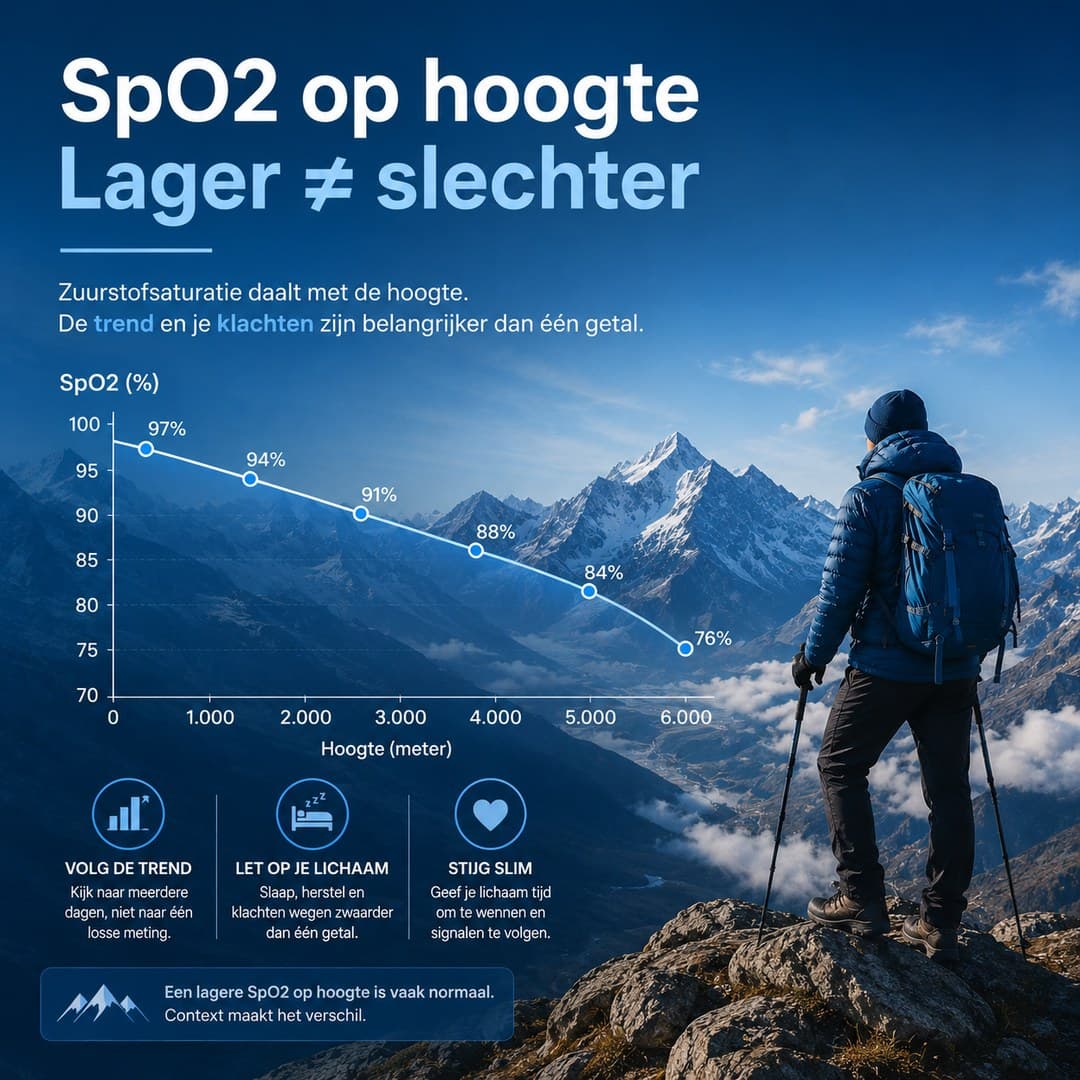
Never use SpO2 as a standalone absolute truth. Look at the trend. A single low reading could be a measurement error. A declining trend with poorer sleep, higher resting heart rate, and symptoms is much more relevant.
| Marker | What are you following? | Good direction | Adjust when |
|---|---|---|---|
| SpO2 trend | Morning value and trend | Stable within personal bandwidth | Complaints or poor sleep |
| Sleep | Expensive, quiet, wake up | Restful sleep after the build-up phase | Several nights of restless or anxious sleep |
| Recovery | Heart rate, HRV, feeling | No structural deterioration | Recovery drops despite reduced training |
| Symptoms | Headache, nausea, dizziness | None or mild and temporary | Complaints are increasing or persisting |
What are you following? Morning value and trend.
Good direction stable within personal bandwidth.
Adjustment: dealing with complaints or poor sleep.
What are you following? Expensive, quiet and waking up.
Good direction peaceful sleep after the build-up phase.
Adjustment: Several nights of restlessness or feeling breathless.
What are you following? Heart rate, HRV and feeling.
Good direction No structural deterioration.
Adjustment: Recovery drops despite lower training.
What are you following? Headache, nausea, and dizziness.
Good direction No complaints or mild and temporary.
Adjustment: Complaints are increasing or persisting.
To track the effect more specifically, combine subjective signals with performance measures. Consider power at a fixed heart rate, pace at a fixed effort, morning pulse, HRV, and training feel. For athletes measuring altitude training effect often more sensible than relying on a single standalone test.
Practical decision rules from the literature
Choose for live high train low when you have sufficient weeks, want to maintain training quality and your main goal is aerobic performance.
Opt for pre-acclimatisation when travelling to altitude and especially want to limit the risk of complaints.
Choose IHT when you're looking for an additional or low-threshold stimulus, but don't expect miracles from it.
Postpone altitude training when you are ill, recovering poorly, have an iron deficiency, or are already severely overloaded.
The literature does not support an all-or-nothing conclusion. Altitude training is not a gimmick that always works. It is a physiological stimulus. Just like training itself, it only works when load, recovery, and timing are in balance.
Common misunderstandings
Misunderstanding 1: Hoger is altijd beter. In werkelijkheid kan een te hoge prikkel echter slaap en herstel verstoren.
Misunderstanding 2: Every athlete reacts the same. Individual response varies greatly.
Misunderstanding 3: Short hypoxia sessions replace a full altitude training camp. That is usually too simplistic.
Misunderstanding 4: A better SpO2 does not automatically mean better performance. The trend is useful, but not the only marker.
A rational approach in steps
Step 1: First, determine the purpose. Performance, expedition preparation, and recovery each require a different approach.
Step 2: Check fundamental conditions such as sleep, training load, iron status, and available time.
Step 3: Gradually build up the altitude stimulus. Avoid large jumps without reason.
Step 4: Monitor SpO2 as a trend, along with sleep, recovery and symptoms.
Step 5: Evaluate afterwards using performance, feeling, and objective data. Not solely on expectation.
When altitude training makes less sense
Altitude training isn't always the best investment. If the foundation is still weak, regular training often yields more. Consider insufficient training consistency, too little sleep, poor nutrition, or unclear competition planning.
Caution is also needed for medical complaints, persistent fatigue, or clear recovery problems. Hypoxia is an extra stressor. An extra stressor only works when the body has room to adapt.
The same applies to expedition participants. Pre-acclimatisation can be beneficial, but it does not substitute for a sensible itinerary, rest days, hydration, nutrition and vigilance for symptoms of altitude sickness.
Reality check: Altitude training does not reduce the risk to zero. It makes preparation more measurable and planable. At actual altitude, pace, gradient profile, rest, and symptom recognition are decisive.
FAQ on altitude training literature
What does the literature say about altitude training?
The literature shows that altitude training can contribute to aerobic capacity, oxygen transport and performance. The effects are highly dependent on method, dose, duration, iron status and individual response.
Welke vorm van hoogtetraining is het best onderzocht?
Live High Train Low has the strongest practical basis for endurance athletes. It combines the hypoxic stimulus with the maintenance of training quality at lower altitudes.
Does intermittent hypoxic training work just as well?
Not always. IHHT can be useful as an additional stimulus, but the literature is more varied. Short protocols in particular do not automatically lead to the same adaptations as longer-term exposure.
Is a hypoxie tent scientifically logical?
Yes, if used correctly. An altitude tent simulates normobaric hypoxia and can allow for longer exposure during sleep. Effectiveness depends on duration, settings, setup, and monitoring.
How do you know if altitude training works?
Look at trends. Combine SpO2, sleep quality, recovery, symptoms, and performance. A single isolated measurement doesn't tell you much. The combination of data and feeling is more reliable.
Do you want to apply altitude training with a clear protocol?
Altitude Dream helps athletes and mountaineers to use altitude training in a controlled, measurable and targeted way. Not as a hype, but as a practical stimulus with guidance.
Conclusion: Altitude training works, especially when properly dosed.
The altitude training literature supports a nuanced conclusion. Altitude training can work, especially when exposure, timing, recovery, and monitoring are well managed. But it is no shortcut and no guarantee.
For endurance athletes, live high train low remains the most logical choice when performance is the goal. For mountain and expedition travellers, the value lies primarily in controlled pre-acclimatisation. For IHT, the message is more nuanced: interesting as a supplementary stimulus, less effective as a standalone solution.
Anyone who takes altitude training seriously doesn't just look at altitude. They look at the overall context: goal, available time, sleep, iron status, training load, SpO2 trend, recovery and symptoms. That's precisely where a good protocol makes a difference.
Research basis This article is substantively based on recent reviews and meta-analyses regarding altitude training, live high train low, intermittent hypoxic training, normobaric hypoxia, and performance effects in athletes. The main practical conclusion is consistent: method, dose, and individual response determine its value.