
High altitude training Sankt Moritz: the ultimate training location for cyclists and runners
Published 6 March 2026 · 10 min read
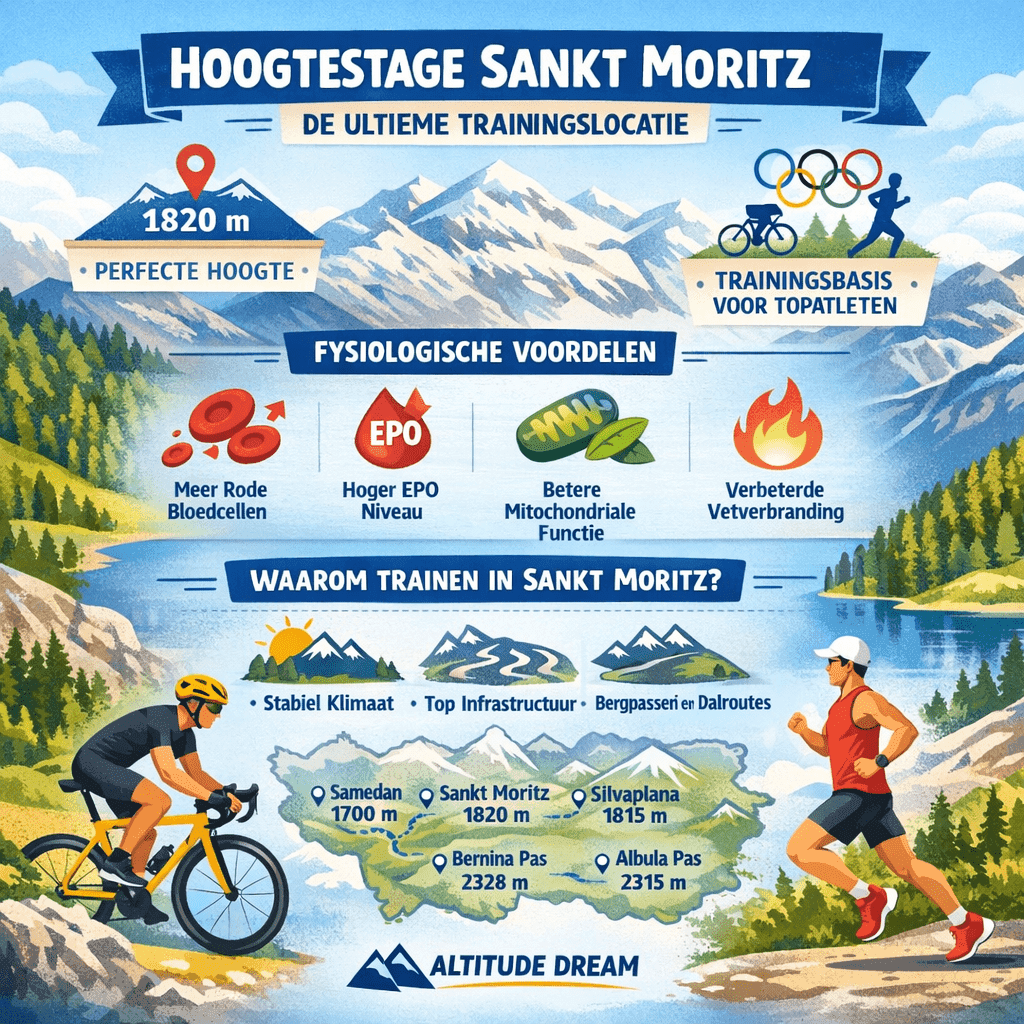
A altitude training in Sankt Moritz has been among the most effective ways to improve aerobic performance for decades. Located at around 1,820 metres altitude, the Swiss mountain village is an ideal setting for endurance athletes looking to improve their oxygen uptake, endurance and recovery capacity.
Olympic athletes, professional cycling teams and elite marathon runners flock to the Engadine valley every year to train here. The reason is simple: the combination of altitude, infrastructure and training opportunities is exceptional. Sankt Moritz has therefore been at the top of many lists of the best locations for an altitude training course in Europe.
In this article, you will discover why Sankt Moritz is so popular with top athletes, how an altitude training period here works physiologically and how to get the most out of an altitude training period as a cyclist or runner.
Why an altitude training course in Sankt Moritz is so effective
The altitude of Sankt Moritz is in a zone where the body already clearly responds to reduced oxygen availability. At around 1,800 metres, oxygen pressure drops sufficiently to stimulate physiological adaptations.
Key adjustments that occur:
- increased production of the hormone EPO
- increase in red blood cell count
- improved oxygen transport capacity of the blood
- improved mitochondrial efficiency
- improved fat burning during exercise
You can read more background on these processes in the physiological benefits of altitude training.
Oxygen percentage at 1,820 metres
A frequently asked question is: how much oxygen is there at 1,820 metres? Important to know: it oxygen percentage in air remains 20.9%, but due to the lower air pressure, the oxygen pressure. As a result, effective oxygen availability is lower, which is exactly the stimulus that makes altitude training so powerful.
Practically, you can compare this to an “equivalent oxygen percentage” at sea level. At approximately 1,820 metres oxygen availability corresponds roughly to approximately 16.3 to 16.7% oxygen at sea level (depending on weather conditions and atmospheric pressure).
| Height | Oxygen percentage in air | Equivalent oxygen percentage (sea level) | What do you often notice? |
|---|---|---|---|
| 0 m | 20,9% | 20,9% | normal load |
| 1,820 m (Sankt Moritz) | 20,9% | approx. 16.3 to 16.7% | higher breathing rate, higher heart rate for the same effort |
| 2,300 m (Bernina or Albula pass level) | 20,9% | approx. 15.3 to 15.7% | Clearer tempo loss at intensity, recovery requires more attention |
This is also why SpO2 monitoring in the first week often provides so much insight: you literally see how your body reacts to the lower oxygen pressure and how quickly adaptation kicks in.
Altitude map of the Engadin valley
A key advantage of Sankt Moritz is that it is part of the wide Engadin valley. This allows athletes to train at different altitudes without major logistical moves.
Important altitudes in the Engadine
- Samedan - 1700 metres
- Sankt Moritz - 1820 metres
- Pontresina - 1800 metres
- Silvaplana - 1815 metres
- Bernina pass - 2328 metres
- Albula pass - 2315 metres
This difference in altitude makes it possible to combine different training zones within one training week.
For athletes who have the sleep high train low apply principles this is ideal: sleep at altitude and perform workouts at slightly lower altitudes.
Why so many Olympic athletes train here
Sankt Moritz was discovered by international athletics teams back in the 1960s. Since then, it has become one of the most famous altitude training locations in the world.
Some of the reasons why top athletes keep coming back here:
1. Ideal height for training
The altitude of around 1,800 metres is high enough to encourage adaptation but low enough to keep intensive training possible.
2. Very stable climate
The Engadine is known for its sunny and dry climate. As a result, training conditions are often more stable than in many other mountain areas.
3. Exceptional sports infrastructure
Sankt Moritz boasts one of the best training facilities in Europe:
- athletics track at altitude
- long flat cycle routes
- perfect gravel paths for endurance runs
- direct access to mountain passes
Which athletes train in Sankt Moritz
Sankt Moritz is no stranger to top athletes. For years, the Engadin valley has been a regular training base for both runners and cyclists who want to increase their aerobic engine without compromising on training quality.
Runners and endurance athletes
Many (inter)national athletes choose Sankt Moritz as an altitude training location because you get into a stable rhythm here relatively quickly: sleeping at altitude, training on well-walkable ground, and plenty of opportunities to dose intensity.
- Eliud Kipchoge and other world-class athletes regularly use altitude blocks as part of their periodisation towards big marathons.
- International national selections (athletics) also return here for summer blocks towards championships.
Cyclists and WorldTour teams
In cycling, the region is famous as a place where teams can run longer blocks with lots of controlled endurance kilometres as well as climbing incentives at higher altitude.
- Tadej Pogacar and other stage riders often use altitude periods towards the Tour or grand tours.
- Several WorldTour teams plan pre-season or pre-Tour stages here because of the combination of passes, valley routes and rest opportunities.
Important: Individual choices of athletes may vary from season to season, but the pattern is consistent: Sankt Moritz remains one of the most widely used altitude bases in Europe for endurance sports.
How altitude training works physiologically
When athletes spend several weeks at altitude, the body starts to adapt to the lower oxygen pressure.
The main mechanism is the rise of the hormone EPO. This hormone stimulates the production of red blood cells.
More red blood cells means the blood can transport more oxygen to muscles and organs.
You can read more about this in How altitude training increases your EPO levels.
This is how a typical altitude internship goes
The first few days at altitude often feel heavier. This is normal. The body has to get used to the lower oxygen availability.
A typical adaptation curve:
- days 1 to 3: lower training capacity
- day 4 to 7: first adaptation
- week 2: improving efficiency
- week 3: training quality stabilises
Training zones at altitude: practical table
The biggest mistake at altitude is steering by pace or wattage as if you were training at sea level. The trick is to dosing intensity cleverly so that you take advantage of the stimulus of altitude without “blowing yourself up” in the first week. Therefore, preferably use a combination of RPE (feeling), heart rate, breathing and possibly lactate.
The table below provides a practical guideline for training around 1,800 metres. These are not hard rules, but they help keep your workouts in the right zone.
| Zone | Target | RPE (1 to 10) | Practical adaptation at 1,800 m | Tip for implementation |
|---|---|---|---|---|
| Z1 recovery | recovery and circulation | 2 to 3 | pace or wattage often 3 to 6% lower | nasal breathing or talking in full sentences |
| Z2 duration | aerobic base | 3 to 4 | pace or wattage often 4 to 7% lower | Steer by “comfortably hard”, not by numbers |
| Z3 pace | endurance | 5 to 6 | pace or wattage often 5 to 9% lower | shorter blocks in week 1, then build out |
| Z4 threshold | lactate threshold | 7 to 8 | pace or wattage often 6 to 10% lower | Rather 2 to 4 x 6 min than 1 long block in week 1 |
| Z5 VO2max | maximum aerobic stimulus | 9 | highly individual, often 8 to 12% lower | only if sleep and recovery remain good |
When in doubt: in week 1, choose less intensity and more volume in Z1 and Z2. In weeks 2 and 3, you can usually add controlled quality again.
Best months for altitude training in Sankt Moritz
The best timing of your altitude training depends on your sport, your goal race and what exactly you want to get out of altitude: mainly endurance stimulus, mainly intensity, or a mix.
May and June: building towards summer goals
- well-suited for endurance athletes competing in July or August
- mostly stable weather and longer days
- roads and passes are often more accessible towards June
July and August: best combination of routes and conditions
- most reliable period in terms of climate
- maximum choice of walking routes and cycling passes
- ideal for a 2-4 week internship block
September: strong for quality and calm
- often still excellent weather but slightly quieter than mid-summer
- very suitable for athletes with autumn marathons or late season goals
- more space for structured training without crowding
Practical timing decision rule
If you want to maximise the performance effect of altitude for a competition, ideally plan your stage so that you can 7 to 21 days after return have your main race. Many athletes experience the best combination of adaptation and training quality during that period.
Best training routes for cyclists
The Engadine offers an exceptional network of cycling routes.
Bernina Pass
One of the most famous climbing routes from Pontresina towards the Bernina pass.
- altitude: 2328 metres
- length of climb: about 18 km
- average gradient: 6 per cent
Albula Pass
A longer climb with beautiful views and relatively little traffic.
- altitude: 2315 metres
- climb length: 17 km
- ideal for tempo climbing
Engadin Valley endurance route
The flat route between Maloja and Zernez is perfect for endurance training.
This route is particularly popular with professional cycling teams.
How much power do you lose at 1,800 metres?
For cyclists, this is the most practical question: how many watts do you lose when you climb and train at 1,800 metres?
In practice, you often see:
- endurance (Z2): relatively limited loss, often 2 to 5% at the same heart rate and RPE
- threshold power (FTP): more often 4 to 8% lower in the first week
- VO2max efforts: loss may amount to 6 to 12%, especially with insufficient recovery
Why this is so individual:
- how fast you acclimatise (often visible via SpO2 trend)
- iron status and haemoglobin
- sleep quality in the first week
- How aggressively you keep pushing the intensity
Practical tip: if you want your training sessions to “succeed” at altitude, don't send on your sea level FTP. Steer on target zone based on RPE and check only after 7 to 10 days if your wattages start coming back.
Best training routes for runners
For runners, the Engadin valley offers perhaps the best running environment in Europe.
St Moritz lake loop
A flat lap around Lake Sankt Moritz.
- distance: about 4.5 km
- ideal for recovery runs
Silvaplana trail
A beautiful trail along Lake Silvaplana.
- distance: 10 to 15 km variants
- perfect for long endurance runs
Pontresina glacier valley
An iconic trail route towards the Morteratsch glacier.
Many marathon runners use this route for long endurance training.
Comparison: Livigno vs Sankt Moritz
Livigno and Sankt Moritz are among the most popular altitude training locations in Europe. In our comprehensive guide to altitude training in Livigno read why this Italian location is especially popular with triathletes and cyclists.
| Location | Height | Advantage | Disadvantage |
|---|---|---|---|
| St Moritz | 1820 m | best infrastructure | more expensive |
| Livigno | 1816 m | more affordable | less training variety |
Livigno is especially popular with triathletes. Sankt Moritz is more often chosen by cycling teams and athletics teams.
This is how you monitor an altitude training objective
To properly understand the effect of altitude training, monitoring is important.
SpO2 trend
Oxygen saturation usually drops in the first few days at altitude.
After about a week, it stabilises when adaptation occurs.
You can read more in oxygen saturation at altitude.
Sleep quality
Many athletes find that their sleep is a little less deep in the first few days.
This usually normalises after a few days.
Recovery feeling
Recovery between workouts may take longer in the first week.
After adaptation, this usually improves again.
Why many athletes prepare their altitude training at home
An altitude training takes time and logistics. This is why many athletes start their acclimatisation already at home.
With an altitude tent, the oxygen percentage can be reduced in a controlled manner while the air pressure remains the same. We call this normobaric hypoxia.
The most important stimulus occurs during sleep. By sleeping in an altitude tent for several weeks, the body can already begin to adapt.
You can read more about this in the complete guide to using an altitude tent.
This makes acclimatisation controlled, measurable and plannable. It significantly reduces the risk of altitude problems.
Conclusion
An altitude training in Sankt Moritz offers a unique combination of ideal altitude, excellent infrastructure and beautiful training routes.
For cyclists and runners looking to improve their aerobic performance, it remains one of the best training locations in the world.
For a broader overview of popular training venues, you can also check out our complete overview of altitude training destinations view.
Want to maximise the effect of altitude training?
Many athletes already start their acclimatisation at home before leaving for an altitude training camp.


