Why do I sleep so restlessly in the mountains?
Published 11 September 2021 · 8 min read
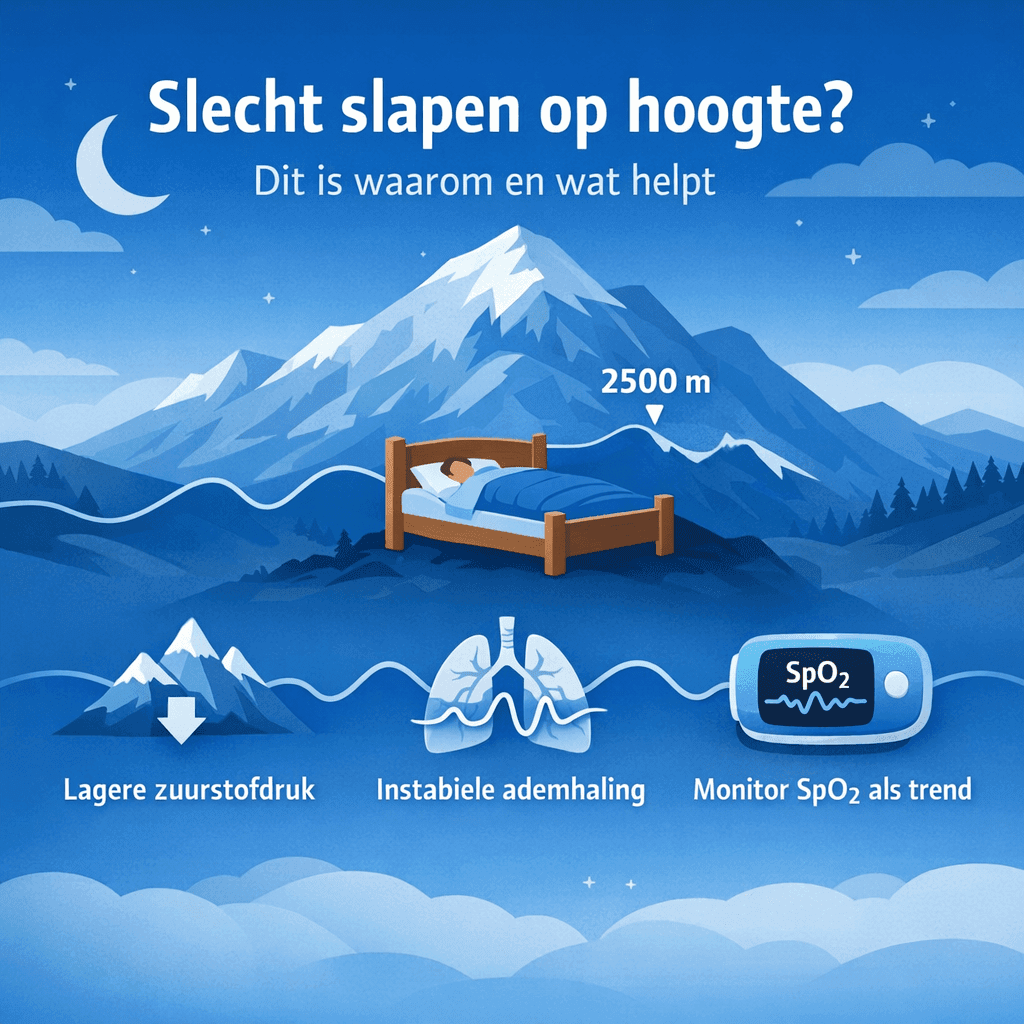
Sleeping badly at altitude is one of the most common complaints during a mountain holiday, trekking or expedition. You lie awake longer, wake up more often and wake up less refreshed, even if you spent enough hours in bed. This is not surprising: above about 1,800 to 2,000 metres, oxygen pressure changes and your body reacts with different breathing, a higher nightly heart rate and more restlessness in your autonomic nervous system.
The good news: this is usually explainable, measurable and can be influenced. In this article, you will learn what is happening physiologically, what you can do yourself and how to monitor it objectively with SpO2 trends and sleep data.
The essentials in 30 seconds
- Sleeping badly at altitude is mainly due to lower oxygen pressure, which makes your breathing more unstable and you are more likely to experience micro-awakenings.
- Many people develop periodic breathing: a rhythm of faster breathing, slower breathing and short breaths. This disrupts deep sleep.
- Your body is temporarily on higher alert: heart rate up, stress hormones up, sleep deeper down.
- With a calm start, smart build-up and SpO2-controlled adjustment you can often improve markedly on the first few nights.
Recognisable problem: why do I sleep restlessly in the mountains?
Many people expect mountain air to automatically ensure the best night's sleep ever. This is sometimes true, but often just not in the first few days. The main reason: your body has to find the balance between taking in enough oxygen and keeping breathing steady during sleep.
When that balance wavers, micro-awakenings occur. You then wake up briefly, sometimes without realising it. Your sleep becomes fragmented. You feel it the next day as a heavy head, irritability, less recovery and sometimes a lower motivation to move.
Why this is often misunderstood
Restless sleep in the mountains is often attributed to “a different bed”, “dry air”, “stress from the trip” or “it was too hot in the room”. Those factors can come into play, but at altitude there is often a primary mechanism underneath: hypoxia by lower partial pressure of oxygen. And most importantly, how your breathing responds to it during sleep.
Important to keep sharp: the oxygen percentage in the air remains roughly the same. The problem is that the air pressure drops. As a result, the partial pressure of oxygen drops. Per breath, less oxygen enters your blood.
Sleeping badly at altitude: what happens step by step?
Step 1 - Your breathing speeds up
At altitude, your body starts breathing faster and deeper. This is a logical compensation. You try to take in more oxygen. Only this has a side effect: you also blow out more CO2. And CO2 is not just waste. It is also an important stimulus that keeps your breathing stable.
Step 2 - CO2 drops and your breathing becomes unstable
If CO2 gets too low, your respiratory stimulus can temporarily drop off. Especially during sleep. Then short breaths occur, followed by compensation with faster breathing. We call this pattern periodic breathing.
What do you notice about this?
- you sometimes wake up with a sigh or a deep breath
- you dream more restlessly
- you feel you have “not slept deeply”
- you wake up more often for no apparent reason
Step 3 - Your heart rate stays higher
Normally, your heart rate drops in deep sleep. At altitude, your sympathetic system remains more active. Your heart rate drops less. As a result, you get less deep sleep and often less REM sleep. Your body remains slightly more alert, so to speak, because it needs to compensate.
Step 4 - Stress hormones increase alertness
In the first few days at altitude, stress hormones rise. This is a normal acute adaptation. Only it works against your sleep. You fall more awkwardly into the deeper sleep stages and wake up more quickly to small stimuli, such as noise or dryness.
From what height does this bother you?
This varies from person to person. Nevertheless, you can roughly see:
- 1,500 to 2,000 m: some sensitive people already notice restlessness, especially after a long trip or with high training loads.
- 2,000 to 2,800 m: Here, it is starting to be noticeable in many people.
- above 3,000 m: periodic breathing and sleep fragmentation are more common.
- above 4,000 m: deep sleep often remains structurally impaired as long as you stay at that altitude.
If you want the basics around acclimatisation and what exactly your body adapts to, read also: /home-acclimatising-mountain-expeditions/.
How do you know if it is normal or a warning?
Restless sleep can be normal in the first 2 to 4 nights. But you also need to know when to become alert. Indeed, sleep disturbance is sometimes an early indicator that you are not yet properly acclimatised.
Pay extra attention if you have this in addition to poor sleep:
- increasing headache
- nausea or loss of appetite
- marked dizziness
- unexplained tightness at rest
- declining performance with a “sick” feeling
For this, also read: /height-sickness-symptoms-risks/ and /heart disease/.
Practical tips: what helps against sleeping badly at altitude?
1 - Start calmer than your ego wants
The first 24 to 48 hours often determine your nights. If you hike too hard on arrival day, climb too fast or exercise too intensely, you increase stress hormones. That increases the chances of sleeping poorly at altitude.
Practical: Keep the first day “easy”. Opt for a short walk, early dinner and a quiet evening routine.
2 - Rise smart: sleep height is more important than day height
Many people make altitude during the day but sleep too high. Sleep altitude is the biggest stimulus to your recovery. Therefore, climb in sleep altitude step by step, especially above 2,500 metres.
Rule of thumb: above 2,500 metres preferably increase your sleeping altitude by 300 to 500 metres per day and plan a rest day every 3 to 4 days.
3 - Hydration and dry air
Dry mountain air increases fluid loss through your breathing. Dehydration can intensify headaches and nocturnal restlessness. Drink staggered throughout the day. Don't overdo it right before bed to limit nightly toilet visits.
4 - Avoid alcohol
Alcohol disrupts your sleep architecture and can make breathing more unstable. At altitude, that effect is often greater. If you already sleep badly the first few nights at altitude, alcohol is usually not a good idea.
5 - Temperature, nasal and respiratory comfort
A cold nose or dry mucous membranes can keep you awake. Nasal breathing often supports calmer breathing patterns. In dry high altitude air, a simple approach can already help: hot shower, gentle breathing exercises, and a comfortable sleeping environment.
This is how you monitor this lens
Subjective feeling is important, but at altitude it is smart to also look objectively. Not at isolated measurements, but at trends. That way, you avoid panic caused by an occasional low SpO2.
Parameter 1 - SpO2 trend during sleep
- preferably measure at the same time every morning
- look at the trend over 2 to 4 days
- combine with how you feel
More context on saturation: /oxygen-saturation-at-height/.
Parameter 2 - Sleep quality
- number of awakenings
- total sleep time versus effective sleep time
- subjective score: how rested do you feel when getting up?
Parameter 3 - Sensation of recovery and symptom development
- morning headache yes or no
- appetite
- resting heart rate trend
- tightness at rest yes or no
Concrete decision rule: If your SpO2 trend drops over 2 nights AND your symptoms increase (headache, nausea, tightness in the chest), treat this as a signal that you are rising too fast. Take an extra rest day at the same sleep level or descend if symptoms clearly worsen.
Decision aid: what is the best approach for you?
Use this quick decision tree:
- You sleep badly for 1-2 nights, but feel ok during the day: probably normal adjustment. Keep your plan calm and monitor trends.
- You sleep badly and also have headaches or nausea: take an extra acclimatisation day. Do not raise sleeping altitude.
- You sleep badly and get tightness at rest: take this seriously. Consider descending and get assessed.
Pre-acclimatisation and altitude tent: what's the role in poor sleep at altitude?
If you know in advance that you will sleep above 3,000 to 4,000 metres, pre-acclimatisation at home can make a big difference. The key mechanism is to get your body acclimatised to hypoxia in a controlled way even before you leave on your trip.
This is done with an altitude tent via normobaric hypoxia. The oxygen percentage in the supplied air is reduced, while the air pressure remains the same. Sleep is the primary stimulus in this process. You gradually build up and adjust based on SpO2 trends and sense of recovery.
Important to frame correctly: an altitude tent is no substitute for acclimatisation in the mountains, but it will significantly reduce the risk of altitude sickness. It makes the process controlled, measurable and planable. It does not offer a 100 per cent guarantee, but it reduces the risk of a difficult start and can significantly reduce sleep disturbance in the first nights.
Want to deepen this? Then also read: Preventing altitude sickness: complete guide - depth & frequently asked questions
2 differentiators that often make the difference
Differentiator 1 - Not steering by 1 number, but by trend + sentiment
Many people get unnecessarily agitated by a single low SpO2 reading. That doesn't help your sleep. Look at the trend over several days and combine this with your symptom pattern. A more stable pattern usually means better sleep, even if the absolute values are not “perfect”.
Differentiator 2 - Sleep as an acclimatisation stimulus is undervalued
During the day, you can compensate a lot with willpower. At night, you can't. If your sleep is structurally fragmented, your recovery slows down and acclimatisation can be slower. That's why it's smart to take sleep level, evening load and sleep comfort as seriously as your route or training schedule.
Conclusion
Sleeping badly at altitude is usually a normal response to lower oxygen pressure. Unstable breathing, higher nighttime heart rate and a temporary stress response disrupt your deep sleep. In most cases, this stabilises within a few days, especially if you start quietly and rise smartly.
Want to maximise your chances of getting off to a strong start on a trek or expedition above 4,000 metres? Then preparation makes sense, especially if you have previous experience of sleeping poorly at altitude.