Training mask vs altitude tent: why a mask is no substitute for altitude training
Published 15 May 2026 · 11 min read
For athletes, that distinction is important. Anyone looking for altitude training, usually looks for a stimulus that helps the body adapt to oxygen deficiency. Think of better oxygen utilisation, possibly more red blood cell response, better tolerance for exertion at altitude, or planned preparation for competition and performance. A training mask feels tough, but feeling tough is not the same as altitude training.
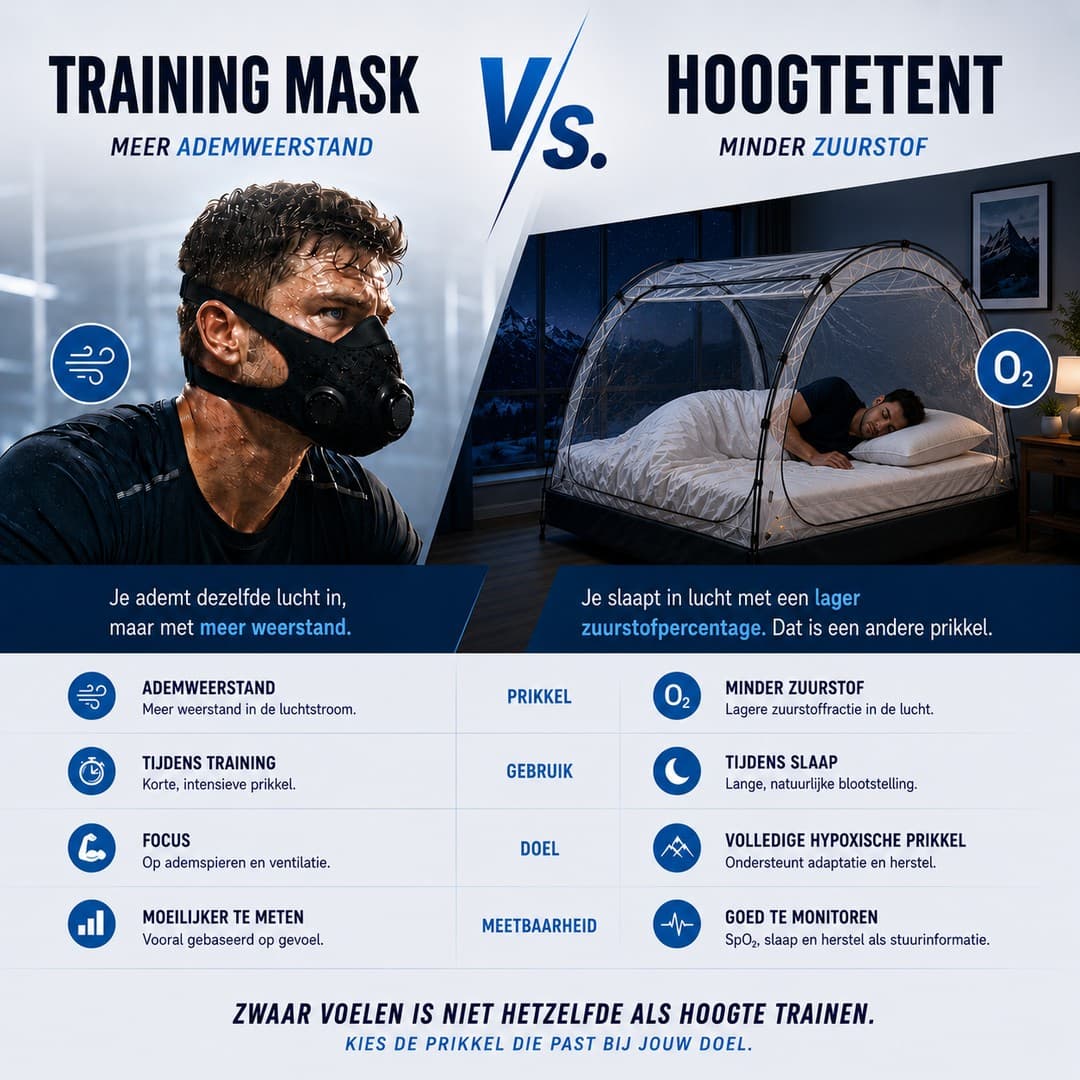
Short answer: A training mask does not replace a altitude tent. A mask makes breathing heavier due to air resistance. An altitude tent lowers the oxygen percentage, giving your body a real hypoxic stimulus. A mask can be useful as a breathing muscle stimulus, but it does not simulate a complete altitude stimulus.
Conclusion: A training mask is mainly breathing resistance, not full-fledged altitude training.
Nuance: That doesn't mean every mask is useless, but the purpose is different.
Practical hook: Choose a mask for breathing muscle training, a hyperbaric chamber for controlled hypoxia.
Why a training mask vs. altitude tent is so often confusing
The confusion arises from marketing language. Many training masks are presented as elevation masks or altitude masks. This makes it seem as though training with such a mask is like being in the mountains. In reality, the mask usually doesn't change the oxygen fraction of the air you breathe. You are still breathing normal air, but with more resistance.
At real altitude, or with a properly adjusted altitude tent, the amount of oxygen available per breath decreases. With an altitude tent, this doesn't happen by lowering the air pressure, but by lowering the oxygen percentage in the air. This is called normobaric hypoxia. Your body therefore experiences a different stimulus than with breathing resistance.
A simple example illustrates this. Imagine you’re breathing through a straw. It feels laboured. Your breathing muscles have to work harder. But the air coming in still contains roughly the same percentage of oxygen as normal ambient air. That’s different from breathing in an environment where the oxygen level has been deliberately reduced.
In practice: A training mask can make your training feel subjectively harder. This can be interesting for breathing muscle load. But if your goal is altitude training, you need to look at the oxygen stimulus, not just how hard breathing feels.
Training mask vs altitude tent: the physiological difference
The key difference is simple: a training mask works primarily through mechanical means, whilst an altitude tent works by increasing oxygen availability.
A training mask restricts the flow of air. As a result, you have to work harder to move enough air. This can put strain on your respiratory muscles. Some athletes therefore experience a greater awareness of their breathing rhythm and ventilation. However, this is no guarantee that your body will undergo the same adaptations as with sleep high, train low.
An altitude tent works differently. You sleep in an environment with a lower percentage of oxygen. Your body has to cope with this stimulus for several hours. This results in a measurable strain on oxygen saturation, breathing, sleep and recovery. The aim is not to make every night as hard as possible. The aim is a controlled, gradual and measurable stimulus.
| Comparison | Training mask | Altitude tent | Practical significance |
|---|---|---|---|
| Stimulus | Greater breathing resistance | Lower oxygen content | Not the same physiological stimulus |
| Usage | During training | Especially whilst sleeping | Other duration and timing of exposure |
| Measurability | Limited by sensation and breathing difficulties | Good via SpO2 trend, sleep and recovery | A high-top tent is easier to manoeuvre |
| Target | Respiratory muscle workload | Hypoxic adaptation | Choose based on your goal, not on a hunch |
Training mask greater breathing resistance.
Altitude tent: Low oxygen content.
Practical significance: not the same physiological stimulus.
Training mask during training.
Altitude tent: especially during sleep.
Practical significance: different duration and timing of exposure.
Training mask limited by sensation and breathing difficulties.
Altitude tent: Good, based on SpO2 trends, sleep and recovery.
Practical significance: A high-top tent is easier to manoeuvre.
Training mask Adams' apple.
Altitude tent: hypoxic adaptation.
Practical significance: Choose based on your goal, not on your gut feeling.
Why a training mask feels heavy but doesn’t simulate altitude
A training mask can feel intense. You get less air in more easily. This increases the perceived exertion. Your breathing feels restricted, your heart rate can feel higher, and a moderate workout can suddenly become harder. That effect is real. However, it doesn't automatically mean you are training at altitude.
Altitude is not about “less air passing through an opening”. Altitude is about there being less oxygen available to your body. At true altitude, the partial pressure of oxygen is lower. In normobaric hypoxia, this effect is simulated by reducing the oxygen concentration in the inhaled air. The body then responds to a lack of oxygen, not just to breathing resistance.
Research into elevation training masks paints a nuanced picture. Some studies find effects on ventilation, respiratory load or performance indicators. Other studies show that the mask does not result in any clear change in oxygen saturation, metabolism or acute lung function. The most defensible conclusion is therefore that a mask may act as a respiratory stimulus, but is not a reliable substitute for genuine hypoxic exposure. [oai_citation:0‡PMC](https://pmc.ncbi.nlm.nih.gov/articles/PMC6561228/?utm_source=chatgpt.com)
Research shows: Elevation masks can make training feel more strenuous and affect breathing, but the hypoxic stimulus is limited or inconsistent. It is therefore too simplistic to equate such a mask with altitude, an altitude chamber or a properly set-up altitude tent.
What a height tent does
A high-altitude tent is designed to provide a controlled oxygen stimulus. This does not involve lowering the air pressure in your room. Instead, the system supplies air with a lower oxygen percentage to the tent. Therefore, you sleep in normobaric hypoxia.
This is particularly relevant because sleep takes a long time. Whereas a training mask is often used for 30 to 60 minutes during exercise, a hypobaric tent can be used for several hours per night. That longer exposure is precisely why the method fits within the principle of to use a height tent For athletes and mountain hikers.
The stimulus must be built up gradually. More is not automatically better. Too large a jump in simulated altitude can disrupt sleep, suppress recovery, or cause symptoms. Therefore, a good protocol involves gradual increase, monitoring, and adjustment. The goal is not to achieve the lowest possible SpO2. The goal is a responsible trend that suits your body, schedule, and objective.
When a training mask can be useful
A nuanced article should also be honest about where a mask can indeed fit. For some athletes, a training mask may be interesting as a form of respiratory muscle loading. It can help to become more aware of breathing rhythm. It can also provide a mental stimulus during short, controlled sessions.
But that is a different purpose than altitude training. Anyone using a mask to simulate “altitude” is likely choosing the wrong equipment. Anyone using a mask for breathing resistance training, with realistic expectations, is making a more logical choice.
When to and when not to?
Quite logical if you want to train with breathing resistance, do short sessions, and don't expect real altitude adaptation.
Illogical if you buy the mask as a replacement for LHTL, pre-acclimatisation or controlled hypoxic exposure.
Best interpretation: Think of the mask as a tool for training your breathing muscles, not as a system for altitude training.
Training mask vs altitude tent for athletic performance
For athletic performance, the question isn't about what feels harder. The better question is: what stimulus do you want your body to receive?
If you’re particularly keen to challenge your breathing under exertion, a training mask can play a specific role. If you want to work with oxygen stimulation, recovery monitoring and a more predictable altitude stimulus, an altitude tent is a better option. This difference is particularly important for endurance athletes. This is because the body responds not only to exercise, but also to the environment in which you recover and sleep.
Therefore, the comparison with intermittent hypoxic training Also interesting. In IHHT, the hypoxic stimulus is consciously controlled via less oxygen. That's different from simply making breathing heavier. The common factor is oxygen availability, not discomfort.
This is an important lesson for athletes looking to improve their performance. A tough training session is not automatically a better one. An advanced stimulus is only valuable if you know what you are measuring, how to adjust your training, and how the stimulus fits into your overall training load.
This is how you monitor this lens
Monitoring is tricky when using a training mask. You can track how you feel, your breathing rate, your heart rate and your training capacity. But you usually don’t get a clear picture of a controlled oxygen stimulus. That makes it difficult to determine whether you’re actually doing anything that resembles altitude training.
With a high-altitude tent, monitoring is more practical. You can work with trends. SpO2 is particularly useful, but only as a trend and never as a standalone absolute truth. Combine that trend with sleep quality, morning feeling, resting heart rate, HRV, and symptoms.
| Measuring point | What you are following | Interpretation | Action |
|---|---|---|---|
| SpO2 trend | Morning values and night trend | Gives direction, not an absolute diagnosis | When going down sharply, reduce speed |
| Sleep | Falling asleep duration, waking up, feeling rested | Poor sleep can show too rapid development | Height temporarily stabilise |
| Recovery | Resting heart rate, HRV, fatigue | Recovery must remain within the target range | Adjust training load |
| Symptoms | Headache, nausea, shortness of breath | Complaints are more important than ego | If symptoms are clear, reduce or stop. |
What you're following: morning values and night trend.
Interpretation: gives direction, not an absolute diagnosis.
Action: Slow down the build-up in the event of a sharp fall.
What you're following: sleep duration, waking up, feeling of rest.
Interpretation: Poor sleep can show too rapid a buildup.
Action: stabilise height temporarily.
What you're following: Resting heart rate, HRV, fatigue.
Interpretation: The recovery must remain within the bandwidth.
Action: Adjust training load.
What you're following: Headache, nausea, shortness of breath.
Interpretation: Complaints are more important than ego.
Action: If complaints are clear, reduce or stop.
This method of monitoring is more suited to controlled hypoxia than a training mask. With a mask, you can primarily determine if a session was difficult. With an altitude tent, you can determine if the stimulus is right for your body.
Practical decision rules for athletes
Choose a training mask if:
You want to work on your breathing resistance in a mindful way, do short sessions and aren’t expecting a full altitude stimulus.
Choose a high-altitude tent if:
You’re looking for a predictable hypoxic stimulus, want to train for several hours a night, and want to monitor your progress objectively.
Do not choose either of these if:
Your foundations aren't in order. Sleep, training progression, nutrition, recovery, and consistency remain more important than any supplement.
For many athletes, the greatest benefit does not lie in seeking out the toughest challenge. The benefit lies in choosing the right stimulus at the right time. Altitude training requires patience, careful planning and monitoring. This is certainly true when you combine it with intensive training blocks.
For those who specifically want to work with hypoxic sessions alongside training, they can delve into Sports IHT. But even there, the basis remains the same: build up measurably, don't guess, and ensure the stimulus fits within the overall training plan.
Common misunderstandings about training masks
Misunderstanding 1: “When breathing becomes more difficult, I train at altitude.”
Not automatic. Difficult breathing mainly means more breathing resistance. Altitude is about less available oxygen.
Misconception 2: “A training mask automatically increases my red blood cells.”
For this, the hypoxic stimulus is usually too limited, too short, or insufficiently specific.
Misunderstanding 3: “The heavier it feels, the better it works.”
A stimulus must be appropriate for the.
Misconception 4: “An altitude tent is just an expensive mask.”
No. A height tent changes the oxygen environment. A mask primarily changes the airflow.
Sources and scientific basis
Scientific literature primarily supports a nuanced conclusion. Elevation training masks can influence breathing and perceived exertion, but they do not fully simulate altitude. Studies on masks show varying effects on hypoxemia, oxygen saturation, and performance. Reviews on hypoxic training suggest that genuine hypoxic protocols represent a different physiological category than breath restriction alone.
Do you want to approach altitude training in a measurable way?
A training mask can challenge your breathing, but an altitude tent works via a different stimulus. If you want to know how to build up controlled, calm, and SpO2-guided acclimatisation with an altitude tent, start with the practical guide.
Conclusion: don't choose the strongest feeling, but the right stimulus
The comparison between a training mask and a height tent ultimately comes down to precision. A training mask can be useful for breathing resistance training. It can make your session more demanding and consciously load your breathing. However, that doesn't make it a fully-fledged altitude training.
An altitude tent works via normobaric hypoxia. The oxygen percentage is lowered, which causes your body to experience a real oxygen stimulus. You can gradually build up this stimulus, objectively monitor it, and adapt it to your recovery. Therefore, an altitude tent is not a magic cure, but rather a much better fitting method for those who want to work with altitude adaptation in a controlled manner.
For athletes, the practical conclusion is clear. Do not use a training mask as a shortcut to altitude training. At best, consider it a specific breathing muscle stimulus. If you want to use the effect of less oxygen in a planned way, the discussion should not be about how difficult something feels, but about how well you can dose, measure, and sustain the stimulus.