SpO2 levels by altitude: what is a normal oxygen saturation level in the mountains?
Published 31 May 2026 · 7 min read
You’re checking your oxygen saturation at altitude, suddenly see ‘89%’ appear on your screen, and wonder: is this normal, or should I be worried? That’s exactly why many mountaineers look for reliable SpO2 values by altitude. A lower oxygen saturation does not automatically mean that something is wrong.
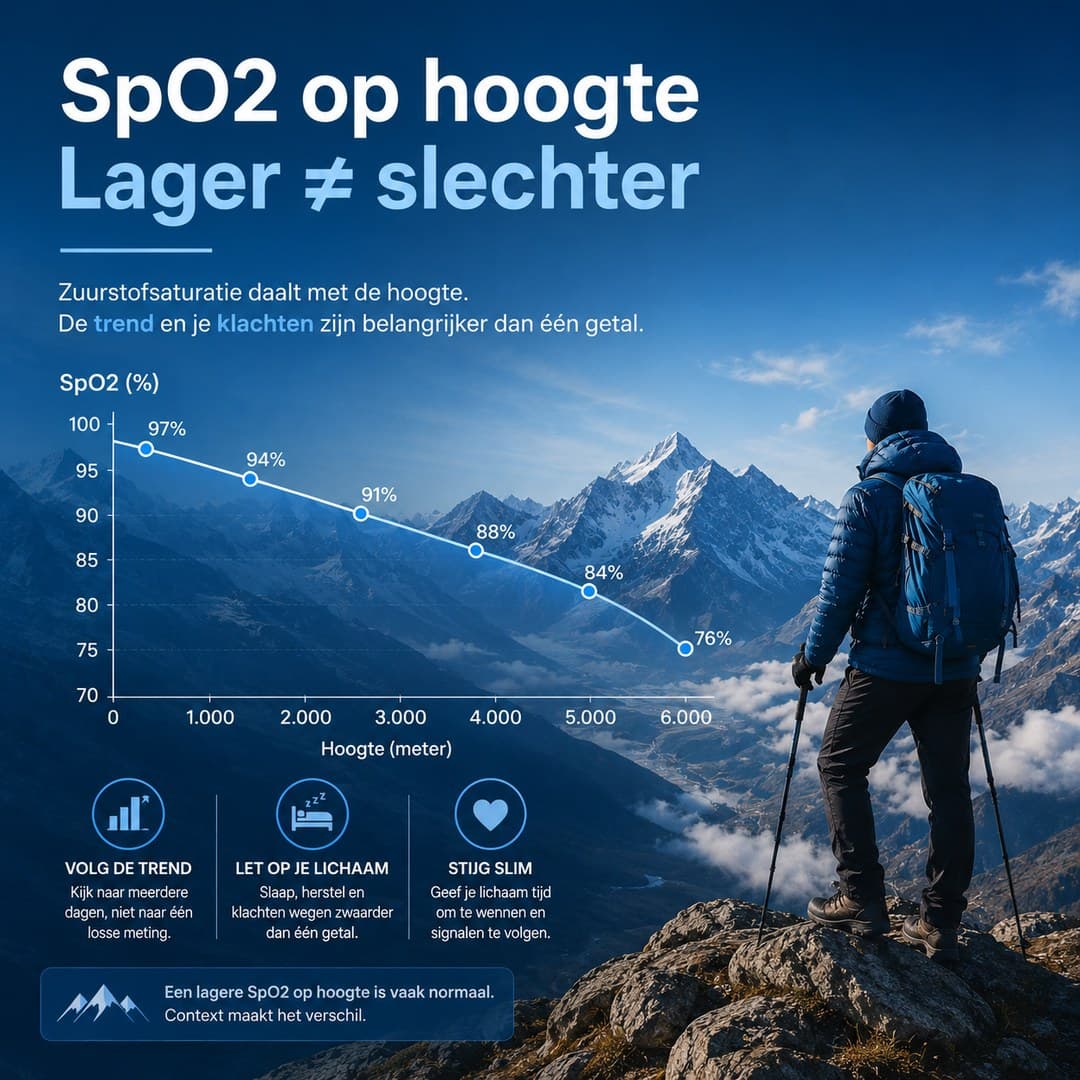
As you ascend, the available oxygen pressure decreases. Consequently, your SpO2 also usually gradually drops. But the tricky part is: the same value can be perfectly normal at 2,500 metres and a cause for extra vigilance at a different altitude.
In this article, you'll learn about the typical oxygen saturation for different altitude zones, how to interpret SpO2 wisely, and most importantly, when a number is less significant than the trend and your symptom pattern.
Short answer
- Up to around 2,500 metres, SpO2 often remains above 92–95% in many healthy people
- Between 3,000 and 4,500 metres, SpO2 regularly drops to 85–92%
- Above 5,000 metres, lower values become increasingly normal.
- Not one measurement counts, but the combination of trend, recovery, and symptoms
Conclusion: A lower SpO2 at altitude is usually a normal physiological response.
Nuance: the same value can mean something slightly different depending on height, pace, and symptoms.
Practical hook: Always look at the trend over several days and not at a single measurement.
Before we look at the table, one principle is important: oxygen saturation is not a competition. People who measure obsessively several times a day often become unnecessarily insecure.
Would you first like to understand why oxygen levels change at all? Then read our comprehensive explanation of oxygen saturation at altitude.
Why does SpO2 drop when you go higher?
At sea level, air contains approximately the same number of oxygen molecules as at altitude. The difference lies in air pressure. At higher altitudes, it becomes more difficult to transfer enough oxygen from the lungs to the blood.
As a result, you often see three things happening:
- your breathing quickens
- your heart rate temporarily increases
- SpO2 is slightly to moderately decreasing
That is not a defect in your body but rather a sign that your system is trying to adapt.
💡 Did you know? Many people at altitude feel fine with saturation levels that would cause concern at home. Context dictates almost everything.
SpO2 values by altitude: reference table for healthy adults
The table below provides a practical reference for healthy adults at rest, after some acclimatisation at altitude. Use these values as a guide and not for diagnosis.
| Height | Typical SpO2 | Interpretation | Practical significance |
|---|---|---|---|
| 0 – 1000 m | 95 – 99% | Normal situation | No height effect expected |
| 1500 – 2500 m | 92 – 96% | First measurable decrease | Often still symptom-free |
| 2500 – 3500 m | 88 – 94% | Acclimatisation becomes important | Trend is more important than absolute value |
| 3500 – 4500 m | 84 – 92% | Greater individual differences | Monitoring of time and recovery |
| 4500 – 6000 m | 75 – 88% | Low values are normal | Always interpret alongside symptoms |
SpO2 95 – 99%
Meaning Normal situation
Action No height effect expected
SpO2 92 – 96%
Meaning first slight decrease
Action Usually without complaint
SpO2 88 – 94%
Meaning Active acclimatisation
Action focus on trend
SpO2 84 – 92%
Meaning wider spread
Action monitor recovery
SpO2 75 – 88%
Meaning low values more often
Action combine with complaints
⚠️ Reality check: two people on the same mountain can measure an 8 to 10 percentage point difference and both feel completely normal.
Wanneer is een lage SpO2 op hoogte wél reden om alert te worden?
A low SpO2 alone is surprisingly poor at predicting altitude sickness. More important is whether the value continues to fall and symptoms appear at the same time.
Be extra careful when you notice:
- increasing headache
- nausea or loss of appetite
- marked sleep deterioration
- shortness of breath at rest
- slow recovery
To understand this better, please also read our guide on altitude sickness symptoms and risks.
Additionally, insight into When low saturation becomes dangerous to interpret isolated figures better.
Why one SpO2 reading often says less than you think
Many mountain travellers overestimate the precision of a saturation meter. Differences of a few percent can arise from cold fingers, fatigue, timing of the measurement, or a small movement during the reading.
That's why experienced mountaineers don't usually work with a single absolute limit value, but with patterns over several days.
Outcome digits versus usable interpretation
Less useful “My SpO2 is 86%, so something’s wrong.”
Much more useful: “My SpO2 dropped from 90% to 84%; I’m sleeping less well and have more headaches.”
Especially above 3000 metres, acclimatisation speed often becomes more important than the exact saturation value.
This is how you monitor this lens
Oxygen saturation is most useful when you combine it with other signals. Always use SpO2 as a trend and never as an isolated judgment.
| Parameter | What are you following? | Interpretation | Decision rule |
|---|---|---|---|
| SpO2 trend | morning values 2-3 days | Stable or declining pattern | Declining plots + complaints = extra rest |
| Sleep | quality and nighttime waking | adjustment or overload | 2 bad nights = review pace |
| Recovery | daytime energy | ability to adapt | deterioration = more conservative rise |
| Symptoms | Headache, appetite, nausea | clinical context | Complaints weigh more than SpO2 |
Follow morning measurements
Interpretation pattern important
Decision rule darling + complaints = rest
Follow Quality
Interpretation Recovery capacity
Decision rule Multiple bad nights = evaluate
Follow Energy
Interpretation Taxation versus adaptation
Decision rule Adjust tempo
Follow Complaints
Interpretation clinical context
Decision rule Consider complaints first
📊 Research shows that complaints and acclimatisation rate often predict how someone functions better than a single saturation measurement.
Common mistakes when measuring SpO2 in the mountains
- Direct measurement after exertion
- measuring with cold hands
- check several times per hour
- interpreting low value without complaints
- Comparing values with someone else
- without taking sleep and recovery into account
The biggest mistake usually remains the same: people treat the pulse oximeter as if it were a diagnostic device. It is not.
A saturation meter is primarily a tool for making trends visible.
Can you influence SpO2 beforehand before your mountain trip?
To a certain extent, yes. The body responds to repeated exposure to lower oxygen availability by learning to cope with oxygen transport more efficiently.
That is precisely why some mountain trekkers opt for prior preparation instead of relying entirely on on-site acclimatisation.
For those who have little time at their destination acclimatising at home for mountain expeditions Interesting.
In practice: preparation beforehand doesn't usually change one magical SpO2 number. The goal is for your body to react more quickly and comfortably as you ascend effectively.
When this happens via an altitude tent, it concerns normobaric hypoxia: the oxygen percentage is reduced while the air pressure remains the same.
Such preparation does not replace real acclimatisation, but it does make the process more controlled, measurable and better planned. It can significantly reduce the chance of complaints, without ever providing a guarantee.
Decision rules: when can you proceed and when is it better not to?
Although no table can replace individual medical assessment, the decision rules below help to provide more context to your measurements.
Practical decision rules at height
Green SpO2 remains relatively stable, you sleep reasonably well, and symptoms are not increasing.
Orange SpO2 has been dropping for several consecutive days and recovery or sleep is worsening.
Red clear symptoms at rest, rapid deterioration, or severe shortness of breath.
An important nuance: ascending without symptoms and with a relatively low SpO2 can be safer than ascending with a higher SpO2 but clear symptoms.
This is why symptom recognition remains essential. Our guide to recognising altitude sickness and how to act expands on that.
Misunderstanding: a high SpO2 does not automatically mean better acclimatisation
This is one of the most underrated insights.
A person with 93% may feel worse than someone with 88%. Acclimatisation is about more than just oxygen saturation.
Among other things, breathing regulation, fluid balance, sleep, recovery capacity, and individual sensitivity play a part.
This is why it is often more useful to understand what is physiologically happening during oxygen deprivation than to obsess over a single figure.
Please also read our in-depth article on physical reactions to oxygen deprivation.
❓ Mini-FAQ: A saturation meter is a tool to guide decisions, not to make them entirely.
Frequently asked questions about SpO2 values by altitude
What SpO2 is normal at 3000 metres?
In healthy people, values are often seen to fall somewhere between approximately 88 and 94%, depending on acclimatisation, rest and individual differences.
At what SpO2 level should you be concerned at altitude?
Not one number determines this. Always look at the trend, complaints, recovery, and speed of increase.
Is a low saturation without symptoms dangerous?
Not automatically. Low values routinely occur at altitude without direct problems.
Can pre-preparation affect SpO2?
Preparation can improve the physiological response to altitude, but does not necessarily change one absolute value.
Should I measure multiple times a day?
For most mountain travellers, one to two regular measurements a day are more than enough.
Would you like to start your mountain trip well-prepared?
If you have little time to acclimatise at your destination, preparation beforehand can help to expose you to altitude in a more controlled way. Without pressure, but with a plan.
Conclusion
SpO2 values by altitude are particularly useful when you learn to interpret them in context.
Lower oxygen saturation levels in the mountains are usually normal. The real question is not: “what figure do I have?” but rather: “how is my body developing?”
Therefore, approach calmly, avoid comparing yourself to others, and always look at the complete picture: trend, sleep, recovery, and symptoms.
Read our disclaimer on altitude and health information
Sources
- Fulco CS, Beidleman BA, Muza SR (2013). Effectiveness of preacclimatization strategies for high-altitude exposure. Exerc Sport Sci Rev 41(1):55-63.