Sleeping in the high altitude tent: what to expect in the first 2 weeks
Published 4 March 2026 · 9 min read
For the first time sleeping in an altitude tent is a bit of a switch for many people. Your body receives less oxygen than normal. As a result, your breathing and sleep structure change. This is exactly the beginning of pre-acclimatisation.
This article tells you what usually happens in the first two weeks, what is normal, which signals require attention and how to monitor objectively. This will help you start off calmer, smarter and with more control.
The essentials in 30 seconds
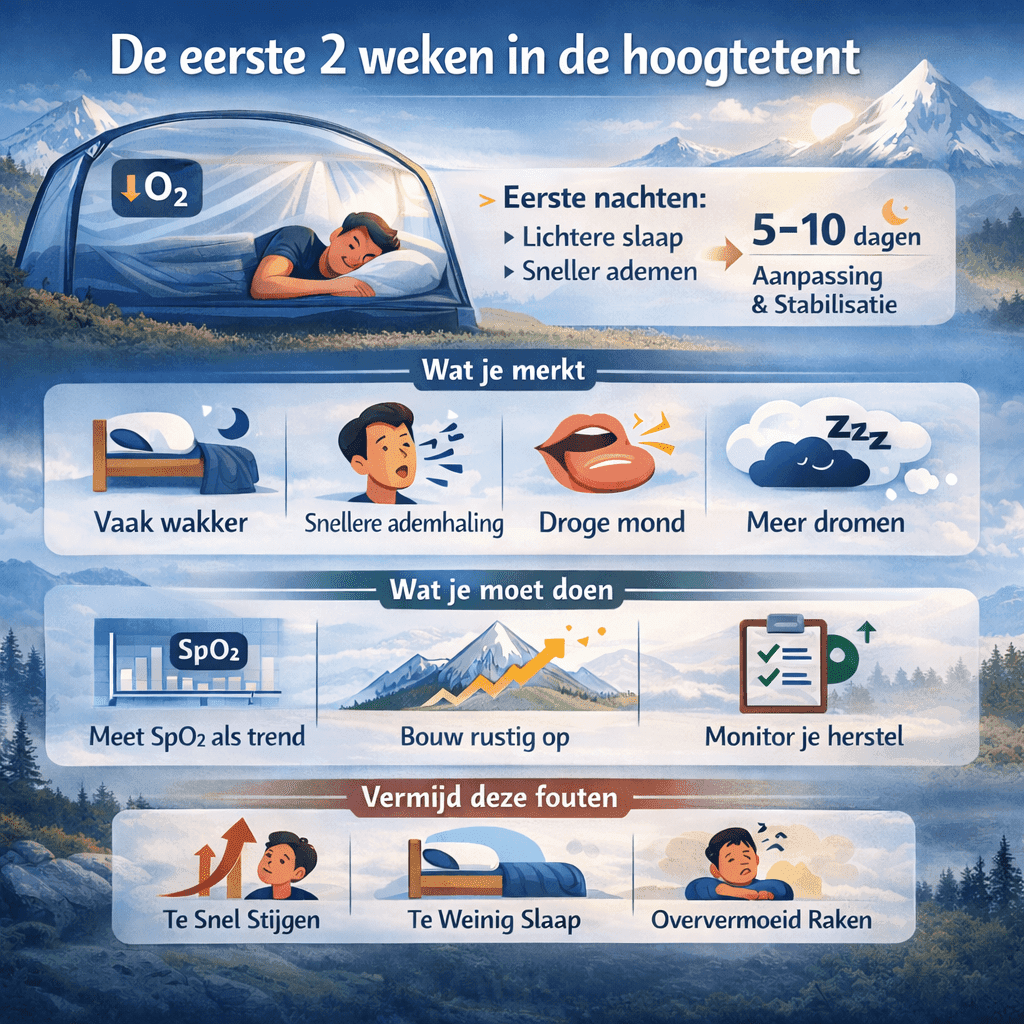
- First nights in an altitude tent often feel different due to less oxygen.
- You breathe faster and some people wake up more often.
- After 5 to 10 days, sleep usually stabilises.
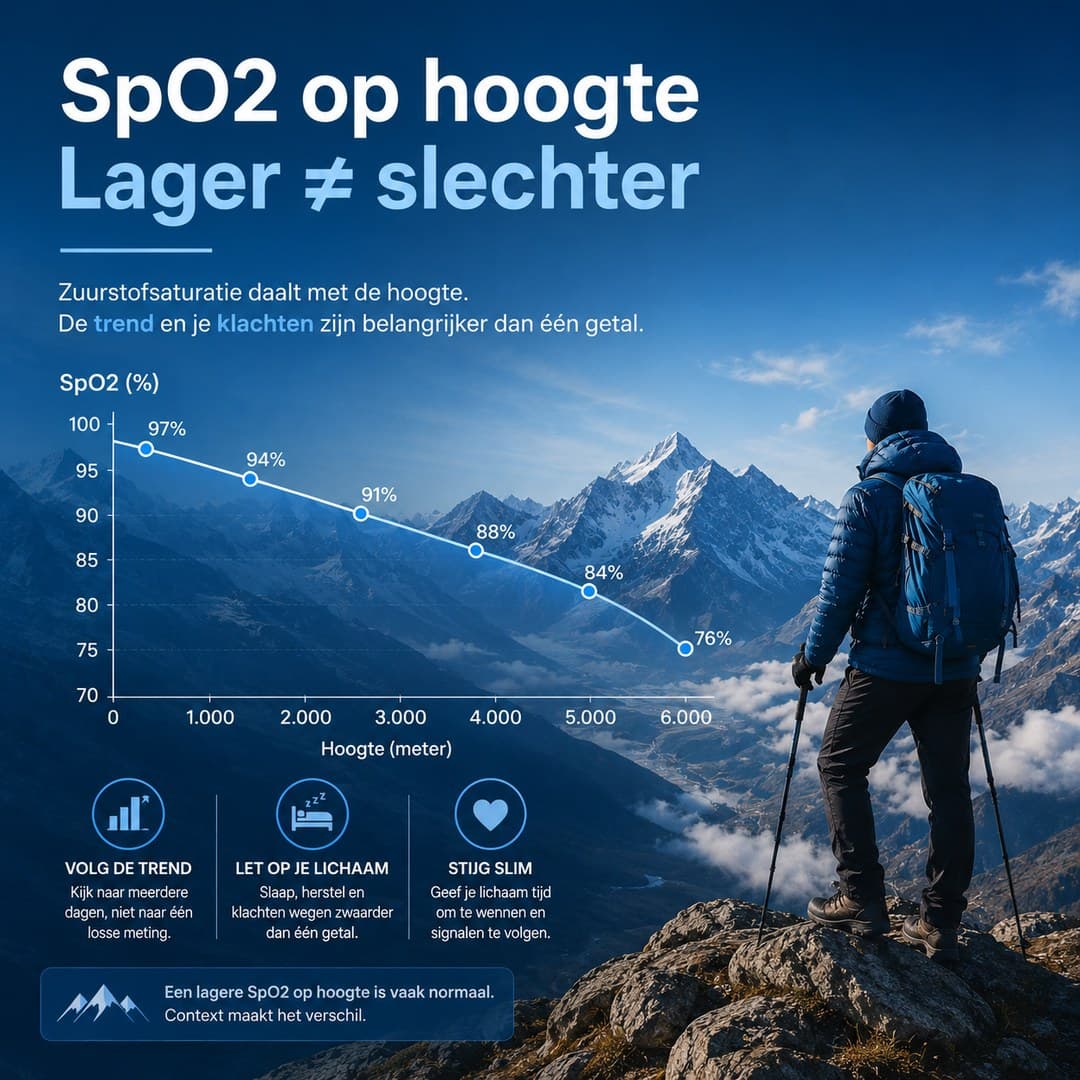
- Measure SpO2 as a trend, not as an isolated value.
- Build up slowly to avoid unnecessary sleep disruption.
Why sleeping in a high altitude tent feels different at first
An altitude tent lowers the oxygen percentage in the air. This is called normobaric hypoxia. Air pressure remains the same, but your body receives less oxygen per breath.
Your body responds immediately. Breathing goes up slightly. Your heart rate may rise slightly. And your sleep may become temporarily lighter. This is not surprising. Your system is looking for a new balance.
The principle is similar to what happens at altitude. Only a height tent is easier to dose. This allows you to build up the stimulus in a controlled way, and make quicker adjustments if necessary.
You can find more basic explanations of this mechanism in how altitude training works.
What you usually notice in the first 3 nights
The first nights are often the most noticeable. Not because it is dangerous, but because your body does not yet have a routine in this environment.
Common experiences:
- lighter sleep
- wake up sth. more often
- faster or deeper breathing
- more dreams or more vivid sleep
- dry mouth or nose
You may also feel fine the next morning. If so, sleep was different, but not necessarily worse. That difference is important. The perception of sleep and recovery are not always the same.
Why this is often misunderstood
Many beginners think: I sleep more restlessly, so this won't work. Or: I need to go higher to get a faster effect. Both assumptions are often incorrect.
Restless nights in the beginning are usually a sign that your body is shifting gears. And going higher faster more often gives extra sleep disruption, with no extra gain.
The best approach is almost always: start slowly, measure as a trend, and only increase when your body responds stably.
What happens physiologically in your body
Sleeping several nights in an altitude tent starts several adaptation processes. Here are the most important ones, in understandable language.
1. Breathing adapts
With less oxygen, you automatically start ventilating a little more. You breathe faster or deeper. In the first few days, this may cause agitation. After a few days, this reaction becomes more efficient and stable.
2. Oxygen transport gets smarter
Your body starts using oxygen more sparingly. Muscles and organs are given the same task, with less supply. This forces efficiency.
3. EPO stimulation gets underway
With a consistent hypoxic stimulus, the hormone EPO can rise. This supports the production of red blood cells. This is part of the broader adaptation package.
If you want to understand more deeply how this works, read How altitude training increases your EPO levels.
4. Sleep structure changes temporarily
In the beginning, you sometimes see less deep sleep or more micro-awakenings. This often normalises once breathing and oxygen regulation become more stable.
Why sleep is the most important stimulus
The strength of an altitude tent is in duration. You lie in it for several hours a night. That makes the stimulus long, but mild. And that's exactly what you want.
This is also at the heart of the Live High Train Low principle. You recover and adapt during sleep. Your training can then continue at normal intensity.
You can find more context in sleep high train low.
Week 1: what to realistically expect
Week 1 is the getting used to phase. Your goal is not maximum effect. Your goal is stability.
What is normal in week 1
- SpO2 is slightly lower than you are used to.
- You breathe noticeably more when falling asleep.
- You sometimes wake up briefly for no apparent reason.
- Your sleep feels lighter, but recovery can be fine.
What helps in week 1
- Start lower than your ego wants.
- Keep your sleep rhythm tight.
- Limit alcohol and heavy meals late at night.
- Ensure adequate hydration during the day.
💡 Tip: Many people sleep better if they spend the first 2-3 nights slightly shorter in the tent and then build up to a full night.
Week 2: stabilisation and first real adaptation
In week 2, you often see more calmness in breathing and sleep. This is when many users say: now it feels normal.
What is normal in week 2
- SpO2 stabilises or increases slightly from week 1.
- Fewer micro wakes.
- More consistent sense of recovery.
- Your tolerance for the tent environment increases.
If week 2 still feels chaotic, that's a signal. Then altitude may have started too aggressively, or your recovery base is too low. That's not a bad thing. It just means you need to make adjustments.
The biggest mistake in the first few weeks
The biggest mistake is going too high too fast. This seems logical, but often backfires.
Too high a start can cause:
- structurally worse sleep
- a decreasing SpO2 trend
- more tiredness during the day
- too much stimulus that makes your body keep fighting
A gentle build-up almost always works better.
Practical structure for beginners
- Week 1: 1800 to 2000 metres
- Week 2: 2000 to 2200 metres
- Week 3: 2200 to 2400 metres
- Week 4: 2,400 to 2,500 metres
For most athletes, 2000 to 2500 metres is a strong zone. You can read more about this in the ideal height for a height tent.
This is how you monitor this lens
Your gut is important, but it is sometimes unreliable. That's why you work with three objective parameters. The goal is: to see trends, not spikes or dips.
1. SpO2 trend
Measure your SpO2 at the same time every morning. Do this at rest. Use the same finger and the same posture. Write it down.
What you want to see:
- a decrease in the first few days is normal
- stabilisation after 4 to 7 days is a good sign
- slow rise in week 2 is often ideal
Note that one low reading says little. The trend over 5 to 7 days says a lot.
2. Sleep quality trend
If you use a sleep tracker, look at the pattern. Not just one night. Note:
- total sleep time
- number of interruptions
- subjective score: did you feel recovered?
If you don't have a tracker, use a simple scale from 1 to 10. Write it down every morning. This often works surprisingly well.
3. Recovery feelings and symptoms
Ask yourself three questions every morning:
- Do I feel energetic normally?
- Do I recover as I expect after training?
- Do I have symptoms such as headache, nausea or obvious tightness?
A mild headache may occur once. A pattern is more important than an incident.
Decision rule
If your SpO2 trend continues to decline over 3 to 5 days and your sleep clearly deteriorates, lower the simulation altitude by about 200 metres for 3 nights. Then stabilise it, then build up more slowly.
Practical tips to sleep better in the high altitude tent
Besides height and structure, there are practical factors that strongly influence sleep quality. Especially in the first few weeks.
Ventilation and heat
Sleeping too warm makes restless sleep worse. Keep the bedroom cool. Ensure adequate ventilation around the tent. Choose thinner bedding rather than too warm a night.
Dry air
Many people notice drier air in the first few days. This can cause a dry throat. Drink enough during the day. Consider a humidifier if you suffer structurally.
Sound and routine
New noises or a different routine can disrupt sleep. Make your sleep environment predictable. Go to bed around the same time. Avoid screens just before sleeping.
Training and timing
If you train heavily late at night, you are more likely to sleep restlessly. This applies even without a high altitude tent. Rather plan intensive sessions earlier in the day in Week 1.
🧭 Direction: see week 1 as start-up week. You gain more by consistency than hard incentives.
When to adjust
Adjusting is not failure. It is professional handling of a stimulus. You adjust when your body does not stabilise.
Signals to adjust:
- SpO2 trend drops several days in a row
- your sleep gets worse every night
- your sense of recovery subsides
- you get obvious symptoms that do not go away
When in doubt, the safest and most effective step is: 200 metres down, stabilise for 3 nights, then slowly build up again.
High altitude tent and pre-acclimatisation for mountains
If you use the tent for a mountain trip or expedition, the purpose is different. Then you want to get your body used to hypoxia beforehand. This can improve your tolerance and significantly reduce the risk of altitude sickness.
Important: an altitude tent is no substitute for acclimatisation in the mountains. It does, however, make the process controlled, measurable and planable. And that helps with smart preparation.
If you want to apply this towards mountaineering, read acclimatising at home for mountain expeditions and preventing altitude sickness.
Conclusion
The first few weeks of sleeping in an altitude tent are mainly a phase of adjustment. Lighter sleep and higher breathing are often normal in the first few days. With a gentle build-up, this usually stabilises within five to 10 days.
The key is control. Measure SpO2 as a trend, pay attention to sleep quality as a trend and take your sense of recovery seriously. That's how you build adaptation without sleep becoming a struggle.
Frequently asked questions about sleeping in an altitude tent
Is it normal to sleep worse in the first few nights?
Yes. During the first nights in an altitude tent, your body has to get used to the lower oxygen availability. Breathing becomes slightly faster and sleep may become temporarily lighter. This is a normal part of the acclimatisation process and usually stabilises within a few days.
How long does it take to get used to a high altitude tent?
Most users experience that the body adapts within about 5 to 10 days. During this period, breathing and oxygen saturation stabilise. After that, sleep often feels more normal and the stimulus is better tolerated.
At what height should you start with an altitude tent?
For most people, a start between 1800 and 2000 metres works best. From there, you can gradually increase the simulation altitude by about 200 metres per week. This gentle build-up helps avoid sleep disruption and makes the adaptation process more stable.
Is it safe to sleep in an altitude tent every night?
Yes, when the altitude is built up gently and the body is monitored properly. Important indicators are the trend in SpO2, the trend in sleep quality and the general sense of recovery. When these parameters remain stable, adaptation usually goes well.
Why does the most important adaptation take place during sleep?
The main stimulus arises from duration. During sleep, your body stays in hypoxia for several hours at a time. This provides a long-term, controlled stimulation of oxygen transport and adaptation processes, without having to lower your training quality.
Does sleeping in an altitude tent help against altitude sickness?
Pre-acclimatisation with an altitude tent can significantly reduce the risk of altitude sickness as the body already gets used to lower oxygen levels. At the same time, it remains important to maintain a good acclimatisation rhythm even on location.