Saturation altitude normal: when is it safe and when alarm?
Published 23 February 2026 · 4 min read
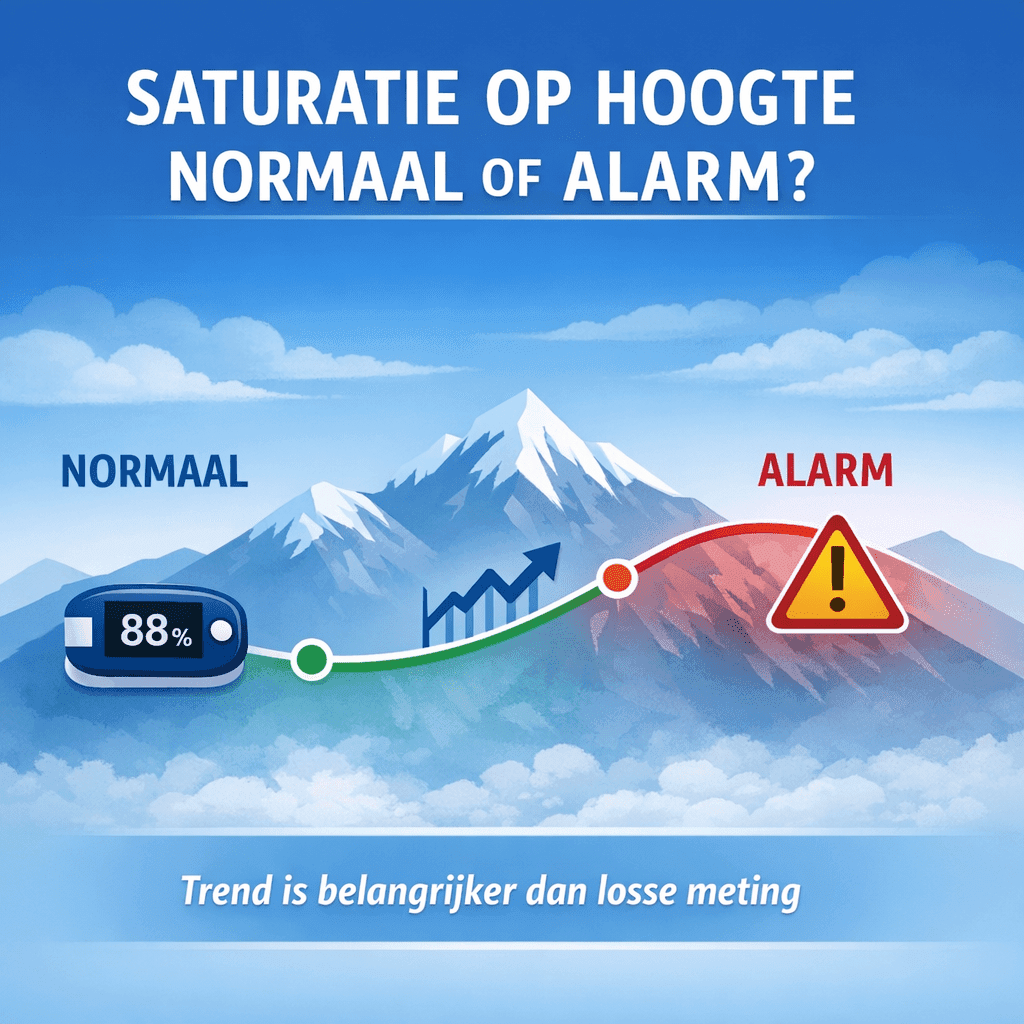
Is your saturation level normal, or should you be worried? At altitude, your oxygen saturation always drops. That's physiological. Yet there is a limit where normal turns into risk. In this article, you will learn exactly when a lower SpO2 is normal, when to adjust and when to stop.
The essentials in 30 seconds
Conclusion: Lower saturation at altitude is normal, as long as the trend is stable and you do not develop symptoms.
Nuance: One single low reading says little. The trend over several days is decisive.
Practical: Measure daily at rest and assess decline, recovery and symptoms together.
What does saturation at altitude actually mean?
Oxygen saturation, or SpO2, is the percentage of haemoglobin saturated with oxygen. At sea level, this is usually between 97 and 99 per cent. At altitude, this drops due to lower oxygen pressure.
That doesn't mean something is wrong. It means your body needs to adjust.
You can read more background on physiology in oxygen saturation at altitude.
Saturation altitude normal: guideline values per altitude
Although individual differences are large, you can broadly see this pattern:
- 2000 metres: 93 to 95 per cent
- 3000 metres: 88 to 92 per cent
- 4000 metres: 80 to 88 per cent
- 5000 metres: 75 to 85 per cent
These are not hard limits. The body adapts gradually. Therefore, it is more important how your saturation evolves than what number you see on day one.
With complaints, you should always think about altitude sickness symptoms and risks.
Why single measurements are misleading
Many athletes are shocked by one low reading. Yet this could be due to cold fingers, fatigue or poor sensor positioning.
Therefore, the key differentiator:
- Trend versus separate measurement
A stable value of 86 with no symptoms is safer than a drop from 92 to 85 in two days with a headache.
Therefore, you should always look at the whole picture.
For general context around height adjustment see also altitude sickness.
📊 Research shows
That acclimatisation takes an average of 3-5 days for initial stabilisation of ventilation and oxygen transport. During that period, SpO2 fluctuates significantly. This is normal as long as symptoms are absent.
When is saturation at altitude normal?
Saturation at altitude is normal when:
- The trend is stable or slightly increasing
- Your sleep gradually improves
- Headaches diminish or disappear
- Your appetite remains normal
- Your exercise tolerance improves slightly
This pattern indicates adaptation. Your body increases ventilation, adjusts acid-base balance and starts EPO production.
You can read more about those physiological benefits in altitude training what are the physiological benefits.
💡 Did you know?
The first increase in EPO can occur as early as 24 hours, but that red blood cell production doesn't take effect until weeks later. Therefore, you see ventilatory adaptation first before you feel real performance improvement.
When is low saturation an alarm signal?
Low saturation becomes worrisome when:
- SpO2 progressively decreases over several days
- Your resting heart rate rises
- Headache worsens
- Nausea or balance disorders occur
- You sleep seriously restless at night
The combination of falling trend and complaints is especially important.
⚠️ Reality check
An SpO2 of 78 per cent with no symptoms at 5000 metres can be stable. A drop from 88 to 82 per cent with increasing headaches at 3,500 metres is riskier.
When in doubt, follow the guidelines from how to deal with acute altitude sickness.
This is how you monitor this lens
Always use multiple parameters:
- SpO2 trend measured every morning at rest
- Sleep quality number of interruptions and sense of calm
- Recovery feeling headache, appetite, energy
Concrete decision rule:
If your SpO2 drops for two consecutive days and symptoms increase, you stop rising.
In severe symptoms, descent is the primary intervention.
High altitude tent and saturation: what is normal?
When using an altitude tent, you simulate altitude via normobaric hypoxia. Air pressure stays the same, oxygen percentage drops.
An altitude tent is no substitute for acclimatisation, but it will significantly reduce the risk of altitude sickness.
Normally, at sleep altitudes around 2,500 metres, you see a morning SpO2 around 90 to 94 per cent. Lower may occur temporarily in the build-up phase.
Importantly:
- Sleep is the primary stimulus
- Building up step by step
- SpO2-controlled adjustment
You can read more practical guidelines in altitude tent use complete guide.
🧭 In practice
We often recommend keeping the morning reading around 92 per cent. Increase only when you are stable above 94. Decrease when you fall towards 90 with poorer sleep.
When to continue, adjust or stop?
When to continue
Trend stable, complaints mild or decreasing, sleep improves.
When to adapt
Slight drop in SpO2 with onset of headache. Stay at the same altitude.
When to slow down or stop
Progressive decline with neurological symptoms, vomiting or severe weakness.
Then: descending is treatment.
Mini FAQ
Is 85 per cent saturation dangerous?
At 4,000 metres, 85 per cent may be normal without symptoms. It becomes worrisome when the value continues to fall and symptoms increase.
Should I measure every day?
Yes, preferably at rest in the morning. Always use the same time and the same finger.
Can I train on low saturation?
Light training is possible, but only if symptoms are absent and the trend is stable.
Resume
Saturation altitude normal does not mean the number has to be high. It means your body adapts without progressive symptoms.
The key is trend, not snapshot.
Want personal advice on your measurements or preparation? Feel free to contact with us.