What to eat at altitude? Nutrition before and during a climb
Published 28 May 2026 · 10 min read
Many mountaineers focus on training, equipment, and ascent schedules, but underestimate nutrition. Yet, nutrition at altitude directly influences your energy levels, recovery, sleep quality, and ailments such as headaches, nausea, and fatigue.
In this article, you'll read practically what eating at altitude means for your preparation, what to best take with you during a climb, and how to link nutrition to hydration, recovery, and acclimatisation.
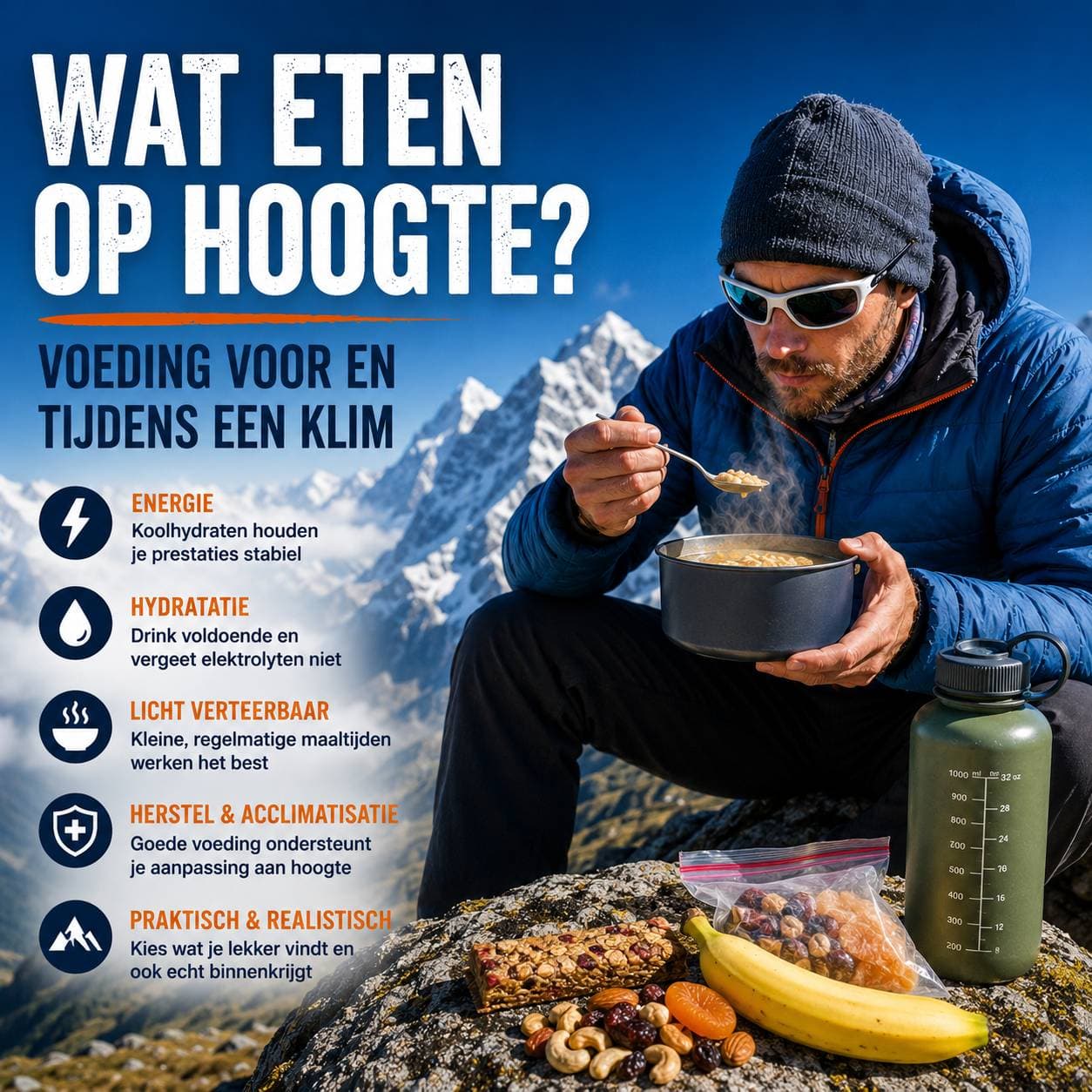
Short answer: What to eat at altitude? Especially carbohydrate-rich, easily digestible food such as oatmeal, rice, pasta, soup, bread, fruit, dried fruit and energy bars. Combine this with sufficient fluids and electrolytes. It's better to eat small portions spread throughout the day than large, heavy meals.
Conclusion: At altitude, eating is about keeping energy available, rehydrating, and supporting recovery.
Nuance: Your appetite often drops faster than your energy needs.
Practical hook: Plan your nutrition in advance, as waiting until you're hungry often doesn't work well at altitude.
Why food works differently at altitude
Nutrition at altitude works differently because your body has to work harder in low-oxygen conditions to achieve the same level of exertion. Your breathing speeds up, your fluid loss increases, and your body uses a relatively high proportion of carbohydrates as a quick fuel source.
At the same time, many people experience a loss of appetite. This creates a difficult combination. You need more energy, but you have less desire to eat.
In addition, headaches, nausea, and fatigue can make it difficult to consume enough calories. This is often seen during treks in Nepal, climbs of Kilimanjaro, alpine tours around Mont Blanc, or expeditions above 5000 metres.
Who understands well in advance precisely what acclimatisation entails, quickly notices why nutrition and hydration become so important when adjusting to thinner air.
⚠️ Reality check
Many people believe that altitude sickness is mainly due to fitness. In reality, dehydration, not eating enough, poor sleep, and ascending too quickly often play a role simultaneously.
What to eat at altitude before departure?
A good nutrition strategy doesn't just begin in the mountains. The final week before departure partly determines how well-stocked your energy reserves are and how fit you are when starting your first acclimatisation days.
Replenish your carbohydrate stores gradually
You don't need to do extreme carb-loading. However, it is sensible to eat enough carbohydrates in the days before departure. Think about:
- Oatmeal or muesli for breakfast
- rice, pasta or potatoes with hot meals
- brood, wraps of crackers as a practical base
- bananas, apples and dried fruit as snacks
- soup or broth for fluid and salt
Carbohydrates are important at altitude because they provide energy relatively efficiently. Especially during long days of climbing, you want to avoid your energy levels dipping early in the day.
Don't forget protein and iron
In addition, protein remains important for recovery. Think of yoghurt, eggs, legumes, chicken, fish, tofu, or quark. Especially during a multi-day trek or expedition, you don't just want to replenish energy, but also repair muscle damage.
Iron status also deserves attention. Without sufficient iron, acclimatisation to altitude is often less efficient. You can read more about this in iron and nutrition during altitude training.
Limit alcohol and heavy meals
Many people start their journey already tired, dehydrated and with little sleep. Alcohol, drinking little, and heavy, fatty meals just before departure usually don't help.
Especially during air travel towards expeditions, you can easily arrive slightly dehydrated. Therefore, start drinking regularly and eating normally, nutritious food even before departure.
What to eat at altitude during a climb?
During a climb, you should primarily choose foods that you can actually consume when you are tired. Therefore, the best choice is not always the most perfect food on paper, but the food that your body tolerates and that you consistently continue to eat.
Choose easily digestible energy
Most climbers tolerate carbohydrate-rich food better than heavy fatty meals. Especially above 3000 to 4000 metres, simplicity becomes more important.
| Nutrition | Why useful at height | Practical application |
|---|---|---|
| Oatmeal | Easily digestible and energy-rich | Breakfast for climbing days |
| Rice or pasta | Replenish carbohydrate stores | Evening meal while hiking |
| A brood of wraps | Easy to carry | Lunch on the go |
| Dried fruit | Compact, fast energy | During ascent |
| Soup or broth | Moisture, salt, and heat | In case of cold or loss of appetite |
| Energy bars | Quick and practical | Short stops during the climb |
Advantage: Easily digestible and energy-rich
Use: Breakfast for climbing days
Advantage: Replenish carbohydrate stores
Use: Evening meal while hiking
Advantage: Easy to carry
Use: Lunch on the go
Advantage: Compact, fast energy
Use: During ascent
Advantage: Moisture, salt, and heat
Use: In case of cold or loss of appetite
Advantage: Quick and practical
Use: Short stops during the climb
Smaller portions often work better
At higher altitudes, many people can no longer tolerate large meals. Small, frequent snacks usually work better than three heavy main meals.
A practical guideline is to eat something small every 60 to 90 minutes during long days. It doesn't have to be a large portion. Half a bar, some dried fruit, a piece of bread or a few mouthfuls of rice can be enough.
Even during longer acclimatisation periods, a stable energy intake can support recovery. Especially when your body is simultaneously adapting to lower oxygen pressure. You can read more about this in What happens in thin air at altitude.
Eating at altitude with little appetite
If you're no longer hungry at altitude, opt for soft, warm, and easily digestible food. Waiting until you're hungry often doesn't work well, as your appetite can decrease the higher you go.
Loss of appetite is one of the most underestimated symptoms of altitude sickness. It is particularly common above 3,500 metres. The problem is not just that you eat less; it often leads to a vicious circle.
- Eat less
- Less energy when moving
- Poorer recovery after exercise
- Increased fatigue
- An even lower appetite
Warm soup, tea with sugar, rice, soft pasta, broth, banana, apple sauce, crackers and small sweet snacks are often easier than large meals.
In practice
Always take a few snacks with you that you know you’ll actually eat even when you’re tired. At altitude, practicality often trumps theoretically perfect sports nutrition.
Hydration at altitude: eating and drinking go hand in hand
At high altitudes, you lose fluid more quickly due to faster breathing, dry air and physical exertion. At the same time, many people actually drink slightly less because they feel less thirsty or don’t want to go to the toilet frequently.
This increases the risk of headaches, tiredness, slower recovery, cramps and reduced performance.
Furthermore, hydration isn't just about water. Salt and electrolytes also play a role, especially during long days with a lot of sweating or in cold conditions where your thirst sensation is low.
In practice, many symptoms that people attribute to altitude turn out to be partly linked to dehydration. This is also evident in symptoms relating to Hydration and altitude sickness.
Water alone versus electrolytes
Water only: Useful for basic hydration, but sometimes insufficient during prolonged exertion.
Water plus electrolytes: often better for heavy sweating, cold conditions, altitude and multi-day treks.
According to international guidelines of the Wilderness Medical Society The foundation of altitude sickness prevention continues to grow steadily. Good nutrition and hydration support this process, but are no substitute for a sensible acclimatisation programme.
What are the most common mistakes climbers make?
So the question is not just what is sensible to eat at high altitudes, but also what you should avoid. These are the mistakes that are often made in practice.
- not drinking enough during the first few days at altitude
- skipping meals because you’re not hungry
- not taking enough carbohydrates for long days of climbing
- relying solely on energy bars and gels
- eating meals that are too heavy and high in fat just before exercise
- no savoury or hot options provided
- drinking alcohol whilst acclimatising
Many of these factors reinforce one another. People who eat poorly recover more slowly. Those who recover more slowly often sleep more restlessly. And those who sleep poorly often find the altitude more difficult to cope with.
The International Society for Mountain Medicine also emphasises that altitude-related symptoms must always be taken seriously and that diet, rest, hydration and rate of ascent must be considered together. See also the explanation of altitude sickness at ISMM.
Practical daily plan: what to eat at altitude during a day’s climbing?
The daily plan below helps to make nutrition at altitude more concrete. Always adjust quantities to your body weight, exertion, cold, appetite, and route.
| Moment | What are you eating or drinking? | Why? |
|---|---|---|
| Breakfast | Oatmeal, bread, banana, tea | Gentle carbohydrate start |
| Start a climb | Sports drink | Early support for fluid balance |
| Every 60 to 90 minutes | Small snack | Keep the energy stable |
| Lunch | Bread, wrap, soup or rice | Refuel |
| Upon arrival | Hot meal plus fluid | Restore and sleep support |
Neem Oatmeal, bread, banana, tea
Why: Gentle carbohydrate start
Neem Sports drink
Why: Early support for fluid balance
Neem Small snack
Why: Keep the energy stable
Neem Bread, wrap, soup or rice
Why: Refuel
Neem Hot meal plus fluid
Why: Restore and sleep support
Therefore Is it wise not to consider nutrition separately from acclimatisation?. Furthermore A regular eating and drinking routine helps to prevent problems rather than correct them afterwards.
This is how you monitor this lens
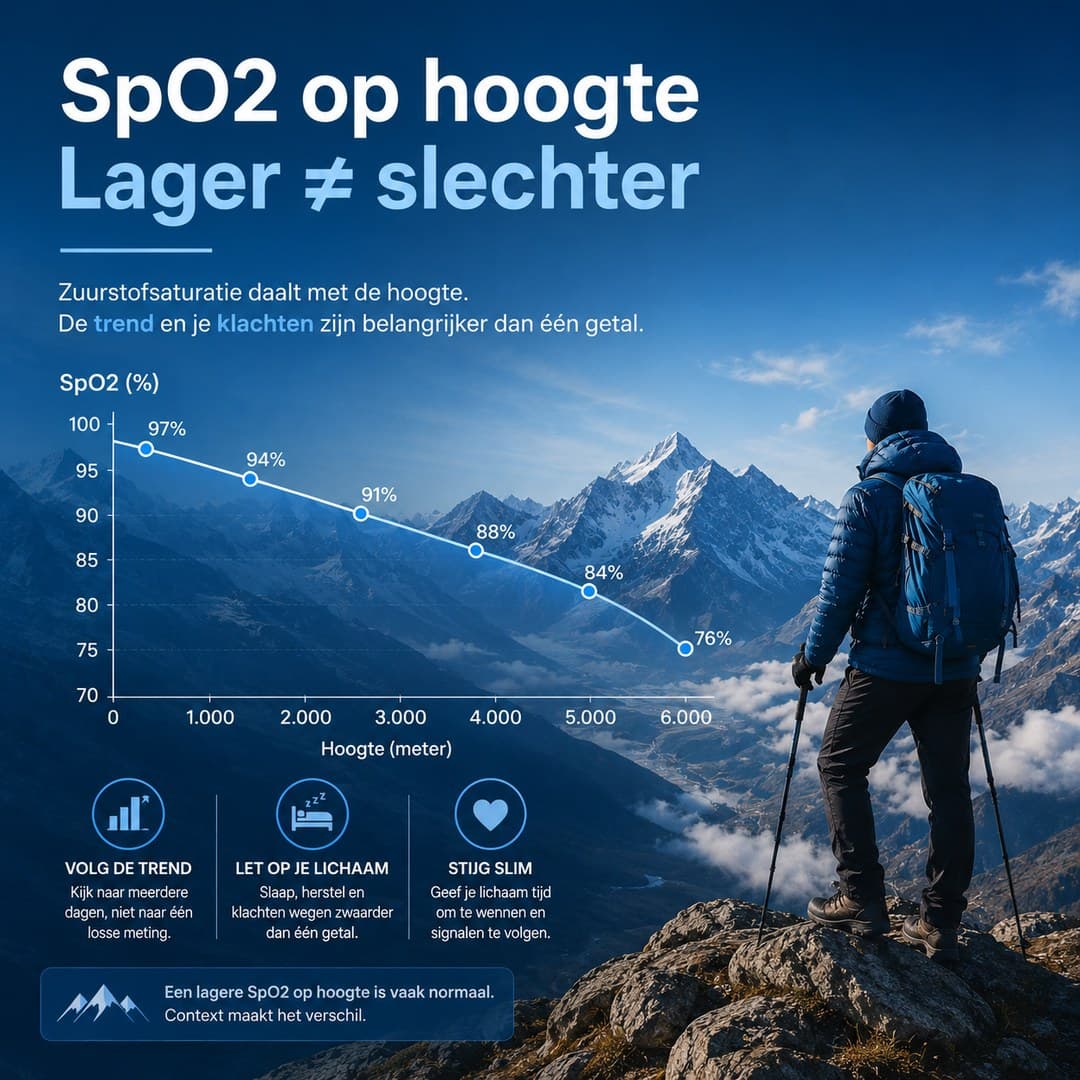
You shouldn't judge nutrition at altitude purely on instinct. An objective trend helps to make quicker adjustments. SpO2, sleep, recovery, appetite, and symptoms, in particular, provide a better picture together.
| Parameter | What to look out for? | Interpretation |
|---|---|---|
| SpO2 trend | Daily evolution | Trend is more important than an individual value |
| Appetite | Drought spanning multiple days | Can indicate insufficient recovery or overload. |
| Sleep quality | Restless nights | Often a combination of altitude, stress, and energy deficit |
| Recovery | Heavy legs or persistent fatigue | Can be related to too few calories or fluids |
| Symptoms | Headache, nausea, dizziness | Always combine with climbing rate and altitude profile |
What to look out for? Daily evolution
Interpretation: Trend is more important than an individual value
What to look out for? Drought spanning multiple days
Interpretation: Can indicate insufficient recovery or overload.
What to look out for? Restless nights
Interpretation: Often a combination of altitude, stress, and energy deficit
What to look out for? Heavy legs or persistent fatigue
Interpretation: Can be related to too few calories or fluids
What to look out for? Headache, nausea, dizziness
Interpretation: Always combine with climbing rate and altitude profile
When should you make adjustments?
If your appetite drops for several days, your recovery clearly deteriorates, your headaches increase, or your SpO2 trend unexpectedly worsens, please report it. Eat and drink more consciously, reduce your exertion, and also assess your ascent rate.
What to eat at altitude for altitude tent preparation?
Those who work with altitude tents beforehand prepare the body in a controlled manner for low-oxygen conditions. This involves normobaric hypoxia: the oxygen percentage decreases while the air pressure remains the same.
Even then, nutrition remains relevant. A height tent is not a replacement for acclimatisation, but makes the process controlled, measurable and plannable. It can significantly reduce the chance of altitude sickness, but does not offer a 100% guarantee.
Adequate energy intake, iron status, recovery, and sleep quality remain particularly important. Those who eat too little during a preparation block may recover less effectively from the hypoxic stimulus.
For mountain travellers who want to acclimatise to altitude beforehand acclimatising at home for mountain expeditions often a logical next step.
FAQ about what to eat at altitude
What to eat at altitude during a trek?
Above all, opt for carbohydrate-rich and easily digestible foods such as oatmeal, rice, pasta, bread, soup, fruit, dried fruit and energy bars.
Why do you have less appetite at altitude?
Due to hypoxia, fatigue, altitude stress, and sometimes mild nausea, appetite often decreases. Therefore, small meals tend to work better than large ones.
How much should you drink at altitude?
That depends on altitude, temperature and exertion. Pay particular attention to urine colour, thirst, headaches, recovery and your general trend.
Are fatty meals bad at altitude?
Not always, but heavy, fatty meals are often less well tolerated at altitude. Around climbing days, lighter, carbohydrate-rich meals are usually more practical.
Does diet help with altitude sickness?
Good nutrition and hydration support energy, recovery and acclimatisation, but do not replace a slow ascent rate, rest days or medical assessment if you have symptoms.
Depart for altitude well-prepared?
Nutrition helps to support your energy and recovery, but acclimatisation remains the foundation. Especially on expeditions above 4000 metres, controlled acclimatisation at home can provide extra rest during the first few days at altitude.
Look at the possibilities for pre-acclimatisation up to 5000 metres.
Experiences of mountain climbers heading towards 5000 metres
Conclusion: what to eat at altitude?
Ultimately, what to eat at altitude isn't a complicated question, but it's an important one. Opt for sufficient carbohydrates, small regular meals, warm light meals, enough fluids, and electrolytes where necessary.
The biggest mistake is usually not one wrong meal. The problem mainly arises when you eat and drink too little for several days while your body has to work harder to acclimatise.
Considering nutrition, hydration, pace, and recovery together makes you stronger in the mountains. Not because nutrition completely prevents altitude sickness, but because it better supports your body when conditions become tougher.