What is acclimatisation? Meaning and the physiological process
Published 19 April 2026 · 11 min read
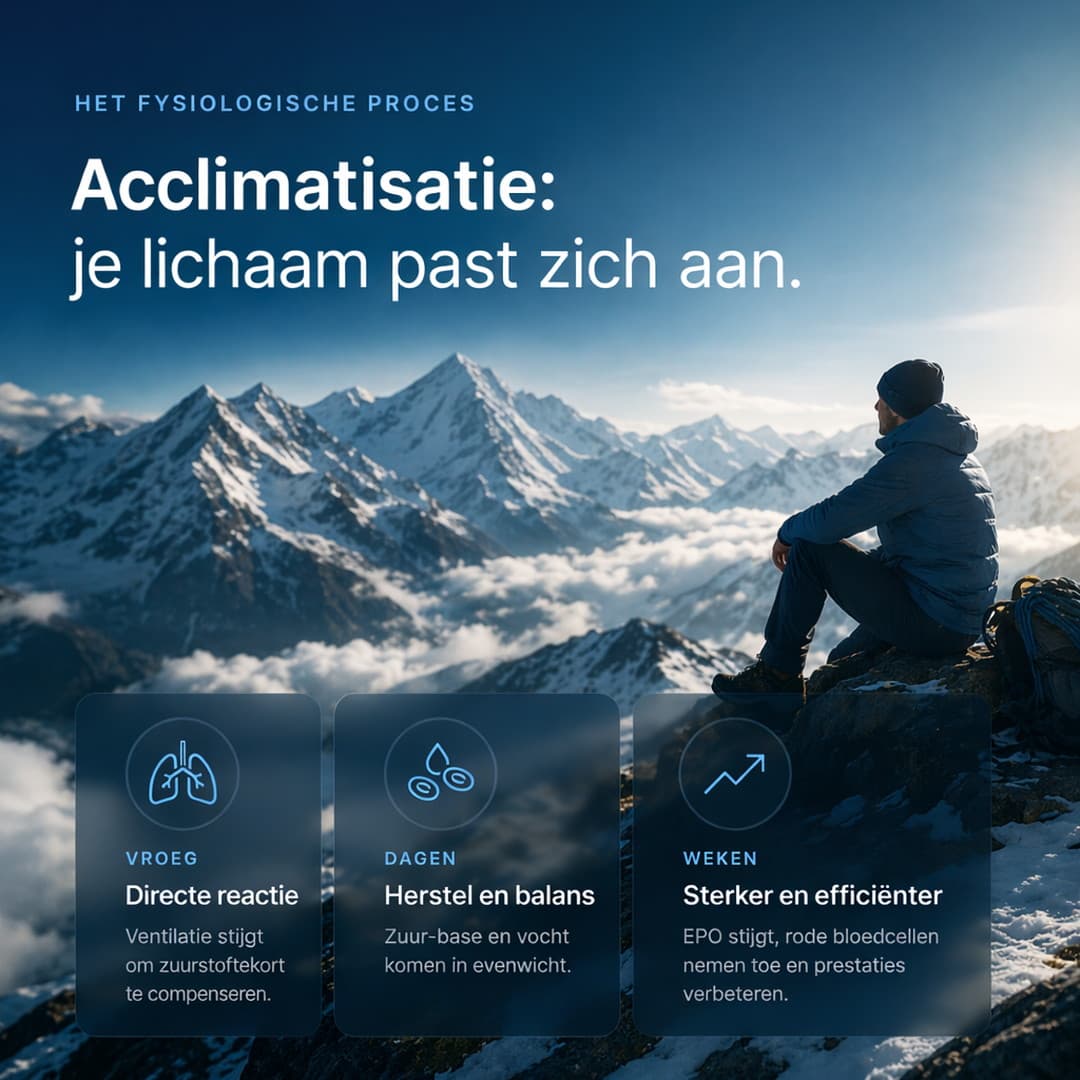
What exactly is acclimatisation, and what really happens in your body? For many mountain travellers, trekkers and climbers, this is not a theoretical question. It determines how much margin you have, how fast you can ascend and when symptoms are still normal or not. Acclimatisation is not a vague concept, but a measurable adaptation process to less available oxygen.
Those who understand that process tend to make better choices. You plan rest days more intelligently. You interpret a restless night more realistically. And you see more quickly when extra preparation makes sense. Basically, it all revolves around one question: does your body manage to get enough oxygen to vital organs and working muscles despite a lower oxygen pressure, without the load getting too high?
Direct response
- Acclimatization is the biological adaptation process to altitude and oxygen deprivation.
- In the first hours you react mainly with faster breathing, a higher heart rate and more perceived exertion.
- In the first days adjusts your body's ventilation, fluid balance and acid-base balance.
- Only then does deeper adjustment, such as an increase in EPO and later more red blood cell mass.
- The goal is not to feel perfect, but more stable functioning with less risk.
Conclusion: acclimatisation is not a moment, but a process that starts within hours and deepens over days to weeks.
Nuance: the same altitude level does not produce the same response in everyone, as ascent rate, recovery, iron status and sensitivity vary greatly.
Practical hook: Those who learn early to recognise which reactions are normal and which are not, decide noticeably better along the way.
What exactly is acclimatisation?
Acclimatisation means your body adapting to an environment where less oxygen is available per breath. At altitude, the oxygen percentage in the air remains roughly the same, but air pressure drops. This also decreases the amount of oxygen that can eventually be absorbed from your lungs into the blood. The practical outcome is simple: the same walk, kick or exertion feels heavier than at sea level.
Why height feels instantly heavier
In the context of altitude training and acclimatisation is crucial. This is because your body does not try to solve the oxygen deficiency with one trick. It uses several layers of adaptation simultaneously: breathing faster, dealing with fluids differently, activating hormonal signals and ultimately improving oxygen transport capacity. This is why acclimatisation sometimes feels messy in practice. You may breathe better, but sleep worse. Or wake up calmer, but still have a higher heart rate during exercise.
What this means practically for the reader
What is also important is what acclimatisation is NOT. It is not the same as being fit. A strong runner or cyclist can still be set back hard at altitude if the body is not given enough time to adapt. Conversely, someone with a slightly lower base condition can function surprisingly well if the build-up is gentle and the recovery is good.
What is acclimatisation in physiological terms?
Physiologically, acclimatisation begins with an acute stress response to hypoxia, i.e. to a situation where there is less oxygen pressure available to the body. Your breathing centre reacts almost immediately. As a result, you start breathing faster and deeper. This helps, but it also has a price: you blow off extra carbon dioxide, shifting your acid-base balance. This is a major reason why the first phase often feels restless.
The first hours
In the first few hours, your body is simply trying to protect oxygen uptake. Your ventilation increases, your heart rate rises and the perceived exertion increases. Many people notice this especially when walking uphill, carrying luggage and sleeping. The latter is not surprising. The very combination of altitude, stress and altered breathing regulation often makes the first night more restless.
If you want to better understand what your body is going through then, in the first 72 hours at altitude usually also immediately why pushing too fast is rarely smart. The acute response is useful, but not yet the same as sustainable adaptation.
The first days
After that initial reaction, the real fine-tuning begins. The kidneys start excreting more bicarbonate. In doing so, the body partly compensates for the shift caused by the extra breathing. That sounds technical, but the practical benefit is great: you can then maintain the faster breathing pattern better. At the same time, you often see a drop in plasma volume. This makes the blood relatively more concentrated, which temporarily helps to carry oxygen.
Many misunderstandings also arise at this stage. Some people think they are fully adjusted by then because headaches subside or sleeping improves a bit. In reality, this is mainly a sign that the initial arrangement is becoming less chaotic. This is positive, but it is not the end point.
Early gains at altitude usually come from better ventilation and regulation rather than from extra red blood cells. The latter takes more time. Therefore, a short period at altitude can already help noticeably, while deeper adaptation only becomes apparent later.
What happens after the first few days?
The deeper adjustment
Only in the subsequent period do you see more structural adaptations. EPO rises, red blood cell production gets going and the body becomes more efficient at dealing with oxygen deprivation. This does not mean that everything improves linearly. Gains depend heavily on sleep level, recovery, energy intake, iron status and overall load. Moreover, not everyone responds equally to the same stimulus.
This is precisely why acclimatisation is not a competition in toughness. It is a process of sufficient stimulus and sufficient recovery. More exposure is not automatically better. If sleep quality, recovery and symptoms deteriorate, chances are that your load is increasing faster than your adaptation.
Timeline of the physiological process
| Phase | What is happening? | What do you often notice? | Practical significance |
|---|---|---|---|
| 0 - 6 hours | Ventilation and heart rate rise immediately to support oxygen uptake. | Faster out of breath, higher exertion, sometimes mild headache or restlessness. | Move slowly, hydrate and don't treat the first day as a performance day. |
| 6 - 48 hours | Acid-base regulation and moisture balance begin to shift. | Sleep can be variable, appetite sometimes lower, recovery slower than usual. | This is where you often make the difference between building cleverly and forcing too quickly. |
| 2 - 5 days | Ventilation becomes more stable and initial complaints often diminish with good build-up. | More control during light exertion, less chaotic feeling. | This is usually the first point at which you notice that adjusting really starts. |
| 1 - 3 weeks | EPO signal and further haematological adaptation deepen. | Load feels more stable, but major efforts still remain relatively heavier. | For serious altitude loads, this is often the phase where preparation really pays off. |
What is happening?
Ventilation and heart rate rise immediately to support oxygen uptake.
What do you often notice?
Faster out of breath, higher exertion, sometimes mild headache or restlessness.
Practical significance
Move slowly, hydrate and don't treat the first day as a performance day.
What is happening?
Acid-base regulation and moisture balance begin to shift.
What do you often notice?
Sleep can be variable, appetite sometimes lower, recovery slower than usual.
Practical significance
This is where you often make the difference between building cleverly and forcing too quickly.
What is happening?
Ventilation becomes more stable and initial complaints often diminish with good build-up.
What do you often notice?
More control during light exertion, less chaotic feeling.
Practical significance
This is usually the first point at which you notice that adjusting really starts.
What is happening?
EPO signal and further haematological adaptation deepen.
What do you often notice?
Load feels more stable, but major efforts still remain relatively heavier.
Practical significance
For serious altitude loads, this is often the phase where preparation really pays off.
What is acclimatisation not?
A good understanding of acclimatisation helps mainly by preventing false expectations. Three misconceptions you see repeatedly. First, many people think acclimatisation is the same as being strong. In addition, there is often the idea that suffering automatically leads to adaptation. It is also frequently assumed that one good saturation measurement proves that everything is fine.
Not the same as fitness
Condition helps, but does not automatically protect you from a too rapid ascent or a bad first night at altitude.
Not the same as renouncing
Too much strain can actually disrupt the process. Smart building works better than forcing on willpower.
Not readable from a single number
One single value says little. The combination of trend, sleep, recovery and symptoms is much more useful.
That last point is important. Many people give loose saturation values too much weight. In reality, it is mainly the oxygen saturation at altitude useful as a trend, not an absolute truth. The body is not a dashboard. Context determines how to interpret a measurement.
What factors determine how quickly you acclimatise?
Acclimatisation rarely follows a set schedule. There are patterns, but no universal pace. Therefore, it is smarter to think in probabilities rather than guarantees. Those who include these factors estimate their margin better.
Rise rate
- The faster you ascend, the less time your physiology gets.
- Realistic planning remains the strongest protective factor.
Sleeping height
- Where you sleep often counts more than what you tap during the day.
- Several nights at the same altitude often give more peace of mind in the system.
Recovery and energy
- Sleep deprivation, undereating and dehydration make adaptation noticeably more difficult.
- A tight schedule without a buffer usually works against you.
Iron status and sensitivity
- Not everyone reacts the same to hypoxia.
- With longer-term preparation, iron availability plays a clear role.
Anyone planning a route or expedition would therefore do well to look not only at the final altitude, but also at the build-up per day. A useful reference is a normal acclimatisation rate per 1,000 metres. That does not provide the perfect answer for everyone, but it does provide a much more realistic starting point than blindly relying on enthusiasm.
This is how you monitor this lens
A good acclimatisation process rarely feels spectacular. It mainly becomes visible as your body gradually becomes more stable. This is why objective monitoring works better than relying on feelings alone. Four signals are most useful here.
SpO2 trend
Don't look at one single morning measurement, but at the line over several days. Stabilisation or gradual improvement says more than peaks and troughs.
Sleep quality
A first bad night is not unusual. Persistently worse sleep, wakefulness or failure to recover is more important.
Recovery at light load
Does walking, climbing stairs or leisurely pace become a little less strenuous? If so, that is often a useful sign of adjustment.
Symptoms
Headache, nausea, dizziness and fatigue should be looked at in context. If this increases at rest, then it is not a detail.
A nice SpO2 reading after a good night can be reassuring, but it is never decisive on its own. Always look at the whole picture: trend, sleep, recovery, appetite and symptoms. That very combination makes your interpretation reliable.
The practical decision rule is simple. If symptoms diminish, sleeping becomes slightly calmer and light exertion feels less strenuous, you are usually in the right direction. If symptoms worsen at rest or clearly expand, slowing down, extra rest or dropping should be on the table sooner. For preventive deepening preventing altitude sickness a logical next step.
When extra preparation makes sense?
Not every trip requires the same preparation. If you go up relatively quietly, with plenty of nights to adapt, then time is often your most important resource. But with tight travel planning, a quick move to high altitude or a performance-based objective, the margin is smaller. Then preparation becomes more interesting.
When time alone is often enough
Usually sufficient with time and build-up
On a quiet trek with room for several nights at intermediate altitudes, classical acclimatisation often works fine.
Extra useful when under time pressure
For expeditions, peak attempts or air travel to altitude, preparing in advance can make much more sense.
Caution for increased risk
Those who had obvious complaints before would do well to plan even more conservatively and never rationalise away complaints.
Preparing at home can help
With normobare hypoxia, you can make pre-acclimatisation in an altitude tent controlled, measurable and plannable.
When preparing in advance makes more sense
The latter is exactly where an altitude tent or other form of prior exposure can be relevant. Not because it is a panacea, but because it makes the process more planable when the journey itself leaves little wiggle room. It can significantly reduce the likelihood of complaints, but it remains neither a 100 per cent guarantee nor a licence to then ascend too fast.
Practical inference for the reader
If you want to take one thing away from this topic, let it be this: acclimatisation is the result of sufficient stimulus plus sufficient recovery. Not from bravado. Nor from one gadget. And certainly not from one strong week of training. Those who respect the process increase the chances of a more stable ride, more control and fewer unnecessary risks.
That makes this knowledge immediately useful. You don't have to be able to explain everything medically to make better choices. You only need to understand what may be normal in the first phase, what should only improve later and which signals require adjustment. This makes acclimatisation not an abstract concept, but a practical compass.
FAQ
How soon does acclimatisation begin?
Initial reaction starts within hours. More lasting adaptation occurs over days to weeks.
Is acclimatisation the same as not getting altitude sickness?
No. Good acclimatisation reduces risk but does not completely rule out symptoms.
Can you prepare acclimatisation at home?
Yes, you can do that with a high altitude tent as support.
Is one good saturation measurement enough?
No. Use SpO2 as a trend and always combine it with sleep, recovery and symptoms.
Want to make acclimatisation plannable in advance?
If you have little time between departure and arrival at altitude, then controlled preparation by sleeping at home in an altitude tent beforehand may make sense. First, read carefully about how pre-acclimatisation works in practice and when it is or is not relevant.
Read how home acclimatisation for mountain expeditions works
Briefly: acclimatisation is the meaningful sum of breathing, regulation, recovery and time. Those who understand that process tend to make calmer and better decisions along the way.