Live High Train Low height training highlighted
Published 23 September 2012 · 5 min read

Live High Train Low is one of the most talked-about forms of altitude training. You sleep at altitude but train at sea level. The goal: create more red blood cells without losing your training quality. In this article, you will discover what Live High Train Low really does, when it works and how to apply it safely and effectively.
The essentials in 30 seconds
Conclusion: Live High Train Low stimulates red blood cell production via hypoxic sleep, while you can continue to train intensively at low altitude.
Nuance: The effect occurs only with sufficient duration, correct height and controlled build-up.
Practical lead: Start 4 to 6 weeks before your peak moment and adjust for SpO2 trend, sleep quality and sense of recovery.
What exactly does Live High Train Low mean?
Live High Train Low literally means: sleep high, train low. You create a hypoxic stimulus during sleep, but maintain training intensity as you perform intervals and paces in normal oxygen conditions.
The concept is part of broader altitude training-strategies. Where traditional altitude stays often lead to reduced training intensity, LHTL seeks to combine the best of both worlds.
Why this is often misunderstood
Many athletes think that any kind of altitude training is automatically better. This is not true. If you also train at altitude, your absolute power output drops. For endurance athletes, this can put training quality under pressure.
Live High Train Low avoids that pitfall. By separating the hypoxic stimulus from the training stimulus, you can combine physiological adaptation with performance maintenance.
Want to first understand how the body responds to oxygen deprivation? Then also read how altitude training works.
The physiological basis
When you sleep in normobaric hypoxia, your oxygen saturation drops temporarily. The kidneys respond by producing more erythropoietin. This hormone stimulates the production of red blood cells.
More red blood cells means higher oxygen transport capacity. This is especially relevant during efforts around or above the anaerobic threshold.
For depth on EPA enhancement via altitude see also how high training increases your EPO levels.
Scientific research supports this principle. A widely cited analysis on LHTL was published in the Journal of Applied Physiology. This describes that a minimum of 3 to 4 weeks of exposure is needed for measurable haematological adaptation.
The most common fallacy
The biggest mistake is thinking that higher is always better. Starting too fast at 3,000 metres equivalent altitude often leads to poor sleep and reduced recovery quality.
The ideal zone for most athletes is between 2000 and 2500 metres equivalent altitude. See also the ideal height for a height tent.
It is not about maximum hypoxia. It's about sustainable adaptation.
💡 Did you know?
Most haematological adaptations occur during repeated nights of mild to moderate desaturation. Extreme falls do not produce faster results, but mainly increase the risk of sleep disruption.
This is how you monitor this lens
Effective LHTL is data-driven. Three parameters are leading:
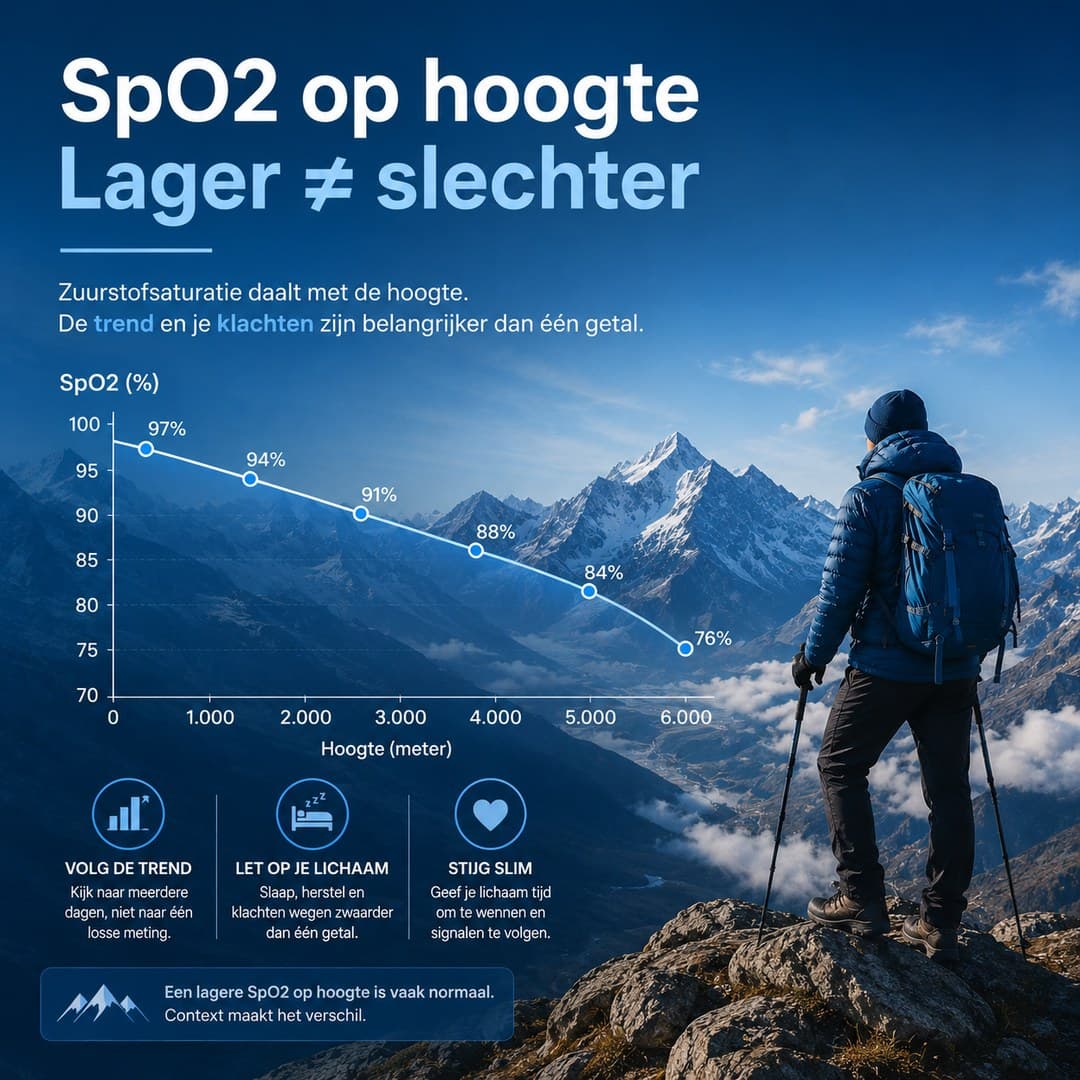
- SpO2 trend: no single measurement, but weekly trend. Work zone often around 90 to 93 per cent during sleep.
- Sleep quality: sleep time, night awakening, resting heart rate.
- Recovery feeling: fatigue, training response, subjective freshness.
Concrete decision rule: if your SpO2 falls below 88 per cent and your sleep deteriorates several nights in a row, then altitude is too aggressive.
⚠️ Reality check
A single low saturation reading says little. Always look at trends over at least 5 to 7 days before adjusting altitude.
Step-by-step implementation
- Start at 1800 to 2000 metres equivalent altitude.
- Build up 200 to 300 metres every 5 to 7 days.
- Sleep at least 7 to 9 hours a night in hypoxia.
- Maintain training intensity at sea level.
- Monitor SpO2 trend and recovery.
- Plan 4 to 6 weeks of total exposure.
When to continue, adjust or stop
When to continue
- Stable sleep quality
- SpO2 trend within target work zone
- Normal recovery after workouts
When to adapt
- Repeated waking up
- Declining training quality
- SpO2 under work zone with fatigue
When to slow down or stop
- Resting headache
- Persistent nausea
- Unexplained extreme fatigue
For alarm symptoms, stopping and descending is always the primary intervention.
Height tent as a practical application
For many athletes, Live High Train Low is applied via an altitude tent. This involves sleeping in normobaric hypoxia while training normally during the day.
An altitude tent is no substitute for acclimatisation, but it will significantly reduce the risk of altitude sickness. For athletes, however, the primary focus is on performance enhancement.
Also read the extensive altitude tent use complete guide for practical details.
🧭 In practice
Athletes who adjust their altitude based on SpO2 trend achieve more consistent results than those who choose a fixed altitude and don't look at it for weeks.
Mini-FAQ
How long does it take for LHTL to take effect?
Usually 3 to 4 weeks before measurable haematological changes.
Should I also train at altitude?
Not so with LHTL. Training quality is actually maintained at low altitude.
Is 3000 metres better than 2200 metres?
Not automatic. Too high a start can undermine sleep and recovery.
Decision aid for endurance athletes
For runners, triathletes and cyclists peaking towards a marathon or important race block, 4 to 6 weeks of LHTL is often ideal.
Want to see this personally tuned in? At personal advice you can have your training phase and goal moment included in an SpO2-driven plan.
Running-specific application
For runners working towards marathons, LHTL offers the opportunity to raise the aerobic ceiling without compromising pace intervals.
Do you want to use LHTL for running?
Check out the running-specific programme: https://altitudedream.com/reserveren/index.php?page=pakketten&sport=running&lang=nl&country=nl
Runner reviews: https://altitudedream.com/reviews/?sport=running
📊 Research shows
Athletes exposed to hypoxia for at least 12 to 14 hours a day show more significant haematological adaptation than athletes with shorter exposure.
❓ Mini-FAQ
Should your iron status be optimal? Yes. Without sufficient iron, increased red blood cell production has limited effectiveness.
Summary
Live High Train Low works, if applied correctly. It's not about maximum altitude, but consistent, measurable hypoxic sleep combined with high-quality training.
Taking a structured approach to this creates not only physiological adaptation, but also control and confidence towards a peak moment.