Climbing K2: preparation, route and acclimatisation
Published 2 April 2026 · 10 min read
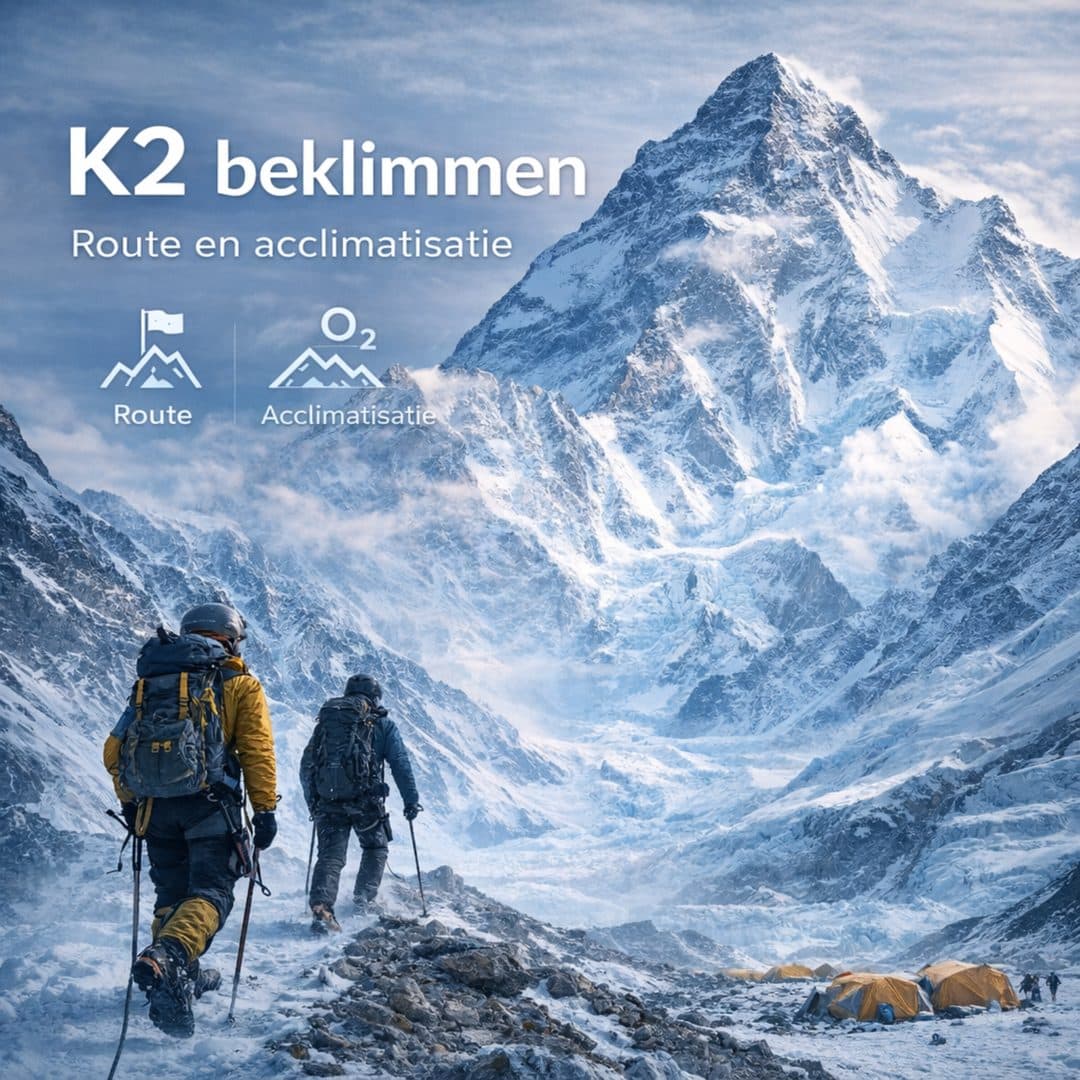
The bottom line is simple. K2 does not reward bravado. This mountain rewards only a team that works step by step, recovers well, monitors objectively and can turn around on time. In this article, you will read how the route is roughly constructed, what a realistic preparation looks like and why acclimatisation at K2 is not a detail, but the foundation of your entire expedition.
Conclusion: Climbing K2 requires much more than top fitness. You need a technically strong, disciplined and well-acclimatised approach.
Nuance: The standard route is known, but that does not make it predictable. Conditions determine each season where the real difficulty lies.
Practical hook: Start your acclimatisation and monitoring weeks before departure, not only when you arrive in Pakistan.
⚠️ Reality check
K2 is not a logical first 8000-er. A strong runner, triathlete or alpinist is not automatically ready for this mountain. Moreover, physical fitness does not protect against altitude sickness. On K2, what counts most is how well you acclimatise, recover, make decisions and function under hypoxic stress.
Climbing K2 in brief
If you are looking for a short answer to the question of what K2 climbing really requires, this is the summary:
- K2 is located in the Karakoram on the border of Pakistan and China and is 8,611 metres high.
- The most frequently used route is the Abruzzi Spur, with technical passages and great objective hazards.
- The toughest zone starts well above 7,000 metres, with the Bottleneck as a well-known bottleneck just below the summit.
- Acclimatisation should be slow, purposeful and measurable. Ascending too quickly almost always breaks the expedition.
- Pre-acclimatisation at home can be useful, but never replaces acclimatisation on the mountain itself.
What makes K2 climbing so exceptional
Many people look at the height figure first. That makes sense, but it doesn't tell the whole story. K2 is not only high. The mountain is also steep, technical and relentless in its terrain construction. The standard route has passages where fixed ropes, good footwork, efficient climbing and calm risk management come together. On top of that, much of the decisive route is in the zone where recovery declines rapidly and small mistakes can have big consequences.
This is why you should not approach K2 as a classic endurance project. Rather, think of it as a combination of technical alpine skill, logistical discipline and meticulously executed acclimatisation. The latter in particular is often underestimated. Those who can handle the mountain physically but do not function hypoxically in a stable way will sooner or later get stuck. For many climbers, good preparation therefore starts at home, for example with a plan for acclimatising at home for mountain expeditions.
The standard route on K2 via the Abruzzi Spur
The Abruzzi Spur is considered the standard route on K2. That does not mean it is easy. Modern expeditions usually work through a build-up from Base Camp to Camp 1, Camp 2, Camp 3 and Camp 4, followed by a summit push via the Shoulder and the Bottleneck. Exact camp locations may shift a bit seasonally due to snow, ice and route conditions, but this structure is usually recognisable.
| Route zone | About | Important focus |
|---|---|---|
| Base Camp | 4.968 m | recovery, eating, sleeping, objective monitoring |
| Camp 1 | 6.065 m | first real load on the route |
| Camp 2 | 6.700 m | rotations, recovery quality, timing |
| Camp 3 | 7.250 m | Black Pyramid, technical efficiency |
| Camp 4 | 7.681 m | Shoulder, final preparation summit push |
| Bottleneck and traverse | over 8,000 m | steep, highly exposed key zone |
The most technically famous section is the Bottleneck. That is a steep couloir under unstable seracs, about 400 metres below the summit. Whoever arrives there is already deep in the death zone. That means pace, concentration, condition of the rope team and route conditions have to come together perfectly. This is exactly why K2 leaves so little room for a mediocre day.
Preparing for K2: what needs to be in place beforehand
Good preparation for K2 does not start with a training schedule, but with an honest audit. Do you already have extensive experience on technical alpine terrain? Can you move efficiently with crampons, fixed ropes and cold hands? Have you previously performed well above 6,000 or 7,000 metres? And do you know how your body reacts to multiple days in hypoxic conditions? Without those answers, you are setting off on hope rather than plan.
Technical basis
For K2, you need to be able to climb routinely on mixed terrain, convert smoothly on fixed ropes and keep moving safely under fatigue. The technical load is too great to learn fundamentals along the way. So don't just practise strength and duration. Also practise transition moments, cold weather actions, descending under stress and deciding when the mountain is not cooperating.
Physical basis
A big aerobic engine remains useful, but it is not enough. For K2, above all, you want a body that can handle several weeks of load, recover well and remain lucid under calorie and sleep deprivation. Long endurance blocks, climbing with packs, strength endurance and robust recovery capacity are often more valuable than peak wattages or short peak performances.
Logistics base
K2 is also a logistical expedition. The run-up to Base Camp takes time. Weather windows are narrow. Build-up rotations take planning. And when you leave too late or rotate too aggressively, you pay for it later on the mountain. This is precisely why it pays to understand in advance what happens in the first 72 hours at altitude. This will help you avoid wasting the first few days by wanting to go too fast.
K2 climbing and acclimatisation: where it often goes wrong
The biggest mistake in K2 is rarely a bad summit day. The biggest mistake is almost always an overly optimistic acclimatisation curve. High-altitude guidelines recommend that above 3,000 metres, sleep altitude should generally not be increased by more than about 500 metres per day and extra rest days should be built in. As you get higher, especially above 5,000 to 6,000 metres, this caution becomes even more important.
Specifically, for K2, that means not only rising, but more importantly, properly processing what you have already risen. That's where things often falter. Strong athletes feel good in the beginning, quickly climb to a higher camp and confuse motivation with adaptation. This is dangerous. Physical fitness does not protect against altitude sickness. A well-trained body may even want too much at a time when physiology is still lagging behind.
Those looking to improve their chances therefore combine three layers: a gentle run-up, well-constructed rotations on the mountain and, where appropriate, targeted pre-acclimatisation at home. Research and international mountain medical guidelines show that pre-acclimatisation in hypoxia can be a useful support, especially if an expedition is logistically tight. But that support never replaces mountain acclimatisation. It mainly makes the process more controlled, measurable and planable.
💡 Did you know?
For long expeditions, sleeping in an altitude tent beforehand can help get the initial adjustments underway already at home. This can be useful when time is scarce in the mountains. The gain is mainly in better preparation and less improvisation, not in a magic shortcut to the summit.
Those who approach the mountain smartly will also delve into a normal acclimatisation rate per 1,000 metres and in the mechanisms behind preventing altitude sickness. On K2, this is not theory, but daily practice.
A realistic acclimatisation plan for K2
The schedule below is not a rigid recipe. Think of it as a realistic capstone for a K2 expedition that combines preparation and mountain acclimatisation.
- 4 to 6 weeks before departure: Start with controlled altitude tent at home if you choose. Build up gradually and control for tolerance, sleep quality and SpO2 trend.
- Approach to Base Camp: Don't use cravings as a race. Eat well, sleep well and keep the pace deliberately slow.
- First rotation: touch the route, sleep higher, but descend back as soon as the quality of recovery decreases.
- Second rotation: usually work through towards Camp 2 and possibly higher, depending on conditions and recovery response.
- Rest in Base Camp: let the adaptation land. Many teams win more here than in a forced extra day of climbing.
- Summit push: only when route, weather, team fitness and your acclimatisation curve are green at the same time.
On paper, that may seem conservative. In practice, it is often actually the fastest route to a real opportunity. Accelerating too early rarely saves time. More often, it costs energy, recovery and safety later. On a mountain like K2, conservative is often just professional.
This is how you monitor this lens
With K2, you don't want to sail by gut feeling alone. Good monitoring makes the decision to go ahead or slow down much less emotional.
- SpO2 trend: don't look at one single measurement, but at the line over several mornings. A downward trend combined with worse recovery is more relevant than a one-off number.
- Sleep quality: restless sleep, frequent waking and a distinctly worse feeling when getting up are early signs that strain is mounting.
- Recovery: note appetite, thirst regulation, fatigue, concentration and readiness to move again.
- Symptoms: headache, nausea, dizziness, loss of coordination or increasing shortness of breath should always be seen in context of the trend, not of a single moment.
Practical decision rule: only ascend further when your trend looks stable, you are sleeping well, you still have an appetite and no ascending symptoms are visible. If you see the opposite pattern, then an extra rest day or descent is often smarter than continuing anyway.
Common misconceptions about K2
- “I am very fit, so acclimatisation will work,” he said.”
Not necessarily. Good fitness does not protect against AMS, HAPE or HACE. - “The standard route is safe when the fixed ropes are in place.”
Even then, objective hazards, cold, fatigue and timing remain decisive. - “Pre-acclimatisation at home replaces a gentle expedition build-up.”
No. It may help, but the mountain still requires real adaptation on the ground. - “If I feel good one day, I'm good for the summit push,” he said.”
On K2, the trend counts over days. A good day can follow an overly aggressive build-up.
When slowing down, descending or stopping is wise
A strong expedition recognises not only opportunities but also limits. Mild AMS often causes symptoms such as headaches, fatigue, reduced appetite, nausea or worse sleep. This is enough reason to slow down and not climb any further. If symptoms become more severe, or ataxia, increasing shortness of breath or neurological signs develop, then descending becomes a medical decision and not a performance choice.
For K2, this is especially important, as you have less margin to correct mistakes high up in the route. On top of that, the Bottleneck and summit stages force you to operate close to your limit already on a good day. Anyone who arrives there with a shaky acclimatisation base is piling risk on risk.
Practical tips for the summit phase
- Save energy for high on the route. Never let ego steer the first few days.
- Eat and drink as soon as still comfortable. Correcting too late is usually too late.
- Check equipment and routine in lower camps, not only high up the mountain.
- Agree clear turnaround rules with your team before the summit push.
- Use your monitoring as a filter. Not every good feeling is a green light.
- Consider descent as part of success. The top is only half the work.
FAQ on climbing K2
Is climbing K2 technically more difficult than just being “high”?
Yes. K2 is not only extremely high, but also technically demanding. In particular, the route structure, exposure and Bottleneck make the mountain exceptionally tough.
What is the default route on K2?
Most expeditions use the Abruzzi Spur. That route runs through several camps to the Shoulder and then through the Bottleneck towards the summit.
Does pre-acclimatisation at home in an altitude tent for K2 help?
Yes, that can help as part of a broader plan. It makes preparation more controlled and can support initial adaptation. It does not replace acclimatisation on the mountain itself.
Does top fitness protect against altitude sickness on K2?
No. Fitness is useful for the load of the expedition, but does not protect against altitude sickness. The quality of your acclimatisation remains decisive.
Conclusion
Climbing K2 requires a different kind of maturity than many other mountain goals. It is not the fastest climber who wins here, but the best prepared. Those who understand the route, take their acclimatisation seriously and dare to make objective decisions significantly increase their chances. This is precisely why it pays to see K2 not as one summit day, but as a carefully constructed process of weeks.
Are you working towards K2 or another 8000m goal?
With targeted pre-acclimatisation, make your preparation at home controlled, measurable and planable. Check out the 8000m package or read experiences of other expedition climbers.
Check out the 8000m acclimatisation package
Read experiences of other high mountain climbers