Blood tests for altitude training: which values really matter?
Published 1 August 2012 · 6 min read

A Blood test for altitude training can remove a lot of uncertainty. Many athletes and mountaineers invest in a hypobaric chamber, altitude training camp or acclimatisation programme, but forget to check beforehand whether their body is optimally prepared. Iron status, haemoglobin and ferritin, in particular, play a bigger role than many people think.
Wil je het maximale uit altitude training Halen, then a blood test is not mandatory. However, in certain situations, it can be one of the most valuable preparatory steps.
Short answer:
- A blood test is not always necessary before altitude training.
- For athletes with performance ambitions, monitoring ferritin levels is often advisable.
- For mountain travellers in good health, a blood test is usually optional.
- A low iron status can limit the training response.
- In cases of unexplained fatigue, a blood test is strongly recommended.
Conclusion: Ferritin and haemoglobin partly determine how well you respond to altitude training.
Nuance: Not every athlete or traveller needs blood tests beforehand.
Practical hook: When in doubt, a simple blood test often provides a quick answer.
Why blood tests can be relevant for altitude training
The main effect of altitude training is that the body adapts to lower oxygen availability. Red blood cells play a central role in this. To produce new red blood cells, the body needs sufficient building blocks, of which iron is the most important.
When iron stores are low, the physiological response to altitude can be less pronounced. This applies both to altitude training camps and to a programme using a sleep tent.
This is why many sports doctors advise gaining insight into iron status beforehand when an athlete aims to invest in performance improvement.
Those not yet familiar with the underlying mechanisms can first read how altitude training works and which physiological processes are stimulated by this.
Which blood values are most important?
Not every extensive sports medical blood test is necessary. In practice, a few core values often provide a lot of information.
| Parameter | Why is it important? | Practical significance |
|---|---|---|
| Ferritin | Indication of iron stores | Main value of altitude training |
| Haemoglobin | Oxygen transport | Shows current capacity |
| Haematocrit | Red blood cell count | Helps to assess the starting situation |
| Transferrin | Iron transport | Supplementary interpretation of iron status |
Function: Iron stock
Importance: primary marker for altitude training
Function: oxygen transport
Importance: current transport capacity
Function: red blood cell count
Importance: to assess the initial situation
Function: Iron transport
Importance: additional context
For athletes who wish to delve deeper into this subject, the article on iron and nutrition during altitude training Additional background.
Blood tests are strongly recommended when: * To diagnose a medical condition. * To monitor a known medical condition. * To assess the effectiveness of a treatment. * Before certain medical procedures or surgeries. * As part of a routine health screening. * To check for infections. * To assess organ function (e.g., kidneys, liver). * To check hormone levels. * To detect deficiencies or excesses of certain nutrients or electrolytes.
For some groups, a blood test clearly offers added value.
- Endurance athletes planning a high-altitude training camp.
- Athletes who have previously had an iron deficiency.
- Vegetarians and vegans.
- Women at increased risk of iron deficiency.
- Athletes with unexplained fatigue.
- Mountain climbers preparing for a tough expedition.
Suboptimal iron status occurs relatively frequently in precisely these groups.
📊 Research shows
Even when haemoglobin levels are still normal, low ferritin levels can limit training adaptation. As a result, some athletes feel tired even though a standard blood test shows no clear abnormalities.
Blood tests are usually not necessary when
Not everyone needs to undergo a sports medical screening beforehand.
If, for example, you are acclimatising for four weeks for a trek at altitudes of 3500 to 4500 metres and have no medical complaints, a blood test is usually not required.
The same applies to recreational athletes who primarily use altitude training as an additional training stimulus and do not pursue specific performance goals.
In these situations, it can often be wiser to pay attention to sleep, recovery, nutrition, and a good acclimatisation plan.
Common misunderstandings
A high ferritin level automatically means better performance
No. More is not always better. An extremely high ferritin value does not automatically result in more red blood cells.
Everyone should take iron supplements.
That is also not correct. Supplementation without blood tests can be unnecessary and sometimes even undesirable.
A normal blood test guarantees success at altitude
Altitude acclimatisation depends on many factors. Genetics, sleep quality, training load and acclimatisation pace also play an important role.
When is a blood test likely to be more valuable for you?
- Yes performance-oriented sport, previous iron issues, unexplained fatigue or a significant altitude training camp.
- Perhaps multi-day mountain tours above 4000 metres.
- Not immediately needed recreational use without complaints or specific performance goals.
This is how you monitor this lens
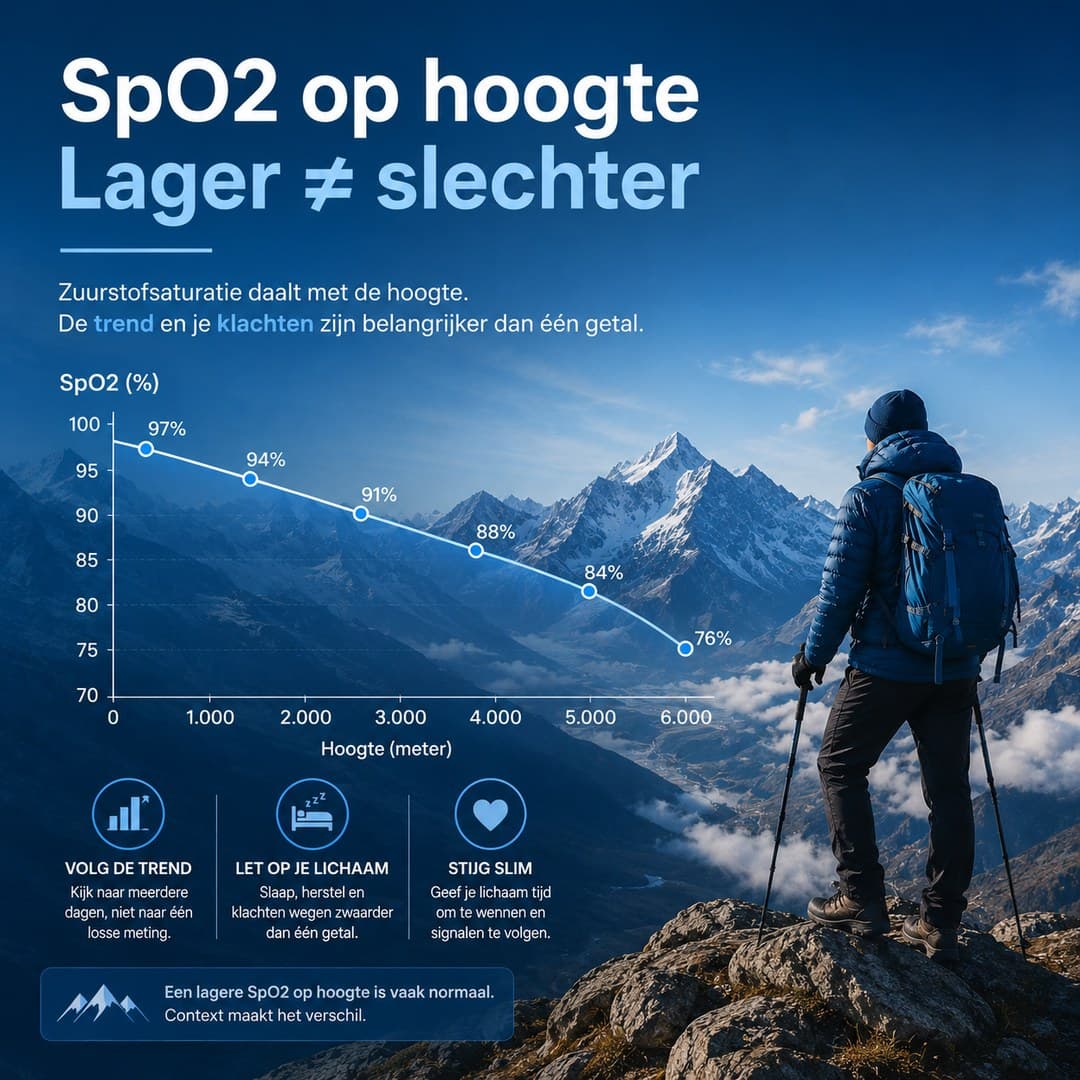
A blood test is just a snapshot. The reality is determined by how your body actually responds.
| Measuring point | What are you paying attention to? | Practical interpretation |
|---|---|---|
| SpO₂ trend | Morning values over several days | Trend is more important than a single measurement |
| Sleep | Recovery and sleep quality | Important indicator of adaptation |
| Recovery | Fatigue and training sensation | Deterioration can warn |
| Symptoms | Headache, nausea, restlessness | More important than individual figures |
Focus: track for several days
Interpretation: Look at the trend
Focus: Quality and duration
Interpretation: reflects adaptation
Focus: fatigue
Interpretation: Key performance indicator
Focus: Complaint pattern
Interpretation: more important than isolated figures
For interpreting oxygen saturation, it's useful to understand what a normal oxygen saturation at altitude and how values change during acclimatisation.
🧭 In practice
Athletes using an altitude tent often monitor their SpO₂ trend, sleep quality, and recovery feeling daily. It is precisely the combination of these data that provides a more reliable picture than any single value.
Would you like to start with altitude training in the best possible way?
A good plan begins with insight into your starting situation. Discover which form of altitude training best suits your goals and preparation.
Conclusion
A blood test for altitude training isn't necessary for everyone. However, it can be a worthwhile investment for athletes with serious ambitions. Levels of ferritin, haemoglobin, and hematocrit, in particular, provide insight into your body's baseline.
If you have no complaints and are travelling to altitude for leisure, a good acclimatisation plan, sufficient recovery, and gradual progression are often sufficient. However, for performance-oriented athletes, a blood test can help to get the most out of a high-altitude training camp or altitude tent programme.
Frequently asked questions
Do I always need to have blood tests for altitude training?
No. For recreational use without complaints, this is usually not necessary.
Which blood value is most important?
Ferritin is often the most relevant marker as it reflects iron stores.
Can I benefit from altitude training without good iron levels?
Yes, but the training response may be less effective when iron stores are low.
Hoe lang voor een hoogtestage laat ik bloed prikken?
Ideally a few weeks in advance, so there is still time to address any deficiencies.
Is a standard blood test a guarantee of success?
No. Adaptation to altitude remains dependent on multiple factors such as sleep, recovery, genetics, and training load.