
Becoming a high-altitude responder: can you make your body react better to altitude?
Published 26 June 2014 · 15 min read
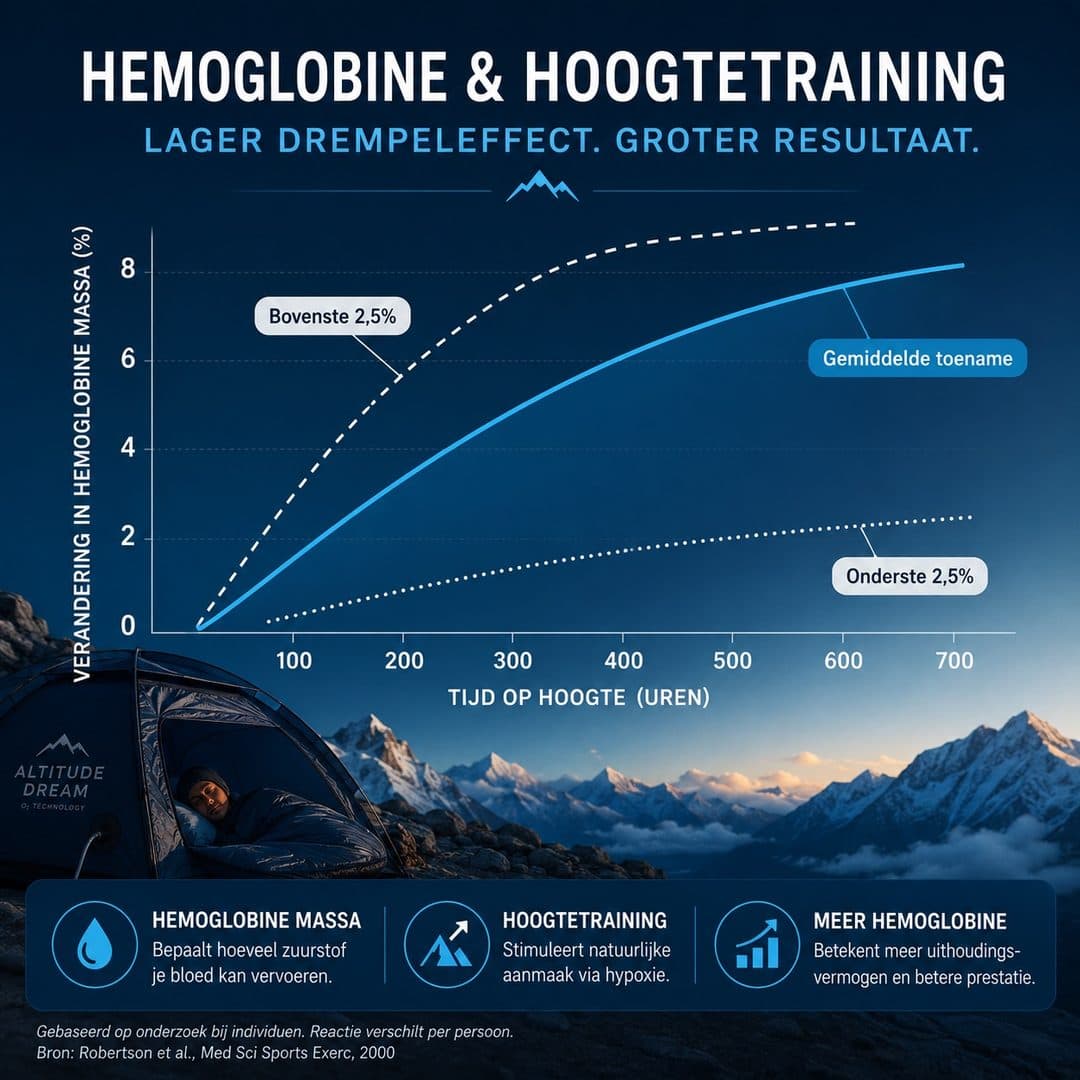
So, a high-altitude training camp doesn't just work because you're staying in the mountains. It primarily works when your body is exposed to low-oxygen air for long enough and often enough. That's why sleeping in an altitude tent is so important. You create a controlled, repeatable, and measurable altitude stimulus at home, without unnecessarily disrupting training, recovery, and sleep.
Short answer: An athlete usually does not become a better responder by training harder at altitude, but by optimising the basic conditions. The most important factors are sufficient hours of sleep in hypoxia, gradual progression, a stable SpO2 trend, good iron status, adequate energy intake, and recovery. With a good protocol, virtually every healthy body responds physiologically to altitude, although the magnitude of the effect varies from person to person.
Conclusion: Becoming a responder is mainly a matter of protocol quality, not just aptitude.
Nuance: The performance outcome varies per athlete, but the physiological stimulus is controllable.
Practical hook: Sleeping in a high-altitude tent makes the altitude stimulus programmable, measurable, and reproducible.
What does it mean to become a high altitude acclimatisation responder?
A responder is an athlete who clearly reacts to altitude training. This can be seen in blood values, recovery, feeling during submaximal exertion, power output, running pace, or race performance. However, the word "responder" can sometimes be misleading. It suggests that your body either reacts or doesn't react. It's rarely that black and white.
At altitude training Your body receives a low-oxygen stimulus. This forces it to manage oxygen more efficiently. Depending on duration, intensity, and recovery, this can influence, among other things, red blood cells, breathing, buffering, muscle metabolism, and recovery adaptation.
However, a reaction takes time. A few sleepless nights at altitude are usually insufficient. A classic altitude training camp can also be disappointing when the first week mainly consists of poorer sleep, lower training quality, and insufficient recovery. Then the stimulus is present, but the execution is not optimal.
Therefore, the central question isn't: am I a genetic responder? The better question is: am I giving my body the right stimulus for long enough, under circumstances where it can actually adapt?
Why some athletes react poorly to altitude training
When altitude training yields little, it's often quickly labelled as a "non-responder." In practice, the problem often lies not with the athlete, but with the surrounding conditions. An athlete can be perfectly suited for altitude training and still gain little benefit from a poorly planned camp.
The most common causes are simple, but important. The height stimulus is too short. The build-up is too aggressive. Sleep quality drops too much. Training becomes too hard. Or iron status is insufficient to adequately support haematological adaptation.
Timing also plays a part. Anyone who returns too fatigued just before an important match might show a physiological response on paper, but perform worse in practice. An effective altitude training camp is therefore not about reaching the highest possible altitude. It's about providing enough stimulus with as little disruption as possible.
Reality check: A disappointing altitude training camp doesn't automatically mean your body isn't responding to altitude. Often, the exposure was too short, the training load too high, or the monitoring insufficient. Precisely for this reason, a controlled protocol at home is often more valuable than an improvised altitude training camp.
Why sleeping in a high-altitude tent is so important
The main stimulus in classical live high train low altitude training is not one tough session in thin air. It is the total time your body spends in hypoxia. This is why sleeping is so powerful. Overnight, you accumulate prolonged exposure without additional training load.
At sleep high train low you sleep in low-oxygen air, while you can train normally during the day. That is an important advantage. You do not have to carry out your quality training sessions at altitude, where pace, power, and recovery are often put under pressure.
An altitude tent makes this principle practical. You sleep at a set virtual altitude at home. As a result, your body receives a stable stimulus night after night. Meanwhile, nutrition, training schedule, work environment, and recovery remain more controllable than during a trip to the mountains.
With the right conditions, sleeping in a height tent will generally have an effect on the body. This does not mean that everyone will see the exact same performance improvement. It does mean that the body will almost always react physiologically to a sufficiently long, well-structured hypoxic stimulus.
Becoming a high-level responder starts with sufficient hours
Many athletes underestimate the amount of exposure required. Altitude training doesn't work like a supplement you take occasionally. It's a repeated stimulus. The more consistent that stimulus, the greater the chance of a useful adaptation.
That's why sleep hours are so important. Those who spend only four or five hours at night in the altitude tent miss out on a large part of the potential stimulus. Those who get seven to nine hours a night build up much more effective hypoxic time.
That's precisely where sleeping at home in a height tent excels. You don't need to travel. You don't need to relocate your training. You don't need to organise a training camp environment. You build the altitude stimulus into your normal routine.
| Precondition | Why important | Practical guideline |
|---|---|---|
| Sleep duration | Determines the total hypoxic stimulus per night. | Aim for 7 to 9 hours per night. |
| Construction | Prevents unnecessary sleep disturbances and overstimulation. | Increase gradually, usually in 300-metre increments. |
| SpO2 trend | Check if the set height is appropriate. | Look at multiple mornings, not at one single measurement. |
| Iron status | Supports red blood cell production. | Check ferritin and discuss supplementation with a doctor. |
| Recovery | Adaptation arises during recovery, not during forcing. | Reduce training stress if sleep or HRV clearly deteriorates. |
Why important determines the total hypoxic stimulus per night.
Practical guideline: Aim for 7 to 9 hours per night.
Why important prevents unnecessary sleep disturbance and overstimulation.
Practical guideline: Increase gradually, usually in steps of 300 metres.
Why important Show if the set height is appropriate.
Practical guideline: look at several mornings, not one single measurement.
Why important supports red blood cell formation.
Practical guideline: Check ferritin and discuss supplementation with a doctor.
Why important Adaptation arises during recovery, not during forcing.
Practical guideline: Reduce training stress if sleep or HRV clearly deteriorates.
Becoming a high-altitude intern requires smart progression
A common mistake is to go too high, too quickly. This feels ambitious, but is rarely wise. Too strong a hypoxic stimulus can disrupt sleep, increase morning fatigue, and affect training quality. As a result, you lose precisely the foundation needed to respond.
A better approach is to build up gradually. Start at an altitude that is easily tolerated. Check how you sleep. Measure your morning trend. Look at any complaints, feeling of recovery, and training response. Only then should you increase the virtual altitude.
So more is not automatically better. The best altitude is the altitude at which your body is clearly stimulated, but at which sleep and recovery remain sufficiently stable. For many athletes, this is initially around 2000 to 2500 metres. After that, the altitude can be adjusted step by step.
Anyone who wants to understand how to choose the right height can delve into setting the correct height. This prevents the altitude tent from being used as a competition in hardship, rather than as a controlled training tool.
Practical setup for athletes
A general structure could look like this. The exact height depends on experience, purpose, sleep response and monitoring.
| Phase | Target | Practical implementation |
|---|---|---|
| Week 1 | Getting used to sleeping in hypoxia. | Start gently, monitor sleep quality and don't push yourself. |
| Week 2 | Increase stimulation without losing recovery. | Increase gradually as SpO2 trend and sleep are stable. |
| Week 3 | Building consistent exposure. | Accumulating plenty of sleep hours and maintaining training quality. |
| Week 4+ | Consolidate effect towards competition or peak period. | Height adjustment to fatigue, timing and competition planning. |
Objective: Getting used to sleeping in hypoxia.
Execution: Start gently, monitor sleep quality, and don't push it.
Objective: increase stimulation without losing recovery.
Execution: Gradually increase as SpO2 trend and sleep are stable.
Objective: building consistent exposure.
Execution: accumulating plenty of sleep hours and maintaining training quality.
Objective: Effect consolidation towards competition or peak period.
Execution: Adjusting height based on fatigue, timing, and match planning.
The role of iron, nutrition and recovery
A good growth stimulus alone is not enough. Your body also needs the building blocks to respond. Iron, in particular, deserves attention. When ferritin is low, the body is less able to cope with the increased demand for red blood cells.
This does not mean that every athlete should simply take iron supplements. However, it does mean that a blood test can be sensible, especially for endurance athletes, women, vegetarians, vegans, or athletes with a history of low ferritin. You can find more background in the article about iron and ferritin in altitude training.
In addition, energy intake must be correct. Combining altitude training with a calorie deficit is usually not a good idea. The body is already under extra stress. If there is too little nutrition on top of that, adaptation becomes more difficult.
Recovery is also crucial. A height tent is not a free pass to train harder. Precisely because your body is extra stimulated at night, the training load during the day must remain smart. Good responders are often not the athletes who push hardest, but the athletes who manage their effort best.
This is how you monitor this lens
A good protocol not only feels right, it's also measurable. This isn't about a single value. Trends are particularly important. A single SpO2 measurement can be influenced by measurement errors, cold fingers, poor sensor position, or a restless night.
Therefore, measure at fixed times. Preferably immediately after waking up, in a relaxed state, using the same pulse oximeter. Then look at the pattern over several mornings. Combine this trend with sleep quality, feeling of recovery, training response, and any complaints.
A useful guideline is that morning SpO2 in the altitude tent is often around 90 to 93 percent. If you consistently remain significantly higher for several mornings, the stimulus might be too low. If you are repeatedly too low or experience symptoms, the stimulus is likely too intense.
Further interpretation is provided in the article about saturation in an altitude tent a logical deepening.
| Signal | Interpretation | Action |
|---|---|---|
| SpO2 stable | The stimulus appears to be well tolerated. | Hold steady or increase gradually for good sleep. |
| Oxygen saturation rises | The body seems to be getting used to the altitude. | Consider a small increase if recovery remains good. |
| SpO2 drops sharply | The stimulus may be too great or recovery is insufficient. | Lower the height and check sleep, complaints and workload. |
| Sleep deteriorates | The total stress can be too high. | Do not increase, possibly temporarily decrease. |
| The training is slipping away | The combination of training and hypoxia may be too strenuous. | Reduce training stress and monitor recovery. |
Interpretation: The injection appears to be well tolerated.
Action: Stick with it or gradually increase with good sleep.
Interpretation: The body seems to be getting used to the altitude.
Action: Consider a small increase if recovery continues well.
Interpretation: The stimulus may be too intense or recovery may be insufficient.
Action: Reduce height and check sleep, complaints and workload.
Interpretation: The total stress can be too high.
Action: Do not increase, possibly temporarily reduce.
Interpretation: The combination of training and hypoxia might be too taxing.
Action: Reduce training stress and monitor recovery.
Misunderstandings about non-responders
The biggest misconception is that being a non-responder is a fixed personal label. Of course, individual differences exist. Not every athlete will achieve the same increase in haemoglobin mass or the same performance improvement. But that does not mean the body is not responding.
A second misunderstanding is that only blood values count. Altitude training can also have an impact on ventilation, muscle efficiency, perceived recovery, and tolerance for low-oxygen conditions. This is particularly relevant for mountain athletes and endurance athletes.
A third misconception is that higher is always better. Sleeping too high can be counterproductive when sleep quality, recovery, and training quality decline. An athlete who sleeps slightly lower but recovers well every night often builds a better overall stimulus than someone who sets their target too aggressively.
That's why becoming a responder is not a trick. It's a careful process. You send the stimulus, monitor the response, and adjust before fatigue builds up.
A height tent is more logical than a traditional altitude camp when you want to simulate living at altitude, but not necessarily performing strenuous exercise at altitude training. It's a good option for athletes who want to benefit from altitude training at home, without the need to travel to higher altitudes.
A classic altitude training camp can be valuable. Especially when the environment, planning, guidance and training facilities are optimal. However, that is not always achievable. Travel takes time, sleep changes, training sessions have to be adapted, and the first few days are often lost to acclimatisation.
A sleep tent is particularly logical when you want to combine the altitude stimulus with normal training quality. You sleep high, but train low. This allows you to perform interval training, tempo work, and strength training better than at true altitude.
This is often a significant advantage for runners, cyclists and triathletes. You maintain the quality of your programme while adding a hypoxic stimulus during the night. This makes the method practical, controllable, and easy to integrate leading up to a peak race.
Altitude tent versus classic altitude training
| Method | Strong point | Focal point |
|---|---|---|
| Altitude tent | Extensive control over sleep, training, altitude, and monitoring. | Does discipline require putting in enough hours?. |
| Altitude internship | The entire environment supports focus and training rhythm. | Travel, sleep disturbance and lower training quality can play a role. |
| Combination | Prepare at home and start more stably at height. | Planning must be well-aligned with the competition or training camp. |
Strong point: extensive control over sleep, training, altitude and monitoring.
Point of attention: Discipline requires putting in enough hours.
Strong point: The whole environment supports focus and training rhythm.
Point of attention: Travel, sleep disturbances, and lower training quality can play a role.
Strong point: prepare at home and start faster at altitude with greater stability.
Point of attention: Training must be well aligned with the competition or training camp.
Decision rules: when are you doing well?
You don't recognise a good altitude training protocol by one spectacular measurement. You recognise it by steady progression. You sleep sufficiently. Your SpO2 trend matches the set altitude. You don't become structurally more tired. Your training sessions remain achievable. And your body visibly adapts to the stimulus.
Your protocol is likely correct if:
- you usually sleep 7 to 9 hours per night in the altitude tent;
- your morning SpO2 as a trend remains stable and fitting;
- your sleep quality after the adaptation phase is acceptable;
- you do not experience persistent headaches, dizziness, or shortness of breath;
- that your training isn't structurally worsening;
- Your recovery markers are not clearly deteriorating for several days in a row.
You need to adjust when:
- you sleep badly for several nights after a height increase;
- your morning SpO2 clearly drops and symptoms worsen;
- you remain unusually tired during the day;
- your quality training sessions inexplicably disappear;
- you get too few hours of sleep in the tent;
- your iron status is unknown or possibly low.
Practical tips for responding better
If you want to be a high-altitude training responder, consistency is key. Don't start too late. Plan for four weeks or longer if the objective is important. Build up gradually. Measure every morning in the same way. And treat sleep as part of your training schedule, not an afterthought.
Furthermore, it helps to ensure that the most intense training weeks do not coincide exactly with the most aggressive altitude build-up. An altitude tent is an additional stress. This stress can be valuable, but only when the overall load remains manageable.
For athletes who are already training a lot, less is sometimes temporarily more. A small adjustment in training volume can ensure that the altitude stimulus lands better. That might sound counterintuitive, but adaptation requires space.
Finally, timing in relation to the competition is important. Some athletes perform well shortly after altitude training. Others need a bit more time to regain freshness. Therefore, it is wise to document previous experiences. This way, each journey becomes more accurate.
Checklist for a better response
- Start early enough, preferably several weeks before your peak.
- Sleep consistently and long enough in the altitude tent.
- Increase the height only if sleep and recovery remain stable.
- Use SpO2 as a trend, not as a standalone absolute score.
- Check iron status when performance or haematological adaptation is important.
- Keep eating enough, especially around heavy training days.
- Note sleep, complaints, recovery feeling, and training quality.
Frequently Asked Questions about Altitude Stage Responder
Can you learn to respond better to altitude training?
Yes, to some extent. Your genetic predisposition plays a role, but execution is often more important. Sufficient hours of sleep, gradual progression, a good iron status, nutrition, and recovery increase the chance of a clear physiological response.
Does sleeping in a hypobaric chamber always work?
With a well-adjusted altitude and sufficient exposure, the body almost always reacts physiologically to hypoxia. However, the size of the effect varies from person to person. Therefore, monitoring remains important.
How many hours per night should I sleep in a high-altitude tent?
Usually aim for 7 to 9 hours per night. Less can still give a boost, but the total hypoxic exposure will then be smaller. Consistency is more important than occasionally sleeping very high.
When will I know if the height is too high?
Pay attention to the combination of SpO2 trend, sleep quality, complaints and recovery. Repeated low values, poor sleep, headache or clear fatigue are signals to reduce.
Is a height tent better than altitude training?
Not always. An altitude training camp can be valuable. An altitude tent is particularly stronger when you prioritise control, sleep quality, training quality, and objective progression.
Do you want to make your altitude training work better?
Altitude Dream helps athletes to build up the altitude stimulus at home in a controlled manner. You sleep in hypoxia, train normally during the day, and adjust based on sleep, recovery, and SpO2 trend.
Conclusion: being a responder is mainly better steering
Becoming a high-altitude responder is less mysterious than often thought. Of course, athletes differ. Not everyone responds equally strongly. However, it is too simplistic to immediately attribute a disappointing result to genetics.
The main question is whether the stimulus has been built up sufficiently. Are you sleeping long enough in hypoxia? Is the altitude appropriate? Is your SpO2 trend logical? Is your iron status in order? Are you recovering sufficiently? And does the training load match the extra stress of altitude?
When the boundary conditions are correct, sleeping in a hypoxic tent almost always has a physiological effect. The art is to control that reaction calmly, measurably, and with a focus on performance. That makes altitude training not a gamble, but a controlled process.
This shifts the question from “Am I a responder?” to “Have I given my body the right conditions to respond?” For most athletes, that's a much better and more practical question.


