Annapurna Circuit: altitude profile and acclimatisation
Published 14 April 2026 · 9 min read
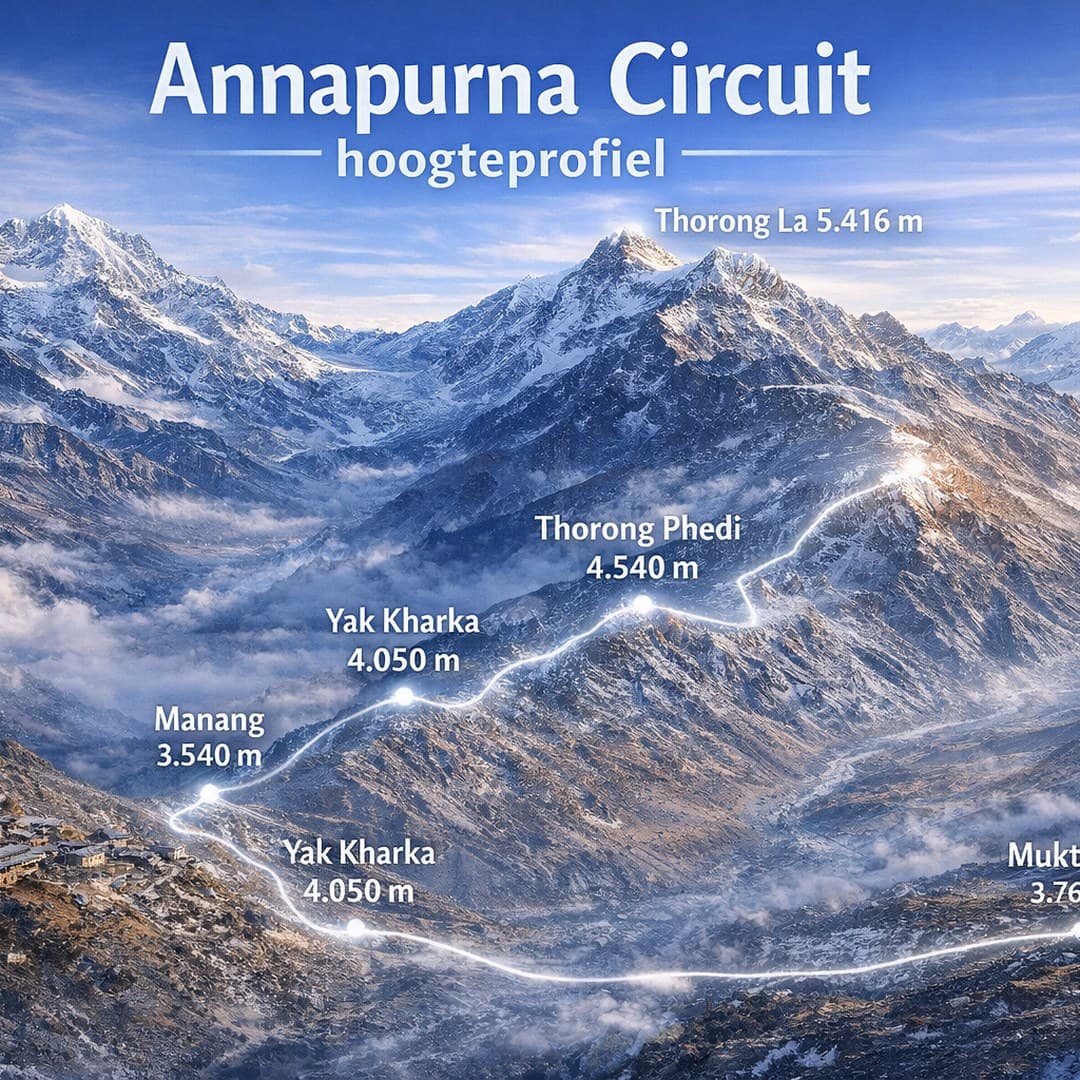
Those who want to tackle the Annapurna Circuit properly need to understand two things above all: the altitude profile and the pace at which your body can adapt. The route often feels logically constructed, but the tipping point is high. From Manang, you already sleep around 3,540 metres and then you slide on in short order to Yak Kharka, Thorong Phedi and finally Thorong La at 5,416 metres. Those who take this too lightly increase the chances of headaches, poor sleep, performance loss and, at worst, serious altitude problems.
The good news is that the Annapurna Circuit is precisely another trek that can be planned well. With a smart rest day in Manang, a controlled build-up and honest monitoring of symptoms, the route is perfectly feasible for many fit trekkers. Those who want to delve extra deeply into acclimatising at home for mountain expeditions, moreover, often leaves with more margin.
Short answer
The Annapurna Circuit altitude profile rises in a classic build-up from about 1,700 metres at Tal to 5,416 metres at Thorong La, with the main acclimatisation phase between Manang, Yak Kharka and Thorong Phedi. The crucial choice is not how hard you can hike, but how sensibly you build up your sleeping altitude.
Conclusion: On the Annapurna Circuit, the acclimatisation day in Manang is usually not a luxury, but a key decision.
Nuance: The route is relatively gradual up to Manang, but quickly becomes more serious above that.
Practical hook: Assess your schedule by sleep level, not by walking hours alone.
The Annapurna Circuit altitude profile at a glance
Today, the exact route varies more often than before. Some trekkers start lower, others take a jeep up to Tal, Dharapani or even higher. Still, the physiological logic remains the same: below about 3,000 metres you mainly build up general load, but from about 3,000 to 3,500 metres acclimatisation becomes really decisive. Those wanting more background on the relationship between altitude and oxygen can also check out our height to oxygen table view.
| Stage | Sleeping height | Difference from previous berth | Practical significance |
|---|---|---|---|
| Tal | 1.700 m | Starting point | Physiologically still relatively forgiving. |
| Dharapani | 1.860 m | +160 m | Little real altitude load yet, but start of rhythm. |
| Chame | 2.670 m | +810 m | First day when some tractors start feeling the altitude. |
| Upper Pisang | 3.300 m | +630 m | This is where acclimatisation really starts to count. |
| Manang | 3.540 m | +240 m | Best place for a mandatory rest and observation day. |
| Yak Kharka | 4.050 m | +510 m | Border area where sleep, appetite and headaches often change. |
| Thorong Phedi | 4.540 m | +490 m | Last sleepover before the pass. Not the day to gamble. |
| Thorong La | 5.416 m | No berth | Highest point and heaviest hypoxic stimulus of the entire route. |
| Muktinath | 3.760 m | After the pass descend | The descent makes this day physically demanding but medically more logical. |
Difference: starting point
Significance: physiologically still relatively forgiving.
Difference: +160 m
Significance: little real altitude load yet, but start of rhythm.
Difference: +810 m
Significance: first day when some tractors are starting to feel the altitude.
Difference: +630 m
Significance: this is where acclimatisation really starts to count.
Difference: +240 m
Significance: best place for a mandatory rest and observation day.
Difference: +510 m
Significance: borderline frequent changes in sleep, appetite and headaches.
Difference: +490 m
Significance: last sleeping place before the pass. Not the day to gamble.
Difference: no berth
Significance: highest point and heaviest hypoxic stimulus of the entire route.
Difference: descend after the pass
Significance: physically demanding, but medically logical after crossing.
This profile immediately explains why the trek feels surprisingly tough for some. Not because the altimeters per day are absurd, but because above Manang you spend several nights at a serious sleeping altitude and then go in one push to a pass above 5,400 metres.
Why exactly Manang is the key place
Many routes have a rest day. On the Annapurna Circuit, Manang is where that rest day really makes a difference. You sleep there around 3,540 metres, so high enough to already experience considerable hypoxic stress, but still low enough that with an extra night you often recover noticeably. At the same time, it is the ideal base for a short dayhike higher up and then sleeping at the same altitude again.
This fits perfectly with the well-known principle of climb high, sleep low. So an acclimatisation day in Manang does not mean sitting still. On the contrary. The best interpretation is often a quiet hike to a higher point, for instance towards Gangapurna or Ice Lake, after which you return to sleep in Manang again. By contrast, those who skip Manang or only stay for a very short time often make the jump to the zone above 4,000 metres more aggressive than is wise.
⚠️ Reality check
An acclimatisation day you skip feels on paper like saving time. In practice, you often pay it back with poorer sleep, loss of appetite, lower running quality and more risk of dropping out around Thorong Phedi or on the pass.
How to smartly build your acclimatisation on the Annapurna Circuit
The golden rule remains simple: watch your sleeping altitude. Above 3,000 metres, you don't normally want to raise it too quickly. The CDC recommends that above 3,000 metres, you should preferably increase your sleeping altitude by no more than about 500 metres per day and build in extra acclimatisation time for every additional 1,000 metres of ascent. That makes the build-up Pisang - Manang - rest day - Yak Kharka - Thorong Phedi logical, as long as you keep up honest monitoring along the way.
Practical protocol
- To Manang: walk economically and don't force it, even if you feel strong.
- In Manang: Always plan an extra night and do a short acclimatisation hike.
- To Yak Kharka: consciously keep the day short and calm.
- To Thorong Phedi: eat, drink and recover actively. This is preparation, not a hero day.
- Pass day: Start early, keep an even pace and descend purposefully after the pass.
For many trekkers, this is also the time to realise again that fitness and acclimatisation are not the same thing. A strong runner or cyclist can feel great conditionally but still get altitude sickness. Those who are more susceptible to altitude sickness would do well to also learn about preventing altitude sickness and in the question of what a normal acclimatisation rate per 1,000 metres actually means.
The most common misunderstandings
What often goes wrong
- “I am fit, so height is not too bad.”
Fitness helps on the trail, but does not protect against altitude sickness. - “A rest day is only necessary when I have complaints.”
In particular, a planned day of rest reduces the chances of complaints escalating later. - “The higher I sleep for the pass, the better.”
For some trekkers, High Camp works, but for sensitive or tired trekkers, sleeping lower is often smarter. - “A little headache is just part of it,” he says.”
Mild symptoms can be normal, but a marked deterioration is never something to ignore.
An additional nuance is High Camp. Some trekkers choose to sleep even higher above Thorong Phedi to make the pass day shorter. This may seem logistically appealing, but physiologically it is not automatically better. You gain time on the climb, but you shift your sleep to thinner air, often on a night when your sleep quality is under pressure anyway. For many people, Thorong Phedi is therefore the safer choice, especially if headaches, poor appetite or restless sleep are already present.
This is how you monitor this lens
A good acclimatisation plan is not just an itinerary. It is also an observation plan. Therefore, use the same four lenses daily: symptoms, sleep, recovery and trend. If you bring a saturation gauge, it is best to use it as a trend instrument and not as an absolute truth. At altitude, oxygen levels drop even in healthy travellers and, especially during sleep, the load can increase markedly.
Daily checklist
- SpO2 trend: look at the line over several mornings, not one single measurement.
- Sleep quality: Did you wake up extremely often, feel stuffy or sleep remarkably shallow?
- Recovery: does your energy sink quickly after breakfast or do you feel abnormally empty after a short exercise?
- Symptoms: headache, nausea, loss of appetite, dizziness, loss of coordination or increasing shortness of breath.
The most useful decision rule is simple. Mild, stable symptoms may fit with acclimatisation. Clearly worsening complaints at the same altitude are an alarm signal. And complaints that get worse as you go higher are a reason not to ascend further. Those who want to understand more about what a saturation reading does and does not say can also read our explanation of oxygen saturation at altitude read.
Decision block
- Continue: if symptoms remain mild, your appetite is reasonable and your recovery does not deteriorate from day to day.
- Stay at the same height: if headache, sleep and general feeling are questionable but not yet clearly escalating.
- Daai af: if your symptoms worsen at rest, you become short of breath at rest, confused or lose coordination.
When an abbreviated schedule becomes too aggressive
The Annapurna Circuit is often walked shorter these days than it used to be. This makes sense because of roads, jeeps and time constraints. But that is precisely where the pitfall lies. A logistically shorter schedule can be medically much more aggressive. For example, those who skip large stretches and start late at altitude can suddenly find themselves with too few nights in the intermediate zone. Then a route that looks feasible on paper becomes much less forgiving in practice.
For a trek to over 5,400 metres, this is an important distinction. It is not the total trip duration that determines whether you acclimatise well, but mainly how many meaningful nights your body gets between about 3,000 and 4,500 metres. This is why overly tight schedules are often not “efficient” but simply marginless.
Practical tips for fitting day
- Start early. Not to race, but to move steadily and be over the pass well before noon.
- Eat early and easily digestible. Appetite is often less at altitude, but an empty tank never helps.
- Walk at a talking pace. The fitting day is a rhythm assignment, not a fitness test.
- Keep you warm without sweating. Overheating in the climb and cooling at the crest cost unnecessary energy.
- Descend to lower sleep. The gain of the day is not only in the pass, but also in the descent to a lower sleeping place.
Want to start the Annapurna Circuit with more margin?
For a trek with a pass above 5,400 metres, a pre-planned pre-acclimatisation route can give a lot of peace of mind. This will make your preparation more controlled, more measurable and less dependent on luck on the route.
Conclusion
The Annapurna Circuit altitude profile is treacherous not because it is extremely illogical, but rather because it feels manageable for a long time and then becomes very serious in a short time. Until Manang, you build up relatively gradually. Then comes the real test: how do you react to sleeping above 3,500 metres, how well do you recover in Manang and how much margin do you take towards Yak Kharka and Thorong Phedi?
Those who take that process seriously make the Annapurna Circuit not a lottery but a plan. And that is exactly how best to approach this trek: not as a race against the clock, but as a cleverly constructed acclimatisation story with Thorong La as its logical endpoint.
❓ Mini-FAQ
What is the maximum altitude of the Annapurna Circuit?
The highest point is Thorong La at 5,416 metres.
Is a rest day in Manang really necessary?
For most trekkers, yes. Especially if you continue to Thorong Phedi via Yak Kharka afterwards.
Is High Camp always better than Thorong Phedi?
No. It makes the summit day shorter, but the night higher and often more restless.
Can you be fit and still get altitude sickness?
Yes. Good fitness does not automatically protect against altitude sickness.
What should you pay particular attention to?
On sleep level, trend in complaints, sleep quality and honest day-to-day recovery.