Altitude training and asthma: prohibited or beneficial for asthmatics?
Published 15 March 2026 · 9 min read
Altitude training and asthma at first glance does not seem like a good combination. Less oxygen, faster breathing and increased strain on the lungs can actually trigger symptoms. This is why many asthmatics wonder whether exercising at altitude or sleeping in an altitude tent is safe.
Yet the answer is not so simple. In practice, it appears that controlled exposure to hypoxia is actually well tolerated in some people with asthma. In some cases, it can even lead to better exercise tolerance, stronger breathing muscles and fewer symptoms during sports.
The difference is mainly in the way the altitude is built up. Rapid ascents in the mountains can cause problems, while a gradual build-up with an altitude tent is often more controllable. It is therefore important to understand how the body reacts to oxygen deprivation and how to apply it safely.
First, read how altitude training works To understand what happens physiologically in hypoxia.
⚡ Short answer: can altitude training with asthma?
- Asthma is not an absolute contraindication for altitude training
- In stable asthma, hypoxia is often well tolerated
- Overexposure can trigger symptoms
- Controlled build-up is essential
- Monitoring of SpO2 and symptoms is important
- A height tent is often safer than real height
The reaction to altitude training is always individual. Therefore, a gentle build-up and good monitoring is necessary.
😮 Why asthmatics often hesitate about height
People with asthma have often been taught to be cautious of anything that might affect breathing. Less oxygen, cold air or strenuous exercise can trigger symptoms. This logically creates doubts about exercising at altitude.
Frequently asked questions are:
- can i go to the mountains with asthma?
- is a high altitude tent safe?
- can hypoxia trigger a seizure?
- is my lung function getting worse?
- can altitude training actually help?
The answer depends on several factors, such as the severity of the asthma, the stability of the symptoms and the rate of elevation.
It is therefore important to approach altitude training in asthma differently from healthy athletes.
🫁 What happens to your lungs during altitude training?
In altitude training, the oxygen percentage is reduced while the air pressure remains the same. This is called normobaric hypoxia. The body responds by increasing its breathing rate, heart rate and adjusting its oxygen transport capacity.
In people with asthma, this can go two ways. On the one hand, higher ventilation can irritate the airways. On the other hand, controlled hypoxia can train the respiratory system and improve load capacity. So the practice is less black and white than many people think.
Possible reactions during altitude training are:
- more ventilation and increased breathability
- more awareness of breathing
- faster fatigue in the first days
- better adaptation with gradual build-up
- improvement of exercise tolerance in some athletes
The reaction varies from person to person. Therefore, observation and monitoring are more important than assumptions beforehand.
📊 Altitude, oxygen and burden on lungs
| Simulated altitude | Oxygen % | Effect on breathing | Risk in asthma |
|---|---|---|---|
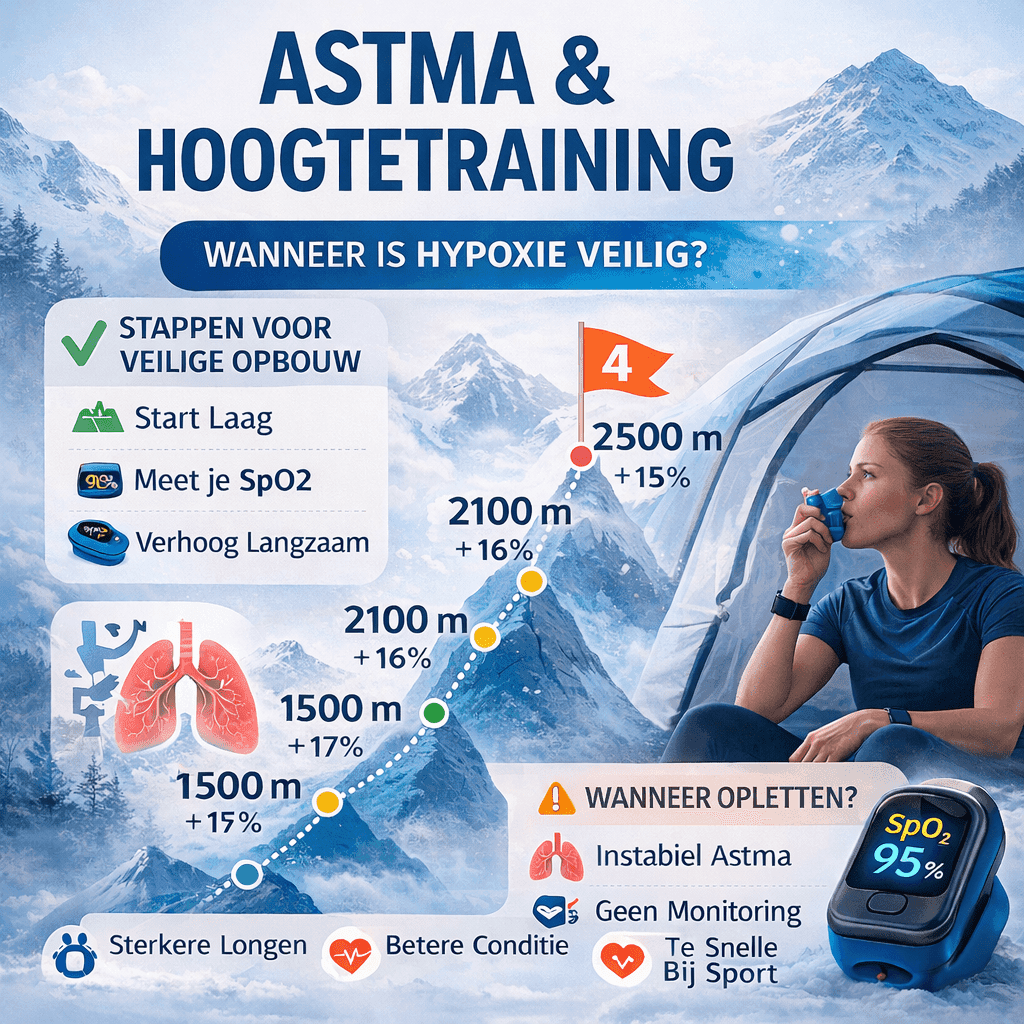
| 1500 m | 17% | slightly increased breathing | low |
| 2000 m | 16% | clearly faster breathing | low to moderate |
| 2500 m | 15% | stronger breathing impulse | moderate |
| 3000 m | 14% | marked hypoxia | individual |
| 3500 m+ | 13% or lower | strong ventilation | only controlled |
You can find more explanation of oxygen levels in the height to oxygen table.
💡 Why altitude training can sometimes actually be beneficial in asthma
In sports medicine, hypoxic training is sometimes used to improve respiratory control. The aim is not to provoke symptoms, but to get the body used to a different oxygen load in small steps.
Possible benefits include:
- stronger breathing muscles
- better ventilation control
- improved exercise tolerance
- better oxygen uptake during training
- more confidence on effort
Even at true altitude, some asthmatics report fewer symptoms. This may be due to lower exposure to pollen, fewer allergens and sometimes cleaner air. This is not always true, but it does show that altitude is not automatically a negative for everyone with asthma.
⚠️ When should you be careful with altitude training in asthma?
Altitude training is not immediately suitable for every asthmatic. Extra caution is needed when symptoms are not stable or when basic lung function is already limited.
Take extra care with:
- unstable asthma
- frequent attacks
- recent use of prednisone
- low saturation at sea level
- obvious complaints on mild exertion
- nocturnal tightness
In those situations, it is wise to seek medical advice before starting hypoxic training.
🫁 Different types of asthma respond differently to altitude training
Not every asthmatic reacts the same to hypoxia. The safety of altitude training depends heavily on the type of asthma and how well the symptoms are controlled.
| Type of asthma | Response to height | Opinion |
|---|---|---|
| Mild stable asthma | often well tolerated | gradual increase |
| Exercise asthma | sometimes better at height | monitoring in training |
| Allergic asthma | often fewer complaints at height | mostly safe |
| Unstable asthma | higher chance of complaints | only under supervision |
| Severe asthma | unpredictable | medical advice only |
Important: it is not the diagnosis alone that determines whether altitude training is possible, but more importantly the stability of the symptoms and the reaction to the build-up.
🏔️ Real height vs height tent in asthma
For asthmatics, there is a big difference between real altitude in the mountains and a simulated altitude in an altitude tent.
| Factor | Bergen | Altitude tent |
|---|---|---|
| Air pressure | lower | normal |
| Oxygen | lower | lower |
| Check | limited | high |
| Reverse gear | hardly possible | directly possible |
| Safety | as the case may be | high when built correctly |
In an altitude tent, only the oxygen percentage is reduced. The air pressure remains the same. This is called normobaric hypoxia. As a result, the strain on the airways is often more controllable than at true altitude.
Also read the complete guide to using an altitude tent.
Especially for asthmatics, that difference is important. In a tent, you can build up slowly, switch back when necessary and monitor how the body reacts much better.
📚 What does research say about asthma and hypoxia?
In sports medicine, hypoxic training has been used for years in athletes with respiratory problems. Research and practical experience show that controlled exposure to hypoxia can lead to better ventilation control, stronger breathing muscles and improved exercise tolerance in a proportion of users.
In addition, when staying at altitude, asthmatics are sometimes seen to experience fewer symptoms due to:
- dry air
- less pollen
- less air pollution
- lower allergen load
This does not mean that altitude is always safe. However, it does show that hypoxia is not automatically bad for people with asthma. The mode of exposure remains decisive.
✅ Decision check: can I do altitude training with asthma?
Use the checklist below as a rough guideline before you start:
- asthma is stable
- no attack in the last 4 weeks
- medication is properly set
- normal saturation at sea level
- no obvious complaints on mild exertion
- no nocturnal tightness
- there is no medical objection
If several points do not add up, it is wise to consult your doctor or sports doctor first. With stable asthma, controlled altitude training is usually possible.
📈 Practical guideline for safe assembly
In asthmatics, a slower build-up is wise than in healthy athletes. The aim is not to go high as fast as possible, but to see how the body adapts step by step.
| Week | Height | Target |
|---|---|---|
| 1 | 1500 m | get used |
| 2 | 1800 m | mild hypoxia |
| 3 | 2000 m | modification |
| 4 | 2200 m | training effect |
| 5+ | 2500 m | Building up individually |
Important rules here are:
- do not raise in case of complaints
- track the SpO2 trend
- check sleep quality
- do not force training
- stay at least a few nights per step
For athletes, you can also sleep high train low be interesting, provided the load is dosed properly.
📊 This is how you monitor this lens
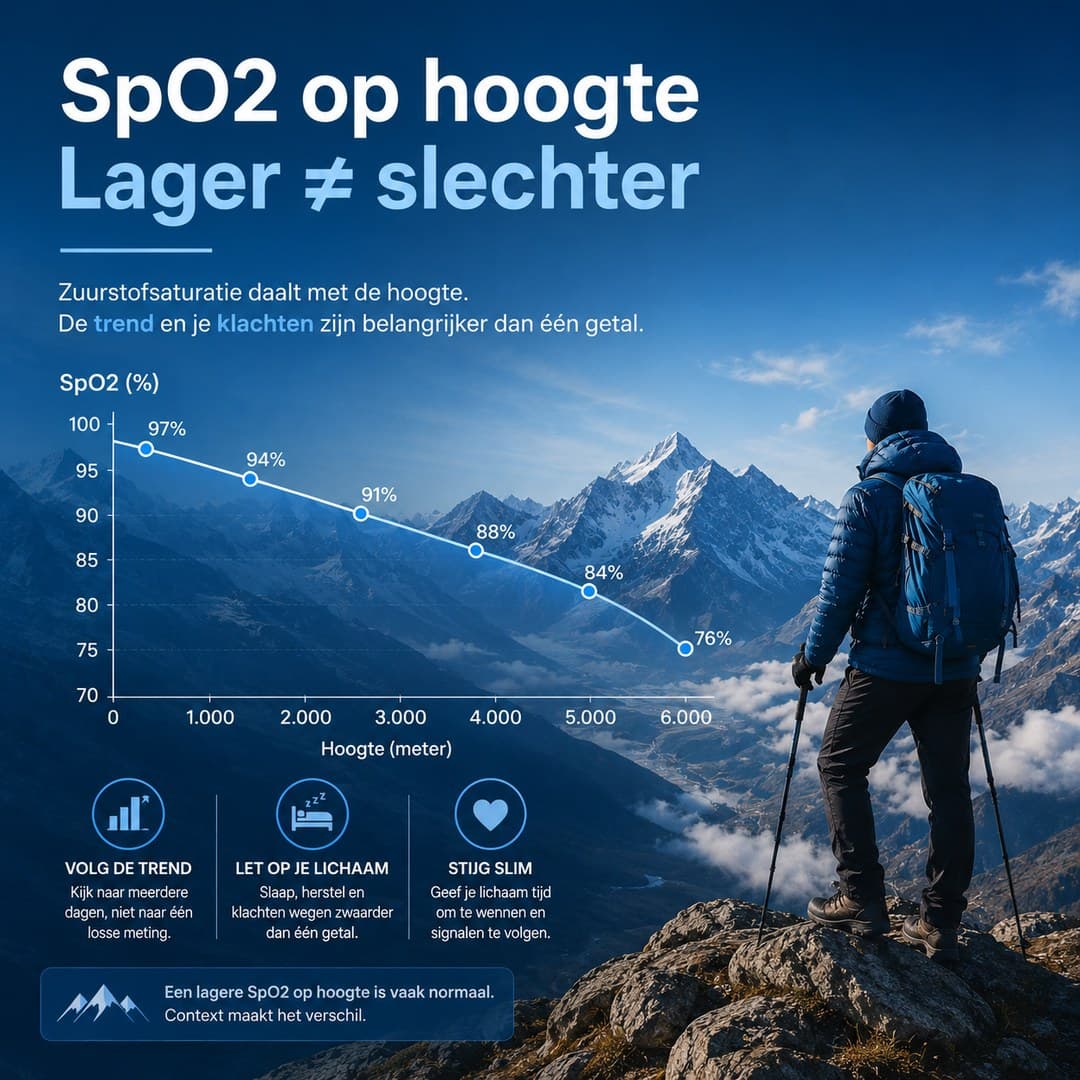
In asthma, monitoring is especially important. One single measurement says little. It is precisely the trend over several days that gives insight into how well the body adapts.
Note these points:
- SpO2 trend in the morning
- nocturnal complaints
- coughing or wheezing
- recovery after training
- resting heart rate
- sleep quality
- general fatigue
Guideline for good adaptation:
- SpO2 drops gradually, not suddenly
- no increase in respiratory symptoms
- sleep remains acceptable
- recovery remains good
- training remains feasible
You can read more about saturation here: oxygen saturation at altitude.
⚠️ Signals that you should stop or downgrade
The response to hypoxia is always individual. Therefore, it is important to recognise clear stopping or lowering signals.
- increase in squeaking
- nocturnal tightness
- worse sleep
- sharp drop in SpO2 trend
- worse recovery
- unusual fatigue
- increase in medication needs
For these signs, it is wise to lower the altitude and only proceed once the symptoms have fully normalised.
💡 Why controlled hypoxia often works better than rapid altitude
Many problems in asthmatics arise from too rapid exposure to altitude. A quick trip to the mountains gives little room to calmly test how the airways react. As a result, altitude often feels riskier than it really needs to be.
With an altitude tent, the load can be controlled much better:
- step by step higher
- downshift immediately
- monitoring possible
- no air pressure change
- acclimatising safely at home
This allows the body to adapt gradually. This often makes controlled hypoxia safer than a rapid climb to altitude.
📊 Asthma and altitude: what happens at different heights?
| Height | Oxygen | Effect in asthma | Opinion |
|---|---|---|---|
| 1500 m | ±17% | usually no complaints | safe start |
| 2000 m | ±16% | slight intake of breath | monitors |
| 2500 m | ±15% | more ventilation needed | gradually |
| 3000 m | ±14% | individual response | only controlled |
| 3500 m+ | ±13% | severe hypoxia | experienced alone or accompanied |
Most asthmatics tolerate mild hypoxia well, as long as the build-up is slow and there is no increase in symptoms.
✅ Safety check for altitude training with asthma
Use this quick safety check before you start:
- asthma is stable
- no attack in the last month
- medication is properly set
- normal saturation at sea level
- no complaints with light exertion
- no nocturnal tightness
- doctor has no objection
If several points do not add up, it is wise to seek additional advice first or not start yet.
📊 Decision rules during altitude training
- SpO2 drops gradually, not suddenly
- there is no increase in wheezing or coughing
- sleep remains normal or acceptable
- training remains possible
- recovery remains good
If symptoms increase, the height should be lowered. Not forcing is more important here than wanting to make quick progression.
❓ FAQ - Altitude training for asthma
Is altitude training dangerous for asthmatics?
Not necessarily. With stable asthma and a gradual build-up, hypoxia is often well tolerated. The risk increases especially with unstable asthma or overexposure.
Can a high altitude tent trigger an asthma attack?
This can happen when building up too quickly or when the airways are already irritated. With a gentle build-up and good monitoring, that chance is usually small.
Is training at altitude good for the lungs?
In some people, controlled hypoxia can strengthen respiratory muscles and improve exercise tolerance. That effect does vary from person to person.
Is real height heavier than a height tent?
Yes. In the mountains, the air pressure is lower. In an altitude tent, the air pressure remains normal and only the oxygen percentage is adjusted. Therefore, an altitude tent is often more controllable.
Should I measure my saturation when altitude training?
Yes. The trend of SpO2 is an important indicator for adjustment. A single measurement is less valuable than a series of measurements over several days.
Can I go to the mountains with asthma?
It is often possible, but proper preparation and acclimatisation are important. For some people, building up at home beforehand is a wise move.
When should I stop altitude training?
Stop or reduce when increased wheezing, nocturnal tightness, worse recovery or a marked deterioration in SpO2 trend occurs.
💡 Summary
Altitude training and asthma are not mutually exclusive. In a controlled environment, hypoxia can be safe and sometimes even give fitness and respiratory benefits. The main difference with healthy athletes is that the build-up needs to be slower and monitoring is essential.
Especially with stable asthma, an altitude tent can be a useful tool because you can precisely dose the load. Real altitude is less controllable. Therefore, gradually building up at home is often a safer starting point than seeking immediate exposure in the mountains.
With proper preparation, gentle build-up and objective monitoring, altitude training can also be used responsibly for asthmatics.