Altitude training and hormones: what changes in hormone levels?
Published 14 March 2026 · 11 min read
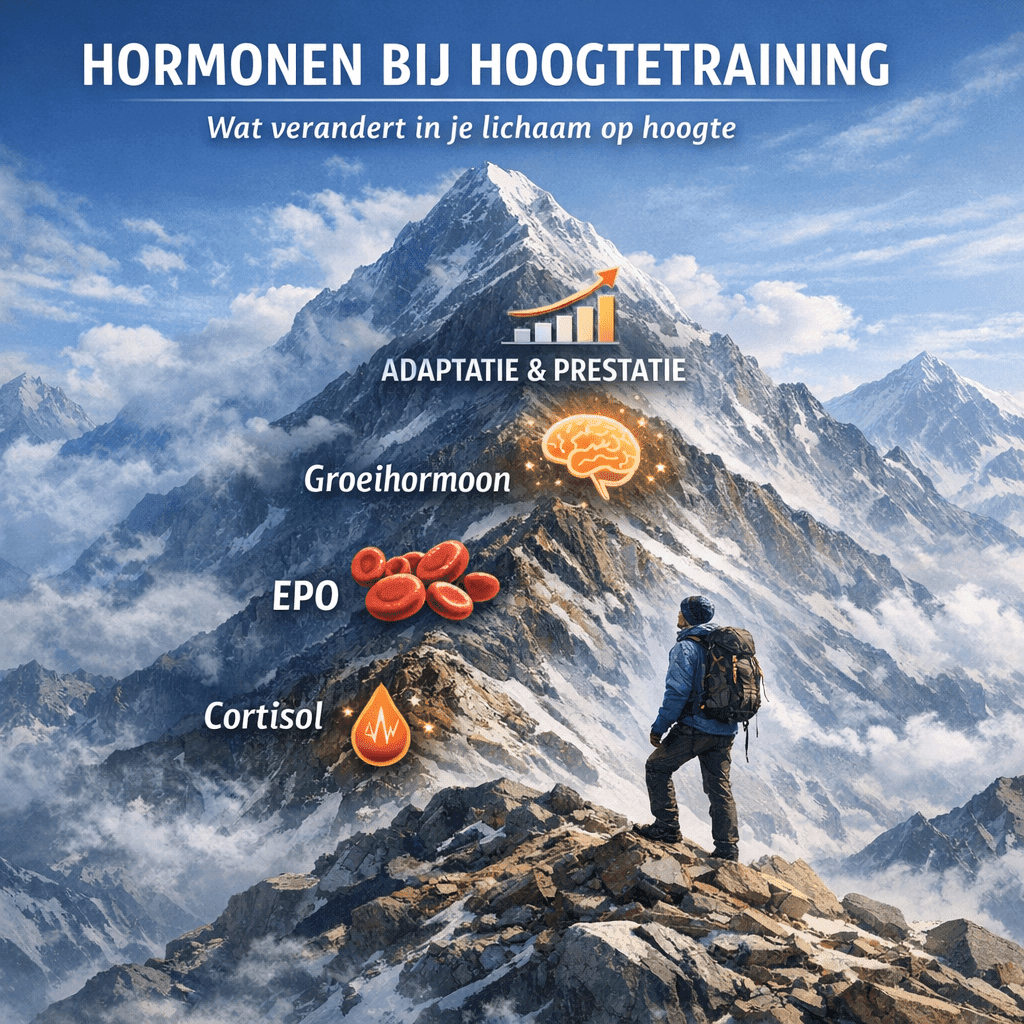
Altitude training and hormones are closely linked. As soon as your body is exposed to less oxygen, not only your breathing and heart rate react, but also your entire hormone system. In particular, hormones such as EPO, cortisol, testosterone and growth hormone change during high altitude training. This hormonal response is one of the main reasons why training or sleeping at altitude can lead to better performance, faster adaptation and increased endurance.
Many athletes think that altitude training only affects red blood cells. In reality, the effect is much broader. The body adapts via the endocrine system to better cope with oxygen deprivation, stress and recovery. These hormonal changes largely determine whether altitude training is successful or actually leads to overtraining.
In this article, you will read which hormones change during altitude training, why this happens, and how you can use these responses to improve performance without putting too much strain on the body.
📌 The essentials in 30 seconds
- Altitude training activates multiple hormones simultaneously
- EPO rises to make more red blood cells
- Cortisol rises temporarily due to stress trigger
- Testosterone may drop when overworked
- Growth hormone often rises during sleep at altitude
- Thyroid and metabolism also change
- Proper construction prevents hormonal disruption
🧠 Why altitude affects hormones
During altitude training, the body receives less oxygen. This is called hypoxia. The body tries to compensate for this shortage by activating several systems simultaneously. This happens not only through breathing and heart rate, but also through hormones.
The hormonal system controls, among other things:
- blood production
- energy consumption
- stress reaction
- recovery processes
- muscle building
- sleep
- metabolism
That is why altitude training not just a training stimulus, but a complete physiological adaptation. Your body is trying to use oxygen, energy and recovery more efficiently. This also explains why some athletes feel a bit flat the first few days, but come out of a good altitude training stronger afterwards.
An important point is that hormones never work in isolation. A rise in EPO is nice, but if cortisol rises too much at the same time and sleep quality deteriorates, the overall effect becomes less favourable. It is precisely this correlation that determines whether high training helps you progress.
📊 What hormones change during altitude training
| Hormone | Change | Impact |
|---|---|---|
| EPO | rises | more red blood cells |
| Cortisol | rises temporarily | stress adaptation |
| Testosterone | can go down | recovery affected |
| Growth hormone | often rises | recovery and adaptation |
| Thyroid hormones | change | metabolism |
| Insulin sensitivity | often improves | energy use |
Not every athlete's response is exactly the same. The hormonal response depends on training level, sleep, nutrition, iron status, duration of exposure and the chosen altitude. Yet, broadly speaking, you always see the same pattern: first a stress response, then adaptation, and then with proper planning a phase where performance can improve.
🩸 EPO: the most important hormone in altitude training
EPO is the hormone that responds most strongly to altitude. As soon as the body senses that less oxygen is available, the kidneys release more EPO. This stimulates the production of red blood cells, allowing the body to transport oxygen better.
| Simulation height | EPA reaction | Physiological effect |
|---|---|---|
| 1500 m | light | initial adaptation |
| 2000 m | clearly | blood production starts |
| 2500 m | strong | performance improvement possible |
| 3000 m+ | very strong | more stress load |
For many athletes, this is the best-known effect of altitude training. Yet it is good to realise that EPO does not immediately mean that you also perform better immediately. There is time between the hormonal signal and the final performance benefit. After all, the body must first produce new red blood cells and be able to use them functionally.
In addition, EPO only works optimally when the basics are in order. Think sufficient iron, recovery and sleep. Without those conditions, the hormone may rise, but the effect remains more limited.
You can read more explanation here:
how altitude training increases your EPO levels
⚠️ Cortisol: stress hormone often rises initially
Cortisol is the body's main stress hormone. During the first few days at altitude, cortisol almost always rises. This is a normal reaction to a new stimulus. This is because the body sees lack of oxygen as a form of stress, even when you just sleep safely at home in an altitude tent.
This increase helps the body to:
- release energy
- speeding up adaptation
- regulate inflammation
- handle stress
Problems arise mainly when the load becomes too great. So a temporary rise in cortisol is not negative. On the contrary, it is part of adaptation. But when cortisol remains elevated for too long, recovery may slow down and the training response may decrease.
Typical causes of excessive cortisol levels:
- increasing altitude too quickly
- too little sleep
- train too intensely
- too long exposure
- insufficient nutrition
This is why a gradual build-up works better than an aggressive approach. Those who get too high right away often end up with more stress than adaptation.
💪 Testosterone and altitude training
Testosterone is important for muscle recovery, strength, motivation and overall load capacity. With well-planned high-altitude training, testosterone tends to remain stable, but it can drop when overloaded.
This happens especially when:
- height is raised too quickly
- training volume is too high
- recovery is insufficient
- sleep quality becomes poor
A temporary drop need not be a problem, but prolonged suppression can lead to fatigue, reduced training desire and performance loss. You see this especially when athletes want to train both hard and follow an overly aggressive altitude schedule at the same time.
The lesson is simple: altitude training should be an extra incentive, not a double whammy on the system. You want to challenge the body, not deplete it.
🌙 Growth hormone and sleep at altitude
Growth hormone is mainly produced during deep sleep. Since much altitude training occurs during sleep, this hormone plays an important role in adaptation.
With correct construction, one often sees:
- more growth hormone during deep sleep
- faster recovery
- better muscle adaptation
- better oxygen use
This is one of the reasons why sleeping at altitude can be effective. During the day you can then still train qualitatively at low altitude or in normal oxygen conditions, while at night your body receives the hormonal stimulus that encourages adaptation.
You can read more about it here:
🔥 Thyroid and metabolism at altitude
Less well known is that the thyroid gland also responds to altitude. Thyroid hormones regulate the rate of metabolism and help determine how quickly the body consumes energy.
At altitude, one can see:
- change in energy consumption
- more fat burning
- faster adaptation
- temporary fatigue
This explains why some athletes feel slower or emptier the first few days at altitude. The body has to get used to a different balance between oxygen availability and energy production. Once that adjustment kicks in, many athletes actually feel more efficient.
As a result, altitude training can affect not only performance, but also how your body uses fuel during endurance exercise.
🧬 Insulin, energy use and altitude training
Besides EPO and stress hormones, the way the body uses energy during altitude training also changes. Under the influence of hypoxia, the body becomes more efficient at handling glucose and oxygen. This directly affects insulin sensitivity.
As a result, many athletes find that their bodies learn to use energy more economically. This is especially interesting for endurance athletes, as energy efficiency plays a major role in longer efforts.
Exposure to altitude can lead to:
- better insulin sensitivity
- more efficient use of carbohydrates
- more fat burning at rest
- lower glucose consumption at the same effort
However, with too much stress, the opposite can happen. The body can then actually produce more stress hormones, making blood sugar regulation less favourable. So again, you can see how important the right dose is.
🧠 The difference between short and long exposure to altitude
The hormonal response to altitude depends greatly on the duration of exposure. The body reacts differently to a few days than to several weeks of altitude training.
| Duration | Hormone response | Impact |
|---|---|---|
| 1-3 days | cortisol rises | stress reaction |
| 4-7 days | EPA rises | adaptation start |
| 1-2 weeks | growth hormone increases | recovery and adaptation |
| 2-4 weeks | blood production increases | performance improvement |
| too long / too high | testosterone drops | overload |
This explains why well-planned altitude training usually takes several weeks. The first part is all about getting used to and hormonal activation. Only then does the real adaptation begin that can lead to measurable benefit.
⚖️ Hormone balance determines whether altitude training works
Altitude training only works when the body can adapt without too much stress. The result is determined by the balance between:
- modification
- stress
- recovery
- tax
When stress becomes too great, cortisol rises too much and testosterone falls. When the load is properly chosen, EPO rises and recovery remains sufficiently high. This is exactly why professional athletes often choose a controlled build-up where the altitude is slowly increased.
In practice, this means that more is not always better. Sleeping higher, exposing longer or training harder sounds appealing, but does not automatically produce better results. Smarter dosage usually works better than maximum push.
🛌 Why sleeping at altitude gives a strong hormonal boost
A special feature of high-altitude training is that the greatest hormonal adjustment often occurs during sleep. During the night, growth hormone, EPO and recovery processes are activated.
When you sleep at altitude, the body receives a controlled oxygen boost every night. This ensures constant adaptation without necessarily having to train extremely hard during the day. This is exactly why the concept of sleeping at altitude is so interesting for athletes who want to maintain their regular training quality.
This principle is used in:
- live high train low
- sleep high train low
- altitude tent training
- altitude internship
Because the body responds to oxygen deprivation and not to the mountain itself, this adaptation can also be induced at home with an altitude tent.
📊 This is how you monitor hormonal load objectively
You don't measure hormones themselves on a daily basis, but you can indirectly see whether the body responds well to altitude training.
- SpO2 trend during the night
- resting heart rate
- sleep quality
- fatigue
- training sense
- recovery
- hunger and energy
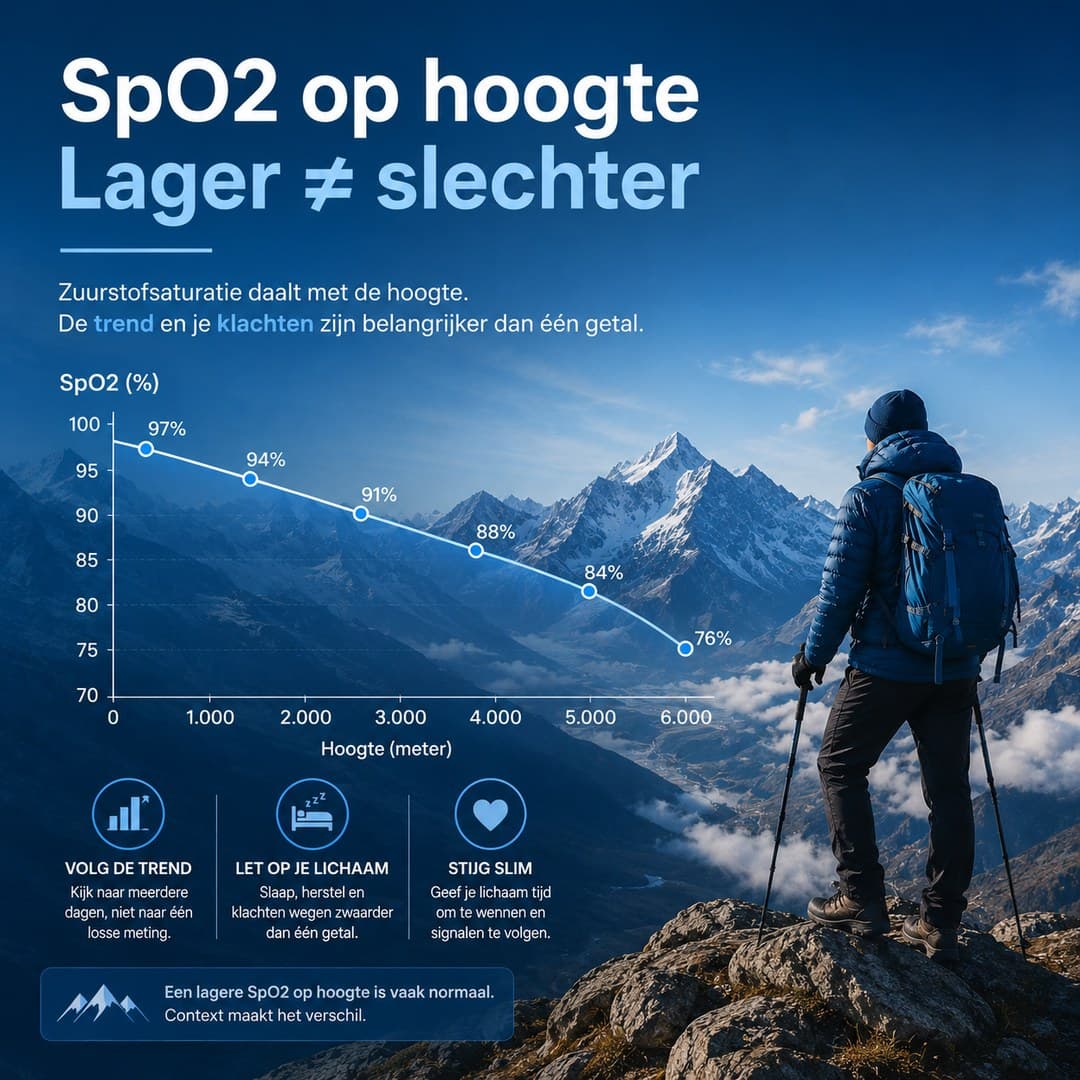
Important: SpO2 should be viewed as a trend, not as an isolated value.
If the SpO2 remains too high, then the stimulus is too low.
If the SpO2 drops too quickly, the load is too great.
If sleep gets worse and the resting heart rate rises for several days, it is often a sign that the hormonal system is under stress.
See also:
iron and nutrition during altitude training
📉 Signs that hormones react negatively to altitude training
When the strain becomes too great, you often see clear signs that the hormonal system is under strain. These are not laboratory values, but practical indicators that are very valuable in everyday life.
- poor sleep
- no appetite
- elevated resting heart rate
- low motivation
- daytime fatigue
- no training progression
- persistently low SpO2 trend
These signals usually mean that the altitude has been increased too quickly or that recovery is insufficient. A temporary step back in simulation altitude often resolves this faster than stubbornly continuing.
❗ Common mistake: too high too soon
The biggest hormonal disruption occurs when athletes go to a high simulation high too quickly.
Possible consequences:
- high cortisol
- low testosterone
- poor sleep
- overtraining
- no EPO rise well utilised
- no performance improvement
A gentle build-up ensures better adaptation and less hormonal stress. This is also why many experienced users start around a modest simulation level and only increase when the body clearly responds well to it.
🏔 Why elite athletes use altitude training for hormonal adaptation
Many people think that altitude training is only used to increase red blood cells. In reality, elite athletes also use it to make the body stronger against stress and to recover more efficiently from tough weeks of training.
Through controlled hypoxia, the body learns:
- using oxygen more economically
- recover faster
- more efficient use of energy
- dealing better with heavy loads
These adaptations are largely controlled by hormones. This is why you see altitude training used not only in marathon runners or cyclists, but also in triathletes and team athletes.
📈 What does this mean for performance?
When altitude training is done properly, hormonal changes can lead to:
- more red blood cells
- better oxygen transport
- faster recovery
- more aerobic capacity
- better training adaptation
- higher loadability
This is why top athletes often use live high train low or sleep in a high altitude tent. The aim is not just to induce a hormonal signal, but to create a complete adaptation that will be noticeable later in training and competition.
📌 Summary: what happens to hormones during altitude training
- EPO rises and stimulates red blood cell production
- Cortisol rises temporarily as normal stress response
- Growth hormone supports recovery and adaptation
- Testosterone may drop when overworked
- Thyroid hormones affect metabolism and energy
- Insulin sensitivity may improve with proper dosing
When the buildup is right, these reactions reinforce each other. When the load is too high, it actually works against it. This is why controlled altitude training is almost always more effective than just training as high as possible.
❓ FAQ
Does testosterone change with altitude training?
Sometimes. When built up properly, it usually remains stable, but when overloaded, it can drop.
Does EPO always rise?
With a sufficiently strong altitude stimulus, EPO usually rises markedly. How strong that effect is depends on altitude, duration and individual response.
Is cortisol bad with high altitude training?
No. A temporary rise is normal and part of adaptation. Only when cortisol stays high for too long can it interfere with recovery and performance.
Does an altitude tent also affect hormones?
Yes. The body reacts to oxygen deprivation, not to the mountain itself. Therefore, even an altitude tent can induce hormonal adaptation.
How long does hormonal adjustment take?
Usually between 1 and 3 weeks for the first clear adjustments. A stronger performance effect often requires a longer trajectory.