Altitude sickness
Published 26 July 2013 · 8 min read
Altitude sickness feels like bad luck to many people: some walk around whistling at 3,500 metres and others get headaches, nausea or suddenly sleep dramatically badly. In reality, altitude sickness is usually not an accident, but a mismatch between ascent rate and adaptability. Those who understand the process and plan smartly significantly reduce the likelihood of complaints.
In this update, you get a complete, practical guide: what altitude sickness is, recognising early signs, assess risks and above all what works to prevent it. You don't need to have prior medical knowledge. You do get clear decision frameworks, so you will know better when to follow through and when to make adjustments.
Important: this article helps you make better choices, but does not replace medical advice. In case of severe symptoms or doubt: choose safety and seek professional help.
What exactly is altitude sickness?
Altitude sickness is a collective term for symptoms caused by exposure to altitude, where your body takes in less oxygen per breath due to the lower air pressure. The oxygen percentage in the air remains roughly the same, but the oxygen pressure drops, reducing the availability of oxygen in your lungs and blood.
There are three classic forms:
- AMS (Acute Mountain Sickness) - the most common form (headache, nausea, poor sleep, dizziness, fatigue).
- HAPE (High Altitude Pulmonary Oedema) - fluid in the lungs, life-threatening.
- HACE (High Altitude Cerebral Edema) - fluid in the brain, life-threatening.
Think of altitude sickness as a spectrum. It often starts mild, but can progress to dangerous situations if ignored or climbed too fast. The main rule remains: if symptoms worsen at the same altitude, stop ascending and descend often.
Want depth with additional FAQ and a traffic light model? Then also read: Preventing altitude sickness: complete guide - depth & frequently asked questions.
From what altitude are you at risk of altitude sickness?
There is no magic number, but there are thresholds that often recur in practice:
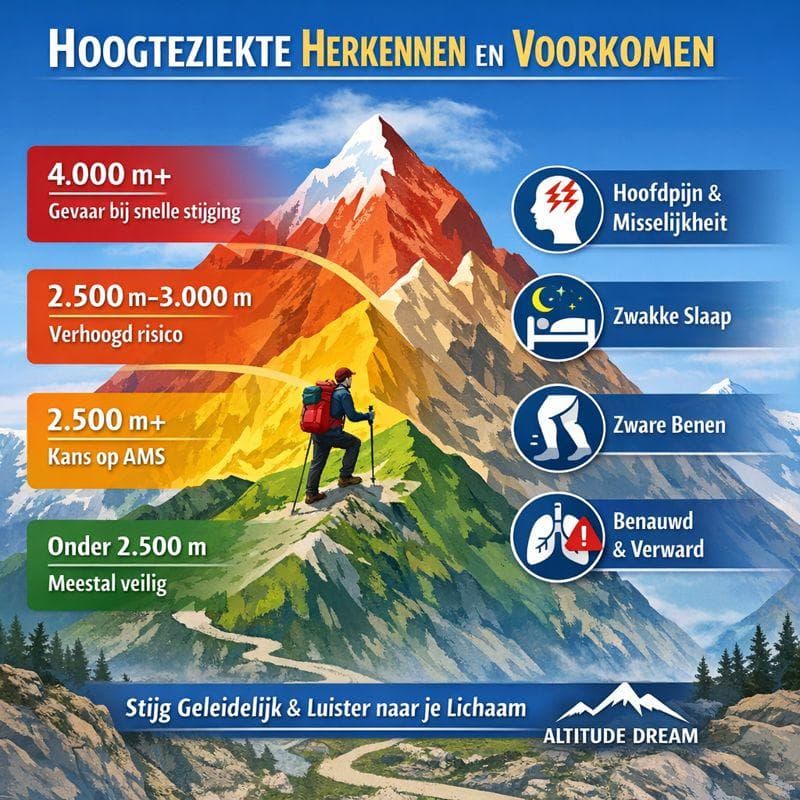
- 2,000 to 2,500 metres - initial impact on sleep and exercise, especially with rapid arrival.
- 2,500 to 3,000 metres - real risk of AMS, especially in people who are sensitive or rapidly rising.
- 3,500 metres and above - risk increases markedly without acclimatisation.
- 4,500 metres and above - ascent rate becomes critical, extra rest days are often needed.
Important: condition does not automatically protect you. Indeed, fit people sometimes go too fast because they feel “strong” on the first day. The bill often comes 12 to 36 hours later.
More on risk factors (ascent rate, sleep height, predisposition): The risk of getting altitude sickness.
Early symptoms: these are the signs you don't want to miss
Altitude sickness rarely announces itself spectacularly. They are often subtle signals that are easily dismissed as “travel day”, “didn't sleep much” or “just got through it”. This is precisely why recognition is so important.
Typical early symptoms in AMS
- Headache (often on getting up, sometimes “hangover-like”).
- Nausea and loss of appetite.
- Poor sleep, restless waking, shallow sleep.
- Dizziness or lightheadedness.
- Unusual fatigue and “heavy legs” on normal exertion.
A handy rule of thumb: headache plus at least one additional symptom after rising in recent days is suspicious for AMS. For more details on recognising and acting: Recognising altitude sickness and how to act.
Not every headache is altitude sickness, but ignoring it is expensive
Headaches can also come from dehydration, heat, stress or alcohol. The problem is that these factors can mimic and amplify altitude symptoms. Therefore, a simple policy often works best: take the symptom seriously and see if it stabilises or worsens if you rest, drink well and don't rise further.
When does it get dangerous? Red flags for HAPE and HACE
HAPE and HACE are rarer than AMS, but they are the reason altitude sickness is a serious issue. You don't need to be a doctor to recognise the alarm signals. You do need to be prepared to act immediately.
Red flags for HAPE (altitude pulmonary oedema)
- Shortness of breath at rest (not just on exertion).
- Coughing that increases, sometimes with frothy or pink sputum.
- Unexplained performance drop and extreme panting on minor exertion.
- Blue lips or nails, cold clammy skin.
Red flags for HACE (altitude cerebral oedema)
- Ataxia (staggering, loss of coordination, “drunk” walking).
- Confusion, drowsiness, strange behaviour.
- Severe headache which is not decreasing.
- Hallucinations or drop in consciousness.
Action on red flags: not rise further, drop as soon as possible and seek medical attention. This is not the time for discussion or schedules. If you are looking for depth from international guidelines: see, for example, the UIAA explanation on prevention and altitude illness: UIAA - How to prevent altitude sickness.
Why some people are more likely to get altitude sickness
It is tempting to point to one cause, but in practice it is usually a combination. These are the biggest “amplifiers”:
- Rising too fast, especially with sleeping height too high.
- Too much effort in the first 24 to 48 hours at altitude.
- Poor sleep or sedatives that suppress breathing.
- Alcohol in the early days.
- Energy deficit (eating too little, especially carbohydrates).
- Previous altitude sickness (the best predictor of recurrence).
Note: “being fit” is no guarantee. Being fit helps you cope with the trek, but it says little about how quickly your body adapts to altitude.
Preventing altitude sickness: what really works?
Prevention revolves around one core principle: give your body time. This is less sexy than gadgets, pills or hero stories, but it is the basis of almost all guidelines.
1) Rise smart: sleep height is more important than day height
You can get quite higher during the day, as long as you sleeping height build up in a controlled way. Much advice boils down to: above about 2,750 to 3,000 metres, increase the sleeping altitude to a limited extent and regularly build in an extra acclimatisation day. This is particularly relevant on intensive treks or fast routes.
Practical tips in compact form can be found here: 8 tips against altitude sickness.
2) First 48 hours: take it easy, even if you feel well
Many people feel fine the first day and then go hard. The problem is that your body does not “feel” the adjustment until later. The gain is often in discipline: first days less pace, less ego.
3) Sleep, food and drink: basics you can't skip
- Sleep: accept that sleep can be restless at first. Avoid sleep aids without medical advice.
- Nutrition: aim for sufficient energy, often carbohydrates work practically and pleasantly at altitude.
- Hydration: not excessive, but consistent. Dehydration and altitude complaints are similar.
4) Monitor signals: combine feel with simple measurements
A simple approach often works best:
- Subjective: headache, nausea, sleep, fatigue. Will it get better, equal or worse?
- Objective: for example SpO2 (oxygen saturation) as an additional data point, not as the only truth.
Use SpO2 mainly as a trend: a decreasing trend in combination with complaints is more valuable than a single single measurement.
Pre-acclimatisation and altitude tent: what's the role?
Not everyone has weeks to ascend gradually. Sometimes the itinerary is fixed, or the first sleeping pitch is immediately relatively high. In such cases, pre-acclimatisation help: get your body used to oxygen-depleted conditions before you leave.
Right away altitude tent you work with normobaric hypoxia: the oxygen percentage in the inhaled air is reduced while the air pressure remains the same. This is no substitute for acclimatisation in the mountains, but it can improve the process controlled, measurable and plannable make. In practice, many mountain travellers find that this is the significantly reduces risk of altitude sickness, though there is never a 100% guarantee.
Want to get a smart start on this? Start at this floor: Using an altitude tent: complete guide to smart preparation.
Want to immediately plan your preparation or request advice? Go to: altitude tent rental or request advice.
What to do in case of complaints at height? A simple traffic light model
Once you have complaints, the goal is not “toughen up”. The goal is: stabilise and prevent escalation. This model helps with quick choices.
Green: mild complaints, stable
- Mild headache or mild sleep disturbance
- No aggravation
- You function normally
Action: slower pace, eat and drink well, no extra altitude gain that day, monitor 12 to 24 hours.
Orange: complaints fit AMS and increasing
- Headache plus nausea, dizziness or marked fatigue
- Worse sleep, less appetite
- Symptoms get worse at the same height
Action: stop rising, plan an extra rest day, reduce effort. If it doesn't improve: drop.
Red: alarm signals for HAPE or HACE
- Chest tightness at rest, increasing cough, extreme weakness
- Ataxia, confusion, drowsiness, change in consciousness
Action: plummet and medical assistance. This is urgent.
More context with symptom summary and risks: Altitude sickness: symptoms, risks and treatment.
Frequently asked questions about altitude sickness
Can you get altitude sickness below 2,500 metres?
It is possible, but less likely. Some people experience sleep and exercise problems earlier, especially with rapid arrivals. Think of it as a warning to take your build-up more seriously.
Does good fitness help against altitude sickness?
Condition helps you cope with the trek, but it does not automatically protect you from altitude sickness. Climbing too fast remains the biggest risk factor.
Is headache at altitude always altitude sickness?
No. Headaches can have multiple causes. The important difference is the combination with other symptoms and the course: does it stabilise with rest and no additional increase, or does it get worse?
How quickly do symptoms disappear when you drop?
In mild AMS, symptoms often improve within hours to a day after descending or resting at lower altitude. In severe symptoms, prompt action is crucial and recovery may take longer.
Can you prevent altitude sickness completely?
You can greatly reduce the risk with smart set-up, rest, monitoring and possibly pre-acclimatisation. There is no such thing as a 100% guarantee, as predisposition and conditions continue to play a role.
Practical next step: make your preparation planable
If you take altitude sickness seriously, your preparation becomes calmer and your trip often more beautiful. Not because you become more “cautious”, but because you make better decisions: you build smarter, recognise signals earlier and make adjustments before things go wrong.
Want to make your preparation concrete? Choose your target altitude and book your route via: https://altitudedream.com/reserveren/.
And want the depth and nuance per situation first? Then start with: Preventing altitude sickness: complete guide - depth & frequently asked questions.