Preventing altitude sickness: salt, moisture and hydration - what does and does not help
Published 11 February 2026 · 5 min read
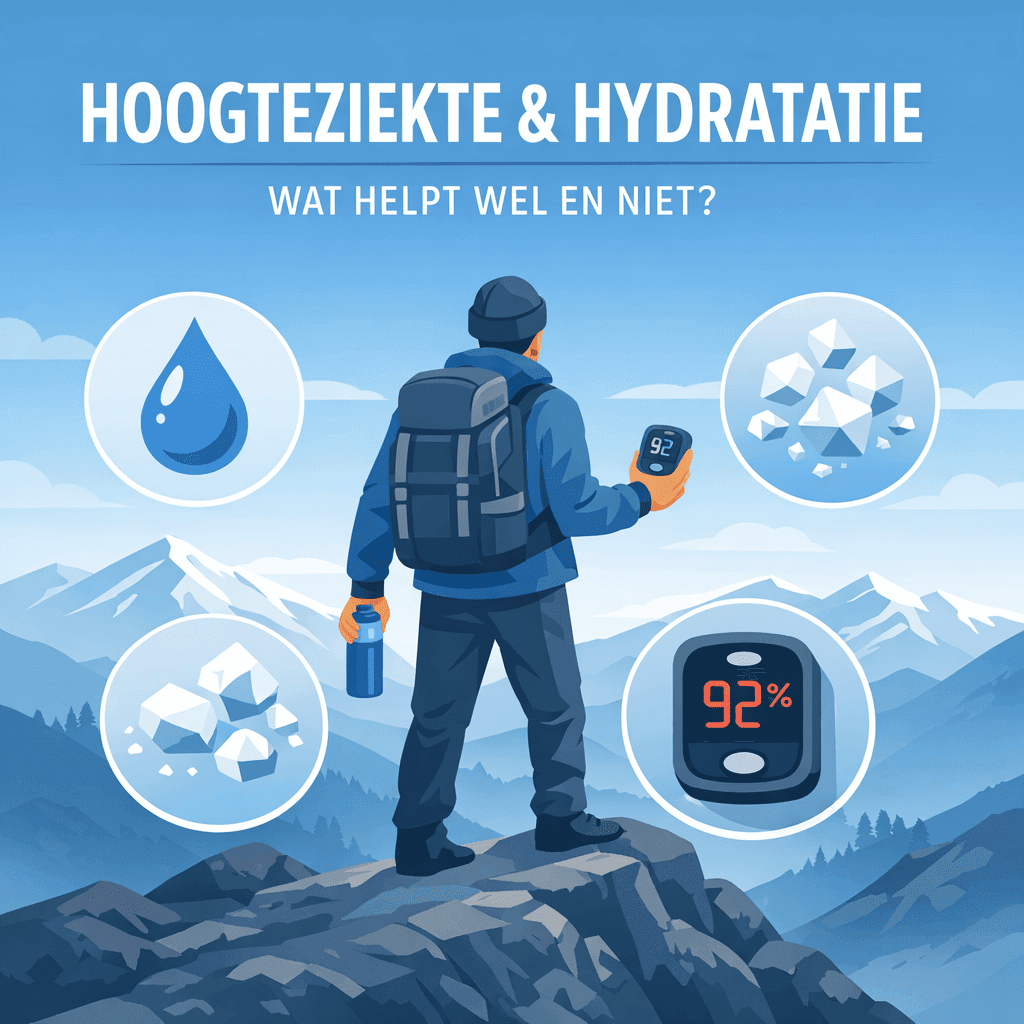
Preventing altitude sickness does not start with extra salt or drinking endless water. Yet many mountain travellers believe that hydration is the key against altitude sickness. In reality, the relationship between hydration, salt and altitude sickness is more nuanced. In this article, you will read what does work, what does not work and how to use hydration smartly within a broader strategy to prevent altitude sickness.
The essentials in 30 seconds
Conclusion: Sufficient drinking supports acclimatisation but does not independently prevent altitude sickness.
Nuance: Overhydration or adding extra salt can actually worsen symptoms.
Practical lead: Monitor your SpO2 trend, sleep quality and symptoms, not just your fluid intake.
Why hydration is often misunderstood
Many people immediately associate headaches at altitude with dehydration. This is understandable: headaches also occur with dehydration. But altitude sickness, as described in our complete guide to preventing altitude sickness, arises primarily from hypoxia - a lack of oxygen - not from fluid deprivation.
The fallacy: “If I drink enough, I won't get altitude sickness”.”
In reality, altitude causes a complex physiological process:
- Accelerated breathing
- Increased fluid loss through breathing
- Changes in fluid distribution in the body
- Hormonal adjustments
Hydration supports these adaptations but does not neutralise hypoxia.
What happens to your moisture balance at altitude?
At altitude, you breathe faster. Every breath contains water vapour. The higher you go, the drier the air becomes. So you imperceptibly lose more moisture through breathing.
At the same time, you often see a slight diuresis in the first few days: you urinate more. This is part of the acclimatisation process. The body tries to increase oxygen transport capacity relatively by reducing plasma volume slightly.
Drinking more compensates for fluid loss, but should not completely block this natural process.
⚠️ Reality check
Drinking more than 4 to 5 litres of water a day for fear of altitude sickness increases the risk of hyponatraemia. This can lead to headache, nausea and confusion - symptoms very similar to altitude sickness. Overhydration actually makes the clinical picture more unclear.
Does extra salt help against altitude sickness?
There is a persistent myth that extra salt reduces the risk of altitude sickness. Scientific evidence for this is lacking. According to guidelines from the UIAA a normal salt pattern is sufficient for healthy individuals.
Extra salt can be useful in specific situations, for example in extreme exercise with a lot of sweating. But adding salt structurally to prevent altitude sickness is not substantiated.
📊 Research shows
The development of acute altitude sickness is related to hypoxic ventilatory response, sleep disturbance and individual susceptibility. Hydration status plays a supporting role but is not a primary predictor of AMS.
So what does help prevent altitude sickness?
Preventing altitude sickness requires a systematic approach. Hydration is just one piece of the puzzle.
- Gradually rise in sleeping height
- Plan rest days above 3,000 metres
- Monitor SpO2 as a trend, not as an isolated measurement
- Conserve energy in the first 72 hours
- Drink on thirst, not out of fear
- Limit alcohol in the acclimatisation phase
Together, these six steps form a robust basic strategy.
This is how you monitor this lens
Assessing hydration by colour of urine alone is insufficient. Combine multiple parameters:
- SpO2 trend: slight decrease in the first few days is normal, then stabilisation. A progressive decline with symptoms requires adjustment.
- Sleep quality: Repeated waking and breathing stops are alarm signals.
- Recovery feeling: persistent fatigue despite rest may indicate inadequate adaptation.
Concrete decision rule: if your SpO2 drops three consecutive mornings AND headaches increase, reduce pace or sleep altitude.
You can find more explanation on interpretation of saturation in our floor on oxygen saturation at altitude.
First 72-hour checklist
The first three days are crucial.
- Drink 2.5 to 3.5 litres spread throughout the day
- Eat easily digestible carbohydrates
- Avoid intense exercise
- Limit alcohol completely
- If possible, sleep slightly lower than maximum daytime height
🧭 In practice
Most symptoms arise not from too little water, but from rising too fast. Optimising hydration without adjusting ascent rate is symptom management.
When to continue, adjust or stop
When to continue
Mild headache responsive to rest, stable SpO2 trend and normal appetite.
When to adapt
Increasing headache, nausea, worse sleep and falling saturation. Reduce pace here or take rest day.
When to stop or descend
Severe headache, ataxia, confusion or shortness of breath at rest. Stopping and descending is then the primary intervention.
Read more about alarm signals in our floor on altitude sickness symptoms and risks.
The role of an altitude tent in prevention
An altitude tent is no substitute for acclimatisation, but it will significantly reduce the risk of altitude sickness. Sleeping in normobaric hypoxia beforehand at home reduces oxygen levels, not air pressure.
Sleep is the primary stimulus. This is where stable adaptation takes place. Stepwise build-up and SpO2-controlled adjustment is essential. The ideal altitude is often chosen around a work zone where morning SpO2 is around 92 per cent, depending on individual response.
You can read more in depth in our guide on acclimatising at home for mountain expeditions.
💡 Did you know?
Many expeditioners who spend 3 to 4 weeks of controlled sleep in an altitude tent beforehand report fewer sleep problems and more stable SpO2 trends upon arrival at altitude.
Decision aid: what do you focus on?
If you focus purely on hydration, you miss the bigger picture. The right question is:
“Does my ascent schedule match my individual adaptation rate?”
Moisture and salt support that process, but do not direct it.
Anyone wanting guidance on interpreting SpO2 trends or setting up a personal pre-acclimatisation plan can always get in touch on a low-key basis via Altitude Dream.
Mini-FAQ
Does drinking more water help against altitude sickness?
No. Sufficient drinking supports recovery, but does not independently prevent altitude sickness.
Should I take extra salt at altitude?
Not standard. Only in cases of exceptionally heavy sweating can extra salt be useful.
Can dehydration make altitude sickness worse?
Yes. Dehydration can intensify symptoms but is not the primary cause.
Is an altitude tent effective?
Yes, if built incrementally and SpO2-controlled. It does not replace acclimatisation.
Conclusion
Hydration is supportive, not a solution in itself. Altitude sickness prevention is all about pace, monitoring and individual response. Those who combine fluid intake with objective measurements and a sensible ascent schedule significantly increase the chances of safe and successful acclimatisation.