Alcohol and altitude: additional risks often underestimated
Published 8 May 2026 · 12 min read
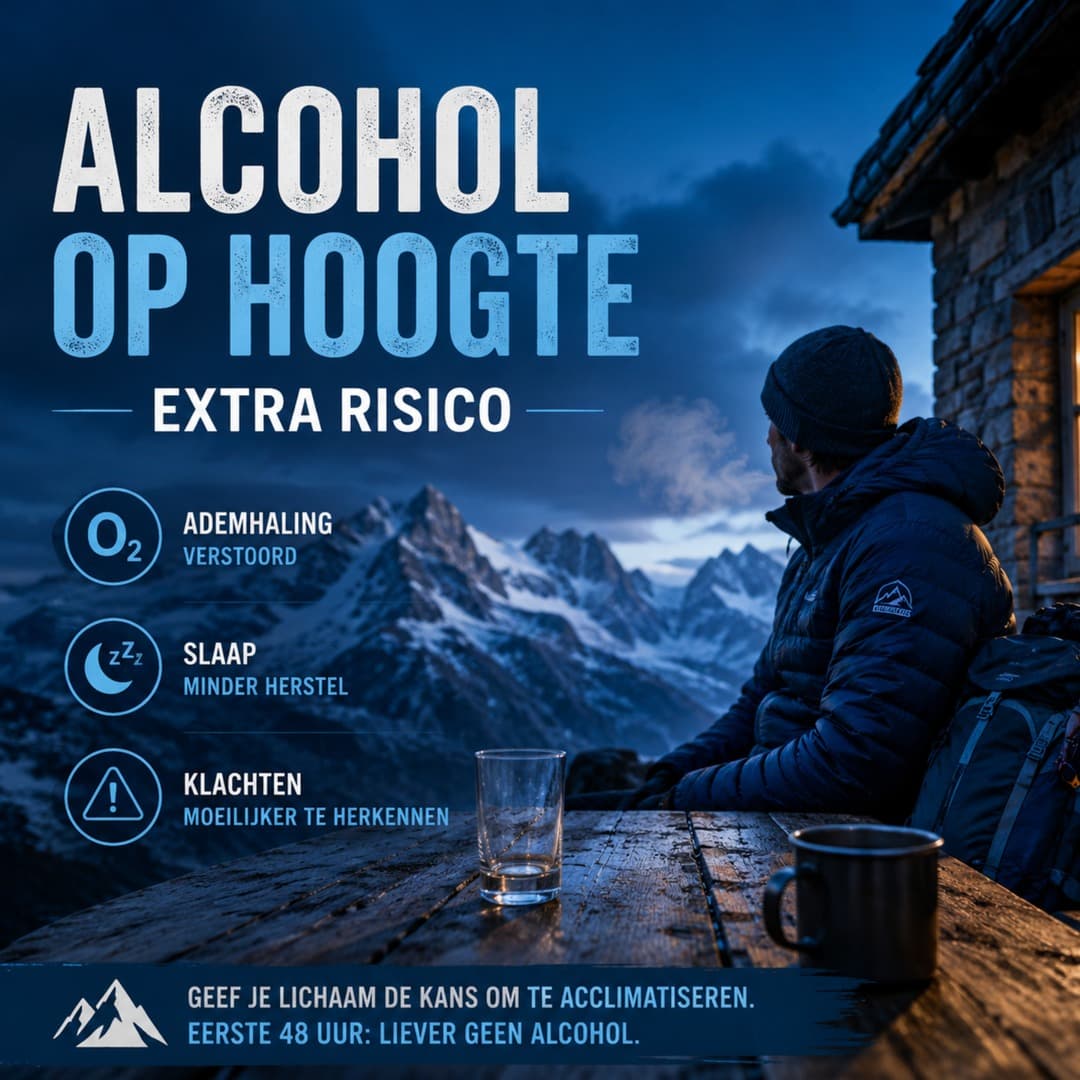
Alcohol and altitude are not a strong combination. Not because one glass is automatically dangerous, but because alcohol disrupts the very processes your body needs at altitude: breathing, sleep, fluid balance, recovery, judgement and recognising early altitude sickness. As a result, a seemingly relaxing drink can have more consequences at altitude than at home at sea level.
The practical conclusion is clear: preferably avoid alcohol in the first 48 hours after arriving at altitude, during rapid ascents and on days when your body is still clearly acclimatising. This certainly applies to trekkers, climbers and athletes sleeping above 2,500 metres or preparing for higher sleeping altitudes. Those at risk of altitude sickness seriously wants to reduce, looks not only at ascent rate and fitness, but also at sleep, hydration and alcohol consumption.
Short answer: Alcohol at altitude especially increases the risk because it can impair sleep quality, breathing, fluid balance and self-assessment. This makes it harder to distinguish symptoms such as headaches, nausea, dizziness and fatigue from incipient altitude sickness.
Conclusion: Alcohol and altitude require restraint, especially in the first 48 hours and around new sleeping heights.
Nuance: the problem is not just alcohol itself, but the sum with hypoxia, cold, exertion, poor sleep and dehydration.
Practical hook: Drink only when you acclimatise stably, sleep well and do not develop any symptoms.
Why alcohol and altitude reinforce each other
At altitude, your body receives less usable oxygen per breath. This is not because the air suddenly contains much less oxygen, but because the air pressure is lower. As a result, oxygen pressure drops and your body has to work harder to take in enough oxygen.
Your body responds by breathing faster and deeper. In addition, your heart rate, fluid balance, sleep and recovery change. This is normal acclimatisation. Alcohol can disrupt this process precisely because it affects breathing, sleep structure and fluid regulation.
Therefore, alcohol and altitude is not just about “can I stand alcohol?”. The better question is: can my body use extra disruption at this time when it already has to adapt to oxygen deprivation?
⚠️ Reality check
A hangover and onset of altitude sickness can be remarkably similar. Headache, fatigue, nausea, dizziness and poor appetite are common to both. As a result, alcohol can cause you to take early warning signs seriously too late.
Alcohol and altitude sickness: the biggest problem is recognition
One of the main risks of alcohol at altitude is not that you get altitude sickness immediately. The bigger problem is that alcohol clouds interpretation. This is especially relevant at symptoms and risks of altitude sickness, because early symptoms often start subtly.
Headache after a long day of travel can be due to lack of fluids. Nausea can be due to food, stress or alcohol. Poor sleep can come from altitude, but also from a glass of wine late at night. At sea level, this is annoying. At altitude, it can affect your decision-making.
Therefore, the rule in the mountains is simple: complaints after alcohol do not count less. Rather, they count more heavily because you cannot be sure which part is due to alcohol and which part to altitude. So when in doubt, you have to act more conservatively.
The main overlap between alcohol and altitude sickness
| Complaint | Possible alcohol factor | Possible height factor | Practical interpretation |
|---|---|---|---|
| Headache | Dehydration, poorer sleep | Early AMS, rapid rise | Do not rise further if headache remains or increases |
| Nausea | Stomach strain, hangover feeling | AMS, poor acclimatisation | Take this seriously if it occurs along with a headache |
| Dizziness | Reduced coordination | Hypoxia, fatigue | Avoid technical passages and reassess |
| Poor sleep | More fragmentation, less recovery | Periodic breathing, lower nocturnal SpO2 | Use sleep as a trend, not a single night |
Alcohol factor: dehydration, poorer sleep.
Height factor: Early AMS, rapid rise.
Interpretation: not rise further if headache remains or increases.
Alcohol factor: stomach strain, hangover feeling.
Height factor: AMS, poor acclimatisation.
Interpretation: take this seriously if it occurs along with a headache.
Alcohol factor: reduced coordination.
Height factor: hypoxia, fatigue.
Interpretation: Avoid technical passages and reassess.
Alcohol factor: More fragmentation, less recovery.
Height factor: periodic breathing, lower nocturnal SpO2.
Interpretation: Use sleep as a trend, not as a single night.
What alcohol does to your sleep at altitude
Sleep is one of the most important recovery moments during acclimatisation. It is precisely at night that your body receives the hypoxic stimulus for a long time. At the same time, sleeping at altitude is often more restless. Many people wake up more often, breathe more irregularly and experience lower sleep quality.
Alcohol sometimes appears to help with falling asleep, but this is misleading. It can worsen sleep quality, disrupt nighttime recovery and flatten the respiratory response. At altitude, this is especially relevant, as your body is precisely trying to compensate for lower oxygen pressure via breathing.
This does not make alcohol a good mountain sleep aid. Especially not when you already notice that you sleep restlessly, wake up often or have headaches in the morning. Those who want to understand more about this mechanism can read further on restless sleep in the mountains.
🧭 In practice
A bad night after alcohol at altitude is difficult to interpret. You don't know whether the disturbance is due to alcohol, altitude, cold, stress, late eating or incipient AMS. Therefore, alcohol is especially awkward at the stage when you want to read objective signals.
Alcohol and altitude: when is it extra risky?
Alcohol is especially unwise when the margin is small. This is true in cases of rapid ascent, new sleep altitude, fatigue, strenuous exercise or a history of altitude sickness. That's when your body wants as little extra noise as possible.
Expedition days also deserve extra attention. Think of arrival in a high-altitude city, the first night above 2,500 metres, a trekking day with many altitude metres or the evening before a summit push. At such times, alcohol is not a relaxant, but a variable you'd rather rule out.
Prefer not to drink alcohol when:
- you are at altitude for less than 48 hours;
- you went to sleep much higher that day;
- you feel headache, nausea or dizziness;
- you sleep badly or breathe remarkably restlessly;
- your SpO2 trend is lower than expected for you;
- you have technical terrain or heavy exertion the next day;
- you were prone to altitude sickness before.
Why alcohol makes your hydration at altitude more fragile
At altitude, you often lose more moisture than you think. You breathe more, the air is drier and you sometimes sweat without noticing. Moreover, many trekkers and climbers drink too little, as cold dampens the thirst stimulus.
Alcohol adds to that burden. It can disrupt fluid balance and make your sleep less restorative. As a result, you wake up earlier with a headache, dry mouth and fatigue. This feels like a hangover, but can also coincide with incipient altitude symptoms.
The consequence is mainly practical: you get less reliable feedback from your body. This is why alcohol at altitude is less a question of discipline and more a question of measurability. If you want to manage your acclimatisation properly, keep the signals as clean as possible.
This is how you monitor this lens
With alcohol and altitude, monitoring is not about one perfect measurement. It's about trends. That certainly applies to oxygen saturation at altitude. A single SpO2 value says little without context. The trend over several mornings is much more valuable.
| Signal | What you are following | Why it matters | Decision rule |
|---|---|---|---|
| SpO2 trend | Morning measurement at rest, over several days | Shows if your body responds more stably | No alcohol if trend drops or fluctuates sharply |
| Sleep | Waking up, breathing peace, morning feeling | Sleep is a key signal for recovery | Do not drink if sleep is restless or deteriorating |
| Recovery | Resting heart rate, fatigue, appetite | Alcohol can cause recovery noise | Keep quieter when deviating trend |
| Symptoms | Headache, nausea, dizziness | These are early warning signs | Do not rise as long as complaints are present |
Tracking: morning measurement at rest, over several days.
Why: shows whether your body responds more stably.
Decision rule: no alcohol if the trend drops or fluctuates sharply.
Tracking: waking up, breathlessness, morning feeling.
Why: sleep is a core signal for recovery.
Decision rule: Do not drink if sleep is restless or deteriorating.
Tracking: resting heart rate, fatigue, appetite.
Why: Alcohol can cause recovery noise.
Decision rule: keep calmer on deviant trend.
Tracking: headache, nausea, dizziness.
Why: these are early warning signs.
Decision rule: not increase as long as complaints are present.
Alcohol in the first 48 hours at altitude
The first 48 hours are often defining. Your body then switches to a different breathing and recovery mode. You often sleep less deeply, your heart rate may be higher and your fluid balance requires more attention. Especially then, you want as few disruptive factors as possible.
Therefore, the most practical rule is: no alcohol in the first 48 hours after arriving above about 2,500 metres. This is not a moralistic rule, but a simple safety margin. You give your body time to react and you keep complaints more interpretable.
If you then go further up, that logic starts all over again. A drink on the third night in a valley is different from alcohol after a day where you went to sleep 700 metres higher. Sleeping altitude is more important than the altitude you were at for a while during the day.
Practical protocol for alcohol and altitude
- Day 0 to 2: Avoid alcohol completely after arriving at altitude.
- At new sleeping height: Again, treat the first night as an observation night.
- In case of complaints: no alcohol, do not rise further and reassess.
- On stable trend: Limit alcohol to a small amount and don't drink late.
- For summit day: Avoid alcohol at least the night before, preferably longer.
Alcohol during preparation with a high altitude tent
For those acclimatising at home with an altitude tent, the same logic applies. An altitude tent works via normobaric hypoxia: the oxygen percentage is reduced while the air pressure remains normal. The stimulus is thus controlled, measurable and plannable.
This is precisely why you want to keep readings as pure as possible. Alcohol can affect sleep quality, sense of recovery and morning readings. This makes it harder to judge whether a lower SpO2, worse night or headache is due to the hypoxic stimulus or alcohol.
An altitude tent is no substitute for acclimatisation in the mountains. It can, however, make the process more controlled, measurable and plannable. It can significantly reduce the risk of altitude problems, but does not offer a 100% guarantee. It requires sensible building, good monitoring and honest interpretation of signals.
Especially in the build-up phase, restraint is wise. If you are just using a higher setting or extending sleep duration, alcohol is a disruptive factor. Rather, wait until you respond stably for a few nights.
Misconceptions about alcohol at altitude
Misconception 1: one drink can't hurt
It depends on timing, altitude, sleep, symptoms and effort. One drink on a stable rest day is different from one drink after rapid ascent or before a hard climbing day. The context determines the risk.
Misconception 2: alcohol helps you sleep better
Alcohol can sometimes make falling asleep feel easier, but sleep quality is different from falling asleep fast. At altitude, restorative sleep matters most. If alcohol makes your night more restless, it works against your acclimatisation.
Misconception 3: Athletes can tolerate alcohol better
Condition does not reliably protect against altitude sickness. A strong runner, cyclist or climber can still react sensitively to altitude. Fitness helps with exertion, but does not replace acclimatisation.
Misconception 4: If my SpO2 is good, alcohol is always allowed
SpO2 is only one signal. Sleep, headache, nausea, sense of recovery and rise profile remain equally important. Use SpO2 as a trend, not a licence.
When can alcohol be responsible again?
Alcohol becomes less of a problem when your body responds stably. That means: you sleep reasonably, you have no headaches, you eat normally, your SpO2 trend is not declining and you do not have a heavy or technical day ahead of you.
Even then, dosage remains important. Prefer to choose little, early in the evening and not on an empty stomach. Drink extra water, but don't use water as an excuse to ignore the underlying disturbance. Hydration helps, but does not make alcohol suddenly neutral.
Wise versus not so wise
| Situation | Wiser choice | Less sensible choice |
|---|---|---|
| Arrival | First 48 hours alcohol-free | Après-ski or wine directly after arrival |
| New sleeping height | Observation night without alcohol | Drinking after a big ascent day |
| Complaints | Rest, measure, do not rise | Putting away complaints as hangovers |
| Stable phase | Limited, early and with food | Late, multiple glasses and poor sleep |
Wiser: first 48 hours alcohol-free.
Less sensible: après-ski or wine right after arrival.
Wiser: observation night without alcohol.
Less sensible: drinking after a big ascent day.
Wiser: rest, measure, do not rise.
Less sensible: putting away complaints as hangovers.
Wiser: limited, early and with food.
Less sensible: late, multiple glasses and poor sleep.
Practical tips on alcohol and altitude
- Plan for the first 48 hours at altitude to be alcohol-free.
- Do not drink on evenings before a big ascent day.
- Never use alcohol as a sleeping aid in the mountains.
- Always take headaches after alcohol at altitude seriously.
- Measure SpO2 only at rest and compare trends over several days.
- Beware of combinations: alcohol plus cold, fatigue and poor sleep.
- Don't let peer pressure play a role in acclimatisation decisions.
- Do not move up further if symptoms persist or increase.
Frequently asked questions about alcohol and altitude
Is alcohol dangerous at altitude?
Alcohol is not necessarily dangerous, but it increases the risk of misinterpretation, poorer sleep and poorer recovery. Especially in the first 48 hours, avoidance is wise.
Do you get drunk faster at altitude?
It is not so simple that your blood alcohol automatically increases. However, you can feel light, tired or dizzy faster due to the combination of alcohol, hypoxia, fluid loss and fatigue.
Can I drink alcohol if I have no symptoms?
This can be less of a problem in a stable phase. Keep it limited, don't drink late and avoid alcohol around new sleep highs or heavy days.
Why does altitude sickness look like a hangover?
Because symptoms such as headache, nausea, dizziness, fatigue and poor appetite can occur with both. Therefore, alcohol makes assessment more difficult.
Does alcohol affect my altitude period?
Yes, mainly because it can interfere with sleep and recovery. This makes it harder to properly interpret your response to normobaric hypoxia.
Prepare your altitude period more calmly and smartly
Alcohol is only one factor within acclimatisation. Those who really want to get a grip on risk also look at ascent rate, sleep altitude, symptoms, recovery and objective monitoring.
Conclusion: alcohol and altitude require margin
Above all, alcohol and altitude require timing and honesty. At times when your body is still adjusting, you don't want any extra noise. This applies on arrival, at new sleeping altitudes, in case of complaints and around heavy climbing or training days.
The best rule is simple: avoid alcohol in the first 48 hours, don't drink in case of symptoms and use sleep, recovery and SpO2 as trends. This way, you will keep your signals purer and make better decisions in an environment where small mistakes can become bigger.
For athletes, trekkers and climbers, this is not a limitation, but a form of professional preparation. The cleaner you read the signals, the better you can manage acclimatisation, recovery and safety.