Trekking Himalayas: which altitude is dangerous without acclimatisation?
Published 11 March 2026 · 5 min read
A trekking in the Himalayas often takes you quickly to altitudes where the body receives less oxygen than at sea level. As a result, many trekkers ask the same question: what altitude is dangerous without acclimatisation?
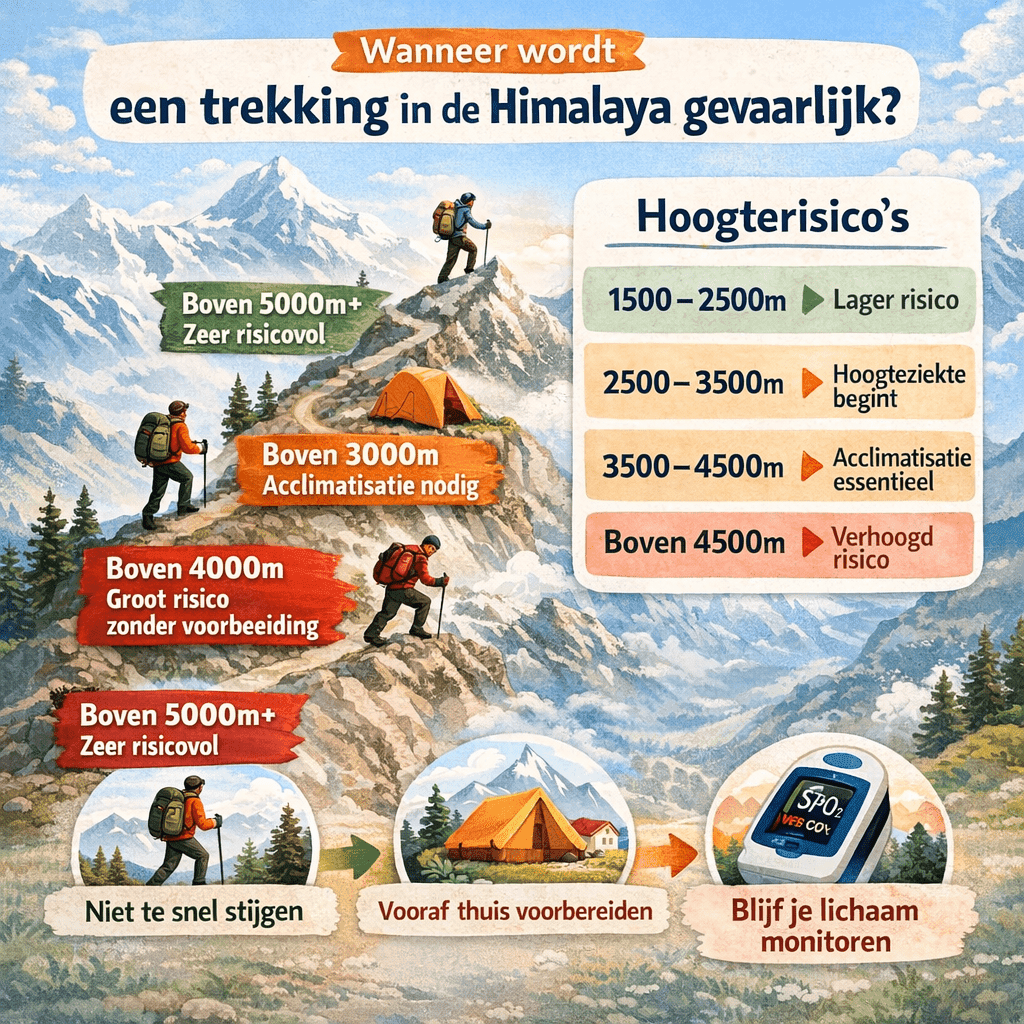
The short answer is clear. From about 2,500 metres the risk of altitude sickness increases. Above 3000 metres almost everyone needs to acclimatise. From 4,000 metres seriously increases the risk without proper adaptation.
This does not mean that trekking above 5,000 metres is necessarily unsafe. In practice, ascent rate, rest days and preparation the difference. In this article, you will discover which altitudes become risky, how fast you can ascend and how to better prepare your body.
The essentials in 30 seconds
- From 2,500 metres increases the risk of altitude sickness.
- Above 3000 metres acclimatisation is necessary.
- Above 4,000 metres rising too fast can become dangerous.
- Many Himalayan treks reach altitudes between 4500 and 5500 metres.
- The main risk factor is too rapid rise in sleeping height.
- Acclimatising at home beforehand can help when your itinerary leaves little room.
From what altitude does a Himalayan trek become dangerous?
Altitude does not work in black and white. The risk of altitude sickness increases gradually. This is why mountain doctors often use clear altitude zones.
| Height zone | Meaning |
|---|---|
| 1500 - 2500 metres | Initial physiological reactions, usually still low risk |
| 2500 - 3500 metres | Risk of acute altitude sickness begins |
| 3500 - 4500 metres | Acclimatisation necessary |
| Above 4500 metres | Markedly increased risk |
Many Himalayan treks are located exactly in these zones. As a result, a good acclimatisation schedule is crucial.
From what altitude can you get altitude sickness?
- 2,500 metres: first clear risk zone
- 3,000 metres: acclimatisation necessary
- 4,000 metres: risk rises sharply with rapid rise
- 5000 metres: almost everyone feels clear height impact
You can read more about symptoms in our guide on altitude sickness symptoms and risks.
Why altitude in the Himalayas feels so tough
The air contains about 21 per cent oxygen at any altitude. What changes is the air pressure. As a result, your body receives less oxygen per breath.
At around 3,500 metres, your body effectively has only approximately 65 per cent of sea level oxygen pressure. At 5500 metres, it is still about 50 per cent.
Oxygen percentage at altitude in the Himalayas
| Height | Effective oxygen availability |
|---|---|
| Sea level | 100% |
| 2,500 metres | ≈ 75% |
| 3500 metres | ≈ 65% |
| 4500 metres | ≈ 58% |
| 5500 metres | ≈ 50% |
How much oxygen is there at Everest Base Camp?

Everest Base Camp is located at about 5364 metres. At that altitude, the air still contains 21 per cent oxygen, but the lower air pressure means your body gets much less oxygen.
In practice, at Everest Base Camp, your body still experiences about 50 per cent of effective oxygen availability of sea level.
| Location | Height | Effective oxygen availability |
|---|---|---|
| Sea level | 0 metres | 100% |
| Namche Bazaar | 3440 metres | ≈ 65% |
| Dingboche | 4410 metres | ≈ 58% |
| Everest Base Camp | 5364 metres | ≈ 50% |
That explains why even fit athletes find hiking at this altitude tough.
How fast can you ascend at altitude during a Himalayan trek?
The speed at which you ascend is the most important factor in preventing altitude sickness.
| Height zone | Recommended rate of climb |
|---|---|
| Under 3,000 metres | Normal rise possible |
| 3000 - 3500 metres | Maximum 500 metres of additional sleeping height per day |
| 3500 - 4500 metres | 300 to 500 metres of ascent per day |
| Above 4500 metres | Very gradual rise and rest days |
In addition, mountain doctors recommend that every 3 to 4 days an acclimatisation day schedule.
What if you do need to rise faster?
Sometimes an itinerary leaves little room for an ideal build-up. Consider treks that start with a flight to Lukla or other high-altitude starting points.
In such situations, acclimatising in advance at home help. Sleeping in an altitude tent reduces oxygen levels via normobaric hypoxia. This allows the body to start acclimatising even before the trip starts.
Important to understand:
- an altitude tent does not replace acclimatisation
- but can start the process in a controlled way
- significantly reducing the risk of altitude sickness
Read more in our guide on acclimatising at home for mountain expeditions.
How common is AMS in the Himalayas?
- approximately 25 per cent of tractors get complaints above 3500 metres
- approximately 40 to 50 per cent Gets complaints above 4500 metres
- severe forms are rarer but possible
The main cause is almost always rise too fast.
You can read more background in our guide on preventing altitude sickness.
Everest Base Camp case study: why this trek often does succeed
The Everest Base Camp trek reaches about 5364 metres. Yet thousands of tractors reach this height safely every year.
This is due to a gradual route:
- Lukla - 2860 m
- Namche Bazaar - 3440 m
- Dingboche - 4410 m
- Lobuche - 4910 m
- Everest Base Camp - 5364 m
Acclimatisation days in Namche Bazaar and Dingboche give the body time to adjust.
Read more in our guide on Preventing altitude sickness at Everest Base Camp.
This is how you monitor acclimatisation objectively
SpO2 trend
Use a saturation gauge mainly to monitor trends. Stabilisation after a few days usually indicates adjustment.
Sleep quality
The first nights are often restless. Improvement after a few days is usually a good sign.
Symptoms
Headaches, nausea and fatigue are key signs.
Decision rule: worsen symptoms when ascending, take a rest day or descend.
Conclusion: which altitude is dangerous without acclimatisation?
- 2,500 metres: first risk area
- 3,000 metres: acclimatisation necessary
- 4,000 metres: serious risk without preparation
The height itself is rarely the problem. In practice, it is mainly how fast you rise Whether a draw is safe.
Are you going to trek above 5,000 metres?
Many trekkers opt for pre-acclimatisation before leaving for the Himalayas.
Check out the pre-acclimatisation package for treks above 5,000 metres
Read altitude tent experiences of other people who have gone to >5000m