
The ideal height for a height tent is 2000 to 2500 meters
Published 12 December 2013 · 5 min read
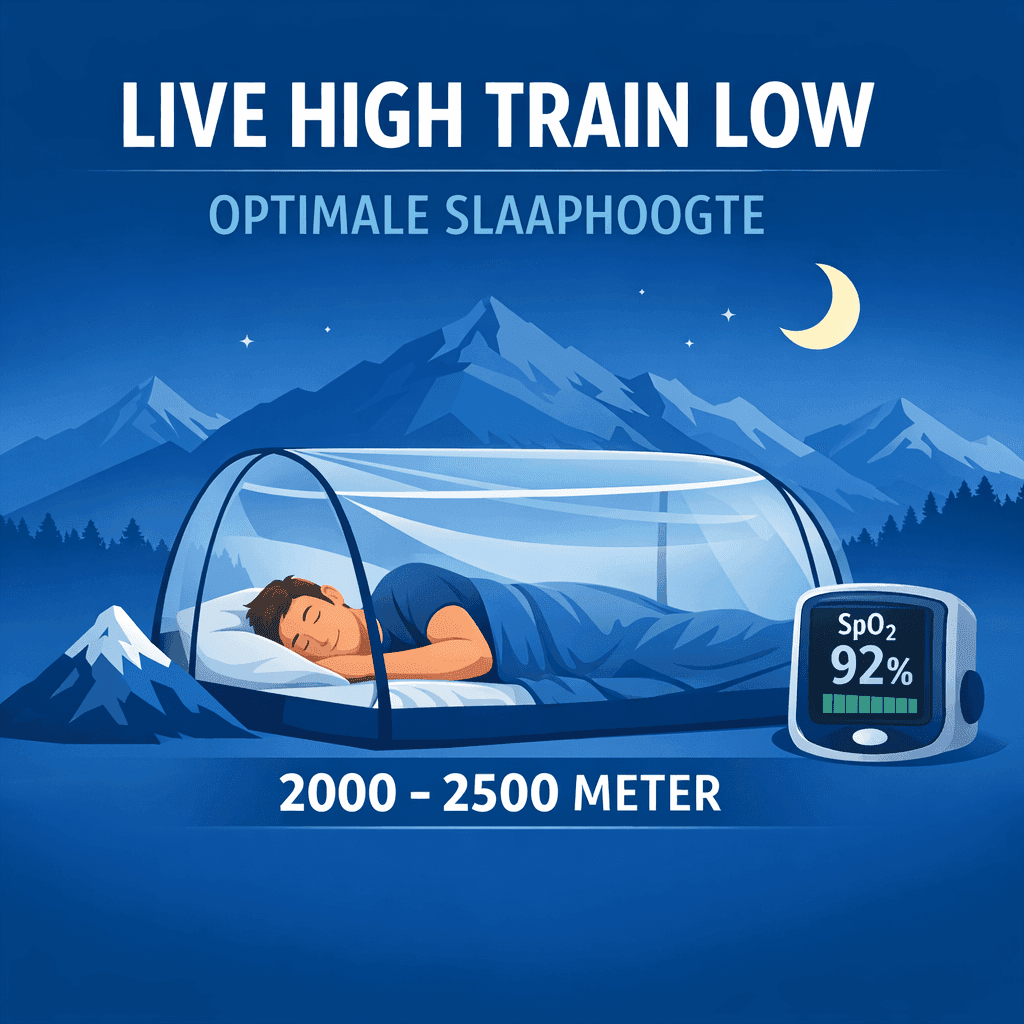
Which height is optimal at Live High Train Low To really improve your performance at sea level? Many athletes sleep too low and miss stimulus. Others go too high and compromise on recovery. The right altitude zone makes the difference between adaptation and overload. Here's how to determine that zone and monitor it objectively.
The essentials in 30 seconds
Conclusion: At Live High Train Low, the optimal sleep altitude for most well-trained athletes is between 2000 and 2500 metres.
Nuance: Not everyone responds in the same way. Individual response determines the final effect.
Practical lead: Build up incrementally and adjust your altitude based on SpO2 trend, sleep quality and recovery.
Why the right height at Live High Train Low is so often chosen incorrectly
A Live High Train Low principle is simple in theory: you sleep at altitude, but train low so that you maintain intensity. In practice, dosage often goes wrong. Too little hypoxic stimulus does not produce meaningful adaptation. Too much stimulus disrupts sleep, recovery and training quality.
Altitude training is not a black-and-white intervention. It is a dosable physiological signal. So the question is not only whether to sleep high, but how high exactly And how to know you are in the right zone.
Those who want to understand the broader physiological framework can first read the basics about altitude training And how hypoxia triggers the body to adapt.
What Chapman's research teaches us about altitude dosing
An influential study by Chapman and colleagues examined 45 well-trained athletes with an average VO2max of about 62 ml per kg per minute. They spent four weeks at various altitudes between 1780 and 2800 metres. The intensive training sessions took place around 1250 metres so that training quality was maintained.
The core finding was clear: only the groups that stayed around 2085 and 2454 metres showed significant improvement in both VO2max and 3000-metre performance at sea level.
VO2max increased by just over 3 per cent. The 3,000-metre time improved about 2 per cent. This seems small, but at top-level sporting levels it is substantial.
The full article was published in the Journal of Applied Physiology.
The most common fallacy of Live High Train Low
Many athletes think that higher is always better. This is not true.
Above about 2500 to 2800 metres, sleep quality is more likely to decline, nocturnal desaturations increase and training loads become more difficult to digest. The balance then shifts from adaptation to stress.
The body responds to hypoxia via an increase in EPO, among other things. Those who want to understand the physiological background can read how high altitude training increases your EPO levels.
So the optimal zone is not a maximum zone, but a effective and repairable zone.
For a practical translation to sleeping in an altitude tent see also the ideal height for a height tent.
Step by step: here's how to determine your effective LHTL height
- Start between 1800 and 2000 metres equivalent.
- Sleep at least 7 to 9 hours a night in hypoxia.
- Monitor daily morning SpO2 and subjective recovery.
- Increase by 200 to 300 metres only when sleep remains stable.
- Aim for an SpO2 trend around about 92 per cent during the night.
- Maintain training quality at low altitude.
- Evaluate effect after 3 to 4 weeks.
This is how you monitor this lens
The biggest mistake is steering by one single measurement. Adaptation you see in trends.
- SpO2 trend: Look at the average over several nights. A work zone around 91 to 93 per cent is often effective. Structurally below 88 per cent indicates overwork.
- Sleep quality: Do you wake up more often, dream restlessly or your deep sleep declines? That's a signal.
- Recovery feeling: Subjective fatigue, resting heart rate and training sensation should remain stable.
So SpO2 is not a snapshot but a directional indicator. You can read more about oxygen saturation at oxygen saturation at altitude.
When training at home with normobare hypoxia, the same principle applies. An altitude tent is no substitute for acclimatisation, but it will significantly reduce the risk of altitude sickness. Sleep is the primary stimulus. Stepwise build-up and SpO2-driven adjustment are essential.
When to continue, adjust or stop?
When to continue
Stable sleep, SpO2 around 91 to 93 per cent, maintenance of exercise quality and normal recovery perception.
When to adapt
Declining sleep quality, structural SpO2 below 88 per cent, rising resting heart rate or persistent fatigue. Decrease 200 to 300 metres.
When to slow down or stop
Persistent headache, nausea, marked performance deterioration or illness. Stopping and descending is the primary intervention for alarm symptoms.
Those seeking guidance on interpreting data can always contact us on a low-key basis at Altitude Dream. The approach is always data-driven and individually tailored.
Micro insights for those serious about optimising
📊 Research shows
That red blood cell volume increases at multiple altitudes, but performance improvement occurs only when training quality is maintained. The combination of sufficient hypoxic stimulus and intact intensity seems decisive.
⚠️ Reality check
Not every athlete is a responder. In the study, some athletes performed worse despite staying in the optimal zone. Thus, individualisation is not a luxury but a necessity.
💡 Did you know?
Most adaptations occur during sleep. Not during training. Therefore, sleep duration and sleep quality is crucial within Live High Train Low.
Mini-FAQ
Is 2800 metres better than 2200 metres?
Not automatic. Higher altitude increases stress load and can disrupt sleep. Effective adaptation requires balance.
How long should an LHTL block last?
Usually 3 to 4 weeks for measurable performance improvement in well-trained athletes.
Can this be done with a high altitude tent?
Yes, via normobaric hypoxia. Sleep is the primary stimulus and buildup should be gradual.
Which is more important: altitude or training intensity?
The combination. No performance translation without training quality.
The core decision
The question is not whether you should sleep high, but whether you are willing to monitor and adjust the process. The optimal altitude for Live High Train Low is between 2000 and 2500 metres for most athletes. But your optimal zone is determined by data, not averages.
Those who approach it carefully increase the chances of meaningful performance improvement at sea level without undue strain. In the end, that is what it is all about.


