Altitude tent asthma: safety and practical protocol
Published 28 February 2026 · 3 min read

A altitude tent asthma combination raises logical questions. Is sleeping in normobaric hypoxia safe if your airways are sensitive? Can an altitude tent exacerbate asthma? Or is it actually possible to have controlled exercise while maintaining safety?
The short answer: in most cases, with well-controlled asthma, an altitude tent is safe to use, provided you work with a step-by-step protocol and objective monitoring. Uncontrolled or unstable asthma is a different situation. Then medical coordination is necessary.
In this article, you get a clear framework. Not a marketing story, but a medically based approach that helps you decide responsibly.
What happens in an altitude tent with asthma?
A height tent simulates height via normobaric hypoxia. The air pressure remains the same, but the oxygen percentage drops. This temporarily lowers your oxygen saturation, after which the body activates adaptation processes.
More background on the mechanism can be found in how altitude training works.
Three factors play a role in asthma:
- Bronchial hyperreactivity
- Inflammatory sensitivity of the airways
- Individual sensitivity to dry or cold air
Important: an altitude tent causes neither lower air pressure nor cold mountain air. The stimulus is solely the lower oxygen content. That makes it physiologically different from actually staying at high altitude.
Why this is often misunderstood
Many people think that altitude is always harder on asthma. In reality, we often see fewer allergens and sometimes even improvement in symptoms in mountain areas. The context determines the effect.
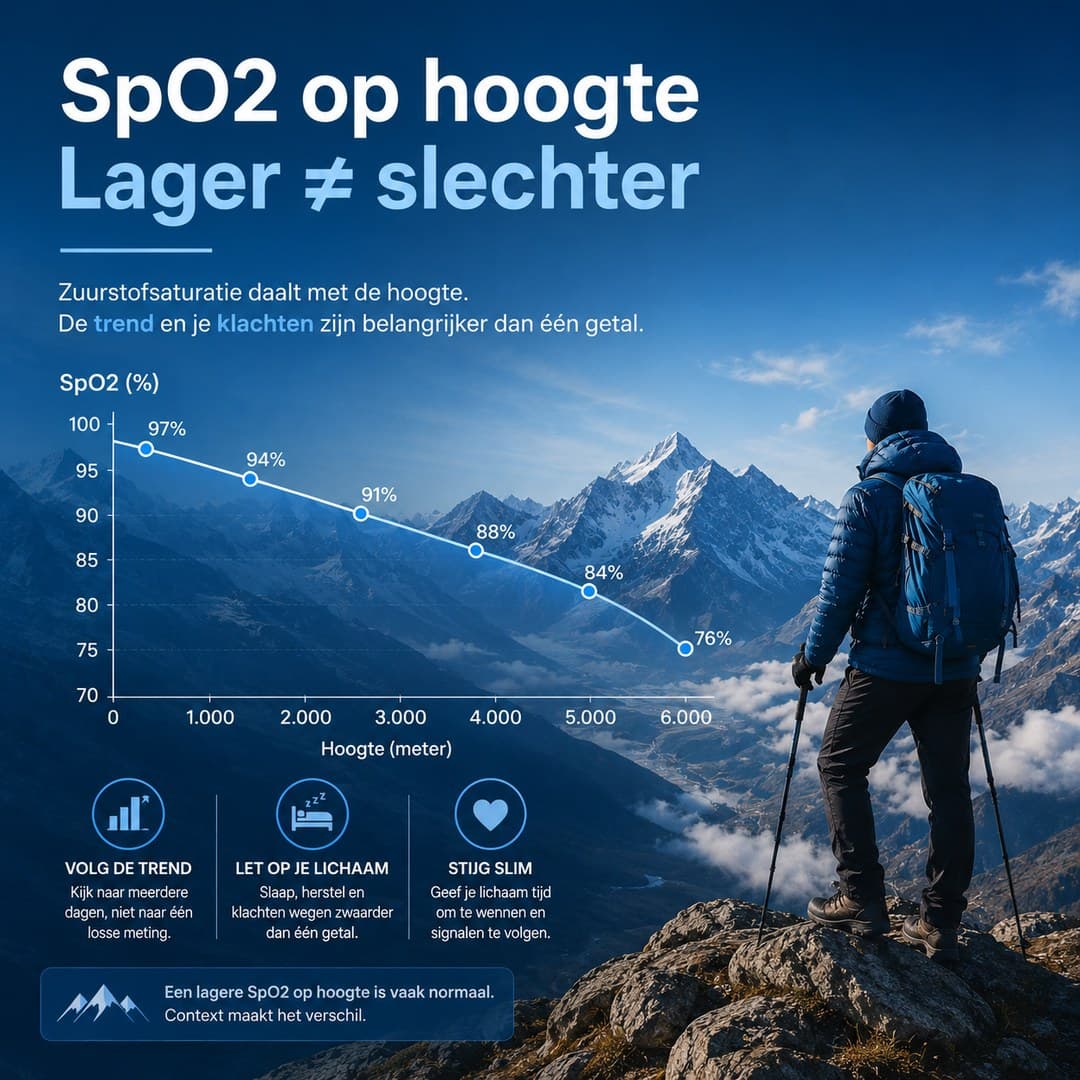
An altitude tent is also a controlled environment. You build up gradually and continuously monitor your oxygen saturation at altitude.
The real risk factor is not hypoxia itself, but too rapid a build-up without monitoring.
When is an altitude tent in case of asthma inadvisable?
Do not use a high altitude tent at:
- Uncontrolled asthma with frequent exacerbations
- Recent use of oral corticosteroids
- Recent hospitalisation for asthma
- Resting SpO2 below 95 per cent at sea level with no clear explanation
In these situations, stability must first be achieved.
Practical protocol: using altitude tents for asthma
Step 1 - Start layer
Start with a simulation from 1500 to 1800 metres. This means a slight drop in oxygen percentage, without strong physiological stress.
Step 2 - Build up slowly
Increase only after 4 to 5 stable nights with good sleep and stable SpO2 trend.
Step 3 - Sleep as a primary stimulus
In pre-acclimatisation or altitude training via tent, sleep is the main stimulus. You can read more about this in altitude tent use.
Step 4 - Maximum 2000 to 2200 metres in early stages
For people with asthma, we do not recommend aggressive altitudes in the first weeks. The ideal zone for adaptation is often between 2000 and 2500 metres, see ideal height for a height tent.
This is how you monitor this lens
Objective monitoring is crucial. Always look at trends, never at isolated values.
- SpO2 trend: morning values follow over several days. A steady decline of 2 to 3 per cent at onset is normal. Sustained decline or erratic patterns are not.
- Sleep quality: falling asleep, waking up at night, feeling stuffy.
- Recovery feeling: daytime fatigue, chest pressure, increased need for inhalation.
Concrete decision rule: on two consecutive mornings with marked SpO2 drop as well as subjective tightness, lower the simulated altitude by 200 to 300 metres.
What does physiology say?
Hypoxia stimulates EPO production and ventilatory adaptation, among other things. This process has been described in how altitude training increases your EPO levels.
In stable asthma, mild hypoxia does not usually lead to bronchoconstriction. However, dry air can be a trigger. Therefore, adequate ventilation and humidity in the bedroom is important.
Differentiations often forgotten
- An altitude tent works with normobare hypoxia, not lower air pressure.
- You adjust the stimulus based on SpO2 trend, not on feeling alone.
That makes it substantially different from uncontrolled stays at altitude.
Decision aid
Ask yourself three questions:
- Is my asthma stable and well adjusted?
- Am I prepared to monitor SpO2 and sleep quality daily?
- Do I have a concrete goal such as pre-acclimatisation or sports performance?
If the answer is yes three times, then a controlled start is usually justified.
Summary in 30 seconds
- Altitude asthma is generally safe in stable asthma.
- Start low and build up gradually.
- Monitor SpO2 as a trend.
- Stop or reduce in case of complaints.
- Use sleep as primary stimulus.
Want personalised advice?
Do you doubt whether a high altitude tent suits your situation? We will gladly think along with you about a safe and measurable route.