Preventing altitude sickness: nausea and loss of appetite at altitude
Published 29 January 2026 · 7 min read
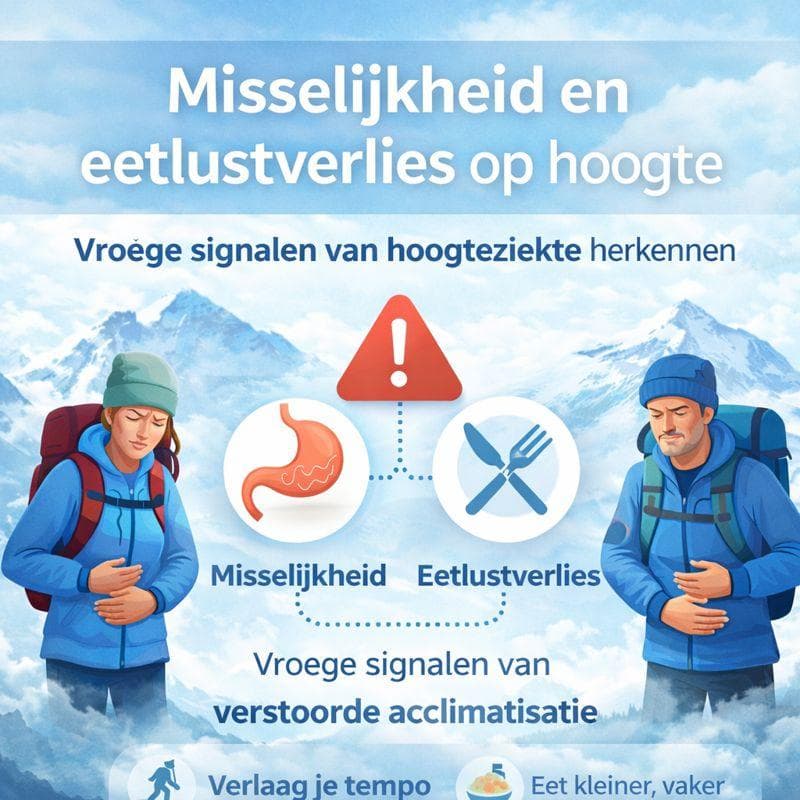
Nausea and appetite loss at altitude are often seen as harmless side effects of travelling or training in the mountains. Yet in many cases, they are the first, subtle signs of incipient altitude sickness. Those who ignore or misinterpret these symptoms increase the risk of further disruption, performance loss and forced descent. In this article, you will learn how to preventing altitude sickness by recognising nausea and appetite loss early and responding smartly.
In a nutshell
Nausea and decreased appetite at altitude are rarely isolated symptoms. They often indicate impaired acclimatisation. The nuance is that not every form of nausea is immediately dangerous. The practical takeaway: do you want to preventing altitude sickness, then you have to learn to distinguish between temporary adjustment and a signal that your load is too high.
Why nausea and appetite loss help you avoid altitude sickness
Many people regard nausea at altitude as something that just comes with the territory. Bad sleep, different food, some tension. This is partly true, but does not explain the whole story. At altitude, oxygen availability changes for every organ system, including the gastrointestinal tract and central nervous system.
Precisely because these symptoms start out mild, they are often ignored. Yet this is exactly the time when the body tries to make it clear that the balance between strain and adaptation is off. And exactly there lies the opportunity to prevent altitude sickness.
Did you know?
Nausea and loss of appetite are explicitly described as common symptoms of altitude sickness (AMS). So they are not just “stomach complaints” but part of the acclimatisation picture.
What happens physiologically at altitude?
At altitude, available oxygen decreases. This has direct consequences for oxygen saturation in the blood and thus for the energy supply of tissues. The body responds with increased breathing and heart rate, as well as redistribution of blood flows. The gastrointestinal tract is not a priority system when the body is under hypoxic stress.
In hypoxia, blood flow to the gastrointestinal tract is relatively reduced. This can lead to:
- delayed gastric emptying
- queasy feeling
- reduced appetite
- bloating
At the same time, hypoxia affects processes in the brain involved in nausea. This explains why nausea at altitude is not only a stomach problem, but can also be neurologically controlled.
Specifically, what does this mean for planning, load and recovery?
- Planning: rising too fast increases the likelihood of symptoms, even if you feel “ok” during the day”
- Tax: intense exercise further inhibits digestion and can accelerate symptoms
- Recovery: insufficient energy intake delays acclimatisation and increases risk of AMS
The relationship with altitude sickness (AMS): when is nausea an alarm signal?
Nausea and loss of appetite are among the classic symptoms of Acute Mountain Sickness (AMS). They rarely come alone. They often accompany:
- mild to moderate headache
- disturbed sleep
- get tired faster
- markedly lower motivation and “drive”
The problem is not the complaint itself, but what lies underneath: a body that is not given enough time to adapt to hypoxia. Do you want to preventing altitude sickness, then you should use this moment to adjust.
Reality check
Not being hungry at 3,000 metres after a hard day is not necessarily dangerous. Not being hungry ánd nauseous ánd sleeping badly for several days is. Then “moving on” is often exactly the wrong choice if you want to avoid altitude sickness.
Why this topic is often misunderstood
There are persistent assumptions:
- “I just have to bite through it.”
- “Everyone suffers from this, so it is normal.”
- “As long as I drink enough, I'll be fine.”
These assumptions are incomplete. Persevering while your body signals increases the risk of worsening altitude sickness. Hydration helps, but does not solve an acclimatisation problem. So you can perfectly “drink well” and still develop AMS.
Scenario 1: the avid athlete who wants to avoid altitude sickness but trains too hard
A trail runner stays at 2,800 metres and continues to train intensively. After a few days, his appetite disappears. He eats less, recovers worse and sleeps restlessly. His SpO2 gradually drops. The conclusion: the combination of altitude and training load is too great.
What does this mean concretely?
Reduce load, extra rest days and train only when appetite and sleep stabilise. This is often the difference between “getting through it” and still developing altitude sickness.
Scenario 2: the mountain hiker with nausea at altitude
A hiker ascends daily on schedule, but finds that meals are resisting. He forces himself to eat, but remains nauseous. Headaches join him. This is a classic pattern of incipient AMS.
What does this mean concretely?
Stop ascent, add extra acclimatisation day and monitor symptoms. If symptoms increase: descending is not “failure”, but risk management.
Practical approach: what helps with nausea and appetite loss at altitude?
If you feel nausea coming on at altitude, your goal is twofold: dampen symptoms and address the cause. These are the most effective steps that also help to prevent altitude sickness:
- Slow down your pace: less intensity gives your system room to stabilise.
- Eat smaller, more often: Small portions are more tolerable than large meals.
- Choose “easy” food: carbohydrates and light snacks are often better than fat or lots of protein.
- Hot and salty often works well: broth or soup can provide both energy and moisture.
- Hydration with policy: Drink regularly, but don't force it. Drinking too much can also make you nauseous.
What does this mean concretely?
- Planning: plan an extra acclimatisation day if your appetite clearly decreases
- Tax: scrap intensive blocks or steep “pushes” on days with complaints
- Recovery: Prioritise sleep, warmth, and simple energy intake
Mini-FAQ
1. Is appetite loss at altitude normal?
Yes, temporarily. But if it persists longer or is accompanied by headaches and poor sleep, it is a signal that acclimatisation is lagging.
2. When should you descend?
If symptoms worsen despite rest, or if you experience marked limitations in walking, thinking or coordination.
3. Does “taking a break” help against nausea at altitude?
Sometimes mild symptoms disappear within 24 to 48 hours if you don't rise further. But continuing to rise increases the risk of AMS.
4. Can training trigger nausea at altitude?
Yes. Intensity increases stress and inhibits digestion, accelerating symptoms.
5. What is a good rule of thumb?
If food, sleep and energy get worse at the same time, treat it as if it is acclimatisation and not “stomach”.
Preventing decision moments and red flags in altitude sickness
Take extra care when nausea and loss of appetite are associated with:
- persistent or increasing headache
- marked sleep deterioration
- Declining SpO2 trends relative to your own baseline
- increasing daytime fatigue
When to continue?
With mild, decreasing symptoms and stable sleep and oxygen levels, with no increase in headache.
When to adjust?
In case of persistent nausea or marked loss of appetite for more than 48 hours, or when your sleep becomes noticeably worse.
When to slow down or stop?
If symptoms worsen despite rest. Stop ascending and consider descending if symptoms worsen.
Altitude tent and pre-acclimatisation in context
Home acclimatisation with an altitude tent involves normobaric hypoxia. The primary stimulus is sleeping in reduced oxygen, not exercising. This can help reduce the initial shock at altitude, making you less likely to fall into the “nausea and not eating” spiral in the first few days.
Important: an altitude tent is not a replacement for acclimatisation, but a way to make the process controlled, measurable and planable. It significantly reduces the risk of altitude sickness, but does not offer a 100% guarantee.
Guidance and adjustment with data
Recognising early signals such as nausea and appetite loss requires experience and data. Combining sleep, SpO2 and recovery feeling creates a more reliable picture than based on feeling alone. This is precisely where the value of guidance and customisation lies: not pushing harder, but making smarter adjustments so that you can preventing altitude sickness rather than having to solve it afterwards.
Get in-depth with reliable sources
If you want to read up on the signs of altitude sickness and prevention principles in medical guidelines and public information, check out these resources:
- NHS: altitude sickness symptoms and warnings
- CDC Yellow Book: high altitude travel and altitude illness
- NCBI StatPearls: acute mountain sickness
Related topics:
- Everything you need to know about altitude sickness: symptoms, risks and what to do
- Preventing altitude sickness: complete guide - depth & frequently asked questions
- Acclimatising at home for mountain expeditions: rent, buy or apply?
Prevent altitude sickness starts with listening to early signs. Nausea and appetite loss are not details, but signposts that help you adjust rest, diet and rise schedule in time.