High altitude tent hire in the Netherlands: everything you need to know
Published 12 February 2026 · 9 min read
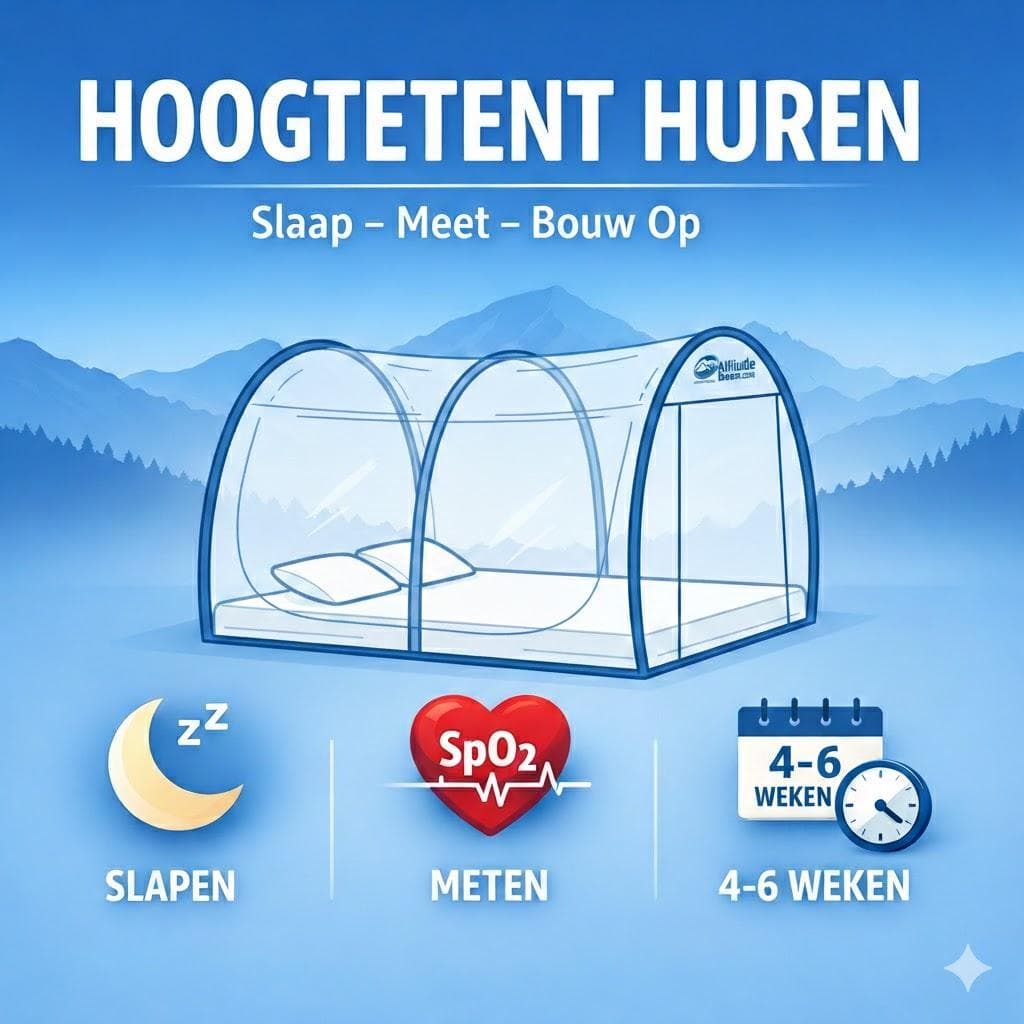
A rent a height tent in the Netherlands seems simple, but in practice it raises many questions. You quickly wonder what altitude is appropriate and how many weeks you should sleep in hypoxia. In addition, you want to know what this does to your SpO2, your sleep quality and your recovery. Ultimately, it all revolves around one decision: does renting fit your goals, schedule and tolerance?
The essentials in 30 seconds
Conclusion: Renting an altitude tent is the most flexible and safe way to start controlled normobaric hypoxia, both for sports performance and pre-acclimatisation.
Nuance: An altitude tent is no substitute for on-site acclimatisation, but it will significantly reduce the risk of altitude sickness.
Practical lead: Start 4 to 6 weeks before your target time and adjust altitude based on SpO2 trend and sleep quality.
Why are more and more people choosing a high altitude tent?
The classic approach to altitude preparation was on-site acclimatisation. While that can be effective, it takes time, money and energy at exactly the stage when you want to feel good. With an altitude tent, you create a controlled environment of normobaric hypoxia at home. You lower the oxygen percentage, not the air pressure, and use sleep as the primary stimulus.
If you want to understand the basics first, start at how altitude training works. Those who then look for the most practical translation for home often end up with sleep high train low. Renting a height tent is essentially the applicable, measurable form of this in your own bedroom.
💡 Did you know?
In normobaric hypoxia, sleep is the main exposure: your body receives hours of calm, consistent stimulation. As a result, you often build up better than with short, intensive sessions. It is precisely this calmness that makes the process plannable and easier to monitor via SpO2 trends and sleep quality.
What exactly is a high altitude tent?
An altitude tent is an enclosed sleeping environment on your bed where you use a generator to lower the oxygen concentration. This is normobare hypoxia: air pressure remains the same, but the amount of available oxygen in the air drops. The goal is not “as high as possible”, but “just high enough” to trigger adaptation without sabotaging your sleep and recovery.
This is why a high altitude tent works especially well when you build up step by step and adjust objectively. That makes the difference between smart preparation and a frustrating period of restless nights.
For whom is a height tent hire relevant?
1. Mountaineers and trekkers
For treks above 4000m, pre-acclimatisation can make all the difference in the first 72 hours at altitude. In that phase, you often see the most complaints: headaches, poor sleep, a flat recovery feeling and sometimes incipient altitude sickness. Especially towards 6000 metres and higher, preparation at home is often rational. If you want to read more deeply about the altitude profile and decision moments, also check out acclimatising for 6000 metres.
2. Endurance athletes
Runners, cyclists and triathletes use hypoxic sleep to make the aerobic system more efficient, provided the load is properly dosed. Moreover, it can help build consistency during a period when you are strengthening your training base. You can read about the underlying physiology around EPO and red blood cell production in How altitude training increases your EPO levels.
3. People who want to test first without a big investment
Those who have never slept in hypoxia simply don't know how the body reacts. That's why renting is often the smartest first step: you test your tolerance, learn your SpO2 trend and discover which build-up works for you. Only then can you make an informed decision on whether buying ever makes sense.
When is renting smarter than buying?
For most athletes and mountain travellers, renting is rationally the best first step. That's because the purpose is usually temporary and specific. Moreover, you want flexibility: you adjust the rental period according to your race calendar or departure date, and it's easier to stop when your schedule changes.
Renting is especially wise if any of these situations apply to you:
- You have a concrete goal moment within 2 to 10 weeks.
- You first want to test how your sleep responds to hypoxia.
- You want guidance on set-up and monitoring.
- You don't want a big investment before you see proof that it works for you.
Snippet checklist: this is how to handle hiring smartly
- Define your goal: expedition intention or sports performance intention.
- Calculate your time to departure or peak time and plan at least 4 weeks.
- Start low (often around 2000 metres simulated altitude) and build up week by week.
- Measure SpO2 daily at a fixed time and look at the trend, not just one reading.
- Note sleep quality and sense of recovery to interpret load.
- Increase only when SpO2 and sleep remain stable over several nights.
- Evaluate after 3 weeks: effect, tolerance and schedule adjustment.
The most common fallacy
Many people focus on the “altitude in metres” rather than the physiological response. The figure 2,500 metres says little if your SpO2 remains stable around 95 per cent, or, on the contrary, structurally drops towards 86 per cent. Adaptation is personal, and so the stimulus must be dosed personally.
Therefore, the altitude is often adjusted to reach an SpO2 work zone, for example around 92 per cent during the first weeks. This is not a magic number, but a practical guideline that you always link to sleep and recovery.
⚠️ Reality check
A one-off low SpO2 reading is rarely a problem. It is precisely the combination of trend, sleep quality and recovery that determines whether you are too high. If you see a drop three nights in a row and wake up tired, it is usually smarter to stabilise first before increasing further.
This is how you monitor this lens
Renting a height tent without monitoring is steering without a dashboard. That is why you use at least three parameters that complement each other:
- SpO2 trend: morning measurement at the same time, ideally as a 5- to 7-day average.
- Sleep quality: sleep time, nighttime awakening and your own score from 1 to 10.
- Recovery feeling: morning energy, resting heart rate and response to training.
Concrete decision rule: If your SpO2 remains below 88 per cent for three nights and your sleep quality deteriorates, lower the simulated altitude by 200 to 300 metres. Then measure for three more nights and only increase when the trend recovers.
📊 Research shows
Gradual hypoxic exposure during sleep can support adaptations, provided the load is built up progressively and sleep does not structurally deteriorate. Too rapid elevation is more likely to produce restlessness and fatigue, which actually reduces the overall quality of exposure.
For medical guidelines around altitude sickness and acclimatisation, international mountain organisations such as the UIAA Medical Commission to the importance of gradual exposure and recognising alarm signals.
When to continue, when to adjust, when to slow down or stop?
When to continue
- SpO2 decreases slightly in week 1, but stabilises thereafter.
- Sleep remains acceptable, with limited night waking.
- Recovery feeling is stable and you don't feel “heavy” mornings.
When to adapt
- You have several nights of restless sleep or wake up often.
- SpO2 structurally drops towards 88 per cent or lower.
- You notice marked increases in morning fatigue or irritability.
When to slow down or stop
- Persistent headaches combined with worse recovery.
- Nausea, dizziness or marked malaise.
- Symptoms consistent with altitude sickness.
In case of alarm symptoms, stopping and descending is always the primary intervention. Even at home, this means: immediately lower the simulated altitude, stop exposure and recover first.
How long should you rent a height tent?
For sporting purposes, 4 to 5 weeks is often ideal, as it gives you enough time to acclimatise, build up and stabilise. For expeditions above 6000 metres, 5 to 7 weeks is common, as you will need more exposure to get rest in the system.
As a practical layout, this often works well:
- Week 1: habituation and basic data collection.
- Week 2 and 3: adaptation phase with controlled build-up.
- Week 4 onwards: consolidation, stability and fine-tuning.
🧭 In practice
Many users start around 2000 metres and increase to 2300 metres after 7 days, provided sleep and SpO2 trend remain stable. The progression is often smaller than expected. This is precisely why the process remains manageable and the overall quality of sleep exposure is higher.
First 72 hours: checklist to get off to a good start
- Start low and choose stability over speed.
- Measure SpO2 every morning at the same time.
- Record sleep quality and nightly awakenings.
- Avoid heavy workouts in the first week to keep your recovery clean.
- Increase only after several stable nights.
What not to do
- Jumping to 3,000 metres too quickly because it “must work”.
- Looking only at SpO2 figures without sleep context.
- Forgetting that hydration and iron status can play into fatigue.
- Continuing while your sleep structurally deteriorates.
Practical questions almost everyone has
At what height do you best start?
A safe start for many people is around 2,000 metres of simulated altitude. Then you increase only when your SpO2 trend does not fall further and your sleep does not deteriorate. This allows you to build adaptation without disturbing the basics. At the same time, the process remains predictable, which is important during a rental period.
Should you train in the tent?
No. Sleep is the primary stimulus in normobaric hypoxia. Training inside the tent usually adds little and may even disrupt your sleep. Rather, train outside the tent for quality while keeping your sleep exposure calm and consistent.
What if you sleep badly at first?
A slight disturbance in the first few days is common. Therefore, start low and build up slowly. However, if sleep does not improve after 5 to 7 days, you are probably too high or going too fast. In that case, lower your altitude and stabilise first.
Altitude Dream as a companion
Because the response to hypoxia is personal, it pays to have your build-up checked against your data. Those in doubt about approach or interpretation can consult in person at this contact page. Guidance here feels like data-driven customisation: above all, you get clarity on when you can continue, when you need to make adjustments and how to make the most of your tenure.
CTA: sports performance intention
Are you an athlete and want to peak in a targeted way? Then the sport-specific approach is leading. For runners:
Or first read experiences of other runners To see how others have tackled their build-up.
Mini-FAQ
Is a high-altitude tent safe?
Yes, our high altitude tents have CE safety certification. Moreover, it remains safe when you build up incrementally and monitor for SpO2 trend and sleep quality.
When do you see effect?
Usually after 2 to 3 weeks of consistent exposure during sleep, especially if you dose the altitude carefully.
Can it prevent altitude sickness?
It lowers the probability significantly, but it is not a 100% guarantee and it does not replace on-site acclimatisation.
Should I train in the tent?
No. Sleep is the primary stimulus for adaptation in normobaric hypoxia.
Is renting flexible?
Yes, you tailor the duration to your goal and schedule. This allows you to start, adjust and evaluate faster.
In short: a rent a height tent in the Netherlands is not an impulse decision, but a strategic preparation. Those who understand how monitoring works and make consistent adjustments to sleep and SpO2 trends will get the most out of a relatively short period of controlled hypoxic sleep.