Prevent altitude sickness
Published 11 June 2016 · 10 min read
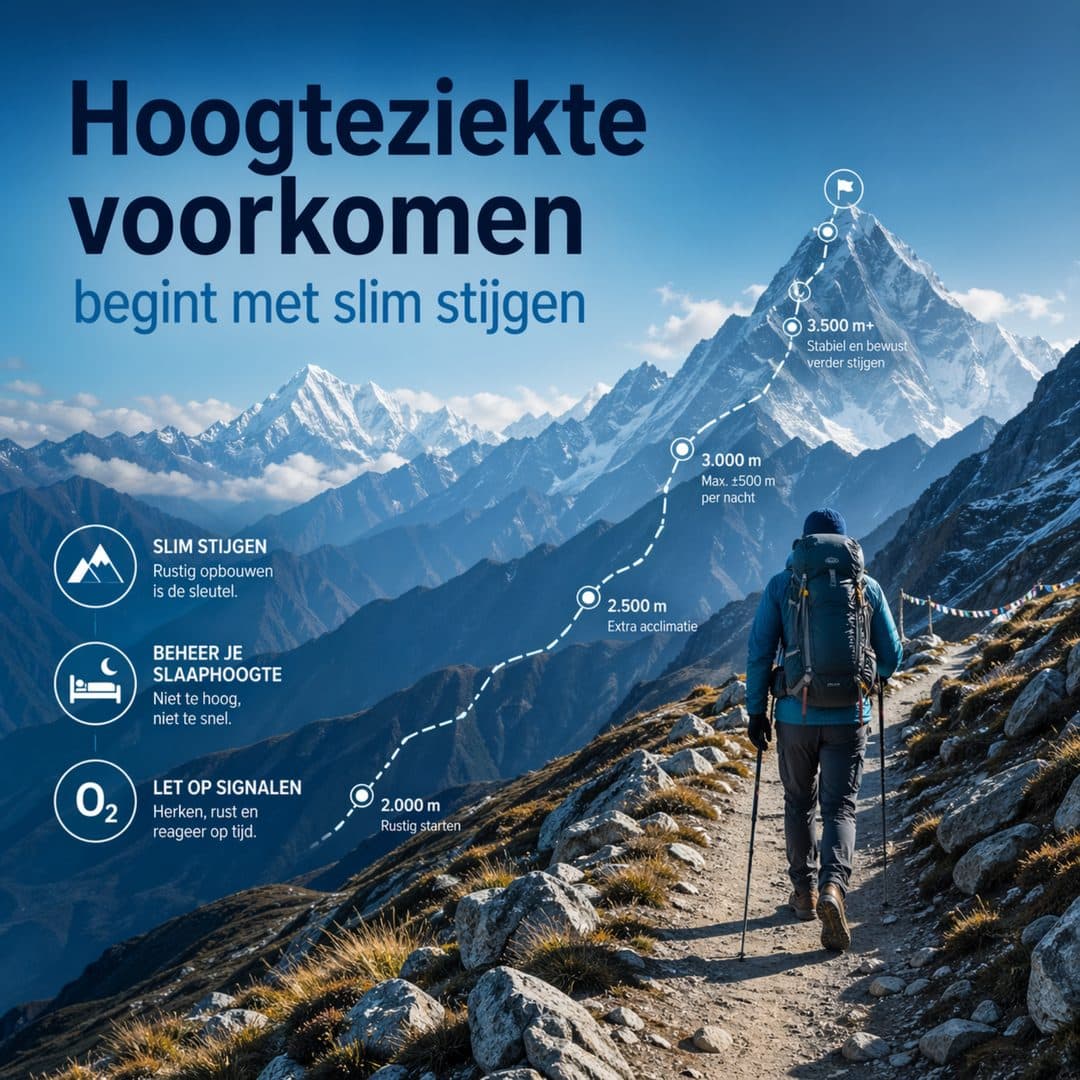
The gist is simple: don't move up too fast, don't sleep unnecessarily high on day one, and treat complaints as information rather than something to be pushed away. Those who want sharp first what altitude sickness exactly means, also sees more quickly why prevention is mainly a matter of planning and discipline.
Direct response
If you want to avoid altitude sickness, focus on four things: build up your sleeping altitude slowly, plan extra time around 2,500 to 3,000 metres, don't ascend further with complaints and arrange a plan B in advance for fast routes or flight destinations at altitude.
- Avoid sleeping too high on day one.
- Above 3,000 metres, preferably do not sleep more than about 500 metres higher each night.
- Allow extra acclimatisation time for every 1,000 metres gain in sleep height.
- Discuss acetazolamide in advance if your route leaves little room for gradual increase.
Conclusion: most of the gains are in a leisurely pace of ascent and tight decision rules along the way.
Nuance: even with a good scheme, individual sensitivity remains.
Practical hook: look at your sleep heights first, only then material or medication.
Preventing altitude sickness starts with your sleeping height
Many people think mainly about their highest point of the day. For prevention, your sleeping height is usually more important. Especially during the night, your body receives less oxygen for long periods of time. As a result, a route with a modest summit but a rapid rise in sleep elevation often counts more heavily than an active day trip where you sleep lower again later.
Therefore, it is useful to understand not only your route, but also the physiology behind it. In the article on how altitude sickness occurs you can see why rapid ascent and insufficient ventilatory adaptation play such a big role.
| Situation | Interpretation | Practical approach |
|---|---|---|
| Day 1 below 2500 m | Relatively favourable start for most travellers. | Use this phase to settle in quietly, sleep well and don't force it. |
| Day 1 around 2750-3400 m | Here, the risk clearly increases, especially with a flight destination or tight schedule. | Preferably plan an extra night at the same altitude and deliberately keep calm for the first 24 to 48 hours. |
| Above 3000 m | Your margin gets smaller and pace counts more heavily. | Preferably do not go to sleep more than about 500 metres up per night and add extra rest time. |
| Fast route or earlier AMS | The likelihood of problems is higher than average. | Work with a concrete prevention plan: extra stopover, pre-acclimatisation or medication in consultation with doctor. |
Day 1 below 2500 m
Interpretation: relatively favourable start for most travellers.
Practical approach: Use this phase to settle in quietly, sleep well and don't force it.
Day 1 around 2750-3400 m
Interpretation: here, the risk clearly increases, especially with a flight destination or tight schedule.
Practical approach: Preferably plan an extra night at the same altitude and keep deliberately quiet for the first 24 to 48 hours.
Above 3000 m
Interpretation: your margin narrows and pace counts more.
Practical approach: preferably go to sleep no more than about 500 metres up per night and add extra rest time.
Fast route or earlier AMS
Interpretation: the likelihood of problems is higher than average.
Practical approach: work with a concrete prevention plan: extra stopover, pre-acclimatisation or medication in consultation with doctor.
A good schedule sometimes feels conservative on paper. In reality, it is often the fastest route to a successful summit day. Not because you are slower, but because you lose less to headaches, nausea, restless nights or unexpected rest days.
The 7 measures that make the most difference
- Steer at sleeping height, not ambition. Avoid an aggressive first sleep altitude if you depart from sea level or low altitude.
- Plan a stopover. An extra night around 2,500 to 2,750 metres can make a lot of difference for the following days.
- Limit ascent above 3,000 metres. An increase in sleep height of about 500 metres per night is a useful upper limit.
- Insert rest before you need it. Think in preventive acclimatisation days, not damage repair afterwards.
- Never rise further with obvious complaints. Rest, observe and descend if symptoms increase or do not recover.
- Keep your first 48 hours controlled. Walking too fast, alcohol and too little sleep make the first phase unnecessarily unstable.
- Make a plan in advance for quick routes. Consider staged ascent, pre-acclimatisation or medication if your schedule gives little slack.
⚠️ Reality check
Preventing altitude sickness is not a guarantee process. Even with a good schedule, someone may prove susceptible. This is precisely why early recognition is more important than tough walkthrough. Prevention does not mean not feeling anything, but catching problems early and preventing escalation.
What many people misjudge
The biggest mistakes often arise from half-truths. People drink extra much water, rely on their fitness, or take a painkiller and think that the risk is gone with that. This gives peace of mind, but often not in the body.
What is often thought
“I am fit, so I will probably be less bothered by it.”
“If I drink enough, I prevent altitude sickness on my own.”
“A headache pill means I can go higher again tomorrow.”
“Last time it went well, so this time too.”
Somewhat more practically correct
Conditioning does not automatically protect. Pushing too hard can even make it harder.
Proper hydration is useful, but over-drinking does not prevent altitude sickness.
Pain relief can mask symptoms, but does not replace recovery or descent.
Previous experience helps especially if altitude and rate of ascent are similar.
Anyone who wants to recognise complaints before they become a problem will benefit greatly from a clear overview of symptoms and risk factors at altitude. This makes it easier to tell the difference between ordinary fatigue and incipient AMS.
💡 Did you know?
Drinking a lot is no direct protection against altitude sickness. It does help reduce dehydration and confusing signs such as headaches and fatigue. Drinking too much is not a good idea either. It can actually cause new problems and make your interpretation less sharp on the way.
Preventing altitude sickness if you are short on time
Not every trip allows for an ideal build-up. Think of treks with a fixed start, expeditions with a flight to a high city or a tight holiday schedule. Then prevention becomes primarily a logistical issue. You are not looking for perfection, but for risk reduction with the resources you do have.
Step 1 - Check your initial sleeping height.
If you already sleep high on day one, the risk shifts forward. Then an extra intermediate night or a quiet first stage suddenly becomes much more valuable.
Step 2 - Build a brake into your schedule.
Deliberately plan a day when you don't sleep higher. This sometimes feels inefficient, but often prevents loss later in the itinerary.
Step 3 - Think about support in advance.
For rapid ascent, getting used to altitude beforehand or medication prevention may be relevant. Especially if you had previous symptoms or are flying in directly at high altitude.
Step 4 - Arrange your emergency scenario.
Know in advance who decides, when you stop, when you go down and what medication is only supportive rather than resolving.
Especially in this category, medication comes into the picture more often. According to current guidelines, acetazolamide is the preferred option when a gradual rise is not feasible. Dexamethasone is seen as an emergency or treatment option rather than the first choice for routine prevention. Those wishing to delve deeper into this can read further on Diamox and acetazolamide for altitude sickness.
For some travellers, pre-acclimatisation at home or at intermediate altitudes also makes sense. This is no substitute for real acclimatisation in the mountains, but it can make the process more controlled, measurable and plannable. Especially if your itinerary has little leeway, this can be a sensible extra layer.
When extra preparation clearly makes sense
Be extra sharp though
With previous altitude sickness, a quick plane ride to altitude, a first sleep above about 2750 metres or a schedule with few rest days.
Even more reason to prepare
With previous moderate or severe symptoms, strong performance drive in the first few days, or routes where descending is logistically difficult.
Less room for improvisation
For expeditions with fixed camp sequences, groups with time constraints or holidays where downshifting becomes mentally difficult.
Not waiting until departure week
Precisely prevention requires preparation in advance. An extra day in your itinerary is often more valuable than improvising with complaints afterwards.
This is how you monitor this lens
Prevention works best when you combine subjective feelings with objective signals. So look not only at how motivated you are, but especially at patterns. In practice, four indicators are most useful: SpO2 trend, sleep quality, daytime recovery and symptoms such as headache, nausea or an unexplained decrease in pace.
If you use a saturation meter, don't treat that value as an absolute truth. A single reading says little. The trend over successive mornings is much more relevant. Especially if you combine it with how you sleep and function. For more context on this, you can also check out oxygen saturation at altitude.
- SpO2 trend: look at the line over several days, not one outlier.
- Sleep quality: Sleeping worse is normal at altitude, but sharp deterioration plus complaints requires attention.
- Recovery: After breakfast and gentle exercise, do you feel better, or heavier and suffer?
- Symptoms: headaches, nausea, dizziness and loss of appetite are more functional than toughness stories.
- Decision rule: Do not improve signals within rest and time, then do not ascend further. If they get worse, then descend.
When to stop, rest or descend
The most important prevention rule is simple: never sleep higher if symptoms do not clearly improve. This sounds strict, but it prevents a mild situation from becoming a logistical or medical problem. Resting at the same height is often sufficient for mild symptoms. But if symptoms increase, you no longer function normally or tightness develops at rest, the priority shifts immediately to descending.
In practice, this three-way division helps:
- Continuing: only if you are stable, eating well, sleeping reasonably and have no obvious alarm signals.
- Rest: for mild headaches, mild nausea or a restless night without a worsening line.
- Descending: with increasing symptoms, confusion, coordination problems, tightness at rest or a wet cough.
🧭 In practice
The best teams are not those that never slow down, but those that adjust early enough. An extra night usually costs less than a lost summit push, a sick teammate or a chaotic descent under time pressure.
Want more margin in your acclimatisation beforehand?
Do you have a fast route or limited travel time? Or do you just want to drastically reduce the risk of altitude sickness? Da can pre-acclimatisation in an altitude tent be a logical next step. Take a leisurely look at how acclimatising at home in an altitude tent works, when it is relevant and where the limits are.
Read more about home acclimatisation for mountain expeditions
Conclusion
Preventing altitude sickness usually succeeds not by being tougher, but by planning smarter. Those who make sleep altitude central, use rest days deliberately and take complaints seriously are by far the most likely to have a strong trip. Medication and pre-acclimatisation can be valuable in some situations, but they only really work well if the basics are right. So don't start with pills or gadgets. Start with your route, your sleeping altitude and your decision rules.
Frequently asked questions
Can you avoid altitude sickness altogether?
No, not with 100 per cent certainty. You can, however, significantly reduce the risk with a leisurely pace of ascent, extra acclimatisation time and timely adjustments in case of symptoms.
Is drinking lots of water enough to prevent altitude sickness?
No. Moisturising well helps, but it is not direct protection. Think of it as supportive, not a main strategy.
When is acetazolamide useful?
Especially if a gradual rise is not feasible or if you had obvious symptoms before. Always discuss this in advance with doctor or travel clinic.
What is the most important rule on the road?
Do not ascend further if symptoms do not improve. And descend if they get worse or alarm signals arise.