Running Everest Marathon: this is how to prepare for extreme altitude
Published 24 April 2026 · 12 min read
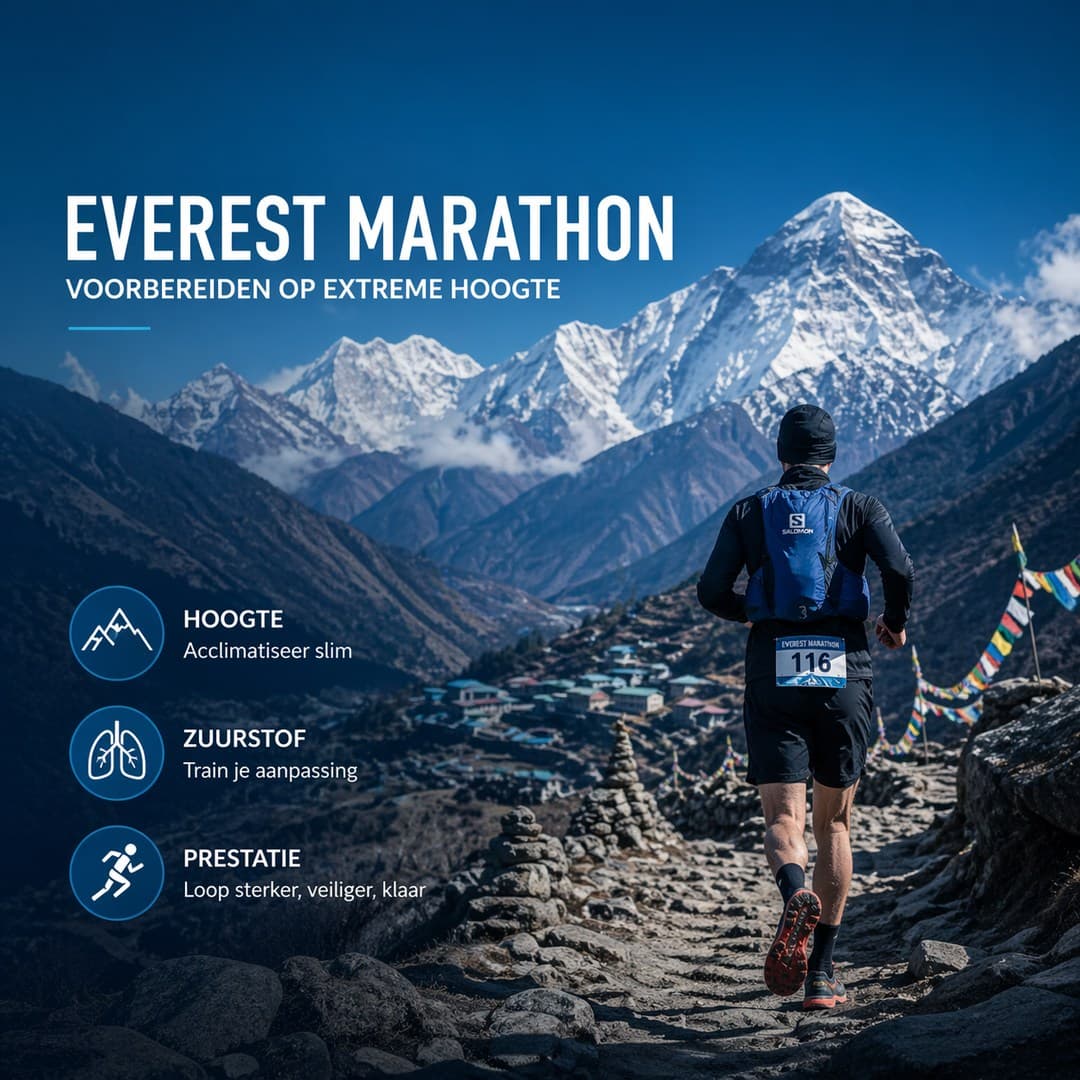
Running Everest Marathon is no ordinary marathon in a special location. It is an extreme trail marathon at altitude, with a start at Everest Base Camp and a finish in Namche Bazar. As a result, not only your fitness is decisive, but more importantly your ability to cope with oxygen deprivation, cold, trail load and fatigue.
The biggest mistake is thinking that marathon experience is automatic enough. Those who run strong at sea level can still suddenly become vulnerable above 5,000 metres. This is precisely why good preparation starts well before departure. Not with training harder, but with smarter planning, more objective monitoring and controlled getting used to hypoxia.
The best preparation for the Everest Marathon combines three pillars: trail-focused marathon fitness, gradual acclimatisation and pre-controlled exposure to oxygen deprivation. An altitude tent can help with this by acclimatising the body to normobaric hypoxia already at home. This significantly lowers the risk of altitude problems, but never gives a full guarantee.
Conclusion: the Everest Marathon requires preparation as an expedition, not just a running race.
Nuance: an altitude tent does not replace acclimatisation in Nepal, but it makes preparation measurable and planable.
Practical hook: ideally, start a structured acclimatisation plan 6 to 10 weeks in advance.
Running Everest Marathon requires more than marathon fitness
The Tenzing-Hillary Everest Marathon is organised annually on May 29. That date refers to the first successful ascent of Mount Everest by Tenzing Norgay Sherpa and Sir Edmund Hillary on 29 May 1953. The classic marathon distance runs from Everest Base Camp to Namche Bazar. This makes the race unique, but also tough in a way that many runners underestimate.
The trail is mostly downhill, but that does not mean it is easy. You run over rough trails, stone paths, stairs, narrow passages and technical descents. Moreover, you start around 5,300 to 5,400 metres. At that altitude, the available oxygen is significantly lower than at sea level. As a result, a leisurely pace soon feels intense.
Those seriously considering running this race should see the preparation as a combination of trailrunning, expedition planning and acclimatising at home for mountain expeditions. That very combination makes the difference between arriving with confidence and arriving with doubt.
The Everest Marathon is often mentally tougher than the distance suggests. Not because 42.195 kilometres suddenly becomes longer, but because altitude affects your pace, breathing, sleep and recovery at the same time. As a result, not always the fastest runner wins, but often the best prepared runner.
What makes the Everest Marathon so physiologically demanding?
At extreme altitudes, oxygen pressure drops. As a result, less oxygen becomes available to your blood and muscles with each breath. Your body responds with higher breathing, a higher heart rate, more fluid loss through breathing and often a less deep sleep.
For a runner, this has immediate consequences. Your aerobic capacity drops, your normal race pace feels too heavy and your recovery between exercise peaks becomes slower. In addition, altitude can affect appetite, sleep quality and decision-making. These are exactly the factors that become important during a long trail day.
That is why Preventing altitude sickness around Everest Base Camp not a peripheral topic. It is a central part of preparation. You don't just want to be fit. You also want to know how your body reacts when oxygen availability drops.
Race profile in practical terms
| Factor | Practical significance | Preparation focus |
|---|---|---|
| Start above 5,000 m | Slow walking feels heavier faster due to lower oxygen availability. | Acclimatisation, SpO2 trends and calm build-up. |
| Technical descent | Upper legs and feet get a lot of eccentric load. | Downhill training, strong quadriceps and stable ankles. |
| Cold and wind | Temperature sensation can vary greatly between start and finish. | Layers, gloves, buff and tested race equipment. |
| Long travel build-up | Fatigue can build up before the start. | Sleep, recovery, nutrition and not too much extra effort. |
Start above 5,000 m
Significance: walking slowly feels heavier faster.
Focus: acclimatisation, SpO2 trends and calm build-up.
Technical descent
Significance: Upper legs and feet receive a lot of eccentric load.
Focus: downhill training and stable ankles.
Cold and wind
Significance: temperature sensation can vary greatly.
Focus: layers and tested competition equipment.
Long travel build-up
Significance: fatigue piles up before the start.
Focus: sleep, recovery, nutrition and dosage.
Running Everest Marathon with altitude tent: what it changes practically
An altitude tent works with normobaric hypoxia. This means that the air pressure remains normal, but the oxygen percentage in the inhaled air is reduced. So you simulate an altitude stimulus without being physically at altitude.
For a race like the Everest Marathon, this is interesting. The first real exposure to extreme altitude then does not take place until Nepal. The body gets a controlled stimulus before then. This allows you to get used to sleeping with less oxygen, monitor your reaction and adjust the build-up before the journey begins.
That does not mean that an altitude tent is a complete substitute for acclimatisation on the move. You still need to ascend carefully, sleep well, take complaints seriously and follow local guidance. But a well-constructed programme can significantly reduce the risk of problems, as your body starts the trekking and competition phase better prepared.
For runners, sleeping in the altitude tent is especially relevant. That gives long, calm exposure without having to perform workouts under oxygen stress all the time. This better preserves your training quality at sea level. You can find more background on sports application in the guide on altitude training for runners.
A realistic 10-week preparation schedule
For the Everest Marathon, you don't want to take big training leaps in the final weeks. The best preparation starts with a stable running base and then shifts to trail loads, altitude-specific preparation and recovery. The goal is not to leave as tired as possible. The goal is to arrive fit, rested and already partially acclimatised.
Protocol for the last 10 weeks
| Phase | Target | Practical interpretation | Main pitfall |
|---|---|---|---|
| Week 10-7 | Strengthen foundations | Endurance running, gentle trail miles, strength training and technique. | Too much focus on speed. |
| Week 6-4 | Building height incentive | Increase altitude gradually, track SpO2 trend, monitor sleep. | Too fast to too high settings. |
| Week 3-2 | Race load simulation | Downhill training, equipment testing, integrating long hikes. | Forcing last major training blocks. |
| Last week at home | Leaving fresh | Reduce volume, prioritise sleep, monitor hydration and iron status. | Panic training due to uncertainty. |
| In Nepal | Finish acclimatisation | Calmly rise, follow complaints, respect local schedule. | Running too fast during trekking. |
Week 10-7
Objective: strengthen base.
Filling in: endurance running, trail miles, strength and technique.
Pitfall: too much speed.
Week 6-4
Objective: build height incentive.
Filling in: elevation, track SpO2 trend and monitor sleep.
Pitfall: going too high too fast.
Week 3-2
Objective: simulate race load.
Filling in: integrate downhill training, equipment testing and hiking.
Pitfall: still forcing large blocks.
Last week at home
Objective: leave fresh.
Filling in: reduce volume, prioritise sleep and monitor hydration.
Pitfall: panic training.
In Nepal
Objective: finish acclimatisation.
Filling in: rise slowly, follow complaints and respect schedule.
Pitfall: Running too fast during the trek.
Note: this is a practical framework. The ideal structure depends on experience, travel planning, previous altitude reaction, health and available preparation time.
Those using a high altitude tent prefer to build up slowly. A programme often starts lower and gradually gets heavier. Here, the body's reaction is more important than the set height. You will find a clear explanation in the article on an altitude tent construction diagram.
Train not only your lungs, but also your legs
A misconception in high-altitude racing is that it is all about breathing. Of course, oxygen availability is crucial. Yet many runners lose time and control precisely because of the technical descent. The route to Namche Bazar requires strong thighs, stable feet and concentration on tired legs.
Therefore, add downhill incentives to your preparation. Think controlled descents, pedal training, eccentric strength training and trail technique. Keep this dosed though. Downhill training can cause a lot of muscle damage, especially when your body is not used to it.
- Run long endurance runs by time and feel, not just pace.
- Train walking on steep sections, as this is normal during the race.
- Strengthen quadriceps, calves, hamstrings, hips and core.
- Test shoes on wet rocks, loose ground and long descents.
- Practice eating and drinking at low intensity and mild nausea.
- Plan recovery weeks before fatigue sets in.
This is how you monitor this lens
For extreme altitude, feeling is important, but feeling alone is not enough. You want to see patterns. That's why you look at SpO2 as a trend, sleep quality, recovery and symptoms. An isolated measurement says little. A declining trend combined with worse sleep and headaches says much more.
Preferably measure your saturation at set times. For example, in the morning, at rest, under similar conditions. In addition, note sleep quality, resting heart rate, headache, appetite and training sensation. More context on interpretation can be found in the guide on oxygen saturation at altitude.
Monitoring for Everest Marathon preparation
| Signal | What you are following | Interpretation | Action |
|---|---|---|---|
| SpO2 trend | Morning value at rest | Trend is more important than a loose value. | If there is a marked drop, build up more slowly. |
| Sleep | Falling asleep, sleeping through, waking up | Poorer sleep may show too heavy a stimulus. | Stabilise or lower height incentive. |
| Recovery | Resting heart rate, fatigue, training feel | Slower recovery requires less training pressure. | Reduce volume and take extra rest. |
| Symptoms | Headache, nausea, dizziness, appetite | Combination of complaints is more important than one complaint. | Do not force it and follow medical advice in case of exacerbation. |
SpO2 trend
Follow: morning value at rest.
Interpretation: trend is more important than a loose value.
Action: in case of marked decrease, build up more slowly.
Sleep
Follow: falling asleep, sleeping through and waking up.
Interpretation: poor sleep may show too heavy a stimulus.
Action: stabilise or lower height incentive.
Recovery
Follow: resting heart rate, fatigue and training feel.
Interpretation: Slow recovery requires less training pressure.
Action: reduce volume and take extra rest.
Symptoms
Follow: headache, nausea, dizziness and appetite.
Interpretation: a combination of complaints counts more heavily.
Action: don't force it and follow medical advice.
Decision rules: when to go ahead, when to adjust?
Good preparation does not always feel comfortable. An altitude tent gives an incentive. Training gives strain. Travelling to Nepal gives fatigue. That's why you need clear decision rules beforehand.
- Your sleep remains fairly stable during altitude tent construction.
- Your morning SpO2 does not drop inexplicably several days in a row.
- You recover normally from gentle workouts.
- You don't have progressive headaches, nausea or dizziness.
- You can keep walking calmly without constantly watching pace.
Make adjustments when several signals deteriorate simultaneously. Think of worse sleep, falling saturation trend, increasing resting heart rate and fatigue. In this case, more stimulus is usually not the solution. Stabilising often works better than increasing.
An altitude tent can significantly reduce the risk of altitude problems, but does not offer a 100 per cent guarantee. In case of obvious or increasing symptoms at altitude, sensible action remains important. Rest, no further ascent, oxygen, medication or descent may be necessary depending on severity and situation.
Common mistakes in preparation
The biggest mistake is starting too late. An altitude tent works best when your body is given time to react gradually. Those who only start just before departure have less room to build up and adjust calmly.
A second mistake is training too much in the final weeks. Many runners want to buy security with extra kilometres. But for an extreme high-altitude race, this often backfires. You want to leave fresh, not empty.
A third mistake is underestimating nutrition. At altitude, appetite sometimes decreases while your energy needs remain high. Therefore, test beforehand what you tolerate well. Choose food that continues to work even in cold, dry air and a restless stomach.
Finally, many runners finalise their equipment choices too late. Shoes, socks, layers, gloves, sunglasses, buff, vest and any poles should be tested. On race day, you don't want experiments.
Practical tips for race day
Start extremely controlled. The start feels special and emotional. You are at Everest Base Camp, among mountains that feel bigger than anything you know. Yet this is exactly the time to park your ego. Your breathing should be leading, not the runners around you.
Use effort as a benchmark. Tempo is less useful than usual on this route. Surface, altitude, wind, cold and technical passages make kilometre times difficult to compare. A smart race plan works with zones of feeling: calm, controlled, alert and safe.
Eat early and small. Don't wait until you are hungry. At altitude, hunger can disappear. Small amounts at a time often work better than large portions. Drink regularly, but don't force excessive amounts.
Also consider concentration. Technical descents require focus. Fatigue makes feet more sloppy. As a result, a relatively easy stretch can still become tricky late in the race.
Frequently asked questions about running Everest Marathon
How tough is the Everest Marathon?
The distance is officially a marathon, but the load feels heavier due to altitude, trail base, cold and technical descents. Preparation should therefore be broader than a normal marathon preparation.
Is an altitude tent useful for the Everest Marathon?
Yes, especially since you can already get used to oxygen deprivation in a controlled way at home. This makes preparation measurable and planable. It does not replace acclimatisation in Nepal, but it can significantly reduce the likelihood of problems.
When should you start preparing in an altitude tent?
Ideally, you should start 6 to 10 weeks before departure. This allows enough time to build up slowly, monitor SpO2 trends and adjust the load.
Do you need to train at pace for this race?
Not primary. Endurance, trail technique, downhill load and control at altitude are more important than pure speed. Pace is less predictable on this trail than on the road.
Can you prevent altitude sickness completely?
No. You can, however, greatly reduce the risk with good acclimatisation, calm set-up, monitoring and sensible behaviour. An altitude tent supports that process, but does not give an absolute guarantee.
Prepare for extreme altitude in a controlled way
Are you running the Everest Marathon or preparing for a similar challenge above 5,000 metres? With a personal altitude programme, you can already start controlled pre-acclimatisation at home, tailored to your schedule, response and goal.
Conclusion: prepare as an athlete as well as an expedition participant
Running Everest Marathon is an exceptional challenge. The distance is familiar, but the context is extreme. You are not just running against kilometres, but against altitude, cold, fatigue and technical trails.
The best preparation therefore starts well in advance. Build up your running base, train your legs for descents, test your equipment and take acclimatisation seriously. An altitude tent can play a strong role in this. Not as a panacea, but as a controlled, measurable and plannable way to acclimatise your body to less oxygen even before departure.
Those who prepare in this way increase the chances of the Everest Marathon becoming not just a survival run, but a strong, conscious and unforgettable achievement.