
Losing weight with altitude training: how does it work?
Published 31 March 2026 · 9 min read
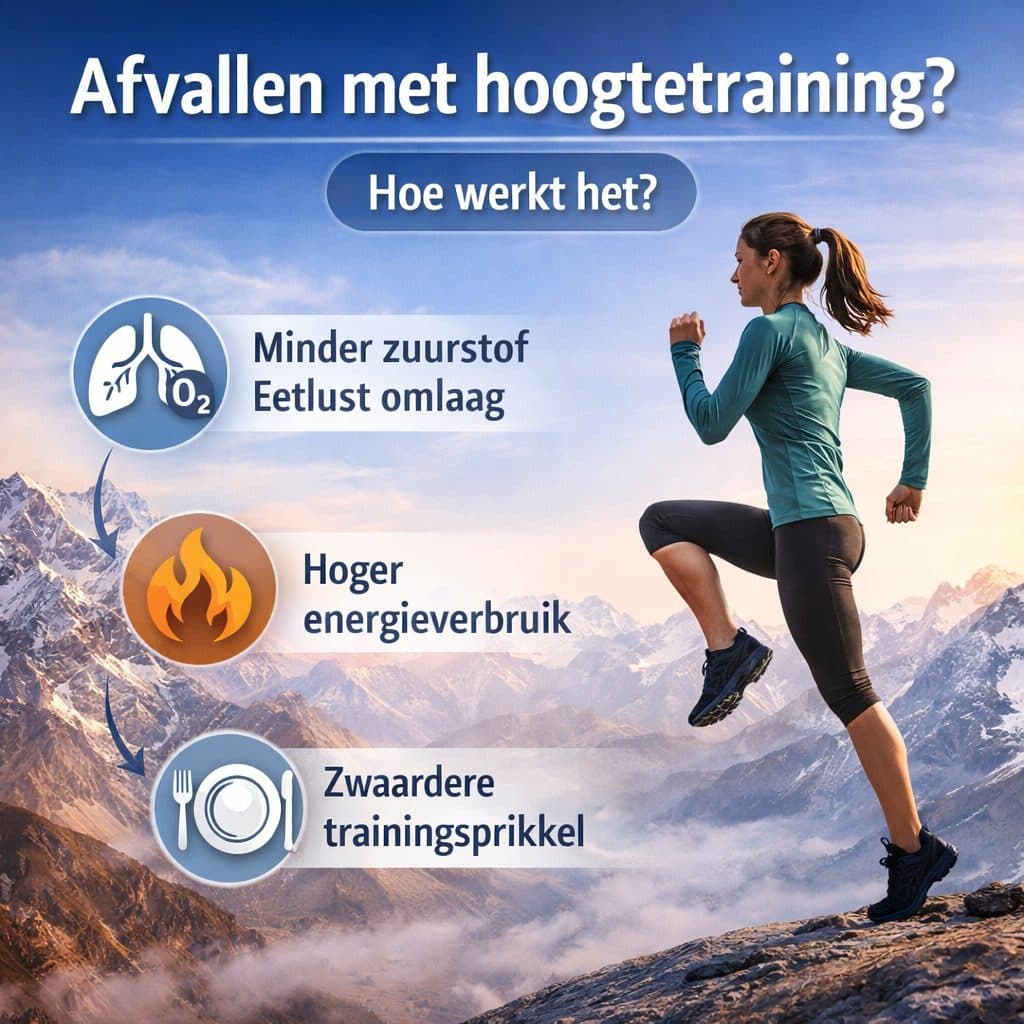
Losing weight with altitude training sounds appealing. You sleep or train in an environment with less oxygen, your body has to work harder and the kilos would naturally follow. Yet it is more nuanced. Altitude training can affect certain processes relevant to weight loss, such as appetite, energy consumption and exercise load. But it is not a magic shortcut. Those who want to lose fat still need a good plan for nutrition, recovery and training composition. Research shows that hypoxia sometimes has acute effects on appetite and energy intake, but that long-term and reliable additional weight loss is certainly not a given.
In this article, you will read what altitude training does and does not do for weight loss, for whom it can be useful and how to avoid sacrificing muscle mass, training quality or recovery in particular.
The essentials in 30 seconds
Altitude training can support weight loss indirectly because hypoxia can temporarily affect appetite, energy consumption and exercise sensation.
But without nutritional control, adequate protein intake and smart training dosage, the effect is often small or inconsistent.
So don't think of altitude training as fat-loss hacking, but as an extra incentive within a broader plan.
What is the short answer?
Losing weight with altitude training sometimes works supportively, but rarely on its own. The greatest chance of results occurs when you use hypoxia alongside a controlled diet, adequate strength training, good recovery and objective monitoring. Recent meta-analyses show that training in normobaric hypoxia in overweight people does not score markedly better than comparable training in normal oxygen conditions when it comes to body weight, BMI or waist circumference.
- Hypoxia can temporarily lower your appetite
- Your body experiences an additional physiological stimulus
- Some workouts feel heavier with the same load
- But long-term extra fat loss is not automatically proven
Therefore, the right question is not, “Does altitude training make you lose weight?” but, “Can altitude training support my weight loss strategy smarter?”
Why do many people think height automatically helps them lose weight?
This idea does not come from nowhere. At altitude or in simulated altitude, many people react differently to exertion, appetite and fatigue. Moreover, the body consumes extra energy to deal with less available oxygen. This logically creates the impression that fat loss would be faster.
In practice, these effects are often smaller than thought. There are studies showing lower energy intake or changes in hormones around hunger and satiety during hypoxic exposure. However, other studies show no meaningful difference in longer-term body weight or fat mass. :contentReference[oaicite:5]{index=5}
💡 Did you know?
The body reacts to less oxygen not only with increased ventilation, but often also with changes in exertion, sleep and appetite. As a result, altitude sometimes feels “effective”, while the ultimate effect on fat loss may still be limited.
What mechanisms can support weight loss?
There are roughly four routes through which altitude training can affect weight loss.
1. Temporary impact on appetite
In some people, spontaneous energy intake decreases during hypoxic exposure. This seems to be associated with changes in appetite signals and general sense of satiety. This effect is not equally strong in everyone and does not always persist for a long time.
2. Higher physiological load
At the same absolute training load, work in hypoxia often feels heavier. This can be beneficial when you want to provide a training stimulus without extremely high speeds or powers. At the same time, there is also a risk in this: you can get tired faster and therefore actually deliver less quality.
3. Possible higher energy consumption
The body has to adapt to an environment with less oxygen. Ventilation increases, cardiorespiratory load shifts and recovery can take more energy. This sounds beneficial, but in practice the extra consumption is usually not large enough to make much difference without a nutrition strategy.
4. Better training structure
For some athletes, altitude training works mostly indirectly. Those who work with a schedule, keeping track of sleep, nutrition and saturation trends often automatically start living in a more structured way. And that very consistency is often the real driver of fat loss.
If you want to understand the basics first, read also altitude training and how altitude training works. For the role of oxygen deprivation physical reactions to oxygen deprivation also relevant.
What does the science really say?
The science is nuanced on this point. Brief exposure to hypoxia can have measurable effects on appetite, energy intake and certain metabolic signals. But when you look at hard outcomes such as weight, fat percentage or waist circumference over several weeks, the picture becomes less spectacular. A recent systematic review and meta-analysis found no clear superiority of normobare hypoxia training over regular training for primary body composition outcomes in obese adults.
| Ask | What the data suggests | Practical conclusion |
|---|---|---|
| Does appetite sometimes descend into hypoxia? | Yes, sometimes temporarily | Can help, but is not reliable enough as a main strategy |
| Is your body consuming extra energy? | Probably slightly elevated | Too small an effect to replace nutrition |
| Do you fall off demonstrably faster? | Not consistently proven | Only valuable within overall plan |
| Can training subjectively feel heavier? | Yes | Proper dosing is crucial |
📊 Research shows
That acute hypoxia can produce effects on appetite and energy intake, but does not automatically translate to markedly better fat loss than similar training in normoxia. This is precisely why context is more important than the trick itself.
Who can lose weight with altitude training be interesting for?
Altitude training can be of particular interest to three groups.
Athletes who want to get lighter without just turning up the volume
In runners, cyclists and endurance athletes, it is sometimes useful to create an additional training stimulus without endlessly increasing the mechanical load. Altitude can then be an additional factor, provided the training quality remains guarded.
People motivated by measurability
Those who like to work with structure often benefit from a system that tracks sleep duration, SpO2 trend, fatigue and training load. Then altitude training becomes a behavioural anchor, not just a physiological stimulus.
Mountain athletes looking to combine fat loss and acclimatisation
For expeditioners, pre-acclimatisation can be useful, but again, the main reason is acclimatisation, not weight loss. Fat loss should be a side effect at most. For practical acclimatisation altitude tent use assembly diagram relevant. Those wanting to track their response in addition will also benefit from oxygen saturation at altitude.
When does it actually backfire?
Losing weight with altitude training can go wrong when the basics are wrong. This happens more often than many people think.
You don't eat enough protein
Then you lose lean mass more easily. This is extra unfavourable if you already train a lot.
You train too hard in hypoxia
Then the quality of your sessions sags. The result is more fatigue, less progression and sometimes actually more snacking later in the day.
You sleep worse
Hypoxia can affect sleep quality. Poorer sleep usually makes weight loss harder, not easier.
You expect a shortcut
Those who think that sleeping in an altitude tent makes fat disappear automatically often end up disappointed. Hypoxia is a stimulus, not a substitute for energy balance.
⚠️ Reality check
If high training noticeably worsens your sleep, recovery or training quality, chances are you will be worse off on net. Then it is wiser to lower the dose first or go back to a more stable base.
How do you do it smart if fat loss is your goal?
The best approach is calm, measurable and conservative.
- First, define your main goal. Do you mainly want to lose weight, mainly improve performance or acclimatise?
- Use hypoxia as an additional stimulus, not a main strategy.
- Keep your energy deficit down. Too great a deficit undermines recovery and muscle maintenance.
- Make sure you get enough protein. Especially if you do a lot of endurance work.
- Schedule strength training. This is how you protect muscle mass while losing weight.
- Build height gradually. Especially when sleeping in an altitude tent.
- Evaluate each week objectively. Not on one single morning value, but on trends.
Those with additional sports-oriented thinking can also click through to altitude training for runners as additional context.
This is how you monitor this lens
At Altitude Dream, this is the part where many people make a difference. Not by going harder, but by looking better.
- SpO2 trend: look at several days, not one single measurement
- Sleep quality: do you wake up rested or restless?
- Recovery: how do legs, motivation and training sense feel?
- Weight trend: look per week, not per day
- Waist and mirror image: often more useful than body weight alone
- Training quality: can you still do your core sessions well?
- Symptoms: headaches, restless sleep, notable fatigue or irritability
A simple decision rule helps: if your weight drops slightly, your training quality remains on par and your SpO2 trend remains stable within your normal pattern, then you are often in the right place. If your weight does drop, but sleep, recovery and performance deteriorate at the same time, then you're probably paying too much for too little result.
Which misunderstandings do I see most often?
“More height is always better”
No. Too aggressive simulation often results in worse sleep and lower quality.
“When I have less appetite, it goes perfectly”
Not necessarily. Less appetite can also mean you are not getting enough nutrients for proper recovery.
“I'm losing weight, so it works”
Weight alone says little. You mainly want to lose fat mass and maintain performance.
“A height tent replaces discipline”
Just the opposite is true. Without structure, the effect usually becomes small or temporary.
🧭 In practice
The people who get the most out of high training for body composition are usually not the ones who start most aggressively. Instead, they are the ones who build up slowly, eat well, keep doing strength training and take their recovery seriously.
Conclusion
Losing weight with altitude training can work, but mostly indirectly. Hypoxia can affect appetite, energy expenditure and training perception. Yet the broader literature does not show a convincing picture that training or staying in normobaric hypoxia by itself causes markedly more fat loss than a well-executed normal training plan.
The real gain is usually in the combination: a smart energy deficit, sufficient protein, maintenance of muscle mass, good sleep, objective monitoring and a hypoxic stimulus appropriate to your load capacity. Then altitude training can be a valuable extra layer. Not as a panacea, but as a refinement of a plan that is already right.
Are you an athlete and want to see if an altitude tent fits into your training or body composition plan?
Then check out the pitch tent rental service from Altitude Dream or read more about the physiological basis of altitude training first.
Mini-FAQ
Do you automatically fall off in a high altitude tent?
No. An altitude tent can be supportive, but without a proper nutrition and training plan, the effect is often small.
Does altitude suppress your appetite?
This may happen temporarily, but not to everyone and not always long-term. So don't use it as your only strategy.
Is altitude training better than regular training for fat loss?
Current meta-analyses show no clear superior effect on body composition compared to similar training in normal oxygen.
Can you lose muscle mass if you try too hard to lose weight in hypoxia?
Yes. Especially if you eat too little, get too little protein or stack too much intensity.
What is the smartest way to test it?
Work with a gentle build-up, track your SpO2 trend, sleep, recovery and training quality and evaluate by week rather than by day.


