Kilimanjaro Lemosho vs Machame route: which is better for acclimatisation?
Published 13 March 2026 · 3 min read
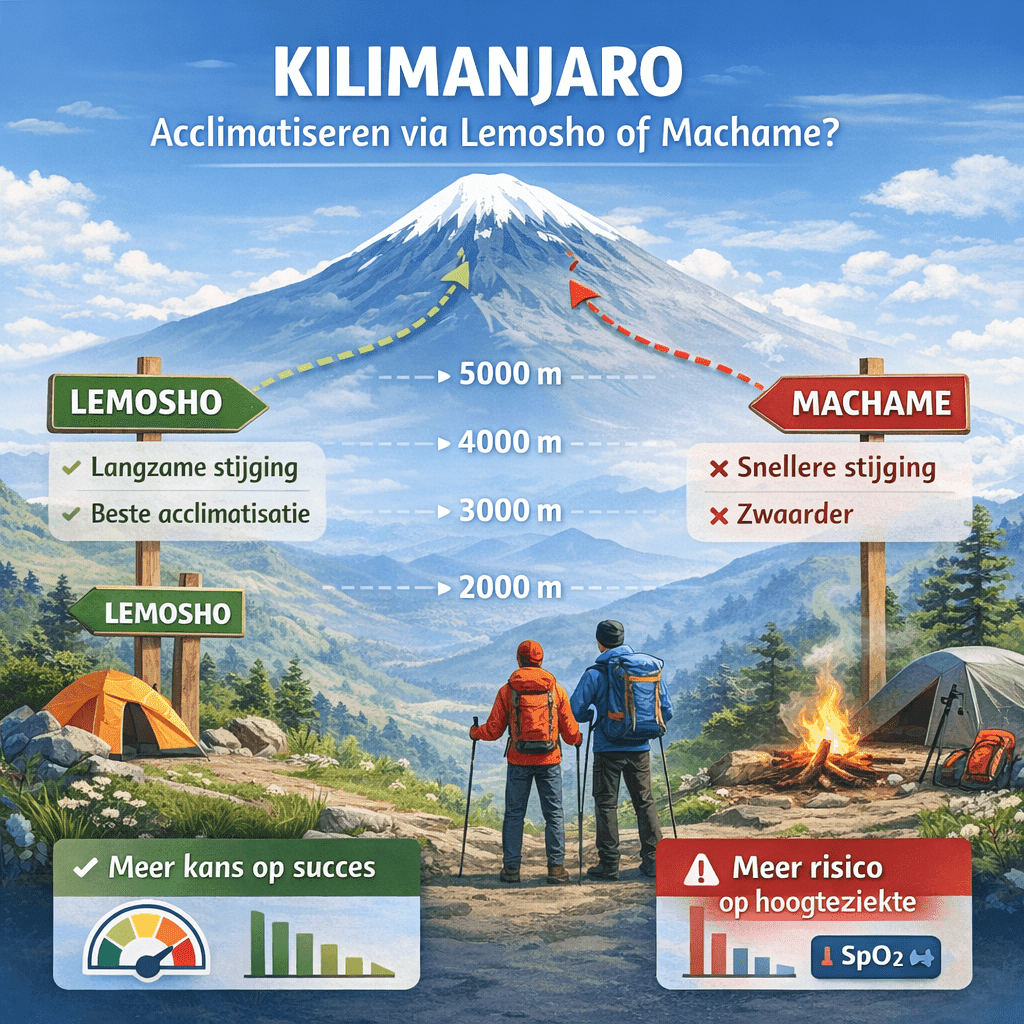
The question Kilimanjaro Lemosho vs Machame route: which is better for acclimatisation is often asked by climbers who want to avoid altitude sickness and increase their chances of success. Both routes are among the most popular on Kilimanjaro, but they differ markedly in ascent profile, acclimatisation rate and success rate.
Choosing the right route significantly increases the chances of a safe and successful ascent. In this article, we compare the Lemosho and Machame routes specifically in terms of acclimatisation, altitude structure and risk of altitude sickness.
Read also:
Best acclimation schedule Kilimanjaro
preventing altitude sickness complete guide
acclimatising at home for mountain expeditions
🧭 The essentials in 30 seconds
- Lemosho route usually gives better acclimatisation than Machame
- Lemosho starts lower and rises more gradually
- Machame is faster and therefore slightly heavier on the body
- Both routes are safe with good schedule
- Extra acclimatisation beforehand greatly increases success
📊 Difference in acclimatisation between Lemosho and Machame
| Feature | Lemosho | Machame |
|---|---|---|
| Start height | ± 2100 m | ± 1800 m |
| Duration | 7-8 days | 6-7 days |
| Acclimatization | Very good | Good |
| Success rate | high | average |
| Risk of altitude sickness | lower | up sth. |
🏔 Why Lemosho is often better for acclimatisation
The Lemosho route is considered by many guides to be the best route for acclimatisation. This is because of its longer duration and more gradual ascent profile.
- more days at altitude
- slower rise
- better sleep high train low profile
- more time above 3500 metres
Especially the extra acclimatisation moment around Lava Tower makes a big difference.
⚠️ Why Machame may give a little more risk
The Machame route is popular because it is shorter and cheaper. But the body gets less time to adjust.
- faster increase
- fewer rest days
- more load above 4000 metres
With a good schedule, Machame is safe, but for people prone to altitude sickness, Lemosho is usually a better choice.
📊 Oxygen percentage at altitude during Kilimanjaro
| Height | Oxygen available | Impact |
|---|---|---|
| 2000 m | 80% | slight adjustment |
| 3000 m | 70% | acclimatisation needed |
| 4000 m | 60% | great burden |
| 5000 m | 50% | high risk without acclimatisation |
| 5895 m | 47% | top zone |
See also:
height to oxygen table
🧠 This is how you monitor acclimatisation objective
- SpO2 trend per day
- sleep quality
- headache/nausea
- recovery after exercise
Important:
- SpO2 should rise as trend
- symptoms should decrease
- sleep must improve
🏕 Can you improve acclimatisation beforehand?
Yes. Many climbers use an altitude tent beforehand to get the body already used to oxygen deprivation.
- simulation up to 3000-4000 m
- more red blood cells
- faster acclimatisation
- less risk of altitude sickness
This makes a big difference especially on shorter routes.
📋 When to choose Lemosho and when to choose Machame
- Lemosho → best acclimatisation
- Lemosho → highest success
- Lemosho → more time
- Machame → cheaper
- Machame → shorter
- Machame → slightly heavier
❓ FAQ
Is Lemosho better than Machame?
For acclimatisation, it usually does, as the route is longer.
Is Machame more dangerous?
No, but the pace is faster.
Which route has highest success?
Lemosho often has the highest success rate.
Do you always need acclimatisation?
Yes, above 3,000 metres always.
✅ Conclusion
If acclimatisation is most important, the Lemosho route is usually the best choice. The longer duration and more gradual ascent give the body more time to adjust. The Machame route is fine, but requires good preparation and possibly extra acclimatisation beforehand.
Want to increase your chances of success on Kilimanjaro?
For climbs around 5000-6000 metres, many climbers use a pre-acclimatisation programme.
View Kilimanjaro acclimatisation programme
Read experiences of other climbers