
Epo natural increase: what is proven to work and what is marketing
Published 24 February 2026 · 3 min read
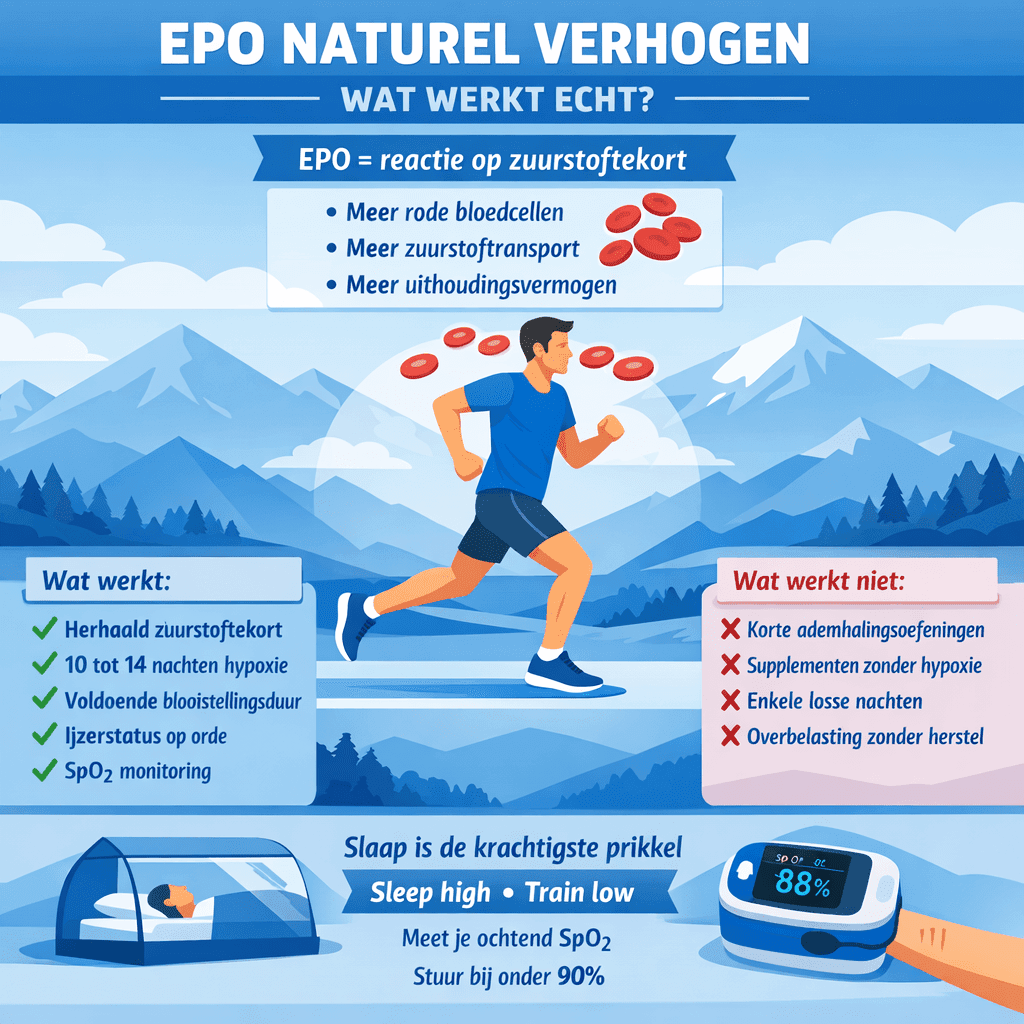
Those who want to improve their sports performance sooner or later end up with EPO. The hormone plays a central role in oxygen transport and endurance. The only question is: can you increase EPO naturally without banned substances, and if so, what really works?
In this article, we separate physiological facts from marketing stories. You get a clear overview of proven strategies, what is better to ignore and how to monitor it objectively.
Why EPA is so often misunderstood
EPO, in full erythropoietin, is often directly associated with doping. That picture is understandable, but incomplete. The body continuously produces EPO itself, mainly in response to oxygen deprivation. That natural mechanism is the basis of legitimate performance enhancement.
Many commercial claims play into this, but lack a physiological underpinning. Supplements, breathing tricks or quick hacks promise more EPO, without activating the fundamental signal your kidneys need.
What exactly EPO does in the body
EPO is produced in the kidneys when the oxygen supply structurally decreases. This hormone stimulates the bone marrow to produce extra red blood cells. More red blood cells means more haemoglobin, and thus more oxygen transport to muscles.
Importantly, this process takes time. EPO peaks within days, but the effect on red blood cells can only be seen after two to three weeks.
The only proven stimulus: controlled oxygen deprivation
The science here is remarkably consistent. Only a sufficiently strong and repeated hypoxic stimulus activates EPO production. That means:
- lower oxygen percentage
- sufficient exposure time
- multiple consecutive days
This explains why altitude training can be so effective, if applied correctly.
Why altitude training works for EPO
During altitude training, available oxygen pressure drops. The body interprets this as a threat to oxygenation and reacts adaptively. The kidneys increase EPO release to compensate.
The effect is strongest when sleep is used as the primary stimulus. During sleep, breathing is calmer and the hypoxic stimulus is more constant.
Therefore, sleeping in an altitude tent or prolonged stays at altitude is at the heart of effective EPO stimulation.
What demonstrably does not work
There are many methods that are popular but physiologically unsupported:
- short breathing exercises without structural oxygen deficiency
- supplements without hypoxic stimulus
- several nights at altitude without repetition
- training in hypoxia without sufficient recovery time
Without repeated oxygen deprivation, the signal for sustained Epo production is missing.
The role of iron in EPO enhancement
EPO can only be effective if sufficient iron is available. Without iron, the body cannot build new red blood cells.
Therefore, it is crucial to check iron status in prolonged hypoxia. You can read more about this in iron and nutrition during altitude training.
This is how you monitor this lens
1. SpO2 trend
Measure your oxygen saturation daily upon waking. Not the absolute value is leading, but the trend. A steady decline with gradual adaptation indicates effective stimulus.
2. Sleep quality
Restless sleep, frequent waking or sharp drop in recovery score are signals to lower the stimulus.
3. Subjective sense of recovery
Watch for daytime fatigue, headaches or reduced training quality.
Decision rule: If your morning SpO2 drops below 90 per cent or your sleep deteriorates for several days, you lower the hypoxic stimulus.
Deploy high altitude tent correctly
An altitude tent works with normobaric hypoxia. Air pressure remains the same, oxygen levels fall. Sleep forms the primary stimulus, training preferably remains at normal oxygen levels.
What is important is step-by-step acclimatisation and SpO2-controlled adjustment. An altitude tent is no substitute for acclimatisation, but it significantly reduces the risk of altitude sickness and makes the process controllable.
A detailed explanation can be found in the complete guide to using an altitude tent.
For whom is EPO augmentation useful?
- endurance and stamina athletes
- runners and cyclists
- athletes with performance plateau
- athletes towards peak moment
Not every athlete benefits equally. Timing, training load and recovery determine returns.
Summary
- Increase EPO naturally can, but only via oxygen deprivation
- altitude training is the best substantiated method
- supplements without hypoxia are insufficient
- always monitor SpO2, sleep and recovery
Ready to apply this in a controlled way?
Want to boost EPO in a safe and measurable way?
More and more athletes are opting for supervised altitude training.


