Hypoxia in ME/CFS and fibromyalgia: what early studies tentatively suggest
Published 18 May 2026 · 11 min read
The core point is important: there is currently no hard evidence that altitude training, intermittent hypoxic training or an altitude tent can treat ME/CFS or fibromyalgia. Nevertheless, the initial studies and ongoing research are interesting. They show that controlled hypoxic stimuli may have an influence on biological systems involved in energy production, autonomic regulation and recovery.
Short answer: Hypoxia in ME/CFS and fibromyalgia is an early research direction around oxygen use, mitochondria and recovery.
Important: Hypoxia is not a proven treatment for ME/CFS or fibromyalgia. Current studies are small, exploratory, or ongoing.
Practical conclusion: Anyone following this topic should focus particularly on mechanisms, monitoring and safety, not on quick claims.
Conclusion: Early studies suggest that hypoxic stimuli may affect systems relevant in ME/CFS and fibromyalgia.
Nuance: The evidence base is still too limited for medical claims, treatment advice, or standard protocols.
Practical hook: For the time being, the value lies mainly in better understanding how oxygen consumption, energy and recovery are related.
⚠️ Medical Disclaimer
This article is informative and does not replace medical advice. ME/CFS and fibromyalgia are complex conditions. Always consult with a doctor or specialist before experimenting with hypoxic stimuli, exercise, altitude exposure, or other interventions.
Why hypoxia is scientifically interesting in ME/CFS
ME/CVS is often characterised by profound fatigue, post-exertional malaise, cognitive complaints, sleep disturbance, autonomic dysfunction, and a notably delayed recovery after physical or mental exertion. According to the NICE guideline, post-exertional malaise is even a core symptom of ME/CVS. The NICE guideline for ME/CFS emphasises the importance of pacing, individual boundaries, and caution.
That makes Hypoxia in ME/CFS Interesting, but also sensitive. A hypoxic stimulus is not a normal training stimulus. The body is temporarily offered less oxygen. In healthy athletes, this can trigger adaptations. In people with ME/CFS, an extra stimulus can actually be too much when the recovery mechanism is already under pressure.
The scientific question, therefore, is not: can hypoxia resolve ME/CVS? The better question is: what does hypoxia teach us about energy production, oxygen utilisation, microcirculation and recovery in people with chronic fatigue complaints?
Also in research into physical reactions to oxygen deprivation it becomes clear that hypoxia affects multiple systems simultaneously. Consider breathing, heart rate, blood flow, hormonal signals, and cellular oxygen response.
What hypoxia precisely means in this context
Hypoxia means that tissues or cells have less oxygen available than normal. This can occur at high altitudes, with certain conditions, with impaired blood flow, or in controlled environments where the oxygen concentration is deliberately lowered.
Inside altitude training Hypoxia is usually applied in a controlled manner. The aim is then to provide a physiological stimulus without unnecessarily overtaxing the body. In the sports context, it often concerns performance, oxygen transport and adaptation. In ME/CFS and fibromyalgia, the question is much more sensitive. Here, it is more about tolerance, recovery and biological response.
It is also important to note the difference between acute hypoxia and controlled, mild hypoxic exposure. Acute or severe hypoxia can be taxing. Mild hypoxic stimuli are being studied precisely because they may be able to activate adaptive stress responses. This does not automatically mean they are safe or beneficial for every patient.
🧭 In practice
One should never view a hypoxic stimulus as sports training in cases of chronic complaints. The question is not how high or how intense someone can go, but how low, short, and controlled the stimulus must remain to avoid triggering a relapse.
Hypoxia in ME/CFS: what early studies cautiously suggest
The current literature surrounding Hypoxia in ME/CFS is still limited. However, there are clear research lines. Some studies look at mitochondrial function. Other research examines oxygen extraction, blood flow, autonomic regulation, or recovery after exercise.
In addition, research is being conducted into intermittent hypoxia-hyperoxia treatment in people with post-viral ME/CVS and long-term symptoms after COVID-19. In the registration of this clinical study Specific attention is paid to fatigue, pain, quality of life, mitochondrial dysfunction and autonomic dysregulation. That is interesting, but as long as results are lacking or limited, this remains a research direction and not a proven intervention.
| Field of research | What researchers are looking at | Why this may be relevant | Important nuance |
|---|---|---|---|
| Mitochondria | Energy production and oxygen use in cells | Can help explain why recovery is delayed | No clear cause-and-effect relationship yet |
| Microcirculation | Blood flow and oxygen release in tissues | Can be relevant for exercise intolerance | Measurements vary greatly between studies |
| Autonomic nervous system | Heart rate, stress response, recovery and regulation | Join complaints such as dizziness and palpitations | Individual differences are large |
| Hypoxic stimulus | Short or controlled exposure to less oxygen | Can activate adaptive stress pathways | No proven treatment protocol |
What researchers are looking at: Energy production and oxygen use in cells.
Relevance can help explain why recovery is delayed.
Nuance: No clear cause-and-effect relationship yet.
What researchers are looking at: blood circulation and oxygen delivery to tissues.
Relevance may be relevant in cases of exertion intolerance.
Nuance: measurements vary greatly between studies.
What researchers are looking at: heart rate, stress response, recovery, and regulation.
Relevance joining complaints such as dizziness and palpitations.
Nuance: Individual differences are significant.
What researchers are looking at: Short or controlled exposure to low oxygen.
Relevance can activate adaptive stress pathways.
Nuance: There is no proven treatment protocol.
The common thread is therefore caution. Hypoxia appears relevant because it directly challenges the body's oxygen use and energy metabolism. However, the leap from mechanistic insight to practical treatment is a large one.
Fibromyalgia, hypoxia and mitochondria
Interest in mitochondria, oxidative stress, muscle blood flow, and energy metabolism also exists in the case of fibromyalgia. A study in Scientific Reports on fibromyalgia and mitochondrial dysfunction found indications of changes in metabolites and blood flow in fibromyalgia patients compared to healthy controls.
That does not mean that fibromyalgia is simply an oxygen problem. It does mean, however, that oxygen usage, local blood flow, and cellular energy production are meaningful research topics.
Fibromyalgia often involves a combination of pain processing, sleep quality, fatigue, stress response, muscle complaints, and recovery. Hypoxia does not directly affect all of these systems. Nevertheless, a controlled oxygen stimulus can theoretically influence multiple biological pathways simultaneously.
Therefore, a cautious hypothesis arises: if certain patients have problems with energy production, oxygen utilisation, or recovery regulation, then controlled hypoxia might help to understand those systems better. That is something different from saying that hypoxia treats fibromyalgia.
Why evidence around hypoxia in ME/CFS is still limited
The biggest problem is that ME/CFS and fibromyalgia are heterogeneous conditions. Not every patient has the same symptom profile. Not everyone reacts the same way to exertion. And not every study uses the same measurement methods.
That's why it's difficult to draw general conclusions.
What we can cautiously say and what we can't yet.
- Well: Oxygen consumption and energy production are relevant research topics.
- Not: Hypoxie is a proven treatment for ME/CFS or fibromyalgia.
- Well: Some studies and trials are investigating hypoxic stimuli in chronic fatigue complaints.
- Not: There is a safe standard protocol for patients.
- Well: Monitoring and individual tolerance are crucial.
- Not: Experiences from the world of sport are automatically applicable.
Furthermore, placebo effects, expectations, natural fluctuations in symptoms and measurement variability are difficult to separate in these conditions. A patient may feel temporarily better, while this says nothing about structural recovery or long-term safety.
Why caution is extra important with ME/CFS
Post-exertional malaise is an important consideration with ME/CFS. This means that symptoms can worsen after physical, mental, emotional, or social exertion. Sometimes this happens immediately. Often, the relapse only occurs later.
This makes Hypoxia in ME/CFS unlike hypoxia in healthy athletes. In sport, a controlled stimulus is often intended to induce adaptation. In ME/CFS, a stimulus that seems mild at the time can later prove to be too much.
| Context | Purpose of the stimulus | Prognosis | Risk of too much stimulation |
|---|---|---|---|
| Healthy athlete | Adaptation and performance improvement | Recovery usually predictable | Fatigue or overreaching |
| Fibromyalgia | Possible insight into pain, energy and recovery | Strongly fluctuating | Increase in pain, fatigue, or sleep problems |
| ME/CFS | For now, primarily of research value | Often delayed and unpredictable | Post-exertional malaise or relapse |
Objective: Adaptation and performance improvement.
Recovery: Usually predictable.
Risk: Fatigue or overreaching.
Objective: Possible insight into pain, energy, and recovery.
Recovery: Strongly varying.
Risk: increase in pain, fatigue, or sleep disturbances.
Objective: voorlopig vooral onderzoekswaarde.
Recovery: often delayed and unpredictable.
Risk: post-exertional malaise or relapse.
That is precisely why it is unwise to directly adopt protocols from performance sports. The starting question should not be how quickly someone can build up. The starting question should be how much stimulus someone can tolerate without a setback.
What forms of hypoxic stimuli are being investigated?
There are multiple forms of controlled hypoxic exposure. They differ significantly in duration, intensity, and load.
| Form | Description | Potential benefit | A word of caution |
|---|---|---|---|
| IHE | Passive exposure to hypoxia | Stimulation without physical exertion | No standard protocol yet |
| IHT | Short hypoxic sessions, sometimes combined with light exertion | Can activate the physiological stress response | Tax can be too heavy with PEM |
| IHHT | Alternation between hypoxia and hyperoxia | Is being investigated in post-viral fatigue | Provisional experimental |
| LHTL | Sleeping with less oxygen, living a normal life during the day | Slow, controlled stimulus | Not investigated as a treatment for ME/CFS |
Description: passive exposure to hypoxia.
Potential benefit Stimulation without physical effort.
Annotation: no standard protocol yet.
Description: Short hypoxic sessions, sometimes combined with light exertion.
Potential benefit can activate the physiological stress response.
Annotation: The burden of taxation can be too heavy with PEM.
Description: alternation between hypoxia and hyperoxia.
Potential benefit is being investigated in post-viral fatigue.
Annotation: Provisional experimental.
Description: Sleeping with less oxygen, normal life during the day.
Potential benefit Slow, controlled stimulus.
Annotation: not investigated as a treatment for ME/CFS.
The principle of sleep high train low is mainly used in sport and acclimatisation. In this process, someone sleeps in an environment with less oxygen, while training or daily activity takes place at normal altitude.
With chronic complaints, it is crucial not to confuse this sports logic with medical application. A hypoxia tent makes hypoxia controlled, measurable, and plannable, but that does not mean it is automatically suitable for people with ME/CFS or fibromyalgia.
How to objectively monitor hypoxia in ME/CFS or fibromyalgia
When someone with chronic complaints experiments with hypoxic stimuli in consultation with a doctor, monitoring must be central. Feeling alone is insufficient, as relapse can occur with a delay.
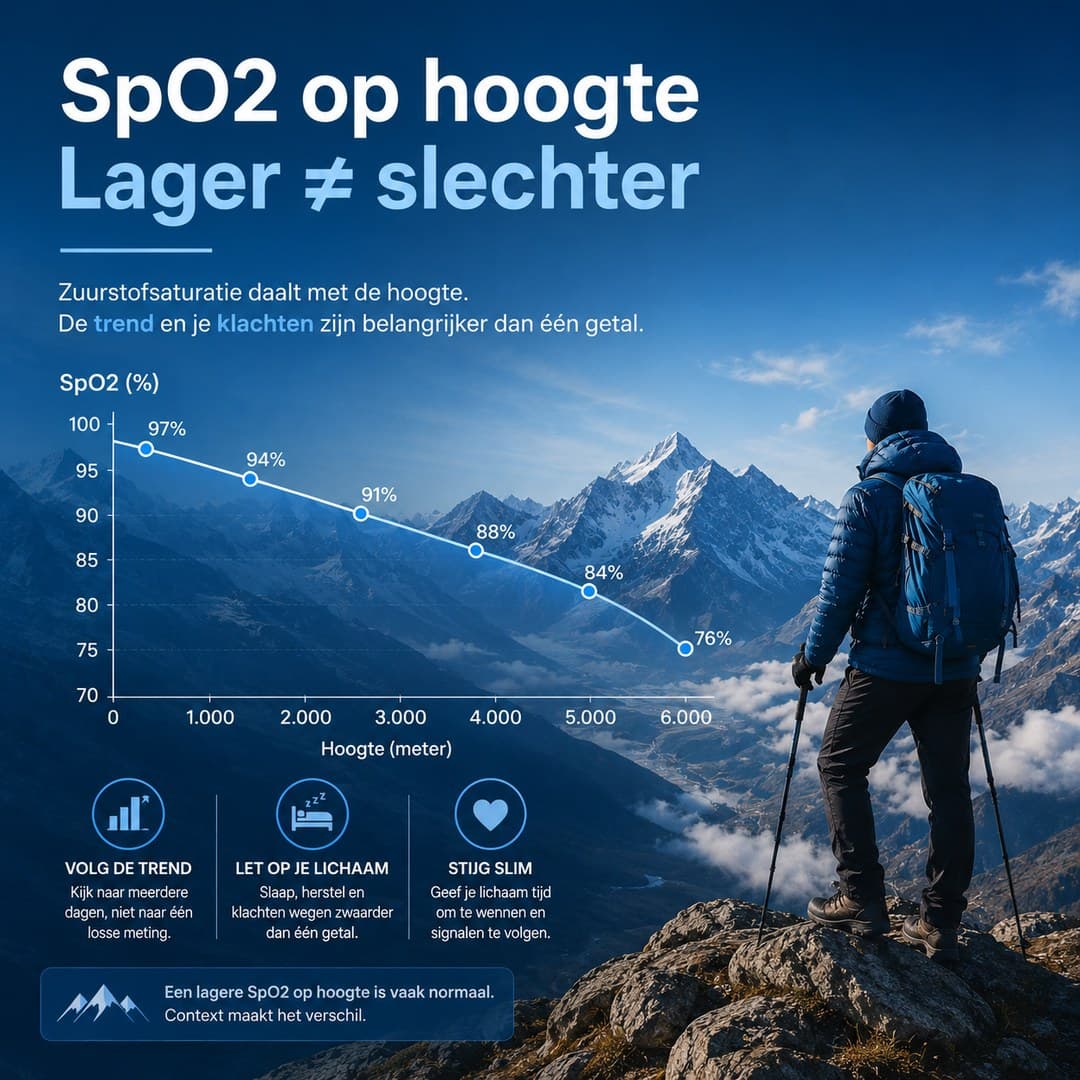
- Always measure SpO2 as a trend, not as an isolated absolute value.
- Record sleep quality and overnight recovery for at least several days.
- Track resting heart rate and HRV if available.
- Observe cognitive complaints, pain, dizziness, and shortness of breath.
- Note relapse 24 to 72 hours after stimulation.
- Reduce or stop if there is clear deterioration.
- Do not use sports protocols without medical guidance.
A standalone saturation value says little without context. Therefore, you should always combine SpO2 with sleep, recovery, symptoms and trends over multiple days. Those who want to understand more deeply how saturation is interpreted, can find more background information in our guide on oxygen saturation at altitude.
💡 Did you know?
When exposed to hypoxia, the response after the event is sometimes more important than the response during the stimulus. Particularly with ME/CFS, a relapse can occur later, making monitoring over several days necessary.
Extra caution is necessary for whom?
Not everyone with chronic fatigue complaints reacts the same. Nevertheless, there are situations where caution is extra important.
Be extra careful with:
- Severe post-exertional malaise
- marked relapse after minimal exertion
- unstable sleep quality
- dizziness, palpitations or orthostatic complaints
- Shortness of breath or low saturation without a clear explanation
- severe pain flare-ups after exertion
- Use of medication that affects breathing, heart rate or blood pressure
In these situations, it is not advisable to experiment independently. The potential gain is uncertain, while the chance of disruption can be real.
Wat betekent dit voor Altitude Dream en hoogtetraining?
Altitude Dream specialises in controlled hypoxia, altitude training and pre-acclimatisation. Our systems are mainly used by mountaineers and athletes who wish to prepare for altitude or performance.
For ME/CFS and fibromyalgia, the situation is different. A hard commercial claim is not appropriate here. An altitude tent or hypoxic system is not a treatment for these conditions. However, our expertise in oxygen stimulation, monitoring, and safe progression can help to carefully explain the topic.
The correct attitude is therefore one of restraint and scientific rigour. Hypoxia can be an interesting window for research. It can help to better understand how the body reacts to less oxygen. However, it should not be presented as a solution for a complex chronic condition.
Frequently asked questions about hypoxia in ME/CFS and fibromyalgia
Is hypoxia a proven treatment for ME/CFS?
No. Hypoxia in ME/CFS is not a proven treatment. It is an early research direction surrounding oxygen use, energy production and recovery mechanisms.
Why are researchers looking into hypoxia in ME/CFS?
Because ME/CFS is often accompanied by exercise intolerance, delayed recovery, and possible disturbances in energy metabolism. Hypoxia affects these physiological systems.
Is hypoxia scientifically researched in fibromyalgia?
Research into fibromyalgia has primarily focused on mitochondria, oxidative stress, muscle blood flow, and energy metabolism. Direct evidence for hypoxia as a treatment is lacking.
Can a sleeping tent for altitude acclimatisation help with chronic fatigue?
There is insufficient evidence for this. An altitude tent can offer controlled hypoxia, but it is not a recognised treatment for ME/CFS or fibromyalgia.
What should someone pay particular attention to?
Pay particular attention to delayed relapses, sleep quality, SpO2 trend, heart rate, HRV, and post-exertional malaise. Stop if there is clear deterioration.
Resources and deepening
Learn more about hypoxia and oxygen deficiency?
Do you want to better understand how the body reacts to less oxygen, acclimatisation, and hypoxic stimuli? Then start with our in-depth guide to the physiology behind altitude training.
Conclusion: Hypoxia in ME/CFS primarily requires nuance
Hypoxia in ME/CFS Fibromyalgia is an interesting but still early area of research. The initial studies and ongoing investigations are primarily focused on oxygen consumption, mitochondria, autonomic regulation, microcirculation, and recovery.
These are relevant themes, as many patients struggle with exercise intolerance, delayed recovery, sleep disturbances, and energy problems. However, the step towards treatment has not yet been taken. Larger, well-controlled studies are needed for this.
The most sensible conclusion is therefore a cautious one. Hypoxia can help to better understand certain biological processes. However, with ME/CFS and fibromyalgia, any application must be considered with medical guidance, low exertion, strict monitoring, and great respect for individual limits.