Impact after a month of altitude tenting: this is how to use your accrued benefit smartly
Published 10 August 2012 · 13 min read

A effect after one month of high altitude tent is not just in how long it sticks. The better question is: after four weeks, what do you know about your body, your response and your timing? After a month of sleeping under normobaric hypoxia, you usually have enough information to decide whether to stabilise, prolong, taper or just make room for recovery and taper.
This article therefore deliberately looks at the subject differently from our new editorial on how long your height effect stays. That editorial gives the broad back count for expedition and sport. This guide mainly helps you decide your next step after a month of altitude trekking.
Direct response: after a month of altitude training, the main benefit is not just that your body has had an altitude stimulus. Above all, you have four weeks of data: your SpO2 trend, sleep quality, sense of recovery, tolerance to oxygen-depleted air and reaction to buildup. With that, you can determine much better whether you are ready, need to make adjustments or better align your period with your goal moment.
Conclusion: four weeks of altitude tent is a strong base period for many users.
Nuance: effect varies by person, target, sleep quality, iron status and timing.
Practical hook: Use week four primarily as an evaluation moment, not as an automatic finish line.
Impact after a month of high altitude tenting: what do you really know?
After four weeks altitude tent use your body has received a controlled hypoxic stimulus for several nights. In an altitude tent, air pressure remains normal, but the oxygen percentage in the inhaled air is reduced. We call this normobaric hypoxia. This allows you to sleep under oxygen-depleted conditions at home, while continuing to work, train and recover normally during the day.
A month is long enough to see more than a loose reaction. The first nights mainly say something about habituation. Weeks two and three show whether your body can process the stimulus. Week four often tells whether the chosen altitude, sleep duration and build-up fit your goal.
Therefore, the effect after a month of altitude tenting is not just a physiological outcome. It's also a decision moment. You will see whether you sleep more peacefully in the tent, whether your morning feeling remains stable, whether your SpO2 trend moves logically with you, and whether your training or daily functioning is not overloaded.
In practice: Those who only ask “how long will this effect last after four weeks?” are missing an important part of the value. The better question is “what response have I built and how do I ensure that response is available at the right time?”
Why four weeks is a valuable evaluation limit
Four weeks is not a magic limit. Still, in practice it is a useful period. You have usually made enough nights by then to look past the initial habituation. Moreover, there has often been enough time to build up gradually, without having to make big jumps in the final days.
For athletes, a month of altitude training can coincide with a controlled altitude block. In trekkers and climbers, four weeks often forms a strong basis for pre-acclimatisation towards high travel. In both situations, the same rule applies: value arises only when the stimulus fits your target moment.
In particular, do you want to know how long the accumulated effects last after quitting? Then use the main article on height effect as a countback table. In this article, we zoom in further on the interpretation after one month.
| After 4 weeks, you see mainly | What it means | Practical action |
|---|---|---|
| SpO2 trend | You see whether your body responds stably to the set altitude. | Increase only if trend, sleep and recovery remain good together. |
| Sleep quality | You notice whether the hypoxic stimulus is still taxing. | Stabilise if you sleep restlessly or wake up tired more often. |
| Recovery | You can see if the stimulus fits within training, work and daily load. | Let freshness precede extra height in the final stage. |
| Target timing | You know if your end date is a good fit for departure, summit day or race. | Do not plan from the tenure, but from the real performance moment. |
What it means: you see whether your body responds stably to the set altitude.
Practical action: raise only if trend, sleep and recovery remain good together.
What it means: you notice whether the hypoxic stimulus is still taxing.
Practical action: Stabilise if you sleep restlessly or wake up tired more often.
What it means: you see whether the stimulus fits within training, work and daily load.
Practical action: let freshness precede extra height in the final phase.
What it means: you know whether your end date fits well with departure, summit day or race.
Practical action: plan not from the hire period, but from the real performance moment.
What not to do in the last week of a month of high altitude camping
Many users want to quickly create “maximum effect” in the last week. This sounds logical, but is often not the best strategy. Especially after three weeks of buildup, you don't need to prove how high you can sleep. Above all, you want to check whether your body continues to process the stimulus properly.
Aggressive elevation in the last few days may disrupt sleep quality. As a result, the net effect may become less favourable. Sleeping badly, waking up tired or continuing with symptoms for several days makes preparation less predictable.
Therefore, it is usually smarter to stabilise in week four. Especially when your goal moment is getting close. Those still weeks away from departure or competition can sometimes continue to build quietly. But those who almost have to perform will benefit more from reliability than a final jump up.
Checklist for week four
- Don't automatically increase because the schedule says so.
- Use your SpO2 as a trend over several nights.
- Pay attention to morning feeling, sleep quality and recovery.
- Avoid major changes just before departure or taper.
- Check that your goal moment is still in line with your last night of tents.
- Rather than forcing, stabilise at a tolerable height.
Three scenarios after one month of high altitude tenting
Not everyone has to do the same thing after four weeks. The right choice depends mainly on your goal. A climber leaving for a high expedition in two days has different needs from a marathon runner who wants to peak at sea level in 10 days. Even someone without a clear peak day needs to plan differently.
This is why it helps to think in three scenarios after a month of altitude tenting: expedition, sea level sport performance and maintenance or follow-up planning.
| Scenario | Best focus after 4 weeks | Most logical choice |
|---|---|---|
| Expedition | Keep acute habituation as close to departure as possible. | Often continue until just before departure, as long as sleep and recovery remain good. |
| Match | Height stimulus combine with freshness and taper. | Often stop or phase out around 7 to 10 days before the peak competition. |
| Continued block | Assess response and reset timing. | Only extend if it makes the goal moment better hit. |
Best focus after 4 weeks: keep acute habituation as close to departure as possible.
Most logical choice: often continue until just before departure, as long as sleep and recovery remain good.
Best focus after 4 weeks: height incentive combine with freshness and taper.
Most logical choice: often stop or phase out around 7 to 10 days before the peak competition.
Best focus after 4 weeks: Assess response and redetermine timing.
Most logical choice: extend only if it makes the goal moment better hit.
For expeditions: keep habituation current
For trekkers and mountaineers, it's not just about blood levels. It's also about familiarity with low-oxygen sleep. Can you keep breathing calmly? Do you wake up less often? Does the night in the tent feel less strange than in week one? Those kinds of signals are valuable.
In an expedition, the most important moment is usually not on the departure day. Often the real test is not until the first high roost, the first night above 4,000 or 5,000 metres, or the summit push. Still, it makes sense to keep the home push as close to departure as possible. After that, acclimatisation on location takes over.
An altitude tent does not replace that acclimatisation on location. It does, however, make preparation controlled, measurable and planable. This can significantly reduce the risk of altitude complaints, without ever providing an absolute guarantee.
For athletes: land the stimulus
For athletes, the final phase is different. A runner, cyclist or triathlete does not only want to react physiologically. That one also wants to be fresh at the start. Therefore, after a month of altitude training, the question is often: should I continue, or should I now make room for recovery?
If your competition takes place at sea level, it is usually not necessary to sleep in the tent until the last night. In fact, for many athletes, a short buffer works better. You then utilise the remaining altitude effect, while giving your sleep, recovery and taper more space.
Want to make this more objective? Combine your gut feeling with training data. Look at heart rate response, power output, pace, recovery and possibly test times. You can read more about that approach in the article on measuring altitude training effect.
This is how you monitor this lens
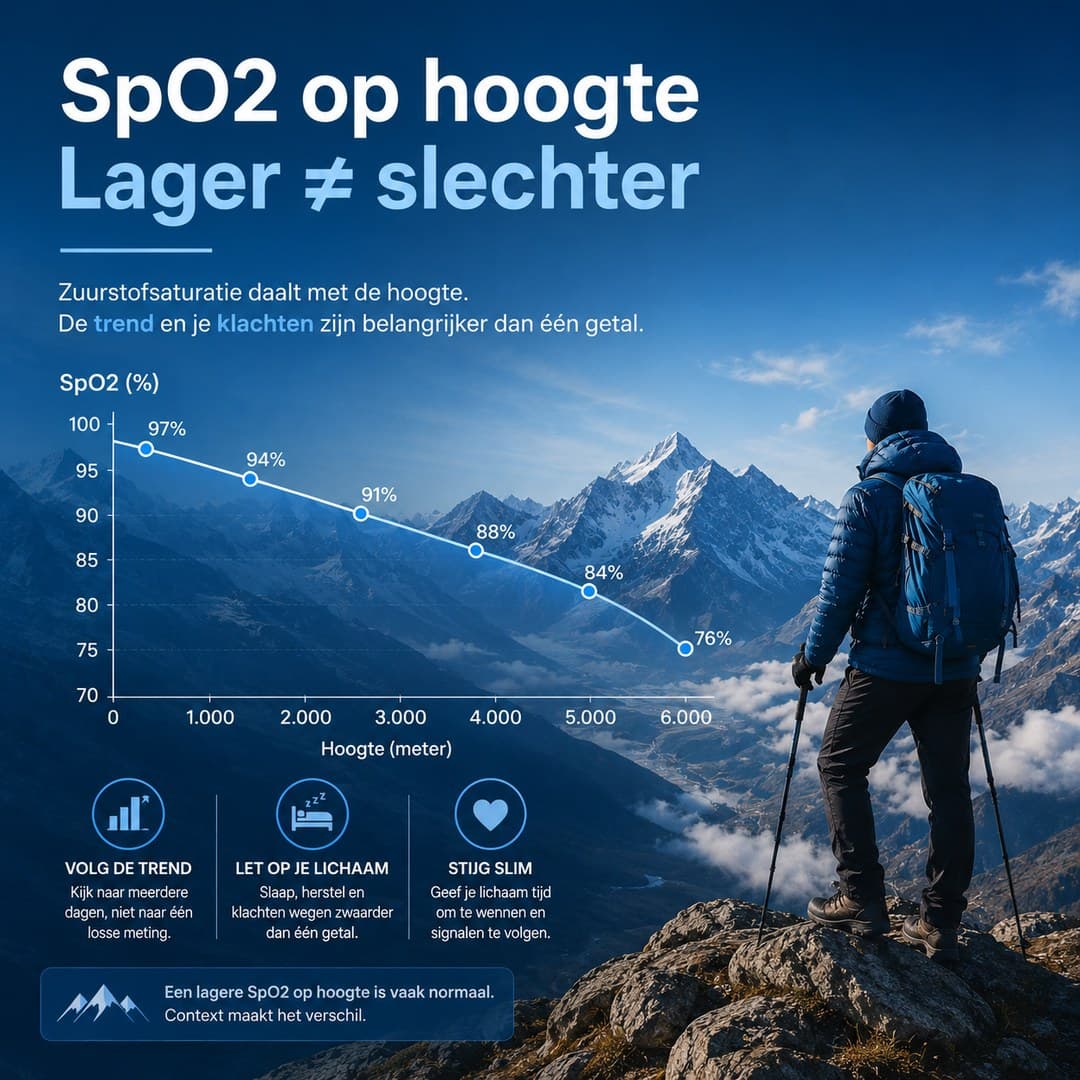
After a month of altitude monitoring is more important than ambition. Not because you have to measure everything clinically, but because you can make much better decisions with a few fixed signals. Above all, the trend counts. One anomalous reading says little. Three to five nights in a row give much more direction.
So never use SpO2 as a loose absolute truth. A saturation meter can vary due to cold fingers, movement, measurement time, sensor position or measurement quality. The value becomes useful only when you link it to sleep, recovery and symptoms.
| Measuring point | What are you looking at? | When to adjust? |
|---|---|---|
| SpO2 | Morning trend over several days, not one single score. | In case of marked decrease combined with poorer sleep or symptoms. |
| Sleep | Falling asleep, sleeping through, feeling rested and headache on waking. | In case of multiple restless nights after an increase. |
| Recovery | Resting heart rate, fatigue, training feel and mental freshness. | In case of accumulating fatigue or declining training quality. |
| Symptoms | Headache, nausea, dizziness, tightness in the chest or feeling unusually unwell. | In case of increasing or persistent symptoms, always slow down. |
What are you looking at? morning trend over several days, not one single score.
When to adjust? in case of marked decrease combined with poorer sleep or symptoms.
What are you looking at? falling asleep, sleeping through, feeling rested and headache on waking.
When to adjust? In case of several restless nights after an increase.
What are you looking at? resting heart rate, fatigue, training feel and mental freshness.
When to adjust? in case of accumulating fatigue or declining training quality.
What are you looking at? headache, nausea, dizziness, tightness in the chest or feeling unusually unwell.
When to adjust? in case of increasing or persistent symptoms, always slow down.
Want to better understand what saturation levels might be normal in an altitude tent? Then be sure to use the in-depth guide on saturation in the altitude tent. Which helps put individual figures into better context.
The role of iron, sleep duration and consistency
A one-month altitude tent works well only when the basics are right. The stimulus itself is important, but your body also needs to be able to do something with it. Therefore, sleep duration, recovery, nutrition and iron status play a big role.
Iron is particularly relevant for longer stretches. Altitude training can stimulate processes related to oxygen transport. But without sufficient building blocks, the response may be more limited. This does not mean that everyone automatically needs supplements. It does mean that athletes and expedition clients with heavy goals would be wise to check in on time.
You can find more background on this in the article on iron and nutrition during altitude training. Especially with fatigue, previous deficiencies, vegetarian diet, heavy training load or repeated altitude blocks, this is not a detail.
In addition, sleep duration remains simple but important. Four weeks with short, restless nights is not the same as four weeks with sufficient hours and stable sleep. The hypoxic stimulus needs to be regular enough to give effect, but not so heavy that it puts structural pressure on your recovery.
Common misunderstandings after a month of altitude tenting
Misconception 1: After four weeks, you should always sleep higher
Sleeping higher is not automatically better. The best altitude is the highest altitude you process well. If your sleep deteriorates, your morning feeling drops or symptoms increase, stabilising is usually smarter than raising.
Misconception 2: The effect only starts after the last night
Your body is already adapting during the period. The last night is not a starting point, but a transition. Therefore, you should plan the last phase around your goal moment and not around the idea that the effect starts only afterwards.
Misconception 3: four weeks is enough for everyone
Four weeks is a strong base for many users. Yet a higher expedition goal, a slow response or a later peak day may call for different timing. Conversely, an athlete with fatigue may actually be better off stopping earlier.
Practical decision rules after four weeks
After a month of altitude tenting, you don't want complex theory. You want calm decision rules that help steer the final stage well. Therefore, don't use just one signal, but combine your most important data.
Continue or stabilise when:
- your sleep quality remains good;
- your SpO2 trend matches the set altitude;
- you wake up with no obvious symptoms;
- your goal moment is still close enough;
- your recovery during the day does not structurally deteriorate.
Reduce, pause or stop earlier when:
- you sleep worse several nights after a raise;
- your fatigue builds up;
- headache, nausea or shortness of breath increase;
- your match freshness becomes more important than extra incentive;
- you no longer have a clear goal moment to work towards.
The main rule remains simple: don't increase because you “have another week”, but because your trend allows it. A controlled month with good sleep is often more valuable than a forced month with too much stress.
Want to plan your next altitude block smarter?
Have you already used an altitude tent for a month or want to better align your preparation with an expedition or sports goal? Then choose your planning based on your real goal moment, not just a standard rental period.
Conclusion: effect after one month of altitude tent is all about timing and response
You cannot sum up the effect after a month of altitude training in one fixed expiry date. A well-executed course can still have value for weeks, especially if sleep, recovery, iron status and timing are right. With good responders, some of the benefit can remain noticeable towards 4 to 6 weeks. Still, that is no promise and no reason to steer blindly towards calendar days.
The biggest gain of a month of altitude training is that your body has had a controlled stimulus AND that you now know better how you respond to it. You know your SpO2 trend, your sleep response and your sense of recovery. This allows you to choose your next step much smarter.
So use this article as a review guide after four weeks. Use the main article on how long your height effect lasts as a broader count-back guide. Together, they give you answers not only to the question of how long the effect stays, but more importantly, how to use it at the right time.
Resources and deepening
Content sources used include publications on Live High Train Low, haemoglobin mass, normobaric hypoxia, deacclimatisation and altitude sickness prevention. Use these sources as depth in addition to your personal monitoring.
FAQ
Is one month's high altitude tent enough?
For many users, a month is a strong base period. Still, it depends on your goal, altitude, sleep quality, response and timing. For high expeditions or slow responders, a longer or differently timed period may make sense.
When do you notice the effect after a month of altitude tenting?
You often notice a difference in habituation, sleep and response to low oxygen air during the period. The practical benefit afterwards depends mainly on your target moment and how well your body has processed the stimulus.
Does the effect last for 4 to 6 weeks after a month of altitude?
With good responders, some of the benefit can remain noticeable towards 4 to 6 weeks. Still, this is not a firm guarantee. For planning purposes, it is smarter to work with ranges and follow your own trend.
Do you need to set higher after four weeks?
Not automatic. Increase only when sleep, recovery, SpO2 trend and symptom picture remain stable. In the final phase, stability is often more valuable than an extra high setting.
Which is more important: sleeping longer or sleeping higher?
Usually consistency is more important than aggressive elevation. Sufficient hours of sleep at a well-tolerated altitude often provide a more reliable stimulus than short and restless sleep at too high a setting.