Diagnosing acute mountain sickness: when is AMS really dangerous?
Published 10 August 2014 · 7 min read
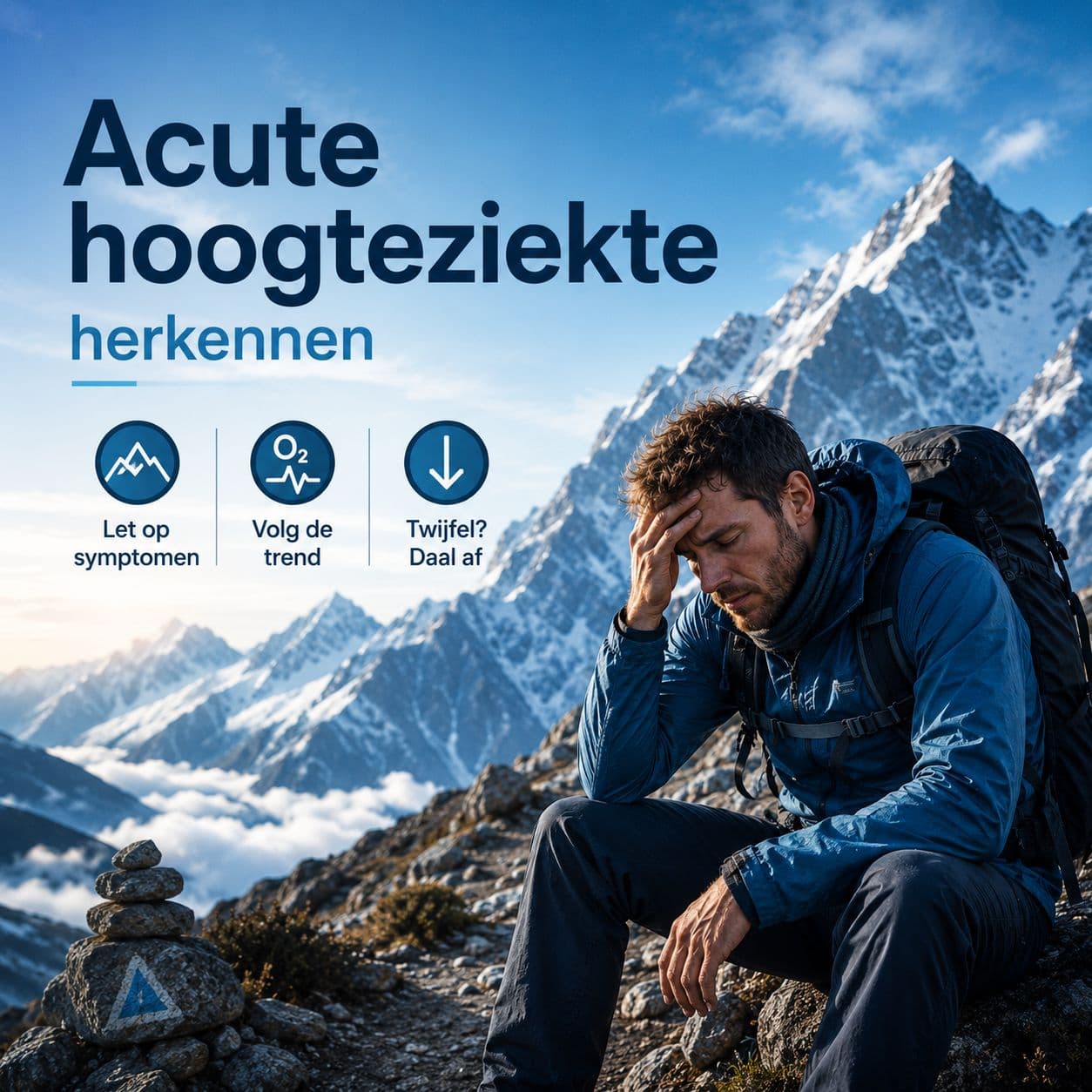
Diagnosing acute mountain sickness is harder than many mountaineers think. Altitude headaches don't automatically mean altitude sickness. At the same time, serious problems often start with complaints that initially seem harmless. Therefore, good interpretation is not just about one symptom, but about the big picture: headaches, nausea, sleep quality, energy levels, rate of ascent, and objective trends like saturation.
In this article, you will learn how to better recognise acute mountain sickness (AMS), which signs are often underestimated, and when you should stop ascending. We will also explain why a diagnosis at altitude is never about a single saturation measurement, but always about trends, behaviour, and symptoms combined.
Short answer: Acute mountain sickness is usually recognised by a headache combined with symptoms such as nausea, dizziness, fatigue or poor sleep after a rapid ascent above approximately 2500 metres.
- A headache alone is insufficient for a diagnosis
- The combination of symptoms determines the risk
- Rapid deterioration requires immediate action
Conclusion: Diagnosing AMS is primarily about pattern recognition and the evolution of symptoms.
Nuance: A low SpO2 alone does not automatically mean dangerous altitude sickness.
Practical hook: always look at symptoms, recovery and speed of ascent at the same time.
Why acute mountain sickness is often underestimated
Many people expect altitude sickness to begin suddenly and dramatically. In reality, AMS usually develops gradually. A mild headache, poorer sleep, or reduced appetite might seem harmless at first glance. However, precisely those early signs can be important.
This is why it's a good idea to have some basic knowledge before you leave Altitude sickness and acclimatisation. Anyone who understands how the body reacts to oxygen deprivation will recognise abnormalities more quickly and react more calmly.
A second problem is that travellers often focus too much on a single data point. For example, an oxygen saturation reading of 82%. But at altitude, an isolated figure means little without context. Some people still function perfectly well at a relatively low saturation level, whilst others develop clear AMS symptoms even at higher values.
⚠️ Reality check
A pulse oximeter can be useful, but it is not a diagnostic device. The trend over several days often says more than a single reading. Always combine saturation with symptoms, feelings of recovery, and behaviour during exertion.
Symptomen van acute hoogteziekte omvatten hoofdpijn, misselijkheid, braken, duizeligheid, vermoeidheid en slaapproblemen.
Acute mountain sickness usually arises from around 2500 metres. The risk increases when you ascend quickly or allow little time for acclimatisation.
The classic combination is:
- Headache
- Nausea or decreased appetite
- Dizziness
- Fatigue
- Poor sleep
The combination of symptoms is particularly important. Someone with just a mild headache may not have AMS. However, a headache combined with nausea, reduced coordination, and clear fatigue warrants more attention.
Anyone who wants to understand more about early warning signs can also read our comprehensive article on symptoms and risks of altitude sickness read.
How do you practically diagnose acute altitude sickness?
In practice, the determination of AMS usually revolves around four questions:
- Have you recently risen to greater heights?
- Is there a headache present?
- Are there any additional symptoms?
- Are the symptoms getting worse or better?
The internationally used Lake Louise approach works on the same principle. In this, complaints are scored to better assess the severity of the situation. In contrast to this article, that score focuses primarily on the practical assessment of symptoms itself.
Our separate article on the Lake Louise score goes into more detail on scoring and interpreting symptoms, while this article primarily aids the broader decision-making framework for acute altitude sickness.
| Situation | Interpretation | Approach |
|---|---|---|
| Light | Headache without obvious accompanying symptoms | Slower ascent and observation |
| Moderate | Headache plus nausea or clear exhaustion | Do not rise further |
| Serious | Balance problems, confusion, or shortness of breath at rest | Go directly to A&E and seek medical attention |
Interpretation: Headache without obvious accompanying symptoms
Approach Slower ascent and observation
Interpretation: Headache plus nausea or clear exhaustion
Approach Do not rise further
Interpretation: Balance problems, confusion, or shortness of breath at rest
Approach Go directly to A&E and seek medical attention
When does acute altitude sickness become dangerous?
Not every form of AMS is immediately dangerous. Many mild symptoms improve with rest, hydration and extra acclimatisation time. The problem arises when travellers continue to ascend despite clear warning signs.
These signals, in particular, warrant extra attention:
- Unable to walk straight anymore
- Confusion or strange behaviour
- Shortness of breath at rest
- Persistent vomiting
- Rapidly increasing exhaustion
- Blue lips or severe shortness of breath
This carries the risk of serious complications such as high-altitude cerebral oedema or high-altitude pulmonary oedema. Those who doubt should err on the side of caution. Descending too soon is rarely a problem. Reacting too late sometimes is.
Therefore, also read what you concretely need to do by Acute mountain sickness in practice.
This is how you monitor this lens
A good monitoring strategy prevents panic as well as underestimation.
| Parameter | What are you paying attention to? | Important trend |
|---|---|---|
| SpO2 | Not a single standalone value | Downtrend plus complaints |
| Sleep | Recovery and sense of calm | Sleeping worse and worse |
| Recovery | Energy during the day | Unexplained exhaustion |
| Symptoms | Headache, nausea, coordination | Rapid increase in complaints |
What are you paying attention to? Not a single standalone value
Key trend: Downtrend plus complaints
What are you paying attention to? Recovery and sense of calm
Key trend: Sleeping worse and worse
What are you paying attention to? Energy during the day
Key trend: Unexplained exhaustion
What are you paying attention to? Headache, nausea, coordination
Key trend: Rapid increase in complaints
For many mountain travellers, it is useful to understand in advance how oxygen saturation at altitude normally evolves. This helps to be less startled by values that would be deviating at sea level.
💡 Did you know?
Many experienced alpinists feel perfectly fine at 4000 metres with a saturation level that would seem concerning at sea level. Therefore, the combination of symptoms, behaviour, and recovery is more important than a single absolute SpO2 value.
Common mistakes when assessing AMS
Rising too quickly despite complaints
This remains the biggest mistake. Many travellers hope that symptoms will disappear on their own as they ascend further. Often, the opposite happens.
Just look at saturation
A low saturation without symptoms doesn't necessarily have to be a disaster. Conversely, severe symptoms can arise while the saturation still appears relatively acceptable.
Dismissing complaints
Fatigue is often attributed to poor sleep, a strenuous trek, or dehydration. Sometimes that's true. But at altitude, AMS must always be actively ruled out.
Using medication to still get ahead
Medication can be useful, but should never be used to ignore clear warning signs. The golden rule remains: symptoms that worsen require rest or descent.
Thuis acclimatiseren is interessant wanneer het gaat om het verminderen van stress en het bevorderen van welzijn na een reis of een ingrijpende gebeurtenis, zoals een verhuizing of een ziekenhuisopname. Het stelt je in staat om geleidelijk weer te wennen aan je vertrouwde omgeving en routines, wat bijdraagt aan een soepeler herstel en een betere emotionele stabiliteit.
For treks and expeditions above roughly 3500 to 4500 metres, an increasing number of people are opting for controlled preparation at home. This is usually achieved through normobaric hypoxia in a altitude tent or altitude chamber.
Such preparation does not replace real acclimatisation in the mountains, but it can make the process more controlled, measurable and planable. This can be particularly interesting with limited travel time or rapid ascent profiles.
Interesting for: Kilimanjaro, Andes treks, Everest Base Camp, Alpine climbs with few acclimatisation days.
Less relevant for: relaxed treks with plenty of acclimatisation time and low maximum altitudes.
A more relaxed acclimatisation towards your mountain trip?
For expeditions and treks above 4000 metres, acclimatising at home can help you start your journey better prepared. Altitude Dream annually guides athletes and mountain travellers with controlled pre-acclimatisation.
Conclusion
Diagnosing acute mountain sickness is about pattern recognition, not panic. Headaches at altitude don't necessarily pose a problem. However, headaches combined with nausea, poor coordination, or clear exhaustion always warrant attention.
The main mistake remains rising too quickly despite symptoms. Those who think conservatively, follow trends, and rest in good time significantly reduce the chance of serious problems.
Frequently asked questions about acute mountain sickness
Vanaf welke hoogte krijg je acute hoogteziekte?
The risk usually increases from around 2,500 metres, especially with rapid ascent.
It is possible to experience altitude sickness even with a normal saturation.
Yes. Symptoms remain more important than one single saturation value.
Is headache always altitude sickness?
No. Dehydration, fatigue, and poor sleep can also cause headaches.
When should you descend?
If symptoms worsen, experience coordination problems, confusion, or breathlessness at rest.
Does an altitude tent help against altitude sickness?
An altitude tent can aid acclimatisation, but it never offers a 100% guarantee.