Climbing Cotopaxi: acclimatisation for 5897 metres
Published 25 April 2026 · 12 min read
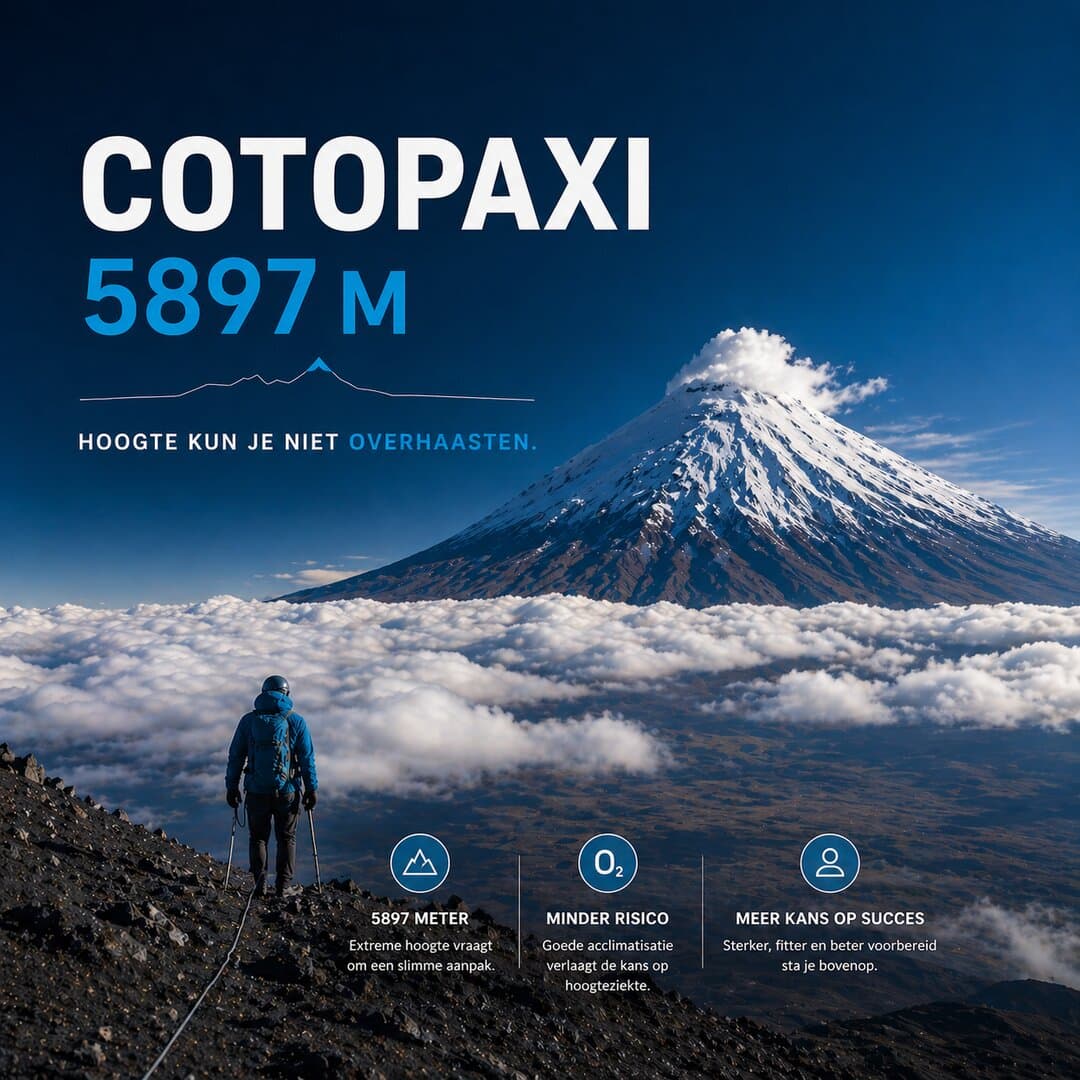
The Climbing Cotopaxi requires more than good fitness. At 5897 metres, you enter an altitude zone where oxygen deprivation, sleep disturbance and altitude sickness become the biggest limiting factors. The summit day is often short, intense and technically manageable, but physiologically demanding. Therefore, successful preparation is mainly about controlled acclimatisation, smart timing and recognising signals.
For many climbers, Cotopaxi is attractive because Quito is already high and the mountain fits relatively compactly into an Ecuador programme. That very fact makes the climb treacherous. Your body is given little time to adjust, while the jump to almost 6,000 metres is huge. Those who already start at home acclimatising at home for mountain expeditions, can significantly reduce the risk of altitude complaints and start the journey better prepared.
For Cotopaxi, good acclimatisation planning is more important than extra fitness. Focus your preparation on 3 pillars: sleep in advance with a controlled hypoxia stimulus, build up slowly in Ecuador via Quito and higher acclimatisation trips, and during the trip steer by SpO₂-trend, sleep quality, recovery and symptoms. An altitude tent can measurably and plannably support acclimatisation, but does not replace a sensible build-up locally.
Conclusion: Climbing Cotopaxi becomes more realistic if you start acclimatisation even before departure and build up slowly locally.
Nuance: An altitude tent significantly reduces the risk of altitude sickness, but does not guarantee 100%.
Practical hook: Combine 3 to 4 weeks of pre-acclimatisation with several days at 2800 to 5000 metres in Ecuador.
Why Cotopaxi is different from many other mountains
Cotopaxi is not an extremely technical expedition mountain like some Himalayan or Andean giants. Still, you should not underestimate the mountain. The combination of altitude, glacier terrain, night summit start and limited acclimatisation time makes the climb serious. Many routes start from a hut or lodge and head towards the glacier and summit at night. As a result, you climb when your body would normally be sleeping.
On top of that, many travellers from Europe fly to Quito first. This seems advantageous, as Quito is already above 2800 metres. Yet this does not mean that you are automatically ready for nearly 6,000 metres. Acclimatisation is not an on-off switch. Your body adapts step by step. Ventilation, hydration, sleep, heart rate, iron status and oxygen transport must react together to the lower oxygen pressure.
For Cotopaxi, therefore, the question is not just: am I fit enough? The better question is: have I given my body enough time to function normally at altitude?
⚠️ Reality check
A strong runner or cyclist can still suffer a lot of altitude sickness on Cotopaxi. Condition helps you move, but does not automatically protect against acute altitude sickness. Acclimatisation therefore remains a separate part of preparation.
Climbing Cotopaxi requires acclimatisation, no rush
At Climbing Cotopaxi the altitude zone around 5000 to 5897 metres is decisive. You can still perform well at that altitude, but only when your body is adequately prepared. Without acclimatisation, the risk of headaches, nausea, insomnia, loss of appetite and performance loss increases. In more serious cases, you have to descend.
For a 5897-metre mountain, it is wise to think like a short 6000-metre expedition. That means: don't start only upon arrival in Ecuador, but make a plan in advance. Those wanting more background on this altitude zone can delve deeper via acclimatising for 6000 metres.
Altitude zones towards Cotopaxi
| Zone | Example | What your body notices | Practical significance |
|---|---|---|---|
| 2800 m | Quito | Breathing and heart rate may already be slightly elevated. | Suitable as a first adaptation, but not yet preparation for the summit. |
| 3500 to 4200 m | Acclimatisation walks | Exercise feels markedly heavier than at sea level. | Important zone to calmly adjust and test recovery. |
| 4500 to 5000 m | Huts, high passes, practice peaks | Sleep and appetite may change. Recovery becomes slower. | Crucial test for Cotopaxi. Do not force in case of complaints. |
| 5897 m | Top Cotopaxi | Oxygen deficiency is strongly felt. Pace must remain controlled. | Only justified with good build-up, guide decision and stable symptoms. |
2800 m
Example: Quito
Interpretation: Breathing and heart rate may already be slightly elevated.
Action: Use this as a first adjustment, not a full top preparation.
3500 to 4200 m
Example: Acclimatisation walks
Interpretation: Exercise feels markedly heavier than at sea level.
Action: Build up slowly and test recovery after each day.
4500 to 5000 m
Example: Huts, high passes, practice peaks
Interpretation: Sleep and appetite may change. Recovery becomes slower.
Action: Consider this a crucial test for Cotopaxi.
5897 m
Example: Top Cotopaxi
Interpretation: Oxygen deficiency is strongly felt. Pace must remain controlled.
Action: Climb on only with stable symptoms and positive guide decision.
What happens to your body towards 5897 metres
At altitude, there is still about 21% of oxygen in the air. The difference is in the lower air pressure. As a result, less oxygen becomes available per breath. Your body reacts by breathing faster and deeper, increasing your heart rate and later activating more oxygen transport adjustments.
In the first few days, breathing, sleep and fluid balance are particularly crucial. You may wake up more often, sleep more lightly or experience dry mouth. Your training pace or walking pace will also feel less natural. This does not immediately mean that something is going wrong. It does mean that you need to keep monitoring objectively.
A useful measurement value is SpO₂. Still, you should never use it as a loose absolute truth. Look at the trend over several days, preferably at the same time of day. You can find more explanation on interpretation in the article on oxygen saturation at altitude.
🧭 In practice
A single lower saturation reading says little. A falling SpO₂ trend combined with worse sleep, headaches, nausea or increasing fatigue is more relevant. That very combination helps determine whether you should stabilise, rest or descend.
Climbing Cotopaxi with high altitude tent: controlled preparation
An altitude tent works with normobaric hypoxia. This means that it is not the air pressure that is lowered, but the oxygen percentage in the inhaled air. So you sleep at home in a controlled environment with lower oxygen availability. For Cotopaxi, this is interesting because your body can get used to hypoxia even before departure.
The power of altitude tent hire is mainly in control. You don't have to hope on good luck that your body will adapt quickly enough during a short trip. You can start in advance, build up slowly and steer by SpO₂, sleep quality and complaints. That makes preparation measurable and planable.
For Cotopaxi, the goal is not to mimic extreme altitude already at home. The goal is to build up a consistent sleep trigger that prepares your body for the lower oxygen availability. Usually a gradual build-up works better than setting high right away. You can find a practical starting point in the altitude tent construction diagram.
What remains important is the right nuance. An altitude tent is no substitute for acclimatisation in Ecuador. However, it can significantly reduce the risk of altitude sickness, as your body gets used to a controlled hypoxia stimulus even before departure. In doing so, you will not arrive invulnerable, but often better prepared.
Practical schedule for Cotopaxi acclimatisation
A good schedule combines preparing at home with confirming locally. Especially with Cotopaxi, you don't want to rely on the first few days in Ecuador alone. The trip is often short, the summit is high and the programme can be under pressure due to weather, guide planning or volcanic conditions.
Sample protocol for Cotopaxi
| Phase | Timing | Target | Practical interpretation |
|---|---|---|---|
| Phase 1 | 3 to 4 weeks before departure | Quietly build up hypoxia stimulus. | Sleep in altitude tent, set gradually, follow SpO₂ trend. |
| Phase 2 | Last week at home | Stabilise, don't overstimulate. | Good sleep, no heavy training blocks, iron and nutrition in order. |
| Phase 3 | Day 1 to 3 in Ecuador | Get used to Quito and move quietly. | Light walks, drink a lot, limit alcohol, monitor recovery. |
| Phase 4 | Day 4 to 7 | Climbing higher, recovering lower. | Acclimatisation peaks or passes, preferably with sleeping lower than highest point. |
| Phase 5 | Top phase | Only continue when signals are stable. | Slow pace, follow guidebook decision, descend in case of obvious complaints. |
Phase 1
Timing: 3 to 4 weeks before departure
Objective: Quietly build up hypoxia stimulus.
Filling in: Sleep in altitude tent, set gradually, follow SpO₂ trend.
Phase 2
Timing: Last week at home
Objective: Stabilise, don't overstimulate.
Filling in: Good sleep, no heavy training blocks, iron and nutrition in order.
Phase 3
Timing: Day 1 to 3 in Ecuador
Objective: Get used to Quito and move quietly.
Filling in: Light walks, drink a lot, limit alcohol, monitor recovery.
Phase 4
Timing: Day 4 to 7
Objective: Climbing higher, recovering lower.
Filling in: Acclimatisation peaks or passes, preferably with sleeping lower than highest point.
Phase 5
Timing: Top phase
Objective: Only continue when signals are stable.
Filling in: Slow pace, follow guidebook decision, descend in case of obvious complaints.
Common misconceptions about Cotopaxi
Because Cotopaxi is often offered as a relatively accessible 5000-metre-plus mountain, misconceptions arise. The mountain is certainly achievable for well-prepared climbers. But achievable does not mean obvious. In particular, the speed at which many programmes move to the summit requires attention.
What does help and what gives false security?
| Misunderstanding | Why it is risky | Better starting point |
|---|---|---|
| I am fit | Fitness does not automatically prevent altitude sickness. | Combine fitness with a specific acclimatisation plan. |
| Quito is enough | A few nights at 2800 metres do not fully prepare you for 5897 metres. | Add higher acclimatisation days or pre-acclimatisation. |
| Faster is more efficient | Haste increases the risk of complaints and an aborted summit attempt. | Schedule rest, intermediate steps and objective monitoring. |
| Medication solves it | Medication can support, but does not replace build-up and descent in severity. | Discuss remedies with a doctor beforehand and keep monitoring symptoms. |
I am fit
Risk: Fitness does not automatically prevent altitude sickness.
Better: Combine fitness with a specific acclimatisation plan.
Quito is enough
Risk: A few nights at 2800 metres do not fully prepare you for 5897 metres.
Better: Add higher acclimatisation days or pre-acclimatisation.
Faster is more efficient
Risk: Haste increases the risk of complaints and an aborted summit attempt.
Better: Schedule rest, intermediate steps and objective monitoring.
Medication solves it
Risk: Medication can support, but does not replace build-up.
Better: Discuss remedies with a doctor beforehand and keep monitoring symptoms.
Medication such as acetazolamide can be useful in certain situations. Yet this is part of a broader strategy, not a quick fix. For depth, read the article on Diamox and altitude sickness.
This is how you monitor this lens
A good plan becomes stronger when you don't just rely on feelings. This applies at home in the altitude tent, but also while travelling. Use measurements as a tool, not an absolute truth. The combination of trend, complaints and recovery defines the picture.
Monitoring for Cotopaxi preparation
| Signal | What you pay attention to | Interpretation | Decision rule |
|---|---|---|---|
| SpO₂-trend | Measure at the same time, preferably morning and rest. | A trend is more valuable than a single measurement. | If the trend drops with complaints added, stabilise or lower the incentive. |
| Sleep | Pay attention to sleep-through, restfulness and nocturnal restlessness. | Poor sleep may indicate too rapid a build-up. | Stay at the same level for a day or take extra rest. |
| Recovery | Observe morning feeling, appetite and normal chargeability. | Slower recovery is normal, but should not overshoot. | No piling on heavy stimuli when fatigue is evident. |
| Symptoms | Headache, nausea, dizziness, coordination and shortness of breath. | Increasing complaints are more important than a number. | If worsening, do not rise further and follow local medical advice. |
SpO₂-trend
Note: Measure at the same time, preferably morning and rest.
Interpretation: A trend is more valuable than a single measurement.
Decision rule: If the trend drops with complaints added, stabilise or lower the incentive.
Sleep
Note: Sleeping through, feeling rested and restless at night.
Interpretation: Poor sleep may indicate too rapid a build-up.
Decision rule: Stay at the same level for a day or take extra rest.
Recovery
Note: Morning feeling, appetite and normal chargeability.
Interpretation: Slower recovery is normal, but should not overshoot.
Decision rule: No piling on heavy stimuli when fatigue is evident.
Symptoms
Note: Headache, nausea, dizziness, coordination and shortness of breath.
Interpretation: Increasing complaints are more important than a number.
Decision rule: If worsening, do not rise further and follow local medical advice.
When to adjust or stop?
At Cotopaxi, discipline is often more important than perseverance. A bad day can be part of normal fatigue, but persistent or increasing symptoms at altitude demand respect. Especially complaints that do not improve with rest, drinking and eating are a signal not to continue ascending.
- Moving on, though: mild fatigue, stable SpO₂ trend, good appetite and no worsening headache.
- Stabilise: restless sleep, moderate headache, marked fatigue or decreasing trend without recovery.
- No further rise: increasing headache, nausea, dizziness, poor coordination or shortness of breath.
- Descend or seek help: confusion, shaky gait, severe shortness of breath, chest pressure or symptoms that worsen.
Practical tips for the last week
The last week before departure is not about getting even fitter. You want to leave fresh. Especially if you are already working with an altitude tent, it is wise to limit extra training stress. A body that starts the journey tired reacts less predictably at altitude.
Let sleep quality outweigh extra training. Poor sleep is an early warning sign.
Avoid heavy intervals or long blocks just before departure. Freshness counts.
Measure SpO₂ as a trend and note sleep, recovery and symptoms briefly per day.
Always check current weather, route and volcano conditions with local professionals.
Make sure you have enough energy, carbohydrates, fluids and a stomach you know.
Discuss personal risks, medication and previous altitude complaints with a doctor in good time.
Frequently asked questions about climbing Cotopaxi
How many days of acclimatisation do you need for Cotopaxi?
For many climbers, a few days in Quito is not enough. Rather, count on a combination of 3-4 weeks of preparation at home and several days of local acclimatisation in Ecuador.
Can you climb Cotopaxi without an altitude tent?
Yes, you can. Then a quiet local programme becomes extra important. An altitude tent especially makes preparation more controllable, measurable and plannable.
Does an altitude tent reduce the risk of altitude sickness?
Yes, a well-constructed altitude program can significantly reduce the risk of altitude complaints. It remains support though, not a 100% guarantee.
Is Cotopaxi suitable as the first nearly 6,000-metre mountain?
It is possible, provided you are technically guided, acclimatise well and have enough margin in your programme. Without preparation, the step to 5897 metres is a big one.
When should you postpone your Cotopaxi attempt?
Defer in case of obvious altitude complaints, poor sleep, worsening SpO₂ trend, tightness of breath or if your guide considers conditions unsafe.
Prepare Cotopaxi checked with high altitude tent hire
If you're heading towards 5897 metres, you don't want to discover how your body responds to altitude only in Ecuador. With a personal altitude program, you will build a controlled hypoxia stimulus at home, significantly reduce the risk of altitude sickness and leave with a better understanding of your own response.
Conclusion: Cotopaxi begins before departure
Climbing Cotopaxi is a wonderful and realistic challenge for many mountain athletes. But the altitude of 5897 metres requires preparation with margin. Those who only look at fitness miss the most important part of the puzzle. The real key lies in acclimatisation.
A strong approach starts at home. With altitude tent hire, you can build up a controlled, measurable and plannable hypoxia stimulus. Then use Quito and higher acclimatisation days to further acclimatise your body. That way, you increase your chances of starting the summit night not only fit, but also physiologically ready.
The best preparation is calm, objective and unhurried. Exactly that makes Cotopaxi more achievable.