Mont Blanc climb without experience - realistic or reckless?
Published 15 April 2016 · 4 min read
A Mont Blanc ascent without experience sounds like a bucket list dream for many people. Western Europe's highest mountain attracts thousands of sporting adventurers every year. But is it realistic to climb Mont Blanc without previous alpine experience? The short answer: yes, but only under strict conditions. Without preparation, it becomes risky. With the right physical base, acclimatisation and guidance, it can be done responsibly.
In this article, you get a clear, medically-based framework. No tough talk. No scaremongering. But reality, measurable parameters and a clear decision model.
The essentials in 30 seconds
- Mont Blanc is 4808 metres high and not a hiking mountain.
- Technically, the normal route is not extremely difficult.
- Physiologically, 4800 metres is underestimated for many people.
- Without experience, you need preparation and acclimatisation.
- SpO2 trend and sleep adaptation determine your success.
Why a Mont Blanc climb without experience is often misjudged
Many people think Mont Blanc is mainly a technical challenge. In reality, the physiological part is at least as decisive. At 4800 metres, oxygen pressure drops significantly. Your body reacts with accelerated breathing, higher heart rate and falling oxygen saturation.
Therefore, first read how altitude sickness arises and why even fit athletes can be susceptible.
What often goes wrong when climbing Mont Blanc without experience:
- Rising too fast without adaptation
- Focusing on fitness, not oxygen adaptation
- No monitoring of SpO2 or recovery
- Sleeping at altitude without preparation
What exactly does “without experience” mean?
Without experience could mean:
- No previous climbs above 3,000 metres
- No use of crampons
- No knowledge of glacier safety
- Never slept above 2,500 metres
Technique you learn relatively quickly with a guide. Physiological adaptation takes weeks.
Step 1 - Physical basis is necessary but not sufficient
You need to be able to move for 6-8 hours with backpack, ascending terrain and cold conditions. Aerobic capacity is essential. But fitness alone does not protect against altitude sickness.
Want to understand what altitude does physiologically? Then read how altitude training works.
Step 2 - Acclimatisation is the real key
A Mont Blanc ascent without experience usually fails not on technique, but on adaptation. Your body has to learn to cope with lower oxygen pressure. This happens through:
- Increased ventilation
- Change in oxygen saturation
- EPO stimulation
- Improved oxygen delivery in tissues
Home acclimatisation via normobaric hypoxia can start this process in a controlled way. See also acclimatising at home for mountain expeditions.
Why sleep is the most important incentive
Sleeping under reduced oxygen is a stable, long-term stimulus. The body gets 7 to 9 hours of adaptation per night. This is more effective than short exposures during the day.
This is how you monitor this lens
For a Mont Blanc climb without experience, you need to measure objectively. Don't rely on feeling alone.
1. SpO2 trend
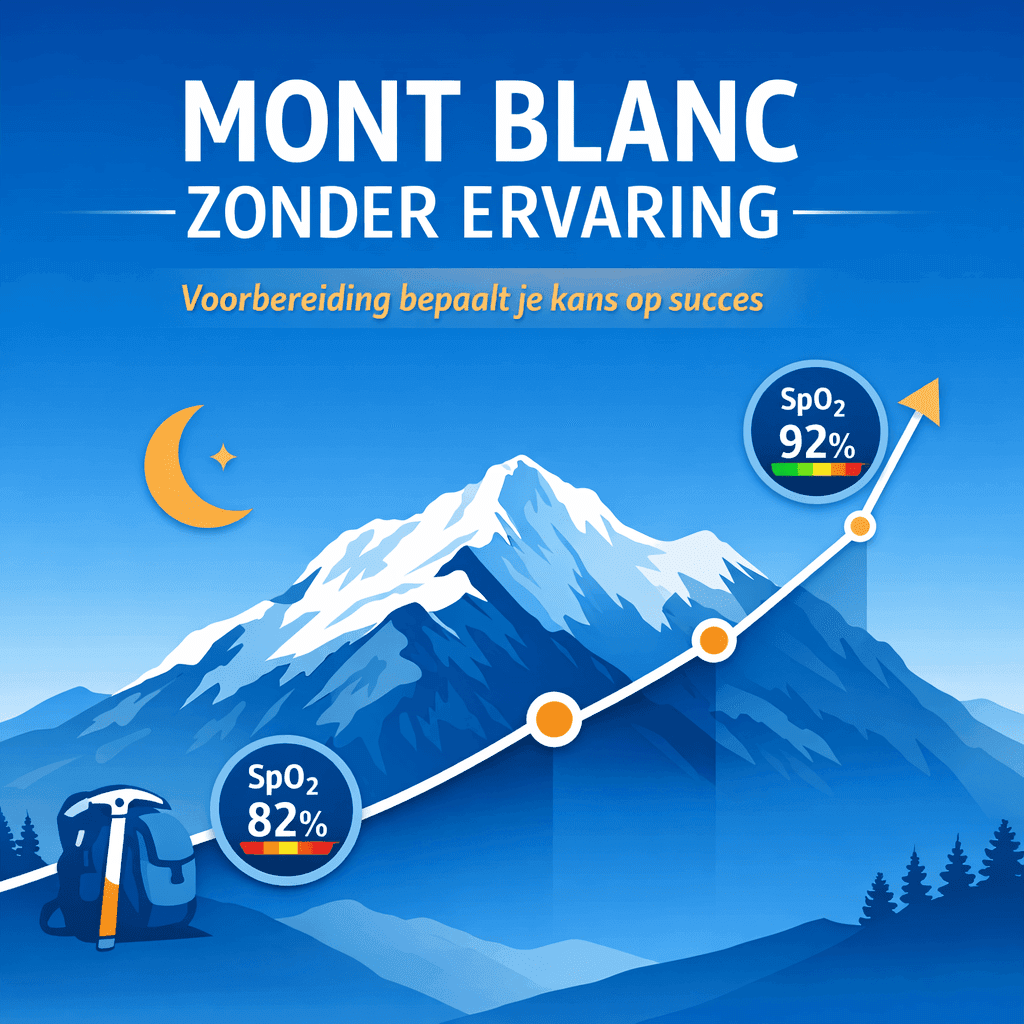
Measure your resting oxygen saturation every morning. Look at the trend over 7 to 14 days. A gradual stabilisation or slight increase at the same simulation altitude is positive.
2. Sleep quality
Pay attention to sleep-in time, night waking and subjective freshness. Poor sleep may indicate too rapid altitude buildup.
3. Symptom development
Headaches, nausea, feeling of pressure in the head and decreased appetite are early signs.
Concrete decision rule: Does your morning SpO2 drop below 90 per cent for several days at simulation around 2,500 metres and feel symptoms? Then temporarily lower the altitude.
What is a realistic preparation schedule?
Ideally, you should start 6 to 8 weeks before departure.
- Week 1-2: 2000 metres simulation
- Week 3-4: 2200 to 2400 metres
- Week 5-6: 2,500 metres
- Final week: stabilising
See also using high altitude tents - complete guide.
So is a Mont Blanc climb without experience responsible?
Yes, provided:
- Your physical foundation is good
- You have guidance from a recognised guide
- Taking your acclimatisation seriously
- Your objective monitors
No, if:
- You don't do any preparation
- You think willpower compensates for height
- Ignoring your complaints
Important nuance about altitude sickness
An altitude tent is no substitute for acclimatisation in the mountains. It makes the process controlled, measurable and planable. It significantly reduces the risk of altitude sickness, but does not offer an absolute guarantee.
You can find more background in the complete guide to preventing altitude sickness.
Decision aid - 5 questions to ask yourself
- Can I climb for 6 hours with 1000 altimeters?
- Have I ever slept above 3,000 metres?
- Do I start at least six weeks of preparation?
- Do I measure my SpO2 as a trend?
- Am I ready to adjust?
Conclusion
Climbing Mont Blanc without experience is possible. But only when you understand that 4808 metres is not a symbolic limit, but a physiological reality. Those who prepare well, work measurably and respect adaptation significantly increase their chances of a safe and successful summit day.
🏔 Prepare controlled for 4,000 metres
Want to take a professional and measurable approach to your acclimatisation?