Annapurna Base Camp acclimatisation schedule: altitude, preparation and smart route construction
Published 9 May 2026 · 14 min read
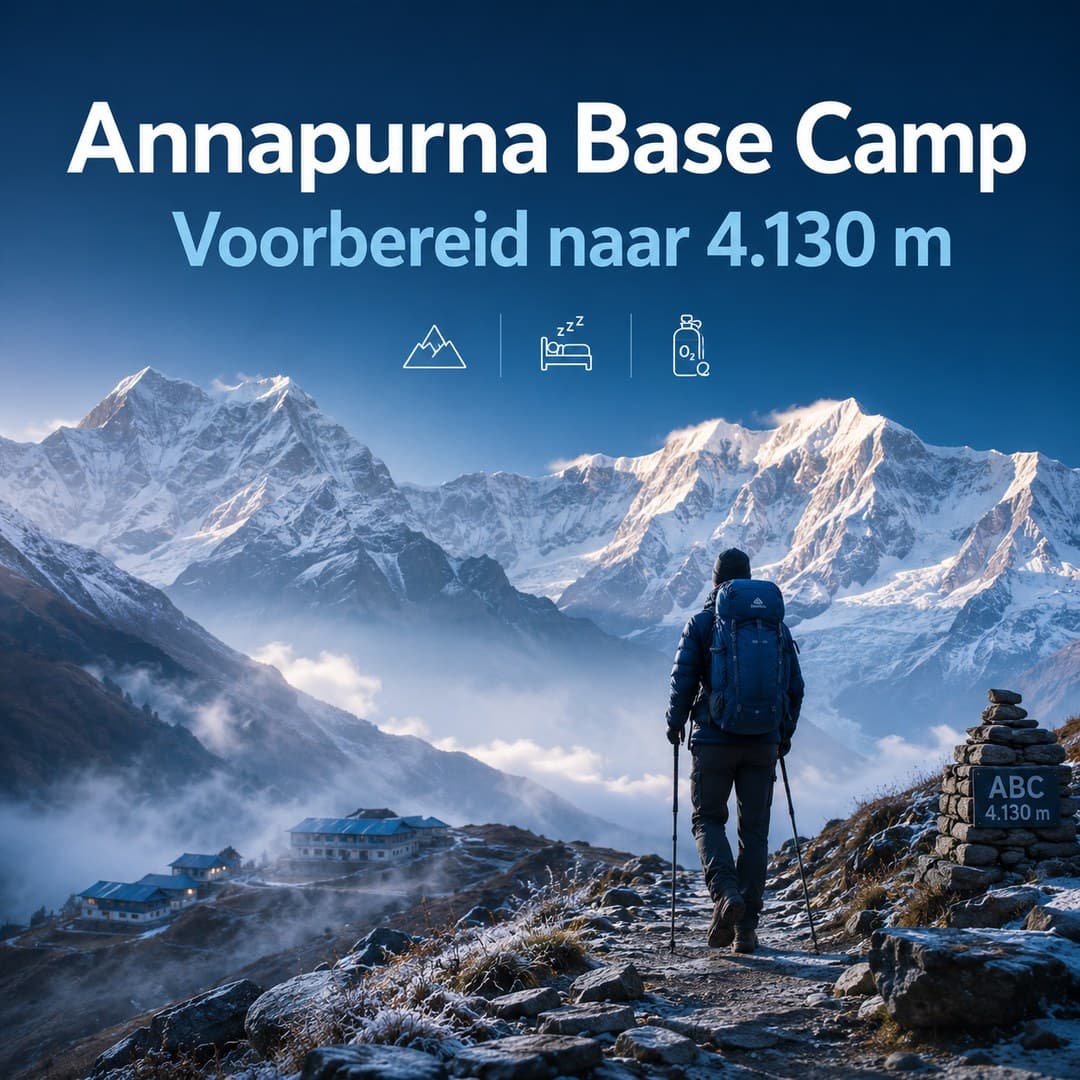
Annapurna Base Camp acclimatisation schedule It's not just about the number of walking days. The trek ends at approximately 4,130 metres, but the real risk lies in the combination of fast route variations, sleeping above 3,000 metres and fatigue from long ascents, damp valleys and cold nights. Anyone seriously preparing for Annapurna Base Camp therefore plans not only the route, but also the acclimatisation beforehand.
The practical conclusion is clear: it's better to choose a schedule with sufficient nights between 2,500 and 3,700 metres, avoid too large a jump to sleeping at or near Base Camp, and consider beforehand acclimatising at home for mountain expeditions. Sleeping in a high-altitude tent makes the hypoxic stimulus controlled, measurable and predictable. This can significantly reduce the chance of altitude sickness, although good acclimatisation along the way remains necessary.
Short answer: Annapurna Base Camp is situated at approximately 4,130 metres. A sensible acclimatisation schedule gradually builds up sleeping altitude via villages such as Chhomrong, Bamboo, Deurali and Machhapuchhre Base Camp. For many trekkers, 8 to 10 trekking days are safer than a condensed 6 or 7-day version.
- Highest point Annapurna Base Camp, approximately 4,130 metres.
- Key risk moment: sleeping above 3,000 metres and ascending too quickly to 3,700 to 4,130 metres.
- Best approach: calm schedule, objective monitoring, no rush and sleeping beforehand in a altitude tent.
Conclusion: Annapurna Base Camp is attainable for fit trekkers, but requires conscious acclimatisation.
Nuance: The route is lower than the Annapurna Circuit, but due to tight schedules, altitude sickness remains a real risk.
Practical hook: Sleep in a hypobaric chamber beforehand and opt for a flexible schedule en route.
Annapurna Base Camp: The Practical Acclimatisation Schedule
The majority of problems on Annapurna Base Camp do not arise because the route is technically extreme. They arise because trekkers underestimate the altitude. You often start low, usually around Pokhara, and then ascend relatively quickly to areas where your body reacts differently to exertion, sleep and recovery.
From approximately 2,500 metres, the risk of altitude sickness increases. Above 3,000 metres, the sleeping altitude becomes particularly important. This is the altitude at which your body must recover for hours on end with less available oxygen. Therefore, it is wiser to look not only at the daily peak altitude but especially at where you sleep.
For Annapurna Base Camp, this means that the transition from Deurali to Machhapuchhre Base Camp and Annapurna Base Camp must be carefully planned. The distance may seem manageable at times, but physiologically a lot is happening. Your body must constantly adjust breathing, fluid balance, sleep quality, and oxygen uptake.
In practice: Completing the Annapurna Base Camp trek on a very tight schedule saves time but sacrifices acclimatisation margin. This is particularly relevant for travellers coming from the Netherlands or Belgium who travel directly to the trailhead via Kathmandu and Pokhara.
Why Annapurna Base Camp is not the same as the Annapurna Circuit
Annapurna Base Camp and Annapurna Circuit are often mentioned in the same breath. However, they are physiologically different treks. The previously published article about the Annapurna Circuit altitude profile is mainly about a longer tour, higher passes and a different route load.
Annapurna Base Camp is shorter, more direct and ends lower than the Thorong La on the Annapurna Circuit. This very fact makes the route seem simpler. However, that can be misleading. Because ABC is often completed in fewer days, the ratio between ascent rate and recovery is sometimes less favourable.
So the difference isn't just in maximum altitude. It's mainly in route construction. The Annapurna Circuit requires a long strategy towards a high pass. Annapurna Base Camp requires a compact strategy towards a high valley, where you walk up in a short time and often descend quickly again.
ABC versus Circuit: alternative preparation
- Annapurna Base Camp shorter, more direct, highest point around 4,130 metres, relatively little margin for rapid schedules.
- Annapurna Circuit longer, higher, other acclimatisation question due to Thorong La and longer exposure.
- Overlap both questions respect sleep height, symptoms and gradual build-up.
Annapurna Base Camp elevation: what 4,130 metres means
The altitude of Annapurna Base Camp is high enough to cause problems for people who ascend too quickly. Fitness makes less difference than many trekkers assume. A well-trained body can walk better, but is not automatically better protected against acute altitude sickness.
The route often feels varied and accessible. You'll walk through villages, forests, valleys, and stone steps. As a result, many trekkers forget that the final section towards Deurali, Machhapuchhre Base Camp, and Annapurna Base Camp is a real high-altitude climb.
| Height zone | Typical spot on the route | Meaning | Practical choice |
|---|---|---|---|
| 800 to 2,200 m | Pokhara, Ghandruk, Chhomrong | Especially building up walking load. | Start calmly and don't run too fast. |
| 2,300 to 3,000 m | Bamboo, Dovan, Himalaya | The first phase in which sleep and recovery can change. | Pay attention to headaches, appetite, and sleep quality. |
| 3,000 to 3,700 m | Deurali, Machhapuchhre Base Camp | Important acclimatisation zone towards ABC. | Don't force big leaps with complaints. |
| 4,130 m | Annapurna Base Camp | Highest point, with clear hypoxic load. | Only ascend if symptoms remain stable. |
Place: Pokhara, Ghandruk, Chhomrong.
Significance: especially building up walking load.
Choice: Start slowly and don't run too fast.
Place: Bamboo, Dovan, Himalaya.
Significance: first phase in which sleep and recovery can change.
Choice: Please note headaches, appetite, and sleep quality.
Place: Deurali, Machhapuchhre Base Camp.
Significance: Important acclimatisation zone towards ABC.
Choice: Don't force big leaps when there are complaints.
Place: Annapurna Base Camp.
Significance: highest point, with marked hypoxic load.
Choice: Only increase if symptoms remain stable.
Annapurna Base Camp acclimatisation schedule per day
A good Annapurna Base Camp acclimatisation schedule doesn't need to be extremely long. It primarily needs to be logical. The biggest gain is in avoiding an abrupt jump to sleeping at around 3,700 or 4,130 metres.
The diagram below is not a fixed route description, but a decision-making framework. Local conditions, lodge availability, weather, snow, group level, and health may require adjustments. Therefore, use it as a starting point, not as rigid planning.
Example schedule with more acclimatisation margin
| Day | Bed | Indicative sleeping height | Why this makes sense |
|---|---|---|---|
| Day 1 | Ghandruk or similar | 1,900 to 2,000 m | Smooth onboarding after travel and transfer. |
| Day 2 | Chhomrong | Approximately 2.170 m | Good transition to the upper valley. |
| Day 3 | Bamboo of Dovan | 2,300 to 2,600 m | First proper recovery test after several days of walking. |
| Day 4 | Himalaya of Deurali | 2,900 to 3,200 m | The start of the altitude zone where sleeping altitude becomes more important. |
| Day 5 | Machhapuchhre Base Camp | around 3,700 m | Logical intermediate step for the final climb to ABC. |
| Day 6 | Visit and descend ABC | 4.130 m as a daily height | Less taxing than sleeping on the highest spot for a long time. |
| Day 7 to 9 | Afdalen via Bamboo, Jhinu or similar | declining sleep height | Recovery and safe completion of the tow. |
Sleeping place Ghandruk or similar.
Sleeping height: 1,900 to 2,000 m.
Why: Smooth check-in after travel and transfer.
Sleeping place Chhomrong.
Sleeping height: circa 2,170 m.
Why: easy transition to the upper valley.
Sleeping place Bamboo of Dovan.
Sleeping height: 2,300 to 2,600 m.
Why: first proper recovery test after multiple walking days.
Sleeping place Himalayas of Deurali.
Sleeping height: 2,900 to 3,200 m.
Why: the beginning of the altitude zone where sleep altitude becomes more important.
Sleeping place Machhapuchhre Base Camp.
Sleeping height: Around 3,700m.
Why: logical intermediate step for the final climb to ABC.
Route: Visit ABC and descend.
Daily height 4.130 m.
Why: less taxing than staying asleep for a long time in the highest place.
Route: Aafaleni via Bamboo, Jhinu or similar.
Sleeping height: legend.
Why: Recovery and safe completion of the move.
Anyone wanting to sleep at Annapurna Base Camp itself needs to be extra critical. A night at 4,130 metres isn't necessarily bad, but it's only sensible if the ascent was gradual and you remain complaint-free. With headaches, nausea, dizziness, poor coordination, or shortness of breath at rest, you should not go any higher.
To better understand what a normal rate of ascent means, delve into normal acclimatisation rate. For ABC, especially the average increase in sleep height is important, not the highest point you briefly reach during the day.
Why sleeping in a high-altitude tent beforehand makes sense for Annapurna Base Camp
For Annapurna Base Camp, sleeping in a high-altitude tent beforehand is particularly logical. Not because ABC is an extreme expedition, but because many travellers are on a tight schedule. You often fly from sea level to Nepal, spend a short time in Kathmandu or Pokhara, and then quickly start hiking.
A height tent works with normobaric hypoxia. This means that the air pressure is not reduced, but the oxygen percentage in the inhaled air. As a result, your body receives a controlled altitude stimulus at home while you can maintain your normal training sessions and daily routines.
The stimulation doesn't replace acclimatisation in Nepal. However, it makes preparation controlled, measurable and plannable. You can see in advance how your body reacts to a lack of oxygen, how your sleep develops and whether your SpO2 trend stabilises. This means you arrive at the start line with more information and less uncertainty.
Reality check: A sleep system does not offer a 100 percent guarantee against altitude sickness. However, sleeping in a sleep system beforehand can significantly reduce the chance of symptoms, especially when combined with a relaxed itinerary, good monitoring, and sensible behaviour during the trip.
Practical altitude tent protocol for ABC
For Annapurna Base Camp, preparation is usually geared towards approximately 4,000 metres. A logical itinerary ideally takes 3 to 4 weeks. If you have less time, 2 weeks is better than nothing, but the margin becomes smaller.
| Phase | Guideline | Target | Adjust when |
|---|---|---|---|
| Week 1 | Start low and sleep sufficient hours. | Getting used to the stimulus without disrupting sleep. | Headaches, restless sleep, or pronounced fatigue increase. |
| Week 2 | Gradually increase if the trend is stable. | Build more hypoxic load. | SpO2 trend is decreasing and recovery is worsening. |
| Week 3 | Continue building towards expedition height. | Developing relevant tolerance for sleeping above 3,000 m. | Sleep quality or morning feeling clearly deteriorates. |
| Week 4 | Stabilize at 4,000 m if well tolerated. | Keep stimulus close to departure. | Complaints arise or you wake up feeling unrested. |
Guideline: Sleep well and get enough hours.
Objective: getting used to the stimulus without disturbing sleep.
Adjustment: headaches, restless sleep, or noticeable fatigue increases.
Guideline: gradually increase if the trend is stable.
Objective: build up more hypoxic load.
Adjustment: SpO2 trend is decreasing and recovery is worsening.
Guideline: Continue building towards expedition height.
Objective: Develop relevant tolerance for sleeping above 3,000 m.
Adjustment: sleep quality or morning feeling clearly deteriorates.
Guideline: stabilise at 4,000 m if well tolerated.
Objective: hold stimulus close to departure.
Adjustment: complaints arise or you wake up feeling unrested.
Always use a gradual buildup. The altitude tent construction diagram helps to not increase too quickly. At ABC, the goal is not to sleep as high as possible. The goal is to react more stably to the altitude you will encounter in Nepal.
This is how you monitor this lens
Objective monitoring makes the difference between hoping things go well and making timely adjustments. Always measure SpO2 as a trend. A single isolated value says little. The combination of saturation, sleep quality, recovery feeling and symptoms provides much more information.
Ideally, measurements should be taken in similar conditions. For example, in the morning, at rest, with warm hands, and after sitting relaxed for a few minutes. Additionally, note how you have slept, whether you have a headache, and how refreshed you feel upon waking.
| Signal | Favourable trend | Warning | Action |
|---|---|---|---|
| SpO2 | The trend stabilises or improves with the same setting. | Trend falling for multiple days or fluctuating heavily. | Don't increase, take extra recovery. |
| Sleep | You sleep more peacefully after a few nights. | You often wake up or feel breathless. | Lower setting or stabilise longer. |
| Recovery | You wake up feeling reasonably refreshed. | You feel heavier, irritable, or tired. | Temporarily limit training load. |
| Symptoms | No headache, nausea or dizziness. | Complaints are increasing or remain present. | Stop increasing and assess medically if necessary. |
Advantageous trend stabilises or improves with equal setting.
Warning: The trend has been falling for several days or is fluctuating strongly.
Action: Do not increase, take extra rest.
Advantageous You sleep more soundly after a few nights.
Warning: You often wake up or feel breathless.
Action: lower setting or stabilize longer.
Advantageous You wake up feeling reasonably refreshed.
Warning: You feel heavier, irritable or tired.
Action: Temporarily limit training load.
Advantageous No headache, nausea, or dizziness.
Warning: Complaints are increasing or remaining present.
Action: Stop increasing and assess medically if necessary.
The same logic applies when travelling in Nepal. Don't just focus on how fast you can walk. Pay particular attention to your sleep, your appetite, your headache patterns, and your recovery. A trekker who walks slowly but sleeps well is often better off than someone who ascends quickly and recovers poorly.
Misunderstandings about Annapurna Base Camp and altitude sickness
Misunderstanding 1: 4.130 metres is not high enough to cause problems
That's not correct. Annapurna Base Camp is clearly in an altitude zone where acute mountain sickness can occur, especially if your route includes few rest days or if you're coming from sea level.
Misconception 2: Fitness automatically protects against altitude sickness
Fitness helps with walking, climbing stairs, and recovering from muscle strain. However, fitness does not reliably predict who will experience altitude sickness. Therefore, even well-trained trekkers should build up their schedules gradually.
Misconception 3: the fastest route is the most efficient route
A short itinerary may seem efficient, but can prove costly if you have to cancel due to complaints. For ABC, one extra acclimation night is often more valuable than a day's time saved.
Misconception 4: An altitude tent replaces acclimatisation en route
A height tent is not a replacement for sensible ascent. The value lies precisely in the combination. You build tolerance at home and remain vigilant on the way regarding sleep altitude, symptoms, and recovery.
To gain a broader understanding of how to prevent complaints, use the guide on preventing altitude sickness as further deepening.
Decision rules for your Annapurna Base Camp preparation
Opt for a quieter schedule when
- you travel directly from sea level to Nepal;
- I've had altitude sickness before;
- your itinerary includes fewer than 8 trekking days;
- you want to sleep at Annapurna Base Camp itself;
- You have little recent mountaineering experience above 3,000 metres.
Adjust en route as needed
- headache does not subside with rest, drinking and eating;
- nausea, dizziness, or extreme fatigue occurs;
- your sleep quality is clearly deteriorating;
- your walking pace is noticeably slowing down compared to the group;
- you are short of breath at rest.
The most important rule remains simple: do not sleep higher up if you have clear symptoms. Taking rest, descending, or adjusting your schedule is not a failure. It is, in fact, good expedition hygiene.
Practical pre-departure checklist
- Plan your route with a buffer. Prefer 8 to 10 trekking days over a maximum compact schedule.
- Start your altitude tent period on time: Preferably 3 to 4 weeks before departure.
- Measure trends: Look at SpO2, sleep, recovery and symptoms together.
- Train specifically Build up walking hours, ascents and descents gradually.
- Respect the first few days: Take it easy, eat well, and avoid unnecessary intensity.
- Discuss medication in advance Consult a doctor if you are considering acetazolamide or other medication.
- Maak een terugvalplan: know in advance where you can rest or descend.
For many travellers, the combination of a hypoxic tent, a relaxed schedule and objective monitoring is the most practical way to reduce uncertainty. You cannot control everything in the Himalayas. However, you can ensure that your body is not first confronted with altitude stress on the route.
Prepare for Annapurna Base Camp in a controlled manner
Annapurna Base Camp finishes at around 4,130 metres. By sleeping in a hypobaric chamber at home beforehand, you make the altitude stimulus measurable and predictable before you leave for Nepal. This significantly reduces the chance of altitude sickness, without replacing the acclimatisation en route.
Conclusion: how to increase your margin towards Annapurna Base Camp
Annapurna Base Camp is a beautiful, accessible, and impressive trek. However, accessible does not mean risk-free. The altitude of 4,130 metres requires a clear strategy, especially if your route is condensed and you are starting from sea level.
The best Annapurna Base Camp acclimatisation schedule is therefore not a 'get there as fast as possible' schedule. It's a schedule that gives your body time. Sleep altitude, recovery, symptoms, and SpO2 trends should be guiding factors. Not just your walking speed.
Sleeping beforehand in a height tent can make a significant difference. You considerably reduce the chance of altitude sickness because your body gets used to a controlled hypoxic stimulus even before departure. Combine that with a gradual route build-up and you'll set off with more grip, more margin and more confidence towards Annapurna Base Camp.
FAQ about Annapurna Base Camp altitude and acclimatisation
Annapurna Base Camp is located at an altitude of 4,130 metres.
Annapurna Base Camp is located at approximately 4,130 metres. That's high enough to cause altitude sickness, especially with rapid itineraries.
How many days do you need for Annapurna Base Camp?
Many programmes last 7 to 11 trekking days. For better acclimatisation, 8 to 10 trekking days are often more sensible than a very compact option.
Is sleeping at Annapurna Base Camp advisable?
That depends on your build and symptoms. Sleeping on ABC is possible, but less advisable for headaches, nausea, poor sleep, or rapid ascent.
Does a height tent help for Annapurna Base Camp?
Yes, sleeping in a hypobaric chamber beforehand can significantly reduce the chance of altitude sickness. However, it remains a support, not a guarantee, and no substitute for acclimatisation en route.
When should you not ascend further?
Do not ascend further if you experience increasing headache, nausea, dizziness, shortness of breath at rest, problems with coordination, or a clear deterioration in your recovery.
Source context The altitude of Annapurna Base Camp is around 4,130 metres and typical route bandwidths are aligned with current trekking information. The medical decision rules are aligned with international altitude guidelines regarding sleeping altitude, ascent rate and symptom recognition.