Altitude training runners: schedule and measurable results
Published 21 February 2026 · 3 min read
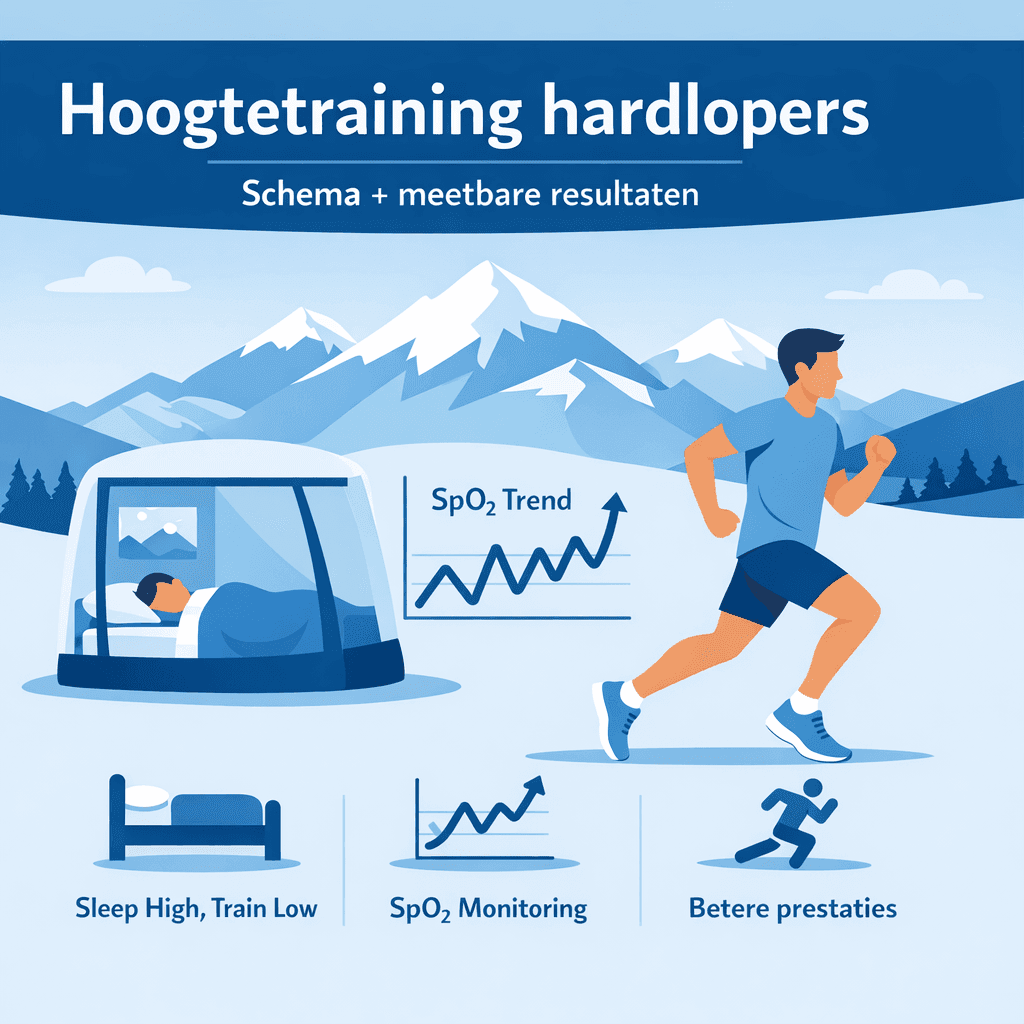
Height training is one of the most effective ways for runners to increase aerobic capacity without adding extra training volume. If applied correctly, it can lead to a demonstrable increase in haemoglobin mass, better oxygen uptake and improved race performance at sea level. In this article, you get a concrete scheme, objective measurement parameters and clear decision rules.
Important: altitude training is not a magic shortcut. The effect comes from controlled normobaric hypoxia, sufficient sleep exposure and SpO2-driven build-up. Those who take a structured approach to this will see measurable progression.
Why altitude training runners are often misunderstood
Many runners think altitude training means training heavily in oxygen deprivation. This is incorrect. The most substantiated method is Sleep High Train Low, where you sleep in simulated altitude and train at normal intensity.
Primary adaptation occurs during rest and sleep. Not during interval training.
A altitude tent lowers the oxygen percentage via normobaric hypoxia. Air pressure remains the same. This stimulates the body to produce more EPO, which may eventually lead to an increase in red blood cell count.
What happens physiologically in altitude training runners?
Key adaptations:
- Increased EPO production
- Increase in haemoglobin mass
- More efficient oxygen transport chain
- Improved mitochondrial function
- Improved fat oxidation during submaximal exercise
You can read more in depth about these processes in the physiological benefits of altitude training.
Concrete LHTL schedule for runners
The schedule below is suitable for experienced runners preparing for an important race.
Week 1
- Altitude: 2000 metres simulation
- Sleep duration: 7 to 8 hours per night
- Target SpO2 morning trend: 93 to 95 per cent
- Training: entirely at sea level
Week 2
- Altitude: 2200 to 2300 metres
- Sleep duration: 8 hours
- SpO2 trend: 92 to 94 per cent
- Maintain normal intensity
Week 3 and 4
- Altitude: 2300 to 2500 metres
- SpO2 trend: around 92 per cent
- At morning values below 90 per cent: temporarily reduce
Important: increase only at morning values of 94 per cent or higher. Decrease at 90 per cent or lower. SpO2 is always looked at as a trend over several days.
This is how you monitor this lens
Without monitoring, altitude training is gambling. Use at least these three parameters:
1. SpO2 trend
Measure every morning immediately after waking up. Look at the trend over 3 to 5 days.
2. Sleep quality
Pay attention to sleep time, nocturnal awakenings and subjective freshness when getting up.
3. Recovery feelings and symptoms
Pay attention to headache, resting heart rate, fatigue and training quality.
Concrete decision rule: If SpO2 drops below 90 per cent for several days and sleep quality deteriorates, then lower your simulation altitude 200 to 300 metres.
Measurable results in runners
When applied correctly, we see on average:
- 3 to 6 per cent increase in haemoglobin mass
- Improvement time to exhaustion
- Lower heart rate at submaximal speed
- Faster recovery time between intervals
Effects usually become visible after 3 to 4 weeks of consistent exposure.
When does altitude training make sense for runners?
- For marathons and half marathons
- For competitions at altitude
- At performance level where marginal gains are relevant
Not useful in absolute beginners or with insufficient recovery capacity.
Is this the right time for you?
Ask yourself three questions:
- Do I have a clear competition peak?
- Can I sleep consistently for 3 to 4 weeks in hypoxia?
- Am I prepared to monitor objectively?
If you answer yes to all three, then altitude training runners is a rational next step.
Ready to tackle this in a controlled way?
Want a personalised schedule or direct booking? Check out the available packages:
Running packages:
View running packages
Experiences of other runners:
Read customer reviews