
Advantages of altitude tents: more accurate and often cheaper than an altitude training camp
Published 7 August 2013 · 14 min read
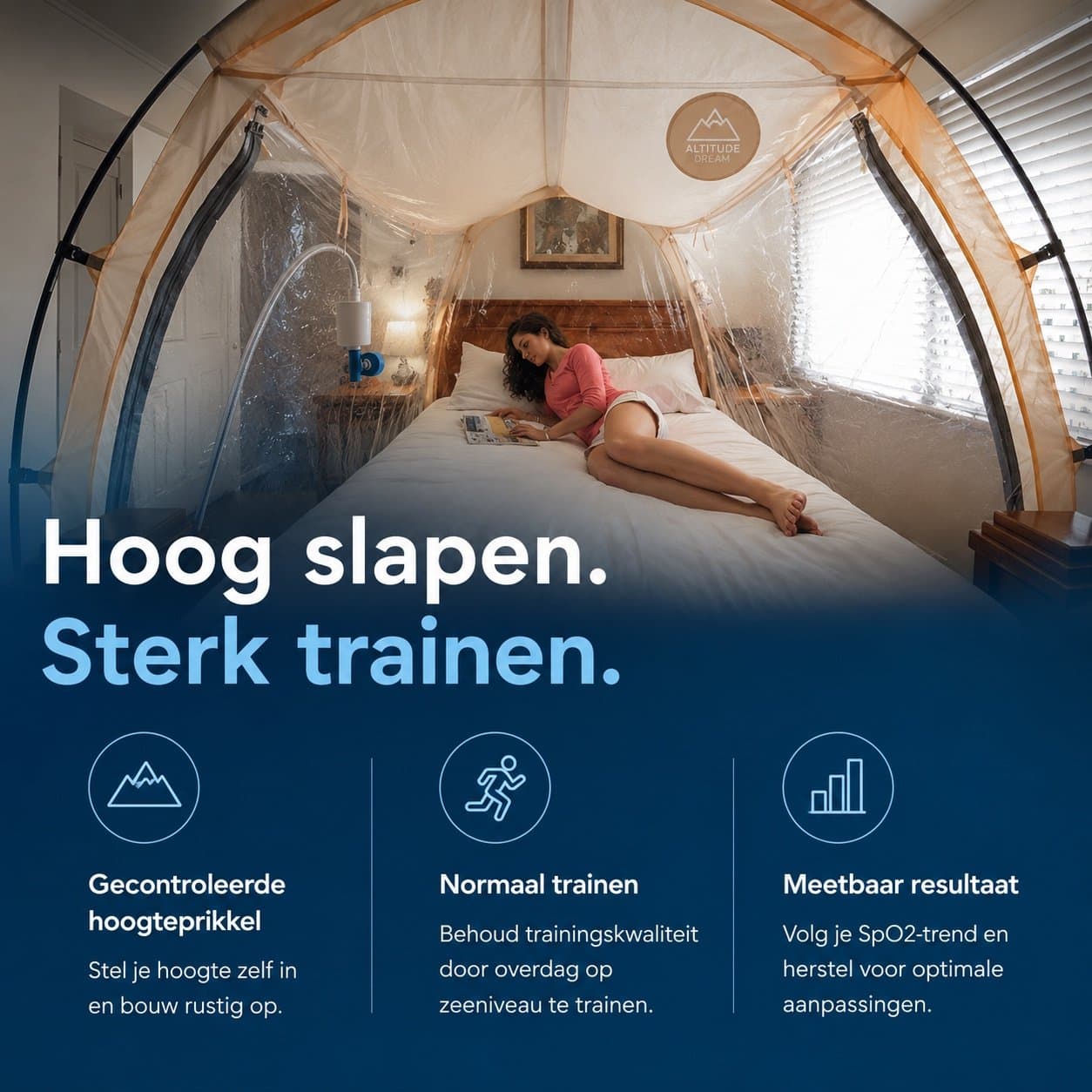
The main altitude tent benefits are control, measurability, lower costs, and better training quality. You don't need to go to the mountains for weeks; you can build up the altitude stimulus at home in a relaxed way and continue training in your usual environment. This makes an altitude tent a practical alternative to a classic altitude stay for many athletes.
Short answer: A height tent is particularly interesting when you want to combine the benefits of sleeping at altitude with training at sea level. You set the altitude yourself, monitor your reaction via SpO2 trends, maintain your normal training routine, and avoid many of the costs and logistics of an overseas altitude training camp.
Conclusion: A altitude tent makes altitude training programmable, controlled and practically feasible.
Nuance: It remains a physiological stimulus that must be carefully built up.
Practical hook: Those who monitor well get more out of the stimulus and reduce the chance of overload.
Why altitude tent benefits are becoming increasingly relevant
Altitude training was for a long time the preserve of professional sportspeople, national teams and athletes with access to expensive altitude camps. Yet the principle behind altitude training relatively simple. The body receives a controlled stimulus by making less oxygen available. This leads to adaptations that can be interesting for athletes.
A classic altitude training camp still has value. You train in the mountains, live at altitude and draw mental energy from a different environment. However, that is not always the most logical solution. Travel takes time. The training load changes. Sleep, nutrition, recovery, and planning are less predictable. Furthermore, not every athlete reacts the same way to the same altitude.
Therefore, the advantages of a height tent are primarily practical. You bring the altitude stimulus into your own bedroom, while your training environment remains the same. You can sleep under normobaric hypoxia, while the air pressure stays the same and the oxygen percentage is controllably reduced. This creates the well-known principle of sleep high train lowSleep high, train low.
That's precisely why many endurance athletes, triathletes, cyclists and runners consider a height tent. Not because it's a shortcut. But because it's a precise instrument for incorporating an altitude stimulus without having to temporarily relocate your entire life.
The core: sleep soundly, train normally
An altitude tent doesn't work by making you train harder. Its value lies in what happens during rest and sleep. While you sleep, the body experiences reduced oxygen availability. This forces the body to adapt. Over several nights, this can contribute to physiological responses that are consistent with altitude training.
The big advantage is that you can continue to train at your usual intensity during the day. This is often more difficult in the mountains. Training sessions feel harder, recovery takes longer and high-intensity sessions can sometimes lose some of their quality. That isn’t always a bad thing, but it doesn’t suit every training goal.
With an altitude tent, you can separate the altitude stimulus from your training load. You use the night for the stimulus and the day for quality training. This is a major advantage, particularly during periods when speed, power or competition-specific intensity are important.
🧭 In practice
A height tent is most effective when you already have a good training rhythm. You don't need to interrupt that rhythm for travel, unfamiliar routes, or reduced training intensity at altitude. The altitude stimulus is added to your existing structure, not the other way around.
Advantages of altitude tents compared to altitude staging
The comparison between an altitude tent and altitude training does not revolve around better or worse. It's about control. Altitude training provides a natural altitude environment. An altitude tent offers an adjustable stimulus. For many athletes, it is precisely this control that is important.
| Factor | Altitude tent | Altitude internship | Practical significance |
|---|---|---|---|
| Check | Height adjustable in steps | Height is fixed by location | You can dose and adjust better |
| Training | Training remains at the normal location | Training often happens at altitude | The quality of intensive sessions is more easily maintained |
| Cost | No trip, stay or training camp required | Travel, accommodation and planning needed | Often cheaper with multiple weeks' preparation |
| Monitoring | Measurable daily via SpO2 trend and recovery | Measurable, but often with more variables | The response to the stimulus is easier to follow |
| Logistics | Fitting work, family and training | Requests temporary relocation | More feasible for amateurs and busy athletes |
Altitude tent: Height adjustable in stages.
Altitude training: The height is fixed by the location.
Significance: You can dose and adjust better.
Altitude tent: training remains in the normal location.
Altitude training: Training often happens at altitude.
Significance: the quality of intensive sessions remains easier to maintain.
Altitude tent: No travel, accommodation or training camp required.
Altitude training: Travel, accommodation and planning needed.
Significance: often cheaper with several weeks' preparation.
Altitude tent: measurable daily via SpO2 trend and recovery.
Altitude training: measurable, but often with more variables.
Significance: the reaction to the stimulus is easier to follow.
Altitude tent: Juggling work, family and training.
Altitude training: requests temporary relocation.
Significance: more achievable for amateurs and busy athletes.
It is precisely the combination of control and continuity that makes an altitude tent effective. You can sleep in your own bed, maintain your normal diet, and follow your familiar training schedule. This results in less disruption. If your body responds well, you will often see this more clearly reflected in your measurements and how you feel after recovery.
Why accuracy is a big advantage
Not every athlete reacts the same way to altitude. Some athletes sleep perfectly well at a relatively high setting. Others quickly notice restlessness, headaches, or reduced recovery quality. Therefore, a fixed altitude isn't always ideal.
With a height tent you can build up more gradually. You usually start conservatively and only increase when the signals remain good. Think of stable sleep, normal training quality, no clear complaints, and an SpO2 trend that matches the set altitude.
This means the altitude tent is not a blind system. It is, in fact, a measurable protocol. You don't aim based on feeling alone, but on trends. That makes the difference between simply sleeping at altitude and applying smart altitude training.
💡 Did you know?
A single SpO2 reading is less informative than the trend over multiple mornings. A drop on one morning could be due to sleep, a measurement error, or fatigue. Adjustments only become truly relevant when the trend coincides with symptoms or poorer recovery.
For whom are the benefits of a high-altitude tent greatest?
A height tent is particularly interesting for athletes who plan their training seriously. Think of marathon runners, cyclists, triathletes, speed skaters, and other endurance athletes. Mountaineers also use a height tent, but this article focuses on athletic performance.
The benefits are greatest when you have sufficient time. A few nights in an altitude tent is usually too short to fully utilise the system. The strength lies in regularity, sleep duration, and progression. Therefore, an altitude tent is particularly suited to athletes who want to work towards a goal moment over several weeks.
A high-altitude tent is suitable when you:
- you have an important sporting goal in a few weeks;
- if you want to maintain your training quality at sea level;
- have no time or budget for a full altitude training camp;
- prepared to track sleep, recovery, and SpO2 trends;
- to build up calmly rather than to stimulate maximally.
an altitude tent fits less well when you:
- sleeps irregularly and can barely get a few nights' sleep;
- complaints are ignored or not wanted to be monitored;
- expect the tent to replace training;
- have a medical problem without appropriate advice;
- expect results within a few days.
How to practically set up a height tent
A good protocol doesn't start with the highest setting. It starts with getting used to it. The first few nights are intended to see how your body reacts. After that, you can gradually increase, as long as sleep and recovery remain good.
For many athletes, the practical value of an altitude tent lies in a controlled stimulus that is easy to maintain. Higher altitude is not automatically better. Increasing the altitude too aggressively can disrupt your sleep and thus limit the benefit.
| Phase | Target | What to look out for | Action |
|---|---|---|---|
| Week 1 | Calmly getting used to the stimulus | Sleep quality, morning feeling, SpO2 trend | Start conservatively and don't force it |
| Week 2 | Gradually increase the stimulus | Recovery, training quality, symptoms | Only increase with stable signals |
| Week 3 | Building consistency | Regularity, sleep duration, fatigue | Keep the height stable or make slight adjustments |
| Week 4+ | Adjusting direction to target moment | Match scheduling, freshness, recovery | Not unnecessarily late, then aggressively increase |
Objective: gently get used to the stimulus.
Note: Sleep quality, morning feeling, and SpO2 trend.
Action: start conservatively and don't force it.
Objective: incentive gradually increase.
Note: Recovery, training quality and symptoms.
Action: only increase with stable signals.
Objective: building consistency.
Note: pattern, sleep duration and fatigue.
Action: Keep height stable or adjust slightly.
Objective: direction target moment fine-tune.
Note: Match planning, freshness and recovery.
Action: not unnecessarily increase aggressively later.
Anyone who wants more structure can work with a specific altitude tent construction diagram. This especially helps to avoid increasing too quickly. The best stimulus is usually not the heaviest stimulus, but the stimulus that you can sustain well for several weeks.
This is how you monitor this lens
An altitude tent becomes more effective when you monitor objectively. Not because you have to capture everything in numbers, but because numbers help to make decisions more calmly. This is particularly important with altitude stimuli. Fatigue, training stress, and sleep can influence each other.
Always use SpO2 as a trend, not as a standalone truth. It's preferably measured at a fixed time, for example, in the morning. Then look at the pattern over multiple days. Combine that with sleep quality, recovery feeling, training quality, and any complaints.
| Signal | What you are following | Good trend | Adjust when |
|---|---|---|---|
| SpO2 | Morning value as a trend | Stable within personal bandwidth | Trend clearly declining with complaints or poor sleep |
| Sleep | Expensive, peace and quiet and interruptions | You are getting enough sleep and wake up feeling reasonably refreshed. | Multiple nights of restless or clearly poorer recovery |
| Recovery | Fatigue, HRV if available, morning feeling | Normal variation without sustained dip | Recovery is worsening for several days in a row. |
| Symptoms | Headache, nausea, shortness of breath, dizziness | None or slight temporary habituation | Complaints increase or do not disappear after reduction |
Follow: morning value as a trend.
Good trend stable within personal bandwidth.
Adjustment: The trend clearly decreases with complaints or poor sleep.
Follow: Duration, rest, and interruptions.
Good trend You sleep enough and wake up feeling reasonably refreshed.
Adjustment: Multiple nights of restless or distinctly poorer recovery.
Follow: Fatigue, HRV if available, and morning feeling.
Good trend normal variation without persistent dip.
Adjustment: gets worse for several days in a row.
Follow: headache, nausea, shortness of breath, and dizziness.
Good trend No or slight temporary adaptation.
Adjustment: Complaints are increasing or not disappearing after reduction.
A separate chapter on measurement can be found in the article about measuring altitude training effect. For altitude tents, the combination is particularly important. A nice SpO2 trend is not enough if your sleep collapses. And a lower SpO2 is not automatically better when your recovery deteriorates.
Common misconceptions about altitude tents
Misconceptions about altitude tents still persist. Part of this stems from elite sports stories and partly from the idea that anything that can improve performance is automatically suspect or extreme. In reality, an altitude tent is primarily a controlled environmental stimulus.
Misunderstanding 1: A sleep tent is the same as doping
A height tent is not on the doping list. The system mimics lower oxygen availability, similar to what happens at altitude. The difference is that you apply the stimulus at home. That does not make it the same as banned substances.
Misconception 2: higher is better
This is one of the most common mistakes. A higher setting gives more stimulation, but also a greater chance of poorer sleep and fatigue. The art is not to go as high as possible. The art is to provide a stimulus for long enough that your body can process.
Misconception 3: you need to train less
An altitude tent does not replace training. It supports your preparation. So you continue to train, sleep, eat and recover as a serious athlete should. The tent adds an extra layer, but does not make the foundation any less important.
Misconception 4: everyone reacts the same
The response to hypoxia varies greatly from person to person. Therefore, measurement is important. Some athletes have a clear response quickly. Others need more time. That makes individual progression more valuable than a standard setting.
The economic side: often cheaper than several weeks at altitude
A high-altitude training camp can be valuable, but it comes with costs. Consider travel, accommodation, meals, training facilities, equipment transport, and time away from work or family. For professional teams, this can make sense. For many individual athletes, it's less straightforward.
An altitude tent removes many of those hurdles. You pay for the system and the guidance, but you don't have to move to the mountains. This makes altitude training more accessible. Especially when you want to prepare for several weeks, the difference can be significant.
Those who want to compare the costs of high-altitude internships can read further about altitude training costs. The right choice depends on your goal. Do you want to train in a new environment, with team structure and full focus? Then an internship can be valuable. Do you primarily want a controlled sleep stimulus without losing training quality? Then a height tent is often more logical.
Practical buying guide
- Opt for a high-altitude tent instead when: - control - costs - training at sea level - and daily routine are important.
- Opt for an internship at altitude instead. when team environment, mental focus, mountain training and temporary isolation are central.
- Combine both when you want to get used to it at home and then train more specifically on site.
Practical tips to get more out of a high-altitude tent
- Start slowly and increase only when sleep and recovery remain stable.
- Use SpO2 as a trend over several days.
- Do not plan strenuous training sessions immediately after a restless first night.
- Keep sleep duration high enough, as the stimulus works primarily during sufficient hours of sleep.
- Pay attention to iron status, nutrition, and general load capacity.
- Temporarily reduce if there are clear symptoms or structurally poorer recovery.
- Use the tent as part of your planning, not as a standalone trick.
The biggest gains are often found in consistency. An athlete who sleeps calmly and consistently in a well-adjusted tent for four weeks will usually get more out of the protocol than someone who starts aggressively and then sleeps poorly for a few nights.
When to adjust or stop?
Adjusting is part of good practice. It is not a sign that the altitude tent is not working. It actually means you are listening to your body's reaction. A lower setting can sometimes yield more than continuing at a level that disrupts your recovery.
Reduce the height or have a gentler build-up when:
- you are sleeping clearly worse for multiple nights;
- your morning mood noticeably worsens;
- The SpO2 trend is decreasing while symptoms are increasing.;
- you digest your training sessions structurally less well;
- headache, nausea, or shortness of breath returning.
Halt temporarily and seek advice when:
- complaints clearly worsening;
- shortness of breath or chest tightness occurs;
- feels unusually unwell or confused;
- my medical history requires extra caution.
For most healthy athletes, a gradually implemented protocol is well tolerated. Nevertheless, individual guidance remains valuable, especially in cases of doubt, with a medical history or an important final goal.
FAQ about altitude tent benefits
What are the main advantages of altitude tents?
The biggest advantages are control, measurability, lower logistical costs, and maintaining training quality. You can sleep soundly at home while continuing to train normally during the day.
Is a height tent better than altitude training?
Not always. A height tent is easier to control and more practical. A high-altitude training camp can be valuable for team focus, mental preparation, and training in a mountain environment.
How long should you use a height tent?
For sports purposes, we usually think in weeks, not days. The exact duration depends on your goal, recovery, sleep quality, and training plan.
Can you keep training intensively with a height tent?
Yes, that is precisely an important advantage. You sleep under altitude stimulus but train at sea level. This often helps maintain the quality of intensive training sessions.
Should you measure SpO2 in a altitude tent?
Yes, preferably. Measure SpO2 as a trend over several mornings and combine this with sleep, recovery, training quality, and symptoms.
Do you want to know if a height tent is suitable for your sports goals?
A altitude tent works best when the altitude stimulus fits your schedule, training load, and recovery. First, calmly consider which choice makes sense for your situation.
Conclusion: the benefits of a high-altitude tent are primarily in control
The main benefits of altitude tents are not found in mysticism or top-secret sporting tricks. They lie in control. You can apply the altitude stimulus at home, maintain your training quality, monitor your response, and adjust your protocol when necessary.
This makes a hypoxytent a serious alternative to a classic altitude training camp for many athletes. Not because mountains have no value, but because the home situation is often more practical, cheaper, and more precise. This difference can be significant, especially for athletes with jobs, families, fixed training times, or a tight competition schedule.
An altitude tent remains a stimulus that demands attention. Build up slowly, look at trends, and let sleep quality remain paramount. Then the tent will not become a forced performance hack, but a controlled part of a mature training approach.


