Altitude sickness on a skiing holiday: preventing headaches and nausea on the slopes
Published 25 May 2026 · 15 min read
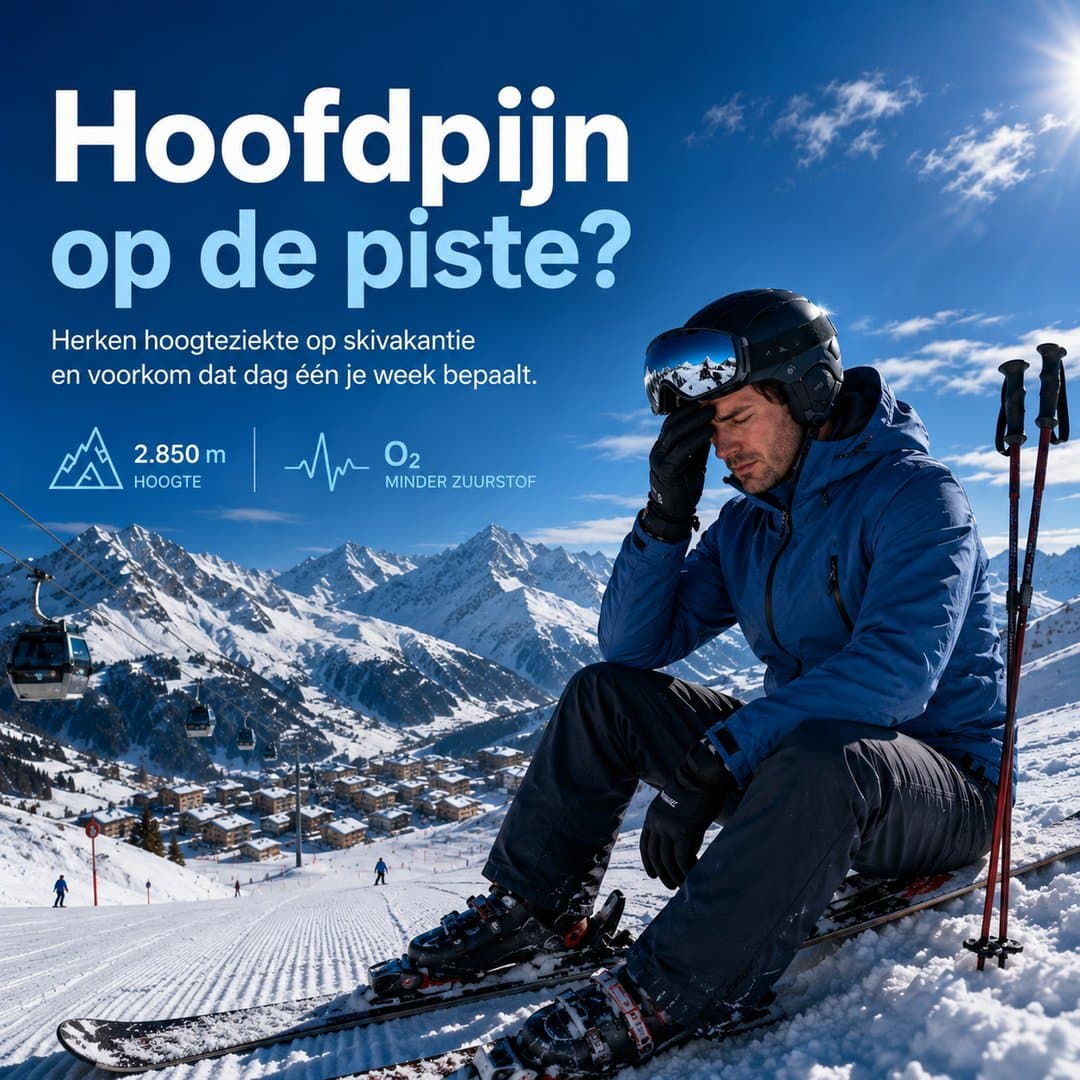
Altitude sickness ski holiday sounds exaggerated to many winter sports enthusiasts, until on the first day they stand on the slopes with headaches, nausea, poor sleep, or noticeably low energy. Especially in high ski resorts, when sleeping above 1800 to 2200 metres or when arriving quickly from sea level, your body may struggle with the transition to less oxygen. This article helps you recognise when symptoms are indicative of altitude sickness, what you can do beforehand, and when sleeping in a high-altitude tent can be a sensible preparation.
Short answer: Headaches and nausea on a skiing holiday can be indicative of mild altitude sickness, especially if you travel quickly to a high ski resort, sleep poorly, and ski intensely on the first day. Starting slowly, drinking enough, limiting alcohol, and not overexerting yourself for the first 24 to 48 hours reduces the risk. If you are clearly sensitive to altitude, sleeping in a hypoxic tent beforehand can help your body acclimatise in a controlled and measurable way to a lower oxygen stimulus.
Conclusion: Altitude sickness on a ski holiday is mainly caused by rapid exposure to height, not solely by poor fitness.
Nuance: Most complaints are mild, but persistent headaches, nausea, and deterioration require serious adjustments.
Practical hook: Those who have previously experienced complaints while skiing can depart much more calmly with preparation, monitoring and, if necessary, a height tent.
Winter sports often feel less “high” than an expedition. Yet, many popular villages and hotels are already situated at 1500 to 2300 metres. The ski lifts then regularly take you towards 2800 to above 3400 metres. As a result, you receive a significant hypoxic stimulus during the day, while your body has had hardly any time to acclimatise.
Those susceptible to altitude often notice it during a ski holiday. Not because skiing is at an extreme height, but because everything comes together: car journeys or flights, short nights, cold air, intensive exertion, alcohol, drinking little, and sleeping at altitude. If you want to understand better what is happening physiologically, then the broader explanation about altitude sickness a good foundation.
Altitude sickness ski holiday: when are headaches and nausea concerning?
Not every headache on a ski holiday is altitude sickness. You could also suffer from dehydration, tense neck muscles, bright sunlight, poor sleep, alcohol, or a virus. However, altitude sickness becomes more likely if the symptoms appear after arriving at altitude and are accompanied by multiple signs.
Mild altitude sickness typically begins within the first 6 to 24 hours of arrival. It often starts with a headache. Nausea, reduced appetite, dizziness, restless sleep, and unusual fatigue can follow. On the slopes, you might notice you're getting out of breath more quickly than normal, have less sharp steering, or have a noticeable lack of appetite.
Reality check: Altitude sickness is not a test of character. Pushing on because you are “just skiing” is not a smart strategy. Symptoms that arise at altitude and worsen with exertion deserve rest, observation, and sometimes a lower sleeping spot. Adjusting early, in particular, prevents a mild first day from becoming a bad week.
An important indicator is the difference compared to your normal feeling. If you never get a headache after exertion at home or at lower winter sports destinations, but you always get one in high-altitude ski resorts? Then altitude sickness is more likely. Especially if nausea or poor sleep accompany it.
Why altitude sickness on ski holidays is more common than you think
Most ski holidays are built around speed. You leave on a Friday evening, drive through the night and arrive in a high valley on Saturday morning. Then it's up the lift. For your body, that feels different. It suddenly has to function with less oxygen pressure, cold air and physical exertion.
At sea level, oxygen availability is familiar. At altitude, the percentage of oxygen in the air remains about the same, but atmospheric pressure drops. Consequently, less oxygen is available per breath. Your body responds with faster breathing, a higher heart rate and changes in fluid balance and sleep. These processes take time.
A second factor also plays a role on a ski holiday: you often sleep at a higher altitude than on a normal mountain hike. Sleeping at altitude is important for acclimatisation, but it's also when symptoms become more apparent. Poor sleep, waking up restless, and morning headaches can therefore be relevant signals. Those who want to understand more about restless nights in the mountains can delve into sleep problems at altitude.
| Situation | Why this risk gives | Practical significance |
|---|---|---|
| Fast arrival | Your body gets very little time to adjust. | Start more gently on days one and two. |
| Sleeping high | The night is often the time when ailments worsen. | Be aware of morning headaches, sleep, and appetite. |
| Intensive skiing | Exercise increases oxygen demand. | Avoid long, steep descents directly. |
| Alcohol and little fluid | This can disrupt headaches, sleep and recovery. | Limit alcohol on the first few evenings. |
Why this risk is given Your body has little time to adjust.
Practical significance: Start more gently on days one and two.
Why this risk is given The night is often when symptoms worsen.
Practical significance: Watch out for morning headaches, sleep and appetite.
Why this risk is given Exertion increases oxygen demand.
Practical significance: avoid long, steep descents directly.
Why this risk is given This can disrupt headaches, sleep, and recovery.
Practical significance: Limit alcohol on the first few evenings.
Altitude sickness ski holiday prevention begins before departure
The best approach doesn't start on the slopes, but in the week or weeks before. This is especially true if you've had previous complaints in Val Thorens, Tignes, Cervinia, Sölden, Ischgl, Livigno or other higher altitude resorts. In that case, “just seeing how it goes” is often not a plan, but a gamble.
The first step is to recognise your risk profile. Do you often feel nauseous at altitude? Do you quickly get headaches when sleeping above 2000 metres? Do you always feel noticeably weak in the first few days? Then there's a high chance you react sensitively to altitude. This sensitivity doesn't mean you can't ski. It does mean your preparation needs to be more serious.
Practical checklist before departure:
- Where possible, choose a first night at a lower altitude.
- Plan the first day of skiing to be lighter.
- Drink normally, but don't force extreme amounts of water.
- Limit alcohol on arrival day and the first ski evening.
- Get enough sleep the week before you leave.
- Take headaches, nausea, and appetite seriously as trends.
- Consider pre-acclimatisation if you have had previous clear complaints.
If you have high sensitivity, sleeping in a high-altitude tent beforehand can be valuable. A high-altitude tent works with normobaric hypoxia. This means that the air pressure in your room remains normal, but the oxygen percentage in the tent is reduced. This way, your body receives a controlled stimulus during the night that resembles altitude.
The aim isn't to make skiing “easy”. The aim is to make the transition to altitude less abrupt. For people who already experience symptoms on normal skiing holidays, this could be the difference between a holiday full of adjustments and preparation with more control. A good start is the practical guide on to use a height tent.
Pre-sleep in a hypobaric chamber is useful when you want to prepare your body for sleeping at high altitudes, for example, before a mountaineering expedition or a trip to a high-altitude region. It can help your body to adapt to lower oxygen levels and improve sleep quality during the night.
An altitude tent is not necessary for every skier. Are you going to a low-lying village, sleeping at around 800 to 1200 metres and mainly skiing in a relaxed manner? Then ordinary measures usually suffice. Think about starting gently, sleeping well and handling alcohol sensibly.
But the picture changes if you are structurally sensitive. Some people already experience complaints around 2000 to 2500 metres. This happens, especially with rapid ascent or sleeping at altitude. For this group, sleeping in a hypoxic tent beforehand can significantly reduce the chance of altitude sickness. Not because it offers a guarantee, but because it allows the body to acclimatise to lower oxygen availability before departure.
Makes perfect sense Previous altitude complaints on ski holidays, sleeping above 1800 to 2200 metres, rapid ascent, short travel duration, high ski lifts or a strong desire to get through days one and two more effectively.
Less logical with: low-lying ski resorts, no previous complaints, calm planning, good sleep at altitude and sufficient time to acclimatise on site.
It is important to have the right expectations. A high-altitude tent is not a 100% guarantee against altitude sickness. Nor does it replace sensible behaviour on the mountain. However, it does make acclimatisation controlled, measurable and predictable. That is precisely what many winter sports enthusiasts who are sensitive to altitude need.
The build-up must happen gradually. You don't start extremely high all of a sudden. You build up the stimulus, monitor your sleep, symptoms, and SpO2 trend, and adjust if the body reacts too severely. For that build-up, a structured altitude tent construction diagram more important than a single night.
A practical protocol for altitude-sensitive winter sports enthusiasts
Those who often have complaints usually only think about altitude once their holiday has already started. However, you can manage it much earlier. A practical protocol doesn't need to be complicated. It just needs to be realistic.
Voorbeeldprotocol voor skivakantie met hoogtegevoeligheid:
- 3 to 4 weeks before departure Determine the sleeping height of the hotel or apartment and the highest ski days.
- 2 to 3 weeks before departure: Start, if necessary, with sleeping in a height tent, built up gradually.
- Last week before departure: Avoid sleep deprivation and heavy training blocks.
- Arrival day Eat lightly, drink normally and limit alcohol.
- First day of skiing: Ski shorter, avoid maximum exertion and take complaints seriously.
- Days two and three: Seek medical advice if headache, nausea, and sleepiness persist.
For many people, sleeping in a high-altitude tent for two to three weeks beforehand is already more relevant than only thinking about complaints once at your destination. However, the ideal duration depends on your sensitivity, destination, and previous experiences. Those who are very sensitive often benefit from more leeway and a gentler build-up.
When going on a ski holiday, it's usually not necessary to use extremely high simulations. It's more about a controlled stimulus that suits the trip. The right setting depends on your accommodation, the altitude of the area, and your personal reaction. Therefore, it is wise not to choose the altitude based on feeling alone, but also to link it to any symptoms and measurement data. More in-depth information can be found in the guide on choosing the right height.
This is how you monitor this lens
Assessing altitude sickness based on feeling alone is difficult. Many factors play a role on holiday. You can be tired from travelling, poor food, cold air, or après-ski. That's why objective monitoring helps. Not to obsess over measurements, but to recognise patterns.
Always use SpO2 as a trend. A single isolated reading doesn't tell you much. It's better to measure at comparable times, for example, in the morning after waking up and at rest. Then see if the trend remains stable, improves, or deteriorates. Combine this with sleep quality, feeling of recovery, headaches, nausea, and appetite.
| Measuring point | What are you paying attention to? | When to adjust? |
|---|---|---|
| SpO2 trend | Is your morning value noticeably declining compared to previous days? | When there's a drop in oxygen levels plus symptoms, take it easier and don't sleep at a higher altitude. |
| Sleep | Do you often wake up with a headache or a feeling of breathlessness? | Plan a lighter day and avoid alcohol. |
| Recovery | Do you feel unusually heavy, slow or irritable? | Reduce intensity and take extra rest. |
| Symptoms | Headache, nausea, loss of appetite, or dizziness. | If symptoms worsen, stop increasing the dose and consider medical advice. |
What are you paying attention to? Is your morning value noticeably declining compared to previous days?
When to adjust? When there's a drop in oxygen levels plus symptoms, take it easier and don't sleep at a higher altitude.
What are you paying attention to? Do you often wake up with a headache or a feeling of breathlessness?
When to adjust? Plan a lighter day and avoid alcohol.
What are you paying attention to? Do you feel unusually heavy, slow or irritable?
When to adjust? Reduce intensity and take extra rest.
What are you paying attention to? Headache, nausea, loss of appetite, or dizziness.
When to adjust? If symptoms worsen, stop increasing the dose and consider medical advice.
A saturation meter can be useful, but only if you measure calmly and interpret the data correctly. Cold fingers, movement, or a faulty sensor can give abnormal readings. Therefore, the combination of measurement and symptoms remains important. For more context, you can read the explanation about oxygen saturation at altitude Use.
Misunderstandings about altitude sickness on the slopes
A persistent misconception is that fit people don't get altitude sickness. This is not true. Fitness helps with exertion, but it doesn't offer complete protection against altitude sickness. Sometimes, fit winter sports enthusiasts are actually at risk because they start too hard on the first day.
A second misconception is that headaches are solely caused by alcohol. Alcohol can certainly contribute. However, the same headache can also be a signal of altitude sickness. The difference is often in the combination with nausea, loss of appetite, poor sleep, and a clear deterioration with exertion.
A third misconception is that you need to drink a lot of water to prevent altitude sickness. Normal hydration is important. However, drinking excessively won't cure altitude sickness and can even be uncomfortable. Drink regularly, pay attention to your urine colour, and combine that with a gradual ascent.
Finally, some winter sports enthusiasts believe that descending is only relevant on expeditions. Even on a skiing holiday, sleeping at a lower altitude can be the most effective intervention if symptoms clearly worsen. This is especially true if headaches do not respond to rest, nausea increases, or someone becomes drowsy, confused, or noticeably unsteady.
Decision rules: when do you ski through and when do you stop?
Deciding on the slopes is harder than at home. You're with friends or family, the ski pass is expensive, and nobody wants to ruin the holiday. Still, making adjustments early is often the quickest way back to a good week.
Green Mild fatigue without headache, normal appetite and good sleep. Ski gently and build up gradually.
Orange Headache with nausea, poor sleep or marked fatigue. Take rest, ski for shorter periods, avoid alcohol and do not sleep at a higher altitude.
Red Deteriorating symptoms, drowsiness, confusion, unsteady gait, shortness of breath at rest, or persistent vomiting. Stop, descend, and seek medical attention.
Extra attention is needed for children. They may find it harder to explain symptoms. Therefore, keep an eye out for unusual behaviour, tearfulness, poor appetite, drowsiness, or a reluctance to ski. Do not dismiss these signs too quickly as “not wanting to”, especially after a rapid ascent to altitude.
It is also advisable to consult a doctor beforehand if you have asthma, heart or lung problems, are pregnant, or have previously suffered from severe altitude sickness. This also applies if you are considering medication. Substances such as acetazolamide are subject to personal medical advice and do not replace good planning.
Practical tips for the first 48 hours
The first two days often determine how your body processes the rest of the week. You don't have to sit still, but you need to pace yourself more wisely. On the first day, opt for shorter blocks, more breaks, and slopes where you can ski with technical relaxation.
It's better not to go straight to the highest lift. Many ski resorts make it tempting to go directly to the panoramic viewpoint. However, for people who are sensitive to heights, it's wiser to stay lower on the first morning. If you feel well, you can build up later.
Eat easily digestible food. Nausea often worsens if you don't eat anything, but also if you eat too much. Opt for small portions with carbohydrates and enough salt. Drink regularly, but don't obsess about hydration.
Alcohol is the easiest switch to flip on the first evening. Not because one drink is always a problem, but because alcohol can disrupt sleep, recovery, and hydration levels. For someone who is already sensitive, that might be just enough to have a poor start the next morning.
Also, allow for some mental leeway. If the first day turns out to be shorter, the holiday isn't a failure. On the contrary, a relaxed start can ensure that days three, four and five run much more smoothly.
Sensitive to altitude on a ski holiday?
If you frequently experience headaches, nausea, or poor sleep at altitude on your ski holidays, sleeping in a high-altitude tent beforehand can help make the transition to the ski resort more controlled. There are no guarantees, but it's a measurable and plannable preparation.
Conclusion: altitude sickness on a ski holiday can often be prevented
Headaches and nausea on the slopes aren't always altitude sickness, but you should take them seriously. Especially if symptoms arise shortly after arrival, are accompanied by poor sleep, or recur every year in high ski resorts. The best approach is a combination of starting gently, sensible behaviour, objective monitoring, and realistic preparation.
For most winter sports enthusiasts, simple measures suffice. For people with clear altitude sensitivity, it's different. Then, sleeping in a high-altitude tent beforehand can be very beneficial. You make the stimulus gradual, measurable, and plannable. This way, you can significantly reduce the chance of altitude sickness, without pretending the risk completely disappears.
A good ski holiday therefore doesn't just start at the first lift. It starts with recognising your own reaction to altitude. Those who take that seriously will not only be fitter on the slopes, but also more confident in the mountains.
Frequently asked questions about altitude sickness on a ski holiday
Kun je hoogteziekte krijgen tijdens een skivakantie?
Yes, that's possible. Particularly with rapid ascent, sleeping above 1800 to 2200 metres, and skiing at higher altitudes. It usually involves mild symptoms such as headaches, nausea, fatigue, and poor sleep.
At what altitude do you experience problems while skiing?
Many people only notice symptoms above 2,500 metres. However, sensitive individuals can react at around 2,000 metres, especially if they sleep there and then engage in intensive skiing straight away.
Does a sleep high tent help against altitude sickness on a ski holiday?
A height tent can significantly reduce the chance of ailments in people who are sensitive to altitude. It is not a guarantee, but it is a controlled way to get used to a lower oxygen stimulus in advance.
Should you stop skiing with a headache?
For mild headaches without other symptoms, you can take it easier. With headaches accompanied by nausea, dizziness, poor coordination, or worsening symptoms, you should stop, rest, and not ascend further.
Is alcohol dangerous on a ski holiday at altitude?
Alcohol can disrupt sleep, hydration, and recovery. For winter sports enthusiasts prone to altitude sickness, this can worsen symptoms. Limit alcohol, especially on the day of arrival and the first evening of skiing.