Acclimatising at altitude: what it is, how it works and the real timeline
Published 17 April 2026 · 9 min read
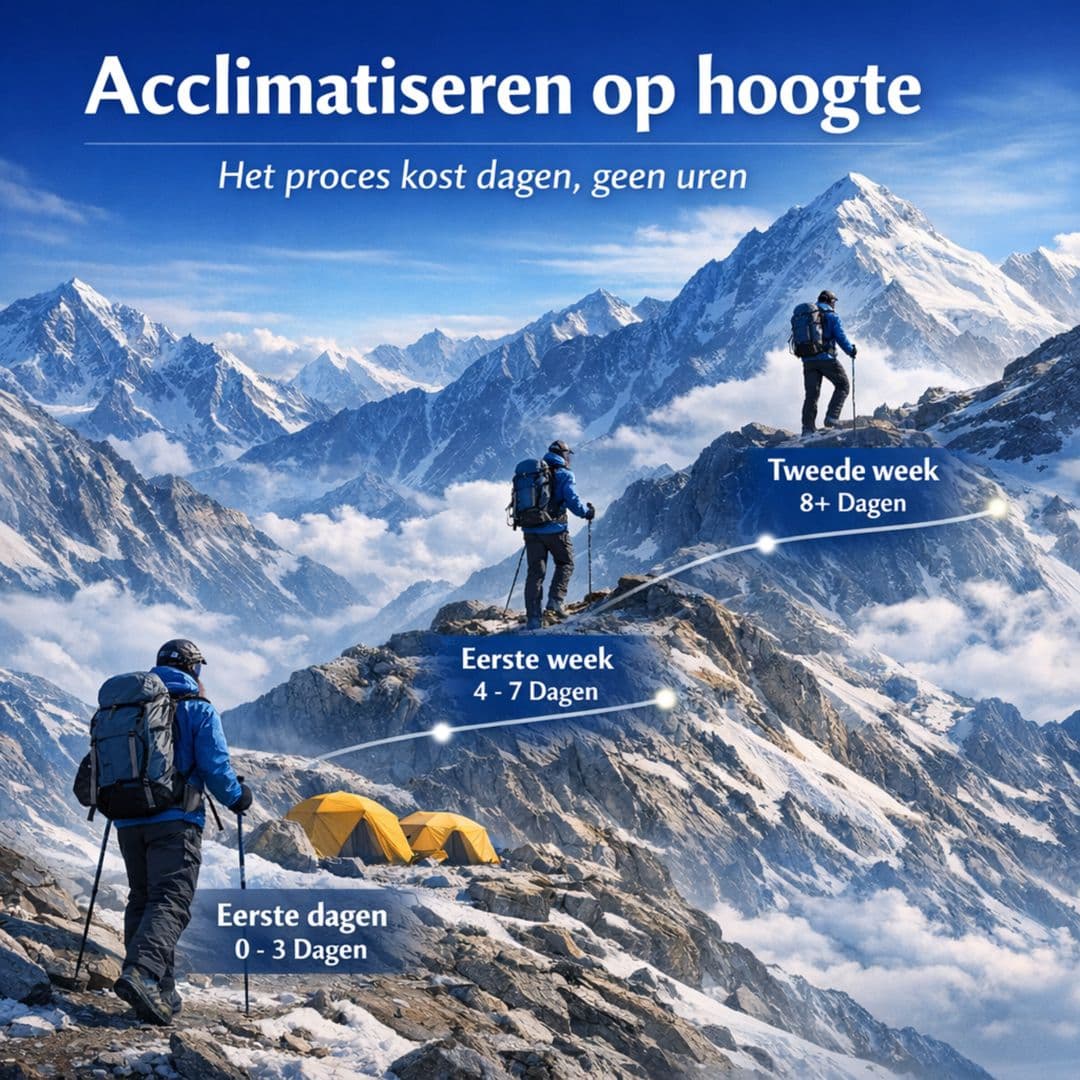
Acclimatising at altitude is the process by which your body adapts step by step to lower oxygen availability. Those who trek to the mountains benefit from this, but not everyone needs the same amount of time. In this article, you will read what exactly acclimatisation is, how it works physiologically, what you can realistically expect in the first hours, days and weeks, and when extra preparation is wise.
Short answer: Acclimatisation at altitude starts within a few hours, but proceeds in stages.
- In the first 24 to 72 hours, especially your breathing and fluid balance adjusts.
- After a few days, sleep often becomes calmer and the likelihood of symptoms decreases.
- After 1 to 2 weeks, there is usually clear functional gain, but not yet full adaptation.
- The higher you sleep and the faster you rise, the more important extra margin becomes.
Conclusion: acclimatisation is not a vague feeling, but a measurable adaptation process to oxygen deprivation.
Nuance: Being fit at sea level does not automatically mean you respond well at altitude quickly.
Practical hook: Therefore, think not only in peak day, but especially in sleep height, ascent rate and recovery time.
What exactly is acclimatisation at altitude?
Acclimatising means that your body learns to function with less available oxygen. Air pressure drops as you get higher. As a result, each breath contains fewer usable oxygen molecules for absorption into the blood. The result is not that you suddenly have to get sick, but that your body has to work harder to perform the same task.
With a gentle rise, that process can go well. With too rapid an ascent, the load can increase faster than your adaptation. Then symptoms increase, sleep deteriorates and the risk of altitude sickness increases. This is why altitude training and acclimatisation mainly a matter of timing, dosage and interpretation, not just fitness.
The important thing to understand is this: acclimatisation is not an all-or-nothing switch. It is a timeline. Your body first reacts acutely, then compensatively, and only later structurally. This is exactly where many mountain athletes go wrong. They feel reasonable on day 2, pull on too fast, and still run into trouble on day 3 or 4.
💡 Did you know? Many people think acclimatisation only starts after days. In reality, your body reacts within minutes with faster breathing and a higher heart rate. That is just not yet a stable adaptation. It is the beginning of the process, not the end point.
How does acclimatising at altitude work in your body?
The first reaction is almost always the same: you start breathing faster and deeper. This helps to take in more oxygen. At the same time, your heart rate often rises, especially on exertion and at rest during the first night. This is normal. Your body immediately tries to compensate for the lower oxygen availability.
This is followed by slower adjustments. Your kidneys play an important role by adjusting the acid-base balance. This makes the accelerated breathing easier to sustain. Meanwhile, your fluid balance also changes. Some people urinate more in the first few days. That's not necessarily a problem, but it makes smart hydration important.
In the slightly longer term, your body handles load, recovery and sleep more efficiently. Later, the production of extra red blood cells may also increase. However, this is not an overnight process. Anyone expecting to be fully adapted in three days is disappointing themselves.
Acute response versus true acclimatisation
Acute reaction
Starts soon after arrival.
Faster breathing, higher heart rate, restless sleep, heavier exertion.
Feels intense sometimes, but in itself is not a sign that things are going wrong.
Real acclimatisation
Emerges gradually over days to weeks.
Better sleep, more stable exercise, fewer complaints, more recovery capacity.
This takes time, proper build-up and often discipline not to rise too fast.
Timeline: how fast acclimatisation at altitude goes in practice
The real question is usually not whether acclimatisation works, but when to expect what. The timeline below helps with that. Think of this as a practical guideline, not a guarantee. Altitude, sleep altitude, ascent rate, previous history and individual sensitivity make a lot of difference.
| Phase | What is happening? | What do you often notice? | Practical significance |
|---|---|---|---|
| 0 - 24 hours | Faster breathing and higher heart rate. Acute stress on the system. | Feeling short of breath, lighter headache, worse sleep, exertion feels heavier. | Keep calm. Don't interpret it as weakness, but as normal first response. |
| 24 - 72 hours | Compensation begins. Acid-base balance and fluid balance shift. | Complaints can improve, but can also become more pronounced when rising too fast. | Key observation phase. This is where the first real decisions often arise. |
| Day 4 - 7 | Functioning becomes more stable when the structure is right. | Better sleep, less stuffy feeling, hiking or climbing feels more controllable. | Good phase to build on gradually, not to accelerate recklessly. |
| Week 2 | Deeper adjustments become more noticeable. | More reserve, calmer recovery, less fluctuation in effort and sleep. | For higher goals often only now real foundation laid. |
| 2+ weeks | Further refining adjustment. Not everyone responds equally. | More stability, but still sensitivity on further rise possible. | Useful for expeditions or those who need to sleep and perform high. |
0 - 24 hours
What is happening? Faster breathing and higher heart rate.
What do you often notice? Shortness of breath, mild headache, restless sleep.
Practical significance: stay calm and keep load low.
24 - 72 hours
What is happening? The first compensation starts.
What do you often notice? Complaints improve or become more pronounced.
Practical significance: this is the main observation phase.
Day 4 - 7
What is happening? Functioning stabilises with good build-up.
What do you often notice? Better sleep and more control on exertion.
Practical significance: carefully build up further.
Week 2
What is happening? Deeper adjustments become more noticeable.
What do you often notice? More reserve and quieter recovery.
Practical significance: this is often where real altitude base emerges.
2+ weeks
What is happening? Further refinement of adaptation.
What do you often notice? More stability, but not complete invulnerability.
Practical significance: useful for higher and longer trajectories.
If you want to better understand what happens in that critical start-up phase, also read what's in the first 72 hours at altitude happens. That is precisely where good or bad decisions often become visible.
What determines whether you acclimatise quickly or slowly?
Not everyone acclimatises at the same rate. This is partly due to sleep altitude, ascent rate, total load, previous susceptibility to altitude sickness, recent infections, energy availability and recovery quality. Age alone says less than is often thought. Experienced mountain athletes can still react incorrectly if they build up too quickly.
Route profile also makes a lot of difference. A day trip to altitude feels different from sleeping several nights high up. That's exactly why a normal ascent rate is more important than many people think. On that point, it makes sense to also look into a normal acclimatisation rate per 1,000 metres.
⚠️ Reality check A strong bike does not automatically protect you from altitude sickness. Indeed, fit athletes sometimes go up too fast precisely because they still feel good early on. The problem then is not lack of form, but lack of margin in the build-up.
Common misconceptions about acclimatisation
1. “I feel good, so I am acclimatised”
That is too short of the mark. You can feel fine one morning and still relapse later that day. Therefore, never look only at one snapshot.
2. “Low saturation automatically means failure”
Not necessarily. Saturation is context. Trend, complaints, sleep and recovery together are much more valuable than one isolated number. That is why oxygen saturation at altitude useful only if interpreted correctly.
3. “After a few days, you will be safe”
The risk of problems often decreases with proper adjustment, but does not disappear completely. Certainly not if you then start sleeping higher again or increase the load substantially.
4. “Acclimatising is the same as training”
No. Trainability and acclimatisation touch but are not the same thing. The former is mainly about performance incentive. The second is about safe and functional adaptation to altitude.
When do you need extra acclimatisation time?
Extra margin is sensible if:
- you go to sleep quickly above 2,500 to 3,000 metres
- you had altitude sickness before
- you have little time between travel and summit attempt
- your route offers few moments of recovery
- you already leave tired, sick or energetically empty
- you need to sleep high and perform high in a short time
For such situations, pre-controlled work with normobaric hypoxia can be useful. This does not replace true acclimatisation, but can make the process more plannable and measurable. Especially for expeditions or a tight travel schedule, this can be a relevant consideration.
This is how you monitor this lens
Good acclimatisations are not only felt, they are followed. Therefore, always use a combination of signals.
- SpO2 as a trend: look at several mornings, not one single measurement.
- Sleep quality: do you wake up calmer or increasingly restless?
- Recovery: does your heart rate normalise and walking feels proportional again?
- Symptoms: headaches, nausea, dizziness and performance loss count heavily.
- Decision rule: Do symptoms worsen despite rest, do not rise further and re-evaluate.
Objective monitoring is especially important because altitude sickness often starts with signs that people dismiss. If you doubt whether symptoms are still within normal adaptation, delve into recognising altitude sickness and how to act.
Practical approach for better acclimatisation
Practical basic approach: Think in sleep level first, then day level. Build load slowly, protect the first few nights, take early signals seriously and plan an extra margin day rather than an overly aggressive schedule. Especially in the mountains, discipline is often more valuable than bravado.
Before departure
Make sure you don't start your trip tired, dehydrated or half sick. A poor starting position increases the chances that normal altitude loading will soon feel like too much.
In the first days at altitude
Keep effort under conscious control. Pushing hard on day 1 because the legs feel good is rarely smart. Give breathing, sleep and recovery time to stabilise first.
When in doubt
Don't confuse ambition with progress. Those who objectively sleep worse, have more complaints and recover less rarely gain anything by moving up anyway.
FAQ on acclimatising at altitude
How long does acclimatisation take on average?
Initial adaptation starts within hours, but noticeable functional gains usually require several days. For higher goals, 1 to 2 weeks is often more useful than 2 or 3 days.
Can you speed up acclimatisation?
Above all, you can plan the process better, not force it. Slow build-up, smart sleep levels, recovery and possibly preparing in advance usually make more of a difference than training harder.
When does the risk of altitude sickness really start to increase?
This varies from person to person, but above about 2,500 metres, the chances increase markedly, especially if you climb quickly and sleep there as well.
Is acclimatising the same as getting used to restless breathing at night?
No. Restless breathing may be part of it, but it is only one part. True acclimatisation is about the total pattern of breathing, sleep, recovery and load capacity.
Want to make acclimatisation plannable in advance?
For those with little time between departure and altitude, acclimatising at home in an altitude tent may be a logical next step.
Read how home acclimatisation for mountain expeditions works
Conclusion
Acclimatising at altitude is a time process, not a talent. Your body's initial reaction starts quickly, but sustained adaptation takes days to weeks. Those who understand this make calmer choices, plan better and reduce the likelihood of problems.
The gist is simple: think in sleep height, ascent rate, recovery and trend. Not in ego, haste or one isolated measurement. Then acclimatisation does not become an uncertain sideshow, but an active part of your preparation.