Why not just live permanently at heights?
Published 28 July 2012 · 6 min read

In this article, you'll discover why living permanently at altitude isn't automatically better, which altitude zones are most interesting, and why many athletes opt for a controlled form of altitude training instead of a permanent move to the mountains.
Short answer:
- Living at altitude stimulates acclimatisation and the production of red blood cells.
- At higher altitudes, recovery, sleep quality, and training intensity often decrease.
- Above approximately 3,000 metres, the disadvantages become increasingly significant for many people.
- This is why many athletes opt for controlled altitude exposure rather than permanent residence.
Conclusion: More height doesn't automatically mean more advantage.
Nuance: The optimal balance often lies between adaptation and recovery.
Practical hook: This is why strategies like 'sleep high, train low' emerged.
Waarom hoogte een krachtig fysiologisch effect heeft
At sea level, the air contains roughly the same number of oxygen molecules as at higher altitudes. The difference lies in air pressure. As you ascend, the pressure drops, making it more difficult to absorb sufficient oxygen.
Your body reacts almost immediately. Breathing quickens, heart rate increases, and various hormones are activated. Over the longer term, adaptations occur that improve oxygen transport.
These processes form the basis of altitude training acclimatisation. The body tries to cope more efficiently with an environment in which there is less oxygen available.
📊 Research shows
People who stay at moderate altitudes for extended periods often develop an increased oxygen transport capacity. This is one of the reasons why many altitude training camps take place between roughly 1,800 and 2,500 metres.
Why living permanently at high altitudes isn't ideal
The advantages of altitude have a downside. The human body can adapt, but not indefinitely. As altitude increases, daily activities become physiologically more costly.
You notice this not only during athletic performance, but also during recovery, sleep, and general health.
Lower training quality
One of the biggest problems for athletes is that intensive training becomes more difficult. At altitude, you can simply produce less power than at sea level.
This is why the well-known concept of sleep high, train low. Athletes benefit from altitude acclimatisation while carrying out their heavy training at lower altitudes.
Poorer recovery
Recovery requires energy. When the body constantly has to compensate for a lack of oxygen, less capacity remains for recovery processes.
This is especially true when the altitude rises towards 3,000 metres and higher.
Sleep quality can decrease
Many people sleep less soundly at altitude for the first few days or weeks. Periodic breathing patterns, waking up more frequently, and lower sleep quality are common.
This effect may decrease after acclimatisation, but does not always disappear completely.
Increased strain on the body
Prolonged exposure to high altitude requires continuous adaptability. The body has to work harder to perform the same daily tasks.
For residents of extreme altitudes, this is normal. For people pursuing maximum performance, it is often less favourable.
What height is optimal?
Not every altitude has the same effect. There is an important difference between moderate altitude and extreme altitude.
| Height zone | Impact | Advantage or disadvantage |
|---|---|---|
| 1,500 – 2,500 m | Good balance between stimulus and recovery | Most commonly used for altitude internships |
| 2,500 – 3,500 m | Stronger acclimatisation stimulus | More recovery tax |
| 3,500 – 5,000 m | Clear physiological stress | Training quality is declining |
| 5,000m+ | Extreme load | Not suitable for long-term stays |
Affect Good balance between stimulus and recovery.
Significance: Popular for altitude training.
Affect Stronger acclimatisation stimulus.
Significance: Recovery is becoming more challenging.
Affect Clear physiological load.
Significance: Training quality is decreasing.
Affect Extreme hypoxic stress.
Significance: Not suitable for long-term living.
Why don't most top athletes live permanently at altitude?
If altitude had only advantages, all world records would come from mountain villages. In reality, we see something different.
Many successful athletes live at moderate altitudes or use temporary altitude blocks. They combine the benefits of acclimatisation with the possibility of quality training and optimal recovery.
Famous altitude training destinations such as St Moritz, Font Romeu and Sierra Nevada are deliberately located in an altitude zone where the advantages outweigh the disadvantages.
Permanent residence versus controlled exposure
- Living permanently at a high level continuous stimuli, but also continuous load.
- Temporary height placement strong stimulus with recovery periods.
- Altitude tent: controlled exposure without relocation.
- Sleep high, train low: combines adjustability and training quality.
What does this mean for mountaineers and expedition participants?
For expedition travellers, the goal is usually not maximum sporting performance, but safe acclimatisation.
In that case, a period of prior acclimatisation can be very valuable. For example, those travelling to Kilimanjaro, the Andes or the Himalayas often benefit from gradual preparation through acclimatising at home for mountain expeditions.
It is important to understand that an altitude tent is not a replacement for actual acclimatisation on the mountain. However, the process can be made more controlled, measurable, and better planned, which can significantly reduce the chance of altitude problems.
This is how you monitor this lens
Whether you live at altitude, are undertaking altitude training, or are using a high-altitude tent: measuring prevents guesswork.
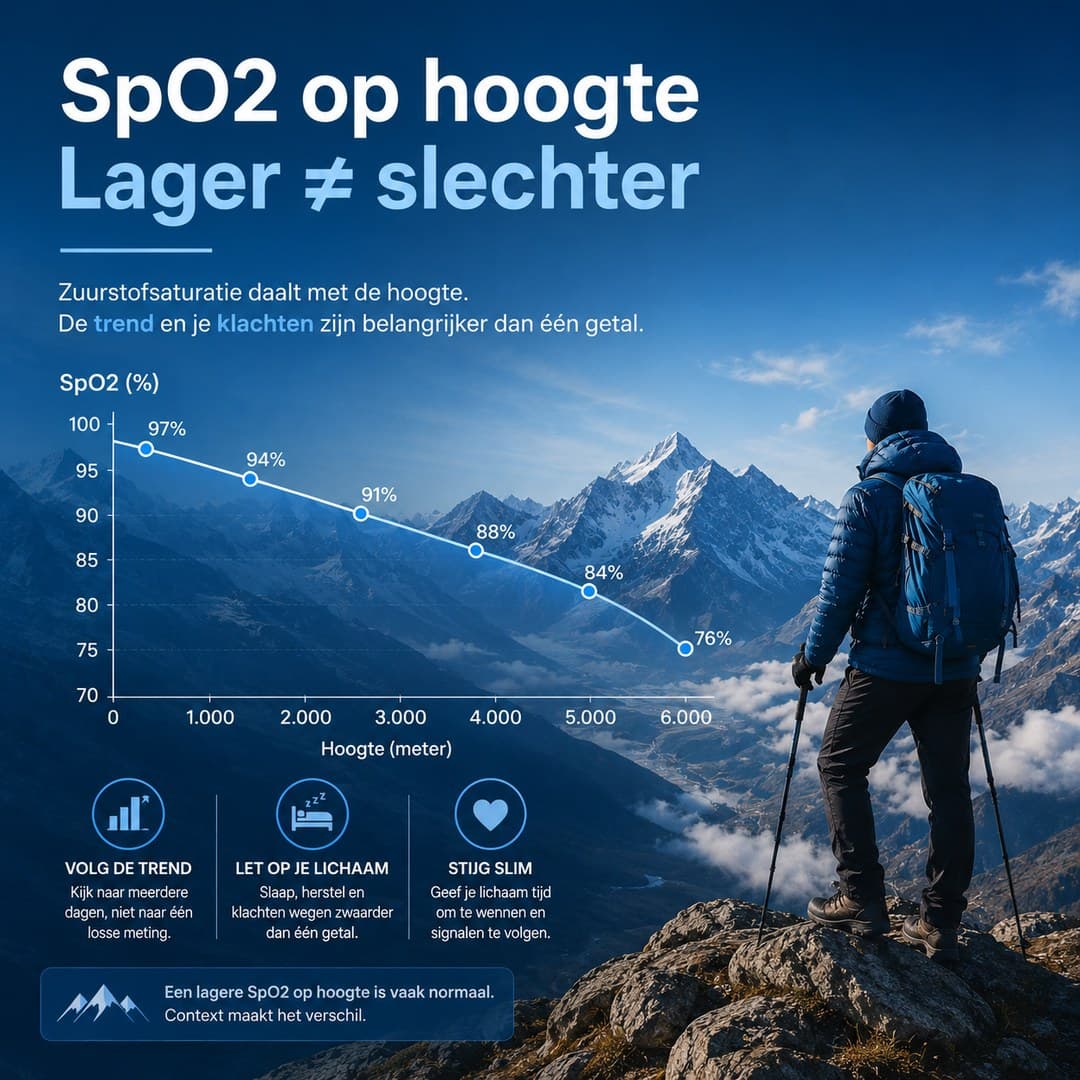
- Track your SpO2 as a trend over several days.
- Monitor sleep quality and nocturnal recovery.
- Watch for changes in resting heart rate.
- Keep track of headaches, fatigue, and appetite.
- Reduce the tax when multiple signals degrade.
Decision rules
- Do you feel fitter while your recovery remains stable? Then the adjustment is usually going well.
- Deteriorating sleep, recovery, and energy levels simultaneously? Then the load may be too high.
- Are symptoms continuing to increase? Lower the intensity or take extra recovery.
Common misunderstandings
The higher, the better
That's not correct. There is an optimal zone where the advantages outweigh the disadvantages.
Everyone reacts the same
This is also incorrect. Genetics, training status, age, and previous height experience all play a role.
Living permanently at a high level makes everyone faster.
Most performance gains come from the right combination of exposure, training, and recovery. Simply adding altitude is usually insufficient.
Do you want to benefit from the advantages of height without moving?
For athletes and mountaineers, controlled exposure to altitude can be a practical solution. Look at the possibilities and experiences of other users.
Conclusion
Living permanently at altitude sounds attractive, but in practice it rarely proves to be optimal. Above a certain altitude, recovery, sleep quality, and training capacity decrease. Therefore, many athletes opt for a compromise: sufficient exposure to stimulate adaptations, but not so much that recovery and performance suffer.
For most people, the art lies not in living as high as possible, but in finding the right balance between oxygen stimulation, recovery, and performance.
Frequently asked questions
Is permanent living at altitude healthy?
For many people, yes, especially at moderate altitudes. At higher altitudes, the physiological strain increases.
From what height do you notice effects?
Most people notice physiological changes from around 1,500 to 2,000 metres.
Why don't top athletes train permanently at high altitude?
Because training quality and recovery decrease when the altitude becomes too great.
Is a height tent comparable to living at altitude?
A height tent simulates normobaric hypoxia and can stimulate certain adaptations, but it does not replace real acclimatisation on the mountain.