How much water should you drink at altitude? Practical guidelines for each altitude zone
Published 27 May 2026 · 7 min read
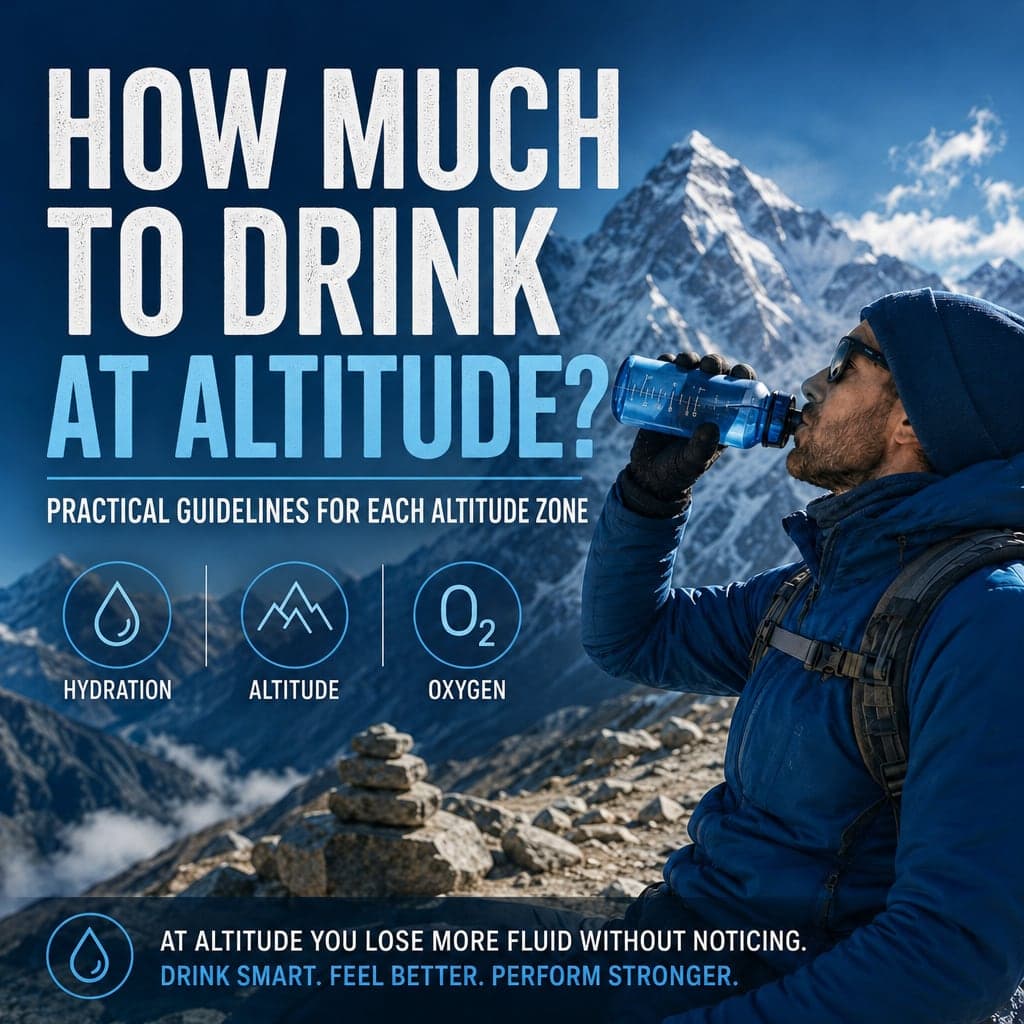
How much water to drink at altitude? It is one of the most underestimated questions for mountain treks, expeditions, and high-altitude stays. At altitude, you unnoticeably lose more fluid through breathing, drier air, and accelerated ventilation. At the same time, drinking too much also causes problems. Those who blindly continue to drink litres of water can experience complaints such as headaches, nausea, or an imbalanced salt level.
In this article, you'll learn how much fluid is usually sensible per altitude zone, how to recognise dehydration, when extra drinking is definitely not a solution, and how to combine hydration with acclimatisation, recovery and SpO2 trends.
Short answer: Most mountain hikers need an extra 1 to 2 litres of fluid per day at altitude compared to sea level, rising by altitude zone as in the table below. The higher, drier and more active you are, the greater the fluid loss. However, don't drink “as much as possible”, but aim for thirst, urine colour, recovery, energy and symptoms.
Conclusion: At altitude, you lose fluid more quickly, often without realising it.
Nuance: Drinking more doesn't automatically prevent altitude sickness, and drinking too much can also cause problems.
Practical hook: Always combine fluid intake with salt, nutrition, recovery, and a gradual acclimatisation process.
Anyone preparing for a trek or expedition would be wise to first understand how altitude acclimatisation works. Hydration is indeed supportive, but never the sole determinant of how well your body copes with altitude.
You lose more fluid at altitude because the air pressure is lower.
From around 2500 metres, your breathing changes. Your body starts to breathe faster and more deeply to get enough oxygen. This causes you to lose extra fluid with every breath.
Furthermore, mountain air is often extremely dry. Especially in cold or windy conditions, moisture evaporates more quickly through the skin and lungs. Many people hardly notice this, as sweating at altitude is sometimes less visible.
On top of that, factors such as:
- further loss of breath
- dry mountain air
- increased urination during acclimatisation
- Physical exertion with a backpack
- strong sun and UV radiation
- reduced appetite
Especially during the first few days at altitude, it's common for people to become dehydrated more quickly without immediately noticing. This also explains why headaches, fatigue, and a dry mouth are so frequent during the initial acclimatisation phase.
Read more about The physical reactions to oxygen deficiency to better understand why your body reacts differently at altitude than at home.
How much water to drink at altitude per altitude zone?
There is no perfect universal formula. Temperature, exertion, body weight, acclimatisation, and nutrition all play a part. Nevertheless, there are practical guidelines that work well for most mountain travellers.
| Altitude zone | Average moisture requirement | Practical interpretation |
|---|---|---|
| 0 – 2500 m | 2 – 3 litres | Normal requirement for moderate activity |
| 2500 – 4000 m | 3 – 4 litres | Extra drinks due to acclimatisation and dry air |
| 4000 – 5500 m | 4 – 5 litres | More loss of breath and often heavy exertion |
| 5500m+ | 5 litres of more | Only achievable with an active food and drink plan |
Moisture requirements: 2 – 3 litres
Interpretation: Normal need with moderate activity.
Moisture requirements: 3 – 4 litres
Interpretation: Extra drinks due to acclimatisation and dry air.
Moisture requirements: 4 – 5 litres
Interpretation: More breathlessness and heavy exertion.
Moisture requirements: 5 litres of more
Interpretation: Only achievable with an active food and drink plan.
These quantities are guidelines, not an end in themselves. In cold weather or with low exertion, you may sometimes need less. During strenuous climbs or extremely dry expeditions, you may need more.
When is drinking more helpful and when is it not?
Many people think that altitude sickness is mainly caused by dehydration. That's only partly true. Dehydration can worsen symptoms, but acute altitude sickness is primarily caused by oxygen deficiency and insufficient acclimatisation.
Drinking more usually helps with:
- Dry mouth and thirst
- mild fatigue
- dark urine
- recovery after exercise
- Headache due to dehydration
Drinking more doesn't usually help with:
- severe AMS complaints
- coordination problems
- severe nausea
- shortness of breath at rest
- Progressive altitude sickness
Anyone experiencing severe symptoms should not continue to “drink it away”, but should primarily consider rest, acclimatisation, descending, and medical assessment. For this, also read how to deal with acute altitude sickness.
⚠️ Reality check
Clear urine doesn't automatically mean you've acclimatised well. Some mountain trekkers actually drink too much out of fear of altitude sickness. This can lead to an unbalanced salt level and symptoms that strongly resemble altitude sickness.
How much water should you drink when trekking or on an expedition?
For trekking days, a practical approach usually works better than obsessively counting litres.
Practical hydration approach during trekking days
- Start the day hydrated
- Drink small amounts frequently
- Add salt or electrolytes for prolonged exertion
- Drink extra during dry or cold conditions
- Check urine colour and energy levels
- Do not force extreme amounts of water
A common mistake is to only drink when you feel very thirsty. At altitude, your fluid loss often outpaces your thirst.
At the same time, you must be careful of the other extreme. Mountain guides regularly see trekkers who drink water continuously “just in case,” while they consume hardly any food or salt.
The role of salt, electrolytes and nutrition
Water alone isn't enough. At altitude, you also lose electrolytes. This can make a big difference, especially during long days of hiking or in warm conditions.
This is why most people function better with:
- regular small meals
- sufficient carbohydrates
- Electrolytes or saline nutrition
- Sufficient iron status
- Alcohol restriction
Iron status in particular is important for acclimatisation and oxygen transport. You can read more about this in iron and nutrition during altitude training.
Common misunderstandings about drinking at altitude
“The more I drink, the lower my chances of altitude sickness”
That's not correct. Good hydration supports acclimatisation, but doesn't entirely prevent altitude sickness.
“Clear urine is always ideal”
Not necessarily. Consistently completely clear urine can also indicate overhydration.
“Coffee dehydrates you completely”
Normal amounts of coffee don't generally cause dramatic dehydration. However, excessive caffeine intake can affect recovery and sleep.
“Alcohol helps to ward off the cold”
Alcohol often increases fluid loss and disrupts sleep and acclimatisation. Caution is advisable, especially during the first few days at altitude.
🧭 In practice
Many experienced climbers focus less on exact litres and more on daily trends. Energy, urine colour, recovery, appetite, and sleep quality often provide more useful information more quickly than obsessively counting how many bottles of water you've drunk.
How to monitor this objectively
When assessing hydration at altitude, it's best to consider multiple signals simultaneously.
| Signal | Normal trend | When to pay attention? |
|---|---|---|
| Urine colour | Pale yellow | Dark or completely colourless |
| SpO2 trend | Gradual stabilisation | Plots strong drop with complaints |
| Sleep | Slowly improving | Severely deteriorating recovery |
| Headache | Mild and temporary | Increasing despite rest |
Normal trend: Pale yellow
Look out for: Dark or completely colourless urine.
Normal trend: Gradual stabilisation
Look out for: Stock plunges with complaints.
Normal trend: Slowly improving
Look out for: Strongly deteriorating recovery.
Normal trend: Mild and temporary
Look out for: Increasing complaints despite rest.
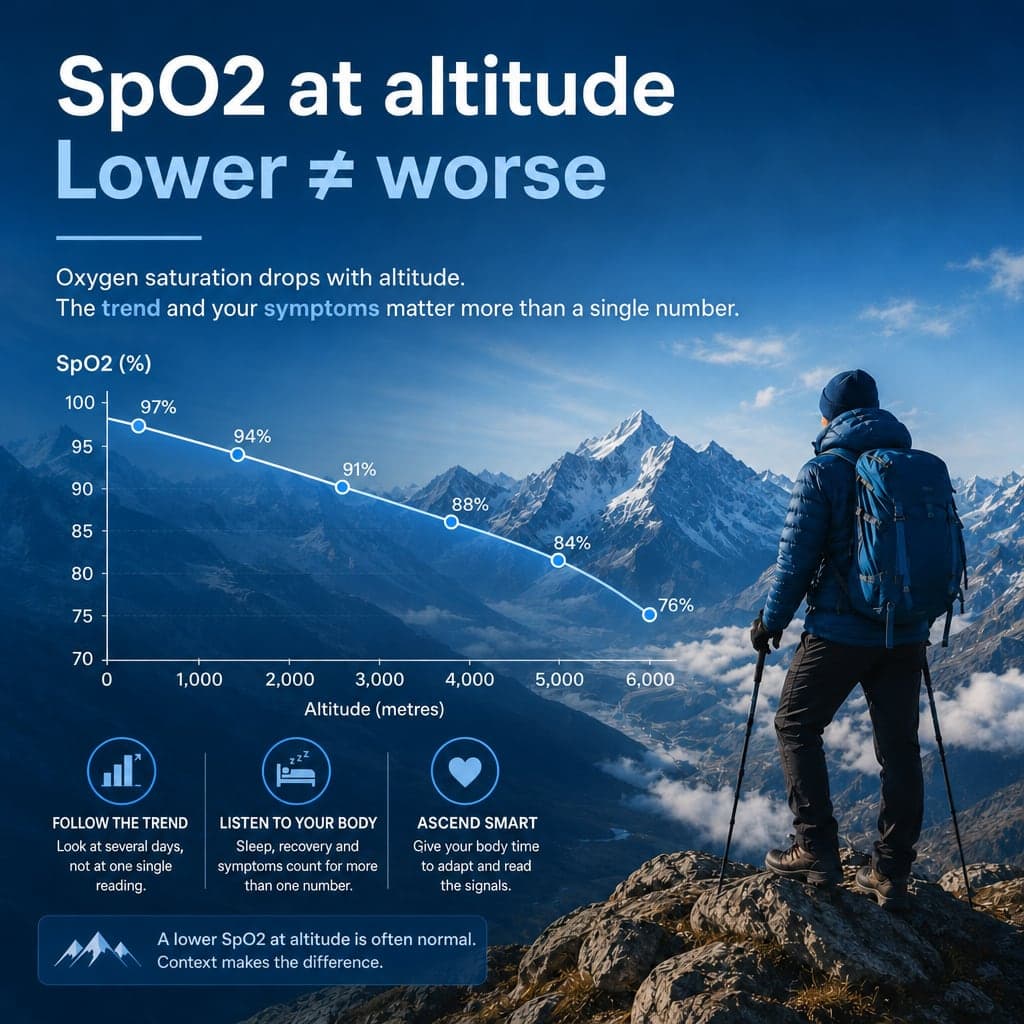
SpO2 should always be viewed as a trend, never as an isolated absolute truth. A slightly lower saturation without complaints is often less important than a sharp drop combined with headache, nausea, and poor recovery.
More background on normal values can be found in oxygen saturation at altitude.
When should you be extra careful?
Extra attention is advisable when:
- first days above 3000 metres
- cold and dry expeditions
- strenuous physical exertion
- Diarrhoea or stomach problems
- reduced appetite
- Use of Diamox
When to slow down or evaluate?
- persistent headache
- Progressive nausea
- Dizziness at rest
- no recovery after rest day
- Severe decline in energy
Hydration when acclimatising at home with an altitude tent
Even when sleeping in an altitude tent, some users notice they lose more moisture. This is due to increased ventilation during normobaric hypoxia.
However, the same applies here: drinking more is supportive, but not the main goal. The focus remains gradual progression, sufficient sleep duration, recovery, and a stable SpO2 trend.
Those who are acclimatising at home would do well to build up gradually and follow signals objectively. You can read more about this in the build-up schedule for an altitude tent.
A more relaxed acclimatisation towards your mountain trip?
Controlled preparation at home can help make acclimatisation more manageable. Especially for expeditions above 4000 metres, many mountaineers therefore opt for prior altitude training or sleeping in an altitude tent.
Read more about home acclimatisation for mountain expeditions
Conclusion
How much water you need at altitude depends on the elevation, exertion, climate, and acclimatisation. For most people, above 2500 metres, they lose noticeably more fluid than they do at home.
However, good hydration isn't about drinking excessively. It's about balance. Sufficient fluids, adequate salt, good nutrition, calm acclimatisation, and objective monitoring reinforce each other.
Anyone who only counts litres often misses the bigger picture. Those who look at recovery, symptoms, sleep and trends usually make better decisions in the mountains.
FAQ
How much water should you drink at 4000 metres?
Most people consume around 3 to 5 litres a day, depending on exertion, temperature and dryness.
Can you prevent altitude sickness by drinking a lot?
No. Good hydration supports acclimatisation, but does not fully prevent altitude sickness.
Is clear urine always a good sign?
Not always. Consistently completely clear urine can also indicate overhydration.
Why do you need to urinate more often at altitude?
During acclimatisation, your breathing and fluid regulation change. As a result, many people urinate more frequently.
Are electrolytes useful at altitude?
Yes. Especially during prolonged exertion, sweating, or in dry conditions, electrolytes can help to keep fluid balance more stable.