Climbing Cho Oyu: acclimatisation for 8188 metres
Published 30 April 2026 · 14 min read
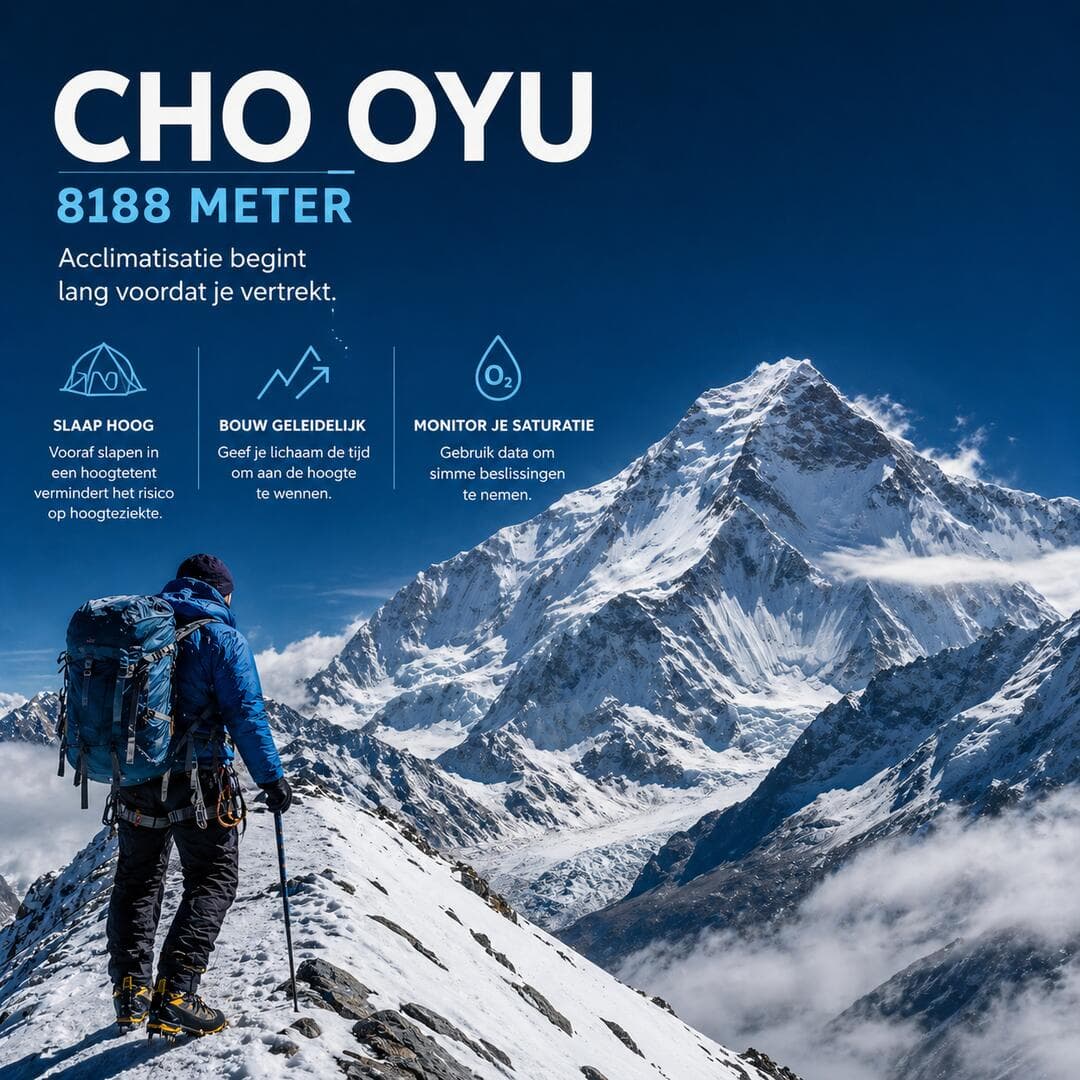
Climbing Cho Oyu is the most logical first step towards the world of 8000 metres for many experienced mountaineers. The mountain is 8188 metres high, lies on the border of Tibet and Nepal and is often seen as a relatively accessible 8000’er. Yet that word “accessible” deserves nuance. Above 8000 metres, altitude turns from a factor into the main problem.
Those seriously considering Cho Oyu should therefore not only look at climbing technique, expedition logistics and equipment. The most important preparation starts earlier: with acclimatisation, recovery, oxygen saturation and a plan to get the body used to oxygen deprivation in a controlled way already at home.
Direct response: Cho Oyu is 8188 metres high and among the 14 highest mountains in the world. For many climbers, it is a first 8000’er, but the altitude remains extreme. Strong preparation combines expedition experience, a leisurely acclimatisation schedule, objective monitoring and preferably sleeping in an altitude tent beforehand.
Conclusion: Cho Oyu is relatively less technical than many other 8000s, but physiologically 8188 metres remains extreme.
Nuance: An easier route does not mean the risk of altitude sickness is low.
Practical hook: Sleeping in an altitude tent beforehand makes acclimatisation controlled, measurable and plannable.
Climbing Cho Oyu: why this mountain is so interesting
Cho Oyu often means “Turquoise Goddess”. That name fits the image many climbers have of the mountain: big, white, open and less threatening than, say, K2, Annapurna or Kangchenjunga. Yet that image is only partly justified. Cho Oyu is the sixth highest mountain in the world and is close to Everest. So the altitude is undeniably serious.
An attractive mountain with a sharp edge
For Altitude Dream, this topic is strong because it touches precisely on a group actively seeking better preparation. Someone who wants to climb Cho Oyu usually already has experience at 5,000, 6,000 or 7,000 metres. That person knows that fitness alone is not enough. The real issue is: how do you prepare your body for weeks of living, sleeping and climbing in extreme hypoxia?
Therefore, Cho Oyu fits perfectly within the theme acclimatising at home for mountain expeditions. Not as a quick trick, but as serious preparation for an environment where recovery, sleep and oxygen uptake become decisive.
Practical fact: Cho Oyu is often called less technical than other 8000s. That's mostly about the normal route, not the physiological load. At 8188 metres, you are in the death zone. There, the body barely recovers and simple actions become slow, heavy and error-prone.
Is Cho Oyu really a good first 8000’er?
For many experienced expedition climbers, Cho Oyu may indeed be a logical first 8000’er. The normal route from Tibet has historically been the most widely used route. Compared to some other 8000s, the technical passages are more limited and the objective hazards are often more manageable. As a result, Cho Oyu is regularly chosen as a stepping stone to Everest or as a first introduction to extremely high climbing.
Relatively accessible does not mean easy
The word “first” should never be confused with “easy”. A first marathon is also still a marathon. Cho Oyu remains an expedition to 8188 metres, with long days, cold nights, logistical uncertainty, weather windows and considerable strain on heart, lungs, sleep and recovery.
A strong candidate for Cho Oyu usually already has experience with high mountains, multi-day expeditions, crampons, fixed ropes, cold conditions and sleeping at altitude. In addition, the climber must have a good understanding of how his or her body reacts to hypoxia. For Cho Oyu, those who develop symptoms quickly at 4,000 or 5,000 metres have no reason to panic, but they do need extra preparation.
When does Cho Oyu make sense? If you have already done several high expeditions, respond well to altitude, remain mentally calm in case of discomfort and take enough time for acclimatisation.
When is Cho Oyu too early? If you have no experience above 6,000 metres, sleep poorly at altitude or rely mainly on fitness rather than acclimatisation.
What 8188 metres does to your body
At sea level, oxygen feels natural. At high altitude, that changes. The air still contains about the same percentage of oxygen, but the air pressure is lower. As a result, less oxygen becomes available to your body per breath. At 8188 metres, that stimulus is extreme.
Why recovery above 8000 metres is so limited
Your breathing speeds up. Heart rate rises. Sleep becomes lighter. Appetite may drop. Recovery is slower. Thinking skills can also become less sharp, just at times when clear decisions are needed. This makes Cho Oyu not only a physical challenge, but also a management issue.
The body can adapt, but not indefinitely. Acclimatisation helps to cope better with oxygen deprivation. Still, prolonged stays above 8,000 metres remain taxing. Therefore, good Cho Oyu preparation revolves around two things at the same time: sufficient stimuli to get used to and sufficient recovery so as not to start the climb exhausted.
Cho Oyu in altitude context
| Height zone | Practical significance | Relevance to Cho Oyu |
|---|---|---|
| 3000 to 4000 m | Many people notice shortness of breath, worse sleep and higher heart rate. | Good zone to learn previous sensitivity to altitude. |
| 5000 to 6000 m | Acclimatisation will determine comfort, pace and recovery. | Relevant experience for base camp, intermediate camps and previous expeditions. |
| 7000 to 8000 m | Sleep, appetite and recovery clearly come under pressure. | Important for senior camps and summit push preparation. |
| 8188 m | Extreme height with minimal recovery space. | Summit zone of Cho Oyu. Here, every previous acclimatisation step counts. |
3000 to 4000 m
Significance: shortness of breath, worse sleep and higher heart rate may occur.
Cho Oyu: useful zone to recognise previous altitude sensitivity.
5000 to 6000 m
Significance: acclimatisation determines comfort, pace and recovery.
Cho Oyu: relevant to base camp, intermediate camps and previous expeditions.
7000 to 8000 m
Significance: sleep, appetite and recovery come under severe pressure.
Cho Oyu: important for higher camps and summit push preparation.
8188 m
Significance: extreme height with minimal recovery space.
Cho Oyu: summit zone. Every previous acclimatisation step counts.
Do not use these zones as hard medical limits. They mainly help to interpret the load practically.
Why pre-sleeping in an altitude tent is so valuable here
At Cho Oyu, sleeping in an altitude tent beforehand is not a luxury detail. It is a rational way of exposing the body to oxygen deprivation in a controlled way even before departure. This is done via normobaric hypoxia: the oxygen percentage is reduced while air pressure remains normal.
The power is in control
In the mountains, altitude, cold, poor sleep, stress and logistics often come together at the same time. At home, you can build up the stimulus step by step. You can track your sleep, your SpO2 trend measure and adjust before you are in the Himalayas.
For an 8000-metre expedition, this is particularly valuable. An altitude tent does not replace actual acclimatisation on the mountain, but it does make the process controlled, measurable and planable. This can significantly reduce the risk of altitude sickness. There is no 100% guarantee, but the difference between going to altitude unprepared and pre-structured acclimatisation is significant.
Important nuance: An altitude tent is neither a panacea nor a licence to climb faster than is sensible. Instead, the value lies in starting more calmly, monitoring better and starting the expedition with more physiological margin.
A practical acclimatisation plan for Cho Oyu
A good plan does not start only in Tibet or Nepal. For Cho Oyu, you ideally think in three layers: preparation at home, expedition acclimatisation on site and conservative decision-making around the higher camps. It is precisely this combination that makes the plan stronger.
Phase 1: getting used to hypoxia at home
In the weeks before departure, sleeping in an altitude tent is the most practical form of pre-acclimatisation. The aim is not to put maximum stress on yourself. You build up a stable nighttime stimulus that your body can process.
Many climbers want to sleep too high too soon. This feels tough, but often backfires. Poor sleep, headaches or fatigue are not proof that the training is “working”. Such signals can also mean that the stimulus is too aggressive.
Phase 2: on expedition continue to build calmly
Even with pre-acclimatisation, the expedition itself remains important. The body has to get used to real altitude, cold, wind, long days and limited appetite. The classic principles still apply: ascend gradually, make rotations, return to lower sleeping altitude and take complaints seriously.
The value of sleeping in an altitude tent beforehand is that you often arrive with a better starting position. Your body has already got to know the hypoxic stimulus. This allows for a calmer transition to base camp and higher camps.
Phase 3: above 7000 metres, decide sharply
Above 7000 metres, every mistake becomes more expensive. You have less margin. Sleep gets lighter. Recovery slows down. Compensation works less well if you go too hard. Therefore, around the higher camps, you need to look not only at the weather but also at your trend: sleep, recovery, appetite, headache, heart rate sensation and SpO2.
Sample build-up for pre-acclimatisation at home
| Phase | Target | Practical focus |
|---|---|---|
| Week 1 | Getting used to sleeping with mild hypoxic stimulus. | Sleep quality, morning feeling and first SpO2 trend follow. |
| Week 2 to 3 | Gently increase incentive if sleep and recovery remain stable. | Don't chase altitude. Stability is more important than speed. |
| Week 4 to 5 | Build more nights with consistent exposure. | Morning measurements compare sleep quality and fatigue. |
| Final stage | Leaving fresh with built-up tolerance. | No aggressive raising just before departure. Monitor recovery. |
Week 1
Objective: Getting used to sleeping with mild hypoxic stimulus.
Focus: sleep quality, morning feeling and initial SpO2 trend tracking.
Week 2 to 3
Objective: Stimulus calm increase in stable sleep and recovery.
Focus: stability is more important than raising it quickly.
Week 4 to 5
Objective: Build up consistent night-time exposure.
Focus: Link morning measurements to sleep and fatigue.
Final stage
Objective: leaving fresh with built-up tolerance.
Focus: no aggressive increase just before departure.
This is a practical mindset, not a medical personal schedule. The optimal structure depends on experience, health, sleep response and expedition planning.
Common misconceptions about Cho Oyu and acclimatisation
Misconception 1: Cho Oyu is technically simpler, so the risk is limited
Technical difficulty and altitude load are two different things. A route can be relatively manageable and yet remain extremely demanding on your body. Especially with Cho Oyu, the reputation of being an “accessible 8000’er” can lead to underestimation.
Misconception 2: Good fitness protects against altitude sickness
Fitness helps you climb, but does not automatically protect against altitude sickness. Strong athletes may actually go too fast because they feel fit. For Cho Oyu, dosage is at least as important as power.
Misconception 3: Using oxygen makes acclimatisation less important
Supplemental oxygen can play a role within expedition management, but it does not replace proper preparation. Even with oxygen, sleep elevation, rotations, symptom recognition and recovery remain crucial.
Misconception 4: Low SpO2 is always a good training signal
Lower saturation is not automatically better. The trend is more important than one single measurement. Look at the whole picture: sleep, headache, recovery, morning feeling and how the values develop over several days.
This is how you monitor this lens
For Cho Oyu, you don't want to rely on feeling alone. Feeling remains important, but altitude can be misleading. Some climbers feel reasonable, while their recovery is visibly deteriorating. Others are startled by one low SpO2 reading, while the trend is still acceptable.
Make monitoring simple enough to persevere
Use a simple routine. Don't measure obsessively, but do measure consistently. This is especially valuable when sleeping in an altitude tent, as you already learn at home how your body reacts to hypoxia.
Monitor at least these four signals:
- SpO2 trend: Preferably measure in the morning and compare over several days.
- Sleep quality: pay attention to sleeping through, restlessness, waking up and morning feeling.
- Recovery: track fatigue, resting heart rate sensation and training response.
- Symptoms: note headache, nausea, dizziness, loss of appetite and unusual shortness of breath.
A useful decision rule: increase the stimulus only if sleep, recovery and symptoms remain stable. If sleep gets worse, headaches increase or your general recovery drops, it is usually wiser to stabilise rather than increase further.
Also read the in-depth explanation on preventing altitude sickness. For additional medical background around altitude sickness and acclimatisation, the English-language CDC Yellow Book page on high-altitude travel a valuable external resource. At Cho Oyu, recognising early is often more important than pushing on tough.
Practical facts that will sharpen your preparation
Cho Oyu is interesting because the mountain is simultaneously attractive and treacherous. The route seems more manageable on paper than many other 8000s, but the altitude gives little room for error. This is precisely why practical details become important.
Arrival may already have acclimatisation impact
Many Cho Oyu expeditions approach the mountain via Tibet. In doing so, the ascent to higher altitude can be relatively quick. Therefore, look not only at the climbing days, but also at the journey to base camp.
The summit plateau can be mentally treacherous
Cho Oyu is known for a wide higher zone towards the summit. At extreme heights, distance can feel misleading. What seems close can be a long time away. This calls for energy management and cool decision-making.
Cold and altitude reinforce each other
Cold makes everything slower: eating, drinking, changing clothes, sleeping and deciding. Combined with hypoxia, it creates a double burden. Therefore, preparation is not only physiological but also practical. Routines should be simple.
Your appetite may drop at a time when you need energy
Many climbers notice less hunger at altitude. Nevertheless, energy intake remains crucial. Therefore, test beforehand which foods you can still tolerate even under stress and fatigue.
Climbing Cho Oyu: when is sleeping in an altitude tent beforehand especially useful?
Sleeping in an altitude tent beforehand is especially useful if you are planning a big expedition, have previously proved sensitive to altitude or have less acclimatisation time on site. It can also be valuable for experienced climbers, as 8000 metres remains a different category from 5000 or 6000 metres.
More information before you leave
The biggest gain is in predictability. You already learn how you react at home. You discover whether your sleep remains stable. You can improve your altitude and oxygen stimulus understand better. As a result, you will leave with more information than just your training condition.
For Cho Oyu, this is important because expedition success often does not depend on one heroic day. It depends on staying calm for weeks, recovering well and being strong enough at the right time for the summit push.
Pre-sleeping in an altitude tent is highly recommended when:
you are going to 8000 metres, you had previous altitude complaints, you have limited time to climb in slowly, you want to monitor your SpO2 trend objectively or you want to start the expedition with more physiological margin.
Checklist for stronger Cho Oyu preparation
- Plan your acclimatisation not only on the mountain, but also in the weeks before.
- Use an altitude tent to get used to hypoxia in a controlled way.
- Always track your SpO2 as a trend, not as a single daily value.
- Save training quality. Arriving tired is not an advantage.
- Test equipment, nutrition and sleep routines even before departure.
- Be conservative with headaches, poor sleep or declining recovery.
- Make clear decision rules in advance for ascending, resting or descending.
Those who take these points seriously approach Cho Oyu not as an “easy 8000’er”, but as a great expedition that becomes more manageable through preparation. That is exactly the right mindset.
Frequently asked questions about Cho Oyu climbing
How tall is Cho Oyu?
Cho Oyu is 8188 metres high. This makes it the sixth highest mountain in the world and one of the 14 official 8000s.
Is Cho Oyu suitable as a first 8000’er?
For experienced expedition climbers, Cho Oyu can be a logical first 8000’er. For climbers with no experience above 6000m, the step is usually too big.
How important is acclimatisation for Cho Oyu?
Acclimatisation is crucial. Above 8000 metres, the physiological margin is small. A gentle build-up, good monitoring and getting used to hypoxia beforehand can make all the difference.
Does an altitude tent help prepare for Cho Oyu?
Yes, especially as part of a broader acclimatisation plan. An altitude tent makes pre-acclimatisation controlled, measurable and planable. It can significantly reduce the risk of altitude sickness, but there is no 100% guarantee.
What signals should you take seriously at altitude?
Headaches, nausea, dizziness, poor coordination, extreme fatigue, confusion and shortness of breath at rest should always be taken seriously.
Prepare your Cho Oyu expedition in a controlled way
If you are heading towards 8000 metres, you don't want to discover how your body reacts to oxygen deprivation only on expedition. With an altitude tent, you can get used to hypoxia beforehand at home, monitor your SpO2 trend and start the trip with more peace of mind.
Conclusion: Cho Oyu calls for respect for height
Climbing Cho Oyu is appealing because the mountain is said to be relatively accessible within the 8,000-metre world. That doesn't make preparation any easier. At 8188 metres, acclimatisation largely determines how safe, clear and strong you can continue to function.
The best approach is calm and rational. Build experience. Plan your expedition conservatively. Monitor objectively. Use advance sleeping in an altitude tent as a controlled, measurable and plannable way to get your body used to oxygen deprivation already at home.
Especially with a mountain like Cho Oyu, this is no luxury. It is a smart way to start one of the world's highest mountains with more physiological margin.