Height training and the art of proper planning
Published 10 March 2020 · 9 min read
You book a high-altitude training camp, train hard and hope for victory. Yet, the results are sometimes disappointing, while a teammate on the same mountain makes progress. Often, the difference lies not in the mountains, but in the planning of your altitude training. More and more research shows that altitude training is most effective when planned over the long term and repeated several times a year. In this article, you will read why repetition yields so much, what a multi-year plan looks like, and how to tailor the content to your goals.
Short answer: A proper altitude training plan thinks in years, not weeks. The gains accumulate: the more often an athlete stays at altitude, the faster the body adapts and the stronger the effect of each subsequent camp. Therefore, plan multiple altitude camps per year within a multi-year plan, tailor the training content to your individual response, and align the timing with your most important goal.
Conclusion: Altitude training yields the most when you plan it structurally, not as an isolated event.
Nuance: The ideal duration and content vary per athlete, as the response to altitude is highly individual.
Practical hook: Monitoring the construction at multiple stages throughout the year strengthens the effect time and again.
Why repetition enhances the effect of altitude training
Altitude training has long been used by endurance athletes to improve performance at sea level. The idea is simple: by training in thin air, your body produces more EPO and more red blood cells, thereby improving oxygen transport to your muscles. That mechanism is the same for everyone, and it forms the basis of the workings of altitude training.
The power of repetition is precisely what makes that mechanism so effective. Your body adapts to altitude more quickly when you've been there before, allowing you to train at your peak level during a subsequent stay. Furthermore, altitude training is more effective when you spend multiple periods at altitude consecutively. The adaptation builds up instead of constantly starting over.
📊 Research shows
A narrative review by Mujika, Sharma, and Stellingwerff (2019) combines the latest scientific knowledge with years of elite athlete coaching. Their main advice is clear: plan altitude training for the long term and go to altitude multiple times a year, as each camp reinforces the effect of the previous one.
The biggest misconceptions about planning altitude training
There are a number of persistent myths surrounding altitude training planning. The first: one training camp per year is enough. In reality, you miss out on the cumulative effect that repetition generates. A single period provides a stimulus, but not the stacked adaptation that really counts.
The second misconception: the fitness gain is permanent. After returning to sea level, the advantage gradually fades, often within a few weeks. The third: everyone reacts the same to altitude. That's not true, and it's precisely these individual differences that make thorough planning so important.
Think in years: the multi-year plan
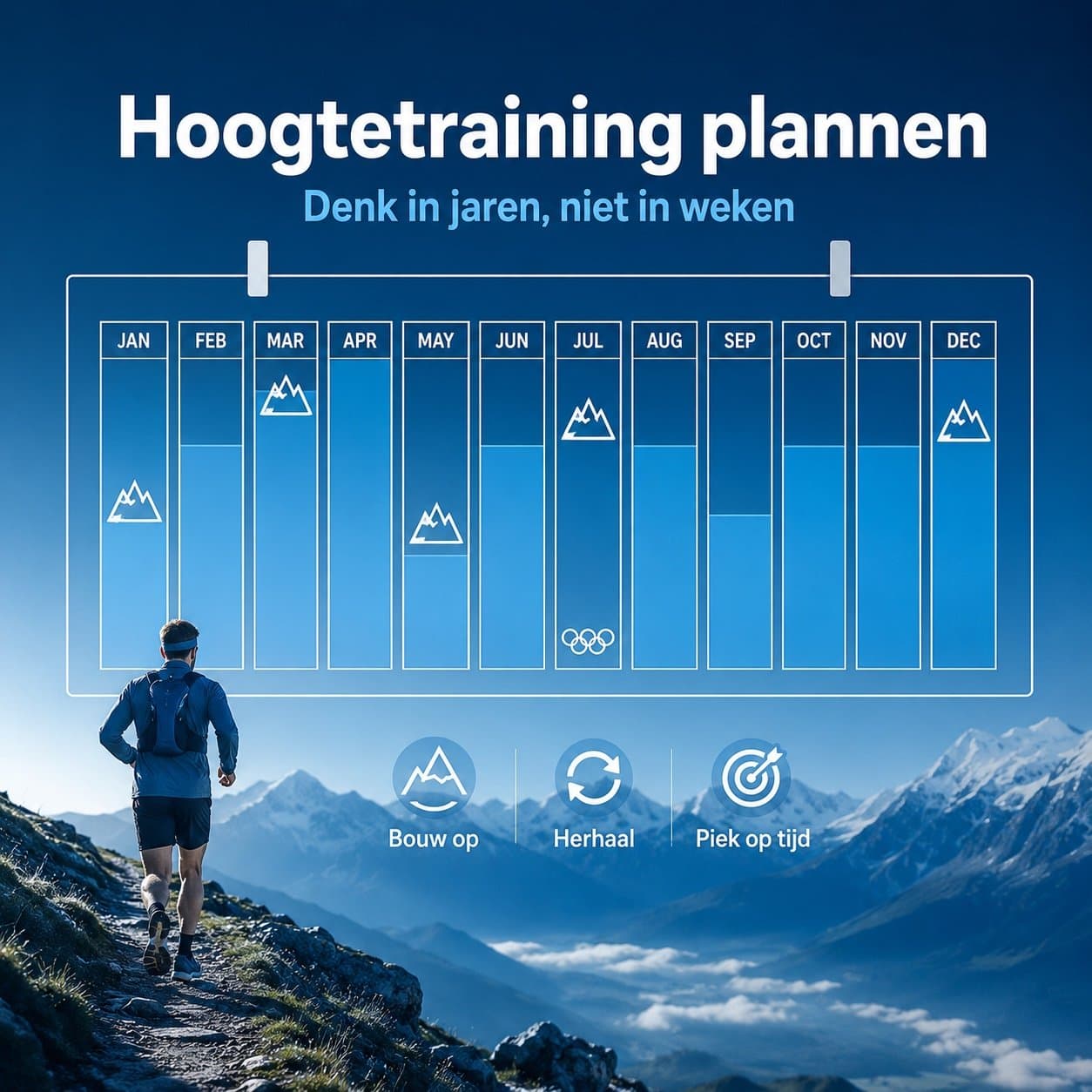
To maximise the benefits of altitude training, plan not one camp, but a series. Researchers therefore advise a multi-year plan. A four-year Olympic cycle is well-suited for this, as it allows the body to become increasingly accustomed to altitude over multiple seasons. As an example, they describe an Olympic swimmer who spent no less than 66 weeks at altitude over four years.
Such a plan builds up deliberately. In the initial years, you acclimatise to height and lay the foundation, while in later years, the stages are increasingly precisely aligned with your main goal. The structure below illustrates the thinking behind a multi-year plan.
| Period | Approach | Target |
|---|---|---|
| Starting phase | First altitude stages, body getting used to it | Faster adaptation during later stages |
| Build-up phase | Multiple stages per year, gradually more intensive | Stacked effect and higher load capacity |
| Peak | Timed stages towards your main goal | Maximum profit at the right time |
Approach Initial acclimatisation at altitude, letting the body adjust.
Objective: faster adaptation during later stages.
Approach Several stages per year, progressively more intensive.
Objective: Stacked effect and higher load capacity.
Approach Milestones towards your main goal.
Objective: maximum profit at the right time.
Timing is therefore the final, decisive step. The altitude advantage builds up over weeks and then decreases again, so you want to appear at the start with a built-up effect. Therefore, count back from your target date and plan the final stage so that you the height effect coincides with your match.
Individual Altitude Training: Tailor the Content to the Athlete
The training sessions during a training camp should align with your training cycle, your competition schedule, and your personal goals. Because athletes react differently to altitude, there is no universal schedule for duration and content. However, there is a proven basic rule. You can train less intensely at altitude, so you should derive the bulk of your volume from low-intensity endurance training, interspersed with short, intensive sessions that you may even carry out at a lower altitude.
This picture changes as you go more often. With successive stages, you can expect to train more intensively and will need fewer descents for your heavy sessions. The difference between a first and a later stage can be seen below.
| Aspect | First altitude training camp | Consecutive stages |
|---|---|---|
| Intensity | Mostly quiet, often descending for heavy sessions | As high as possible, fewer descents needed. |
| Adaptation | Tragers, the body has to get used to it | Quicker, you'll be at the right level sooner |
| Impact | Noticeable but modest | Stronger and cumulative |
First stage predominantly low, often descending for heavy sessions.
Later stages: Higher possible, less descending needed.
First stage The body needs to get used to it.
Later stages: Faster, you're at the top level sooner.
First stage noticeable but modest.
Later stages: stronger and cumulative.
The model that you sleep and stay at altitude but train low is known as Live High Train Low. This precise combination gives the most consistent profit, as you get the adaptation stimulus without sacrificing your training intensity. Recovery between stages is an inseparable part of this, because a good approach after your altitude training determines how fresh you start the next one.
Non-responders don't exist, poor planning does
Some athletes don't seem to make progress after altitude training. They are called non-responders, but researchers go as far as to state that they don't actually exist. According to them, those who don't achieve performance gains are usually the victims of poor planning and programming.
Think of athletes who only went to altitude training once, were exposed to low oxygen pressure for too short a period, or trained too little or too intensively. These are all planning errors, not matters of innate ability. With the right approach, virtually every endurance athlete should benefit from altitude training.
⚠️ Reality check
Don't be too quick to blame your genes for a disappointing result. More often, something is wrong with the plan: too few stages, too short an exposure, or the wrong training dose. That's good news, because you can adjust a plan. Assess your approach first before concluding that altitude doesn't work for you.
This is how you monitor this lens
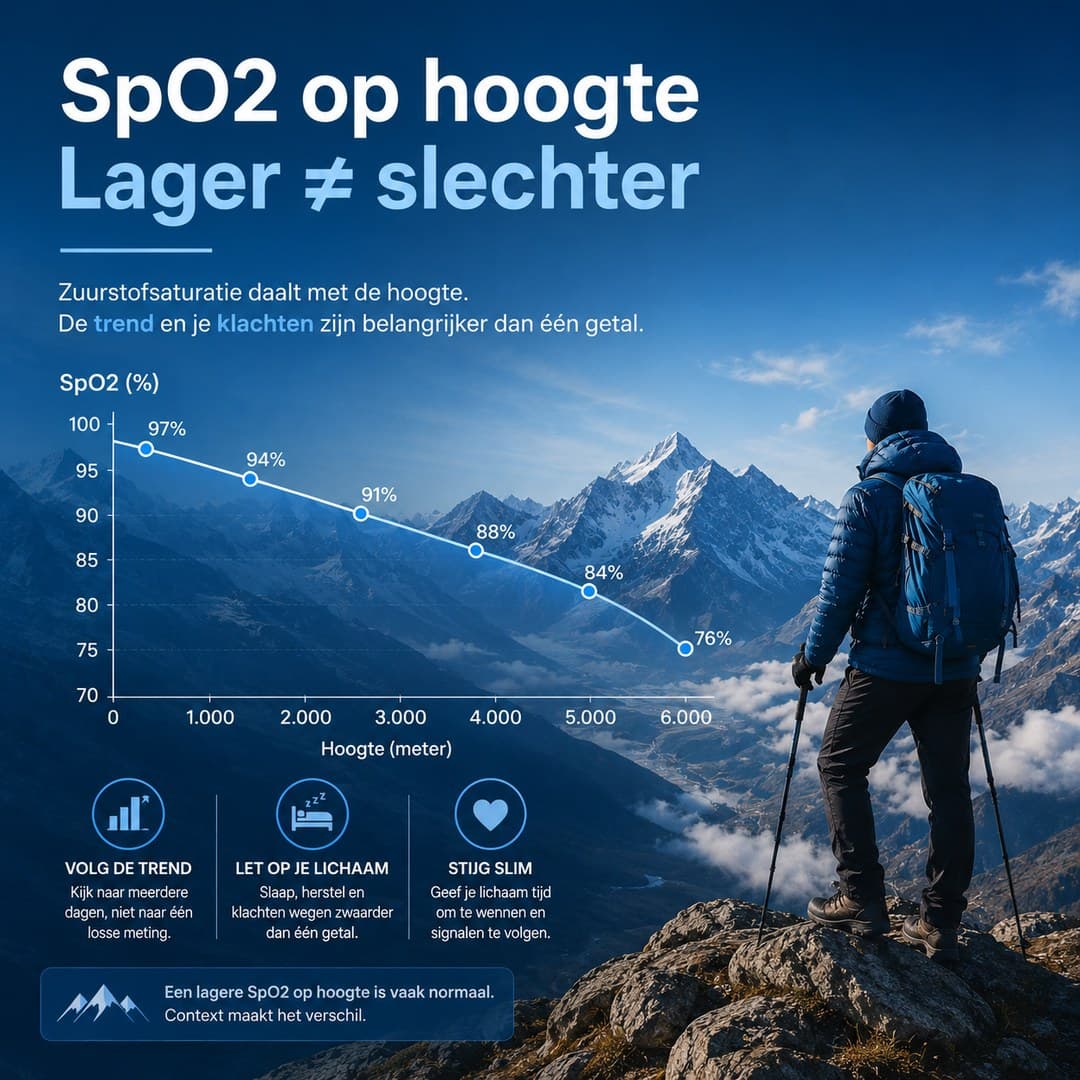
Whether your plan is working, you don't gauge by how you feel, but by your trends. Measure consistently and assess over days, not by individual readings. Four signals together give the best picture: your oxygen saturation (SpO2), your heart rate variability (HRV), your sleep quality and your recovery after training. How you To measure the effect of altitude training, determines whether you can make timely adjustments between two stages.
One measurement is noise, a trend over days is information. This guideline helps you read your SpO2 trend during an internship.
| SpO2 trend | Interpretation | Action |
|---|---|---|
| Stable, recovering during the day | Healthy adaptation | Continue with the plan |
| Multi-day trek | Taxes are ahead of recovery | Reduce intensity, schedule a rest day |
| Low plus poor sleep and complaints | Overstimulation | Step back and evaluate your internship |
Interpretation: Healthy adjustment.
Action: Continue with plan.
Interpretation: Tax is running ahead of recovery.
Action: reduce intensity, schedule rest day.
Interpretation: the stimulus is too big.
Action: Take a step back and evaluate your internship.
🧭 In practice
Measure your SpO2 and heart rate every morning at the same time, immediately after waking up. Also, briefly note down your sleep and how you feel. After a week, you'll see your own baseline, and only then will deviations truly mean something. Without a baseline measurement, you'll miss the signal that your plan requires adjustment.
When are you planning your next altitude training camp?
Multiple stages per year are the starting point, but it's not sensible to be on top of things every month. These decision rules help you determine when to schedule your next stage and when to fix something first.
To schedule once you have recovered from the previous internship, your trends are stable, and there is room in your annual plan towards your goal.
Just a moment longer If your recovery is lagging or your last stage ended recently, first give your body a chance to consolidate.
Adjust If your SpO2 trend drops or your sleep deteriorates during a stage, lower the intensity before you build further.
Don't force it just before your main goal; a late stage gives profits no time to establish themselves and can be counterproductive.
Practical tips for your height planning
A good plan stands or falls by its execution. Start early, because a multi-year plan only works if you build in the initial stages in a timely manner. Lay your annual plan alongside your competition calendar, so that each stage gets a clear function instead of remaining an isolated trip.
Furthermore, treat each stage as a learning opportunity. Note what you did, how you reacted, and what your trends showed. This way, over time, you build a personal profile that allows you to plan subsequent stages with increasing precision. This accumulated knowledge is at least as valuable as the physiological gains themselves.
Plan your long-term altitude training
Altitude training works best when you repeat it and build it up measurably. Do you want to plan multiple stages per year and prepare at home? Look at your options and the experiences of other athletes.
Frequently asked questions
How many times a year should you go on a high-altitude training camp?
There is no fixed number, but research consensus points to multiple stages per year rather than just one. Each repetition strengthens the effect and accelerates adaptation during the next stage. Plan them within a multi-year plan and align the number with your goals and recovery.
Why is a multi-year plan better than individual high-altitude training camps?
Because the effect of altitude training builds up. Those who have previously stayed at altitude adapt more quickly and can train intensely sooner. A multi-year plan, such as a four-year Olympic cycle, capitalises on this build-up and aligns the gains with your most important goals.
Do non-responders to altitude training really exist?
According to the researchers, practically not at all. What is often seen as non-response is usually the result of poor planning: too few internships, exposure that is too short, or the wrong training dosage. With the right approach, virtually every endurance athlete should benefit from altitude training.
How intensively can you train during a high-altitude training camp?
During an initial training camp, you'll get the most out of low-intensity endurance training, with short intensive sessions possibly at lower altitudes. With subsequent camps, you can train more intensively and won't need to descend as much. Let trends determine whether you can handle more or need to scale back.
The art of altitude training isn't in one perfect stage, but in a plan that is meticulously built over years. Repetition enhances the effect, individual tailoring makes it yours, and objective monitoring keeps you on course. Plan multiple stages per year, monitor your trends, and ensure the timing is right. Then altitude training delivers what it promises: a real, repeatable advantage.