
How do you combine altitude training with strength training?
Published 15 November 2025 · 9 min read
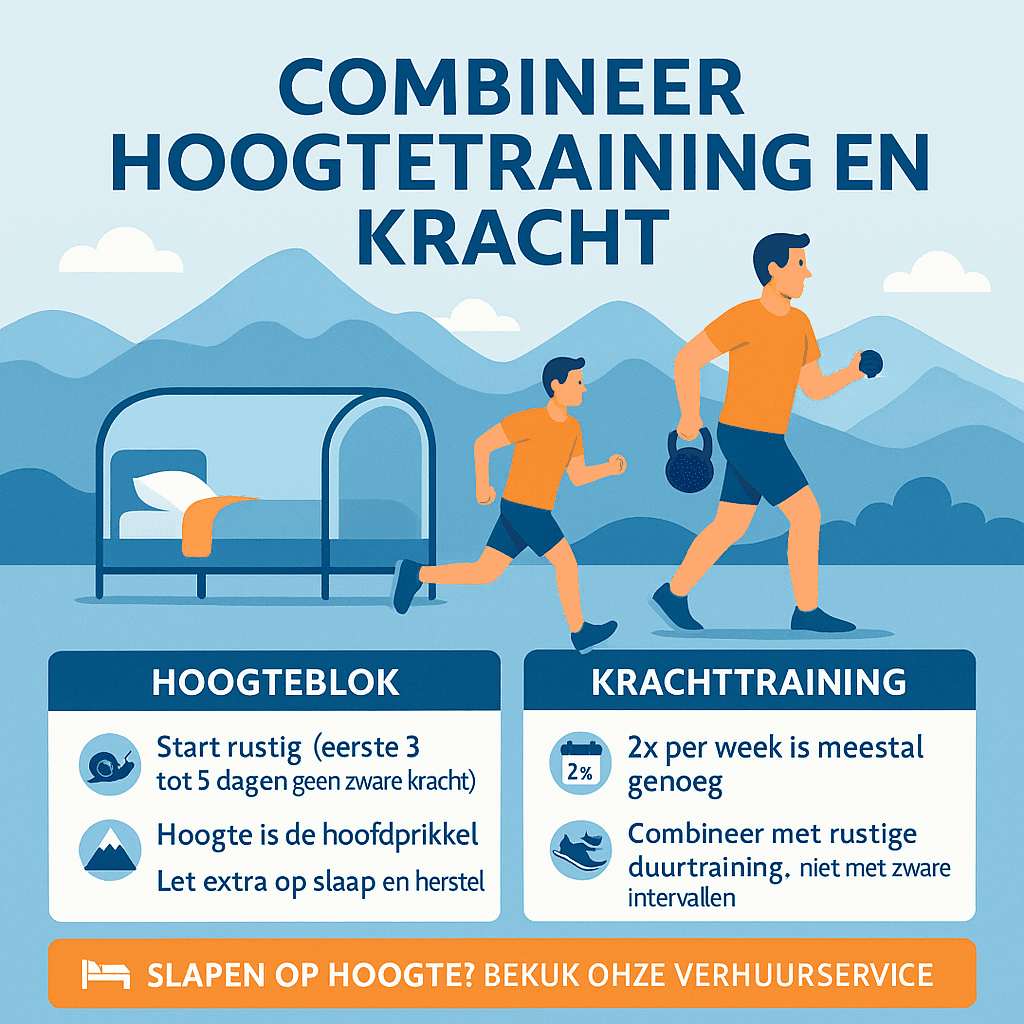
Together, they can give your performance a serious boost. But only if you combine them wisely. In this article, you will learn exactly how.
how to plan altitude training and strength training without overloading your body, with practical weekly schedules for
different types of athletes.
Would you like to learn the basics of altitude training refresh
or know how the popular sleep high, train low principle Does it work?
Then those are perfect starting points for the theory. Here, we will focus mainly on the practical side: how to combine altitude and strength in your weekly schedule.
In short: how to combine altitude training and strength training
Don't have time to read everything? Here are the key rules:
- Plan your most intense strength training sessions outside of the first 3 to 5 days of a new altitude stimulus.
- Do not combine maximum strength or plyometric training with very intensive interval blocks on the same day.
- Use strength training primarily as a supplement: two sessions per week is sufficient for most endurance athletes.
- Periodise: build up strength in the weeks before your altitude training, and maintain that strength during the altitude phase.
- Focus extra on recovery, sleep and nutrition during altitude training, especially on iron status and protein intake.
- Test what works for you and record your response in a training logbook.
Are you now concerned about whether you are doing it correctly? In
the most common mistakes in altitude training
you can see where things often go wrong. This article provides you with specific guidelines on how to safely combine height and strength.
Why altitude training and strength training actually reinforce each other
Altitude training basically focuses on your oxygen transport and endurance. Among other things, your body produces more red blood cells.
and learns to use oxygen more efficiently. Strength training tackles another piece of the puzzle: muscle strength, tendon strength,
running or stair-climbing technique and neuromuscular efficiency.
Combine the two, and you get, among other things:
- Better running economy or cycling economy thanks to stronger muscles and tendons.
- More power per heartbeat by strengthening both your engine (endurance) and your transmission (power).
- Greater load capacity, allowing you to increase your training volume over time without overloading.
- Improved sprinting and top speed for example, marathon runners or team sports players.
Especially if you already have a good aerobic base, a targeted strength stimulus in combination with a
altitude tent
make the difference between a good performance and a real breakthrough.
The biggest pitfalls when combining height and strength
So what goes wrong when athletes combine altitude training and strength training?
- Too many stimuli at once
A new altitude stimulus is already a considerable strain on your body. If you immediately add heavy weight training to that,
you quickly end up with a cocktail of fatigue, stiffness and poorer recovery. The result: you sleep less well, your fatigue builds up
and the positive effects of altitude are left behind. - No clear priority
Do you primarily want to become stronger, or do you want to peak after altitude training? Many athletes want everything at once: a personal record in the squat,
lots of elevation gain and fast paces. Without clear priorities, you lose focus and none of your training stimuli will be optimal. - Incorrect timing during the week
Intense strength training just before an important interval training session or competitive stimulus at altitude is asking for trouble.
Your muscles are still tired, your technique becomes sloppy and your risk of injury increases.
Are you unsure whether you are overloading yourself? Be sure to check out our tips on
what you should avoid during altitude training
.
Often, the same stress signals are also visible when you do not combine strength and height properly.
Basic principle: periodisation around your altitude training
The key to combining strength training with altitude training effectively is periodisation. Think in terms of blocks of several weeks, with a
clear role for strength in every phase.
Phase 1: building strength (4 to 8 weeks before your peak period)
In this phase, strength training should play a key role, especially if you have not done much strength training before. Guidelines:
- Two to three strength training sessions per week.
- Focus on technique and basic strength: squats, deadlifts, lunges, core, hip stability, calves.
- Gradually build up the load, no maximum jumps.
- Endurance running and cycling training should be slightly less intense in the days following a heavy strength training session.
Phase 2: altitude block while maintaining strength (altitude tent or altitude stage)
As soon as you start with an altitude tent or altitude camp, the priority shifts. The altitude stimulus is now the main player.
Strength training becomes supportive:
- Two relatively short strength training sessions per week, mainly maintenance.
- The first 3 to 5 days at altitude: only light or no strength training.
- No heavy eccentric force or maximum lifts during this period.
- Focus on core, stability, running or kicking technique, and light explosiveness.
Do you work with a altitude tent at home
According to a sleep high, train low approach, you can simply train at sea level during the day. But your body is still working extra hard.
during the night. Take this additional workload into account in your planning.
Phase 3: after the altitude boost towards the peak competition
In the 1 to 3 weeks after your altitude camp, you will benefit from altitude adaptation. You will then want to focus on sharpening your competition-specific stimulus:
- 1 to 2 short strength sessions per week, mainly maintenance and light explosiveness.
- More focus on competition-specific paces and interval training.
- Build in enough rest days so as not to negate the effect of altitude.
Want to know more about timing your peak competition? Be sure to read on.
what is the optimal time to plan for altitude acclimatisation
.
Practical combinations: runners, cyclists and team sports players
The logic is the same for every athlete, but the details differ. Below are some practical examples.
1. Runners (5 km to marathon)
For runners, strength training is mainly about running economy, tendon load and injury prevention. Consider:
- Squats or split squats.
- Calf raises and eccentric exercises for Achilles tendon and foot arches.
- Core and hip stability (planks, side planks, hip thrusts).
- Light plyometrics such as jumping or skipping, but not too strenuous in combination with altitude training.
In combination with an altitude tent, you can, for example, plan two strength sessions on days with gentle endurance training.
You can find more running-specific tips in
altitude training for runners.
2. Cyclists and triathletes
Cyclists and triathletes mainly use strength training to increase pedalling power, improve posture on the bike and increase stability while swimming and running:
- Heavy but controlled squats, deadlifts and hip thrusts.
- Core exercises for a stable torso in aeroposition.
- Specific ankle and knee stability exercises.
Because the impact of cycling is lower than that of walking, cyclists can often handle slightly more power volume.
However, the same rule applies here: do not combine maximum strength with the most intense interval training at altitude within the same 24-hour period.
3. Team sports players
For team sports players (football, hockey, basketball), strength training is indispensable.
Altitude training can provide additional assistance for repeated sprints and faster recovery. In our article
altitude training for team athletes
You can read more about that there.
The combination with power looks something like this:
- Two strength training sessions per week focusing on the entire chain (legs, core, upper body).
- Height stimulus, especially on days with low to average field load.
- Extra attention to recovery, especially during periods with matches.
How often and how intensely should you do strength training during altitude training?
The ideal frequency depends on your training experience and overall workload, but the guidelines below work for most athletes:
- Beginners in strength training: Two sessions per week, with a strong focus on technique, moderate weights, two to three sets of eight to twelve repetitions.
- Experienced strength trainers: 2 sessions per week, 3 to 4 sets of 4 to 8 repetitions for the main movements, fewer exercises in total.
- Top level or large total training volumeSometimes one strength training session per week is enough to maintain strength during a heavy altitude training block.
Important: if you notice that your sleep is deteriorating, your morning heart rate is increasing, or your mood is declining, please reduce your intake.
Temporarily opt for lighter weights or one less session per week. It is preferable to have slightly less strength than to reach a plateau in altitude adaptation.
Sample week: sleep high, train low with 2 strength training sessions
The sample week below is based on an endurance athlete who uses an altitude tent, trains 5 to 6 times a week and wants to maintain 2 strength sessions.
Adjust the days and intensity to your situation, but above all, pay attention to logic.
- Monday: morning gentle endurance training, evening light core and mobility (no heavy strength training).
- Tuesday: interval training at pace, no strength training (so that you are fresh for the quality).
- Wednesday: gentle endurance training + lower body strength training (squats, lunges, calves) at submaximal level.
- Thursday: recovery training or rest day, possibly short core training.
- FridaySecond interval training (e.g. tempo blocks or hills), no strength training.
- SaturdayLonger endurance training at a gentle pace + short upper body and core strength training.
- Sunday: rest day or very light recovery training, no strength training.
Are you just starting out with altitude training? Then skip the heavier strength training sessions for the first 3 to 5 days and focus solely on mobility and light core training.
This gives your body time to adjust to the oxygen stimulus.
Recovery, nutrition and iron: the secret links
Altitude training only works optimally if your body has enough building blocks to adapt.
This is certainly true when you add strength training on top of that. Consider:
- Sufficient protein for muscle recovery (as a guideline, 1.6 to 2.2 grams of protein per kilogram of body weight per day for athletes).
- Good iron status: If necessary, have your ferritin levels checked and discuss supplementation with a doctor or dietitian.
- HydrationAt altitude or simulated altitude, you often lose more fluid.
- Sleep quality: If necessary, use a sleep diary or tracking to see how you respond to the altitude tent.
You can find more background information about sleep and the immune system at altitude in our article.
how altitude training can strengthen your immune system
.
The better you recover, the more you will benefit from the combination of altitude and strength.
Checklist: are you combining height and strength wisely?
Use this checklist to quickly evaluate your own schedule:
- Do you have a clear priority: is this block mainly for height, for strength or for both?
- Do you plan your most intense strength training sessions on days with light endurance training instead of heavy intervals?
- Will you refrain from heavy lifting for the first 3 to 5 days?
- Do you do a maximum of two intense strength training sessions per week during your altitude training?
- Do you monitor your sleep, fatigue and possibly your resting heart rate?
- Have you adjusted your diet and iron intake to cope with the extra strain?
Did you answer 'no' to several questions? Then it is worth adjusting your schedule.,
or work with us to find the optimal combination of altitude training and strength training.
Would you like assistance in planning your combination of height and strength?
Do you already have a strength programme, but are unsure how best to combine it with an altitude tent or altitude training?
Or would you prefer a fully customised plan, tailored to your competition schedule and training background?
Please feel free to contact us or discover more via our
rental service
which altitude tent best suits your goals. Together, we will ensure that altitude training and strength training reinforce each other to the maximum extent possible.,
without your body paying the price.


