
Altitude tent and anti-doping: what’s allowed and what’s not in competition
Published 13 February 2026 · 5 min read
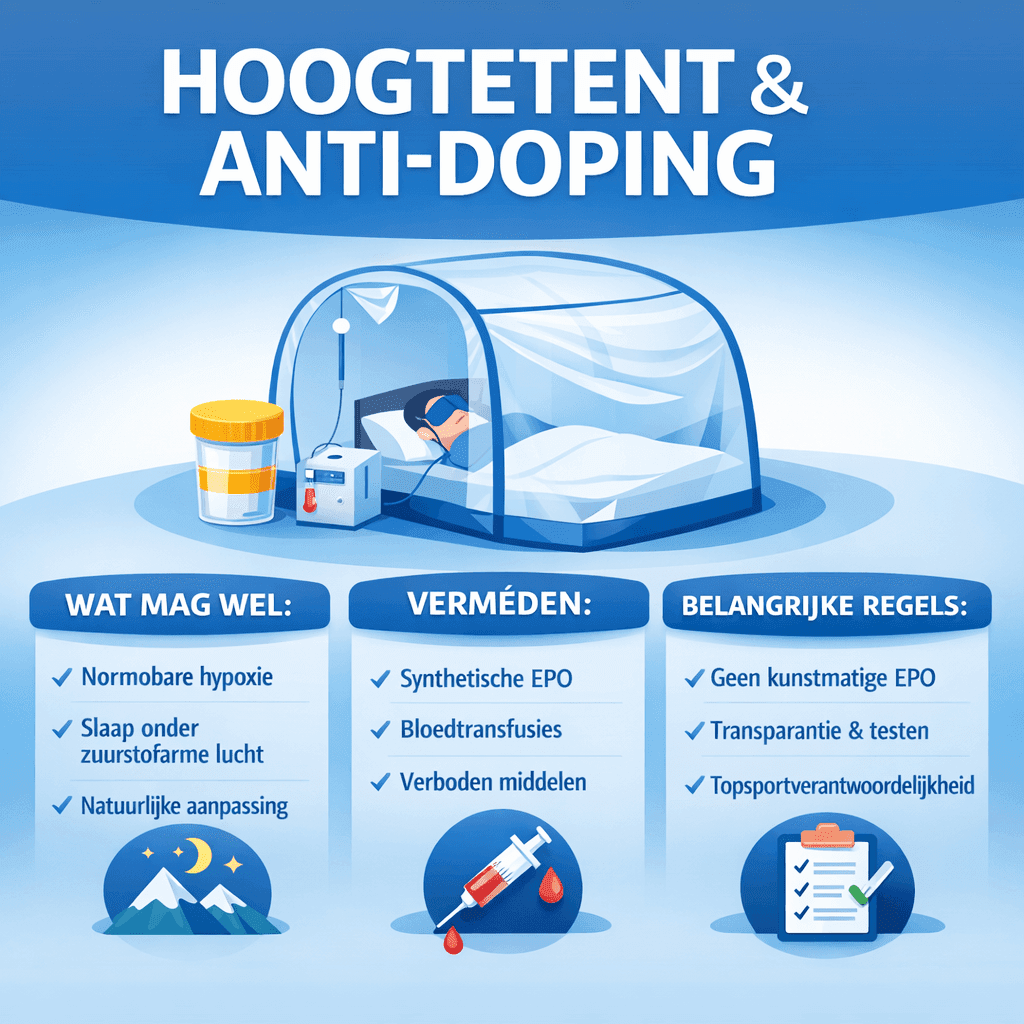
Is an altitude tent allowed within anti-doping rules? Many athletes doubt whether height tent anti-doping is a grey area. The short answer: an altitude tent is allowed. Yet there are misunderstandings about EPO, artificial oxygen and competitive advantage. This article will give you clarity so you know what is allowed, what is not and where the line is drawn.
The essentials in 30 seconds
Conclusion: A high altitude tent does not fall under doping and is allowed in competition.
Nuance: Artificial administration of EPO or blood manipulation is prohibited, but natural adaptation via hypoxia is not.
Practical lead: If you use an altitude tent, monitor your SpO2 trend and follow a controlled build-up schedule.
Why is there confusion around altitude tent anti-doping?
The confusion arises because altitude training stimulates the natural production of EPO. This increases the number of red blood cells. This is similar to the effect of EPO doping. Yet the mechanism is fundamentally different.
In doping, a banned substance is administered externally. In an altitude tent, adaptation occurs because your body responds to less oxygen. This process is called normobaric hypoxia. You simulate altitude without changing air pressure.
So the difference is in the intervention. External manipulation of blood or hormones is prohibited. Physiological adaptation via oxygen deprivation is allowed.
You can find more background on physiology in how high training increases your EPO levels and in oxygen saturation at altitude.
What does the World Anti-Doping Code say?
The World Anti-Doping Code bans substances and methods that artificially enhance performance through manipulation of blood or hormones. Altitude training is not on the banned list.
The international rules are publicly available via the official WADA Prohibited List. The latest list mentions no ban on normobare hypoxia or altitude tents.
Important difference: blood transfusions, synthetic EPO and oxygen carriers are banned. Sleeping in an altitude tent is not.
⚠️ Reality check
An altitude tent does not increase your haematocrit indefinitely. The body regulates adaptation within physiological limits. Anyone seeing rapid, extreme increases in blood values should always have it medically assessed.
How does an altitude tent work physiologically?
An altitude tent lowers the oxygen percentage in the inhaled air. This temporarily lowers your oxygen saturation. The kidneys register this and increase the production of EPO. This stimulates the production of red blood cells.
This process is gradual. It is similar to training or staying at real altitude. That is why it is often used within sleep high train low protocols.
The crucial point: the body continues to drive the adaptation itself. No external substance is added.
💡 Did you know?
The first discussions on altitude training within the anti-doping world date back to the early 2000s. It was eventually decided that hypoxia training was not a prohibited method because it mimics a natural stimulus.
Feeling versus objective data
Many athletes feel “extra strong” after a period in an altitude tent. But feeling is no evidence of doping-like effects.
Objective data show that the increase in haemoglobin is usually limited and controlled. Moreover, the response varies greatly among individuals.
There is often the fallacy here that any EPO-related effect is automatically doping. This is not true. The difference is in administration versus adaptation.
This is how you monitor this lens
If you use an altitude tent, then monitoring is essential. Not from an anti-doping perspective, but from a performance and recovery perspective.
- SpO2 trend: look at development over several nights. A work zone around 92 per cent may be appropriate, but always in context of recovery.
- Sleep quality: sleep time, nighttime awakening and subjective rest.
- Recovery feeling: morning fatigue, training response and possible headaches.
Important: never assess SpO2 as an isolated measurement. Only trends provide direction.
📊 Research shows
Adaptation via normobaric hypoxia usually occurs after several weeks of consistent exposure. Short-term sessions without a sleep component produce less stable haematological adaptations.
When to continue, adjust or stop?
When to continue
SpO2 trend stable, sleep good and workouts feel manageable. No progressive fatigue.
When to adapt
Declining sleep quality or persistent fatigue. Temporarily reduce simulated altitude or shorten exposure.
When to slow down or stop
For severe headache, dizziness or other symptoms consistent with altitude sickness. Stopping and descending is the primary intervention.
What not to do
- Raising height too quickly without monitoring
- Interpreting SpO2 as a separate measurement
- High altitude tent combine with extreme training load
- Ignoring medical checks when blood levels are abnormal
- Thinking that more hypoxia is automatically better
An altitude tent is no substitute for acclimatisation, but it will significantly reduce the risk of altitude sickness. The principle remains incremental acclimatisation with SpO2-controlled adjustment.
🧭 In practice
Athletes who adjust their altitude based on sleep and SpO2 trend report more stable performance than athletes who only focus on maximum simulated gauges.
Is a high altitude tent ethical?
Ethics within sport is about equal access and transparency. Altitude training has been accepted for decades. An altitude tent makes that incentive more accessible, but does not change the physiological principle.
Therefore, within the anti-doping code, it is considered a permitted training method, just like training in the mountains.
Mini-FAQ
Does an altitude tent fall under doping?
No. An altitude tent simulates altitude via normobaric hypoxia and is not on the banned list.
Is EPA surge due to altitude illegal?
No. Natural stimulation of EPO via hypoxia is allowed. External administration of synthetic EPO is prohibited.
Can an altitude tent make my blood values suspect?
With normal, controlled application, values remain within physiological limits. When in doubt, always have medical assessment.
Guidance makes the difference
If you use a high altitude tent in preparation for competition, then guidance is valuable. Not to get around rules, but to make adaptation happen in a controlled way.
Via personal guidance you can tailor your schedule to sport, timing and recovery capacity.
In summary, altitude anti-doping is not a conflict. If applied correctly, it is a legitimate training tool within the rules of international competition.


