
Are altitude tents permitted under anti-doping rules?
Published 14 September 2015 · 8 min read
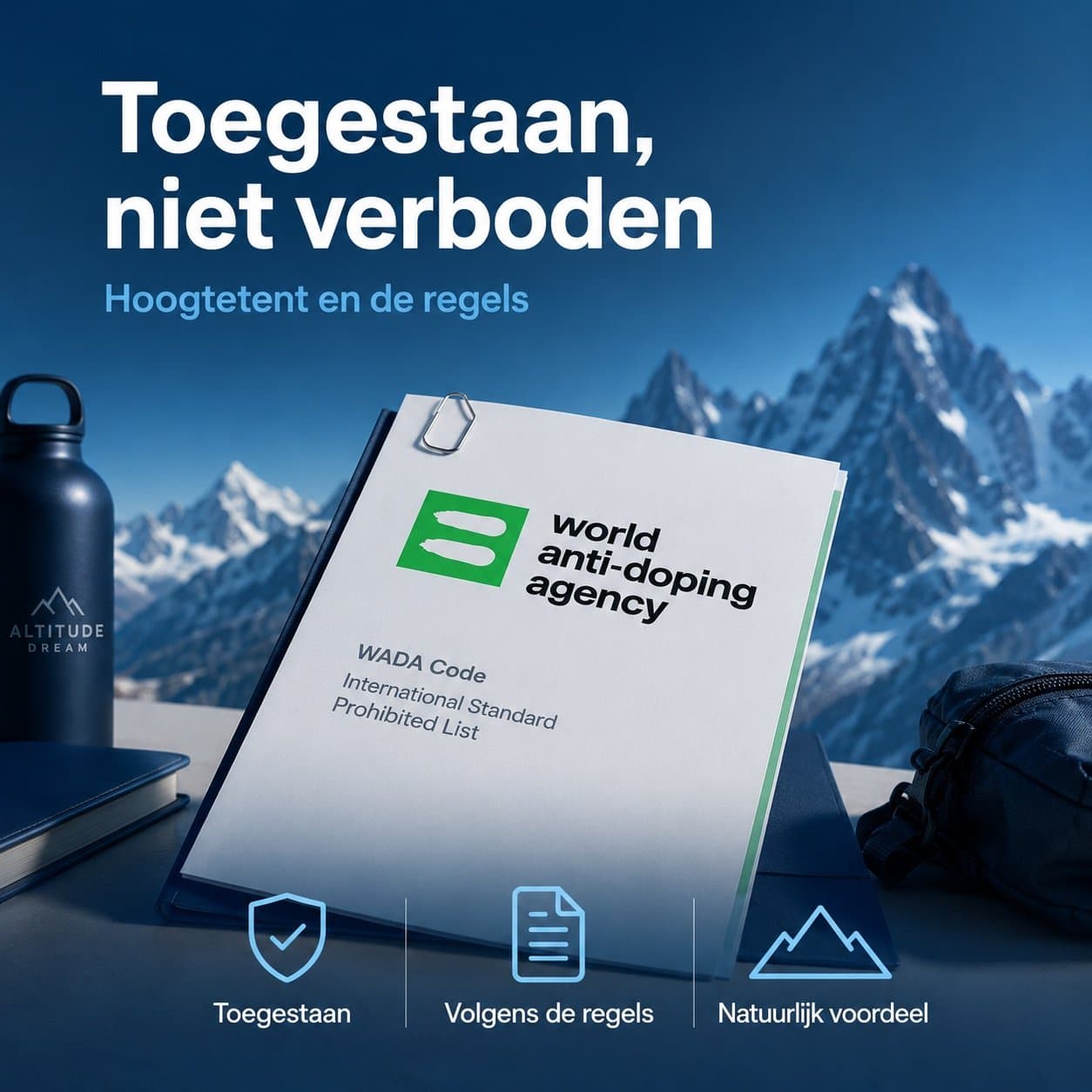
You are considering a height tent to prepare better for altitude or to build up a training stimulus, and then the question arises: is this actually allowed? The short answer will reassure most athletes. A height tent is not on the doping list and is permitted according to anti-doping rules. However, nuance is important, because in addition to international rules, your sports federation and sometimes your country also play a role. In this article, you will read exactly where a height tent stands according to anti-doping rules, why that is, and how you can be sure you are training within the lines.
In short: Yes, an altitude tent is permitted. The World Anti-Doping Agency (WADA) has deliberately not placed normobaric hypoxia, the technique behind an altitude tent, on the prohibited list. Additionally, always check two things: the regulations of your own sports federation and the national rules of the country where you live or compete.
Conclusion: Aeson tent is not forbidden under international anti-doping rules.
Nuance: individual federations or countries can set their own limitations.
Practical hook: Check your club rules, then train with peace of mind.
De anti-dopingregels stellen dat er geen enkele regel is die het gebruik van een hoogtetent expliciet verbiedt. Het gebruik van een hoogtetent wordt niet als een verboden methode beschouwd omdat het niet als chirurgische, fysieke of chemische interventie wordt gezien.
The basics are clear. WADA establishes the doping list annually, the so-called Prohibited List. For 2026, that list is in force again, and as in all previous years, artificial hypoxia is not on it. An altitude tent, or hypoxia tent, falls under that heading. So, you are allowed to sleep and train with it without being in breach of international rules. If you want to know how to practically use such a tent, our guide on [topic] will help. to use a height tent continue.
Why is a substance included or not included on the list? WADA uses three criteria. A method or substance can be prohibited if it meets at least two of the following three conditions: it enhances performance, it poses a health risk to the athlete, and it is contrary to the spirit of sport. Artificial hypoxia has been held against that framework, but WADA consciously chose not to ban the technique. The table below shows exactly what to look out for.
| Rule level | Altitude tent status | What it means to you |
|---|---|---|
| WADA (international) | Allowed, not on the list | No offence upon use or possession |
| National | Usually allowed, sometimes restricted | Check the rules of your country |
| Sports Federation | Varies by federation | Read your association's regulations |
Status: permitted, not on the list.
For you: no offence when used or possessed.
Status: Usually permitted, sometimes restricted.
For you: Check the rules of your country.
Status: varies per federation.
For you: Read your association's regulations.
Why an altitude tent is not doping
The difference with forbidden methods lies in the mechanism. A height tent doesn't add anything to your body. The tent actually lowers the oxygen content of the air you breathe, making you sleep as if you are at altitude. Your body reacts to that with a natural adaptation, partly through the hormone EPO, which stimulates red blood cell production. You get exactly the same stimulus as if you were sleeping in the mountains. Travelling to real altitude has never been forbidden, and the tent simply mimics that process at home.
That is a fundamentally different story than blood doping or an EPO injection. With those methods, you are introducing a forbidden substance or a procedure that is foreign to the body. Artificially administering oxygen also falls under forbidden methods. A high-altitude tent does the opposite: it deprives you of oxygen and lets your own physiology do the work. If you want to understand how that stimulus works, read how you naturally increases EPO levels. The table below sets the two worlds side by side.
| Aspect | Altitude tent (normobaric hypoxia) | Prohibited methods (EPO, blood doping) |
|---|---|---|
| Operation | Less oxygen, natural stimulus | External influence or intervention |
| Body | Makes its own red blood cells | Administration of a foreign substance into the body |
| Rule status | Permitted by WADA | Prohibited, it is on the doping list |
Altitude tent: less oxygen, natural stimulus.
Forbidden methods: Obstruction or external intervention.
Altitude tent: makes red blood cells itself.
Forbidden methods: is administered extraneously.
Altitude tent: permitted by WADA.
Forbidden methods: prohibited, appears on the doping list.
One confusing detail is the term oxygen tent. That provides extra oxygen and serves a medical purpose, whereas a altitude tent removes oxygen. It is therefore good to The difference between an oxygen tent and a (simulated) altitude tent to be sharp, as the two are often confused.
The discussion about the spirit of sport
However, the altitude tent is not without controversy. In 2006, an ethics committee of WADA considered the question of whether artificial hypoxia violates the spirit of sport. That committee concluded that it does, arguing that an athlete need do nothing more than lie in a tent and flip a switch. Excelling, according to that idea, should stem from talent and effort, not passive exposure.
💡 Did you know?
Despite the ethical judgment, WADA decided in 2006 not to ban the altitude tent. The medical and scientific committees found there was insufficient grounds. Since then, the technique has not been on the doping list every year, while the discussion continues in the background.
Proponents point out that sleeping at natural altitude offers the exact same benefits and is always permitted. An athlete living in the mountains is therefore fortunate in a way that a sportsman in the polder is not. From this perspective, a hypoxic tent actually makes the playing field more level. Critics maintain the argument that any form of artificial performance enhancement is undesirable. Both sides have a point, which is precisely why regulators remain cautious and monitor health risks.
Pay attention to your sports federation and your country
The international rule is clear, but that's not the end of it. Individual sports federations may lay down stricter rules in their own regulations, for example, regarding the use of hypoxic techniques during competitions or training camps. For those working towards a goal, such as the spring classics, it is wise to height tent aimed towards the course to set off and to check the federal regulations beforehand.
⚠️ Reality check
For a long time, some countries had a national ban on hypoxic tents, with Italy and Norway being the most well-known examples. Both regulations have been relaxed in recent years. Because national rules can change, check the current situation in your country before you buy or take a tent with you.
The practical lesson is simple. The chance that an altitude tent is prohibited for you is small, but it is not zero. A quick check of your federation's rules and national regulations takes little effort and removes any doubt. This way, you can train with a clear conscience and avoid an unpleasant surprise during an inspection.
Are you allowed to use a height tent?
Use the following decision rules to quickly assess your own situation.
When using a high-altitude tent without worries: You are a recreational athlete or a mountain climber without a competition license. There are no federation rules, and international rules permit its use.
When you first check: You have a competition licence or represent a federation. Read your federation's regulations and the national rules, especially regarding competitions and training camps.
When you seek advice: You are starting in a country that once had a ban, or your federation's status is unclear. Ask your federation or national anti-doping organisation for written confirmation.
When you don't proceed: The league regulations explicitly prohibit hypoxie techniques. Please respect this rule, as regulations can be stricter than the WADA list.
This is how you keep your altitude training transparent and objective
Staying within the rules is one thing, but being able to prove it is another. An altitude tent works on the basis of normobaric hypoxia, and you control the setup with your oxygen saturation. By keeping your data tidy, you show that you are working with a controlled, measurable method and have nothing to hide.
Measure your SpO2 every morning at the same time and track the trend over several days. A single reading doesn't say much, but a line over a week tells you how your body is adapting. Also, record your sleep duration, your sleep quality, and your perceived recovery. That combination makes your preparation predictable and controllable.
🧭 In practice
Keep a simple logbook with date, altitude set, morning SpO2, and how you felt. Those subject to doping control or whereabouts requirements can submit such an overview for context. It is not mandatory, but it underlines that your altitude stimulus comes from a legal, transparent method.
Frequently asked questions
Is a hypoxic tent on the doping list?
No. Artificial hypoxia, the technique behind an altitude tent, is not on the WADA doping list, nor has it ever been. You may use the tent without being in breach of the international anti-doping rules.
Is it permissible to use a height tent in professional cycling?
Internationally, it's permitted and many professionals use a height tent. However, individual federations or countries may have their own rules. Therefore, always check your federation's regulations before taking the tent to a competition.
Does sleeping at altitude count as doping?
No. Sleeping at altitude is always permitted and does not count as doping. An altitude tent imitates that same natural stimulus at home, without the use of any prohibited substance or method.
Which countries have banned altitude tents?
Italy and Norway operated a national ban for a long time. Both countries have relaxed those rules in recent years. Because national legislation changes, check the current situation in your country before you purchase a tent.
Ready to build your altitude craving?
Now that you know a height tent is within the rules, the next question is how to use it effectively. Discover how to plan your setup step by step and monitor your SpO2 trend.
Conclusion
An altitude tent is permitted under anti-doping rules. WADA deliberately keeps artificial hypoxia off the doping list, because the tent does not administer a prohibited substance but rather provides your own body with a natural stimulus. The only nuance lies at national and federation level, where stricter rules sometimes apply. A quick check beforehand will remove that doubt. This is how you build a measurable, predictable advantage at home, with peace of mind and completely within the rules.


