What is pulmonary oedema?
Published 23 August 2021 · 8 min read
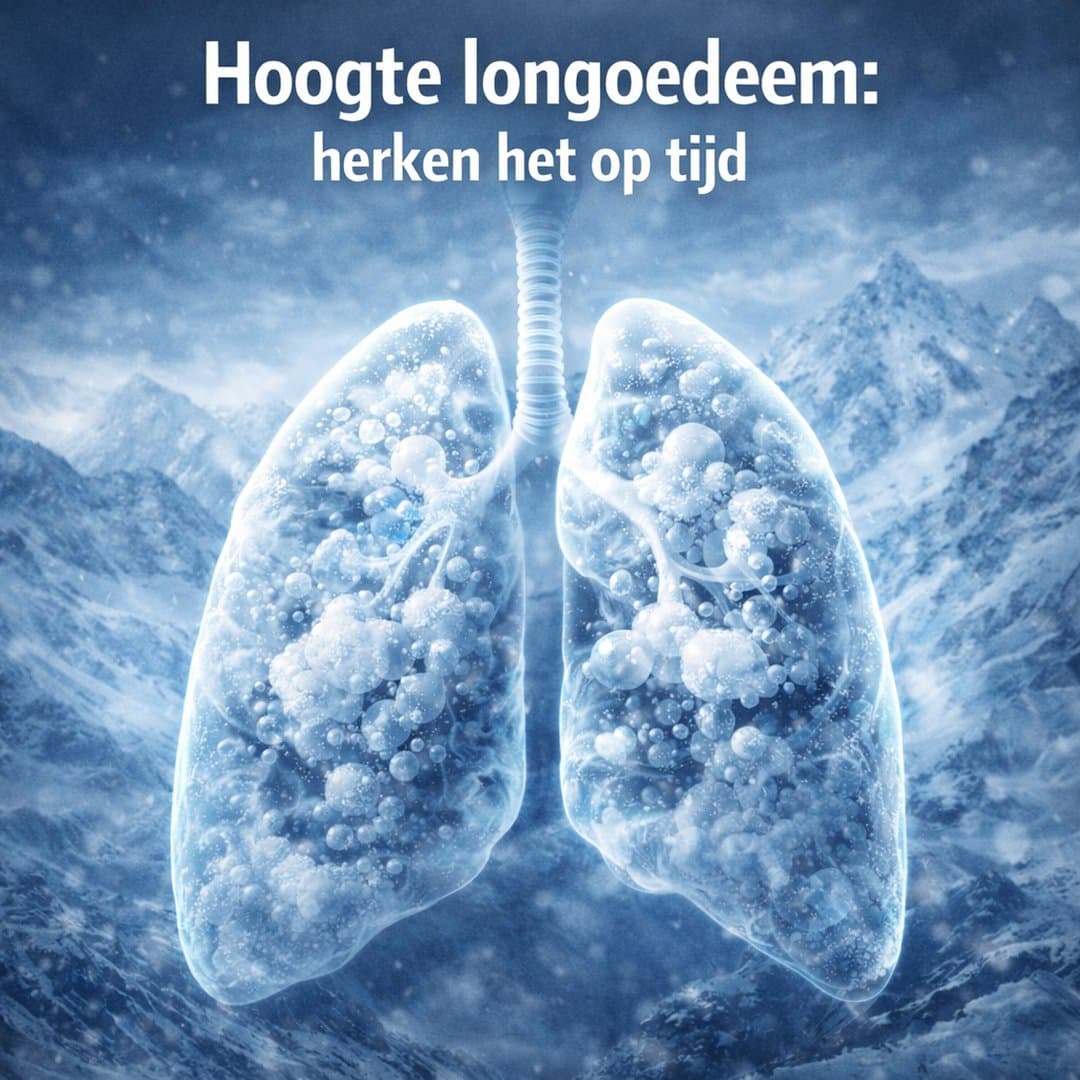
What is altitude pulmonary oedema? Altitude pulmonary oedema, also known as HAPE, is a severe form of altitude sickness in which fluid builds up in the lungs. This makes oxygen uptake increasingly difficult and an initially harmless exertion can quickly turn into tightness, exhaustion and danger. This is precisely why it is important to recognise the early signs, stop the rise immediately and not wait for it to pass on its own.
Conclusion: High altitude pulmonary oedema is a medical emergency at altitude.
Nuance: it can also occur without obvious prior symptoms of acute altitude sickness.
Practical hook: stop the increase immediately in case of unexplained shortness of breath, cough and sudden loss of performance.
What exactly is altitude pulmonary oedema?
Altitude pulmonary oedema is a non-cardiogenic pulmonary oedema. That means it does not arise from heart failure, but from a dysregulation in lung circulation at altitude. Lack of oxygen causes blood vessels in the lungs to contract. In some people, this happens too strongly and too unevenly. As a result, pressure rises in parts of the lungs and fluid can leak into the alveoli. This is exactly where gas exchange normally takes place. Once moisture gets there, the efficiency of breathing drops rapidly}.
In practice, altitude pulmonary oedema belongs within the broader spectrum of altitude sickness, but it is a different and more severe category than ordinary acute altitude sickness. Whereas acute altitude sickness often starts with headache, nausea or feeling heavy, altitude pulmonary oedema mainly revolves around the lungs: tightness in the chest, coughing, weakness and a marked decrease in exercise capacity.
The context is also important. Current guidelines describe HAPE mainly in unacclimatised lowlanders ascending to about 2,500 metres or higher. It often develops within 24 to 96 hours of an excessively rapid ascent. It can be preceded by acute altitude sickness, but it can also arise on its own. This makes it insidious.
What is altitude pulmonary oedema and why is it dangerous?
The danger lies in how quickly the picture can tilt. At first, a person may still think they are just tired, have slept badly or are suffering from a cold. But as soon as fluid in the lungs increases, oxygen uptake gets worse and worse. This creates a vicious circle: less oxygen leads to more stress in the body, more shortness of breath and often even worse exercise tolerance. Without intervention, high altitude pulmonary oedema can become severe within hours.
Short answer
- Altitude pulmonary oedema is fluid in the lungs due to staying at altitude.
- It usually occurs after a rapid ascent to about 2,500 metres or higher.
- Early signs are unexplained shortness of breath, dry cough and conspicuous rapid fatigue.
- If suspected, do not ascend further, preferably descend, give oxygen as available and arrange medical assistance.
Those wanting more background on what happens physiologically at altitude, sees that the lung response to oxygen deprivation is not the same for everyone. This explains precisely why some climbers climb relatively trouble-free while others run into problems early on.
Symptoms of high altitude pulmonary oedema: early and late signs
The earliest signs are usually more subtle than people expect. It often starts with shortness of breath during an effort that previously went fine. Think of a short incline, stairs, simple walk or pitching a tent. To this are often added dry cough, fatigue, weakness and a restless feeling in the chest. As HAPE progresses, the tightness becomes noticeable even at rest. In later stages, blue lips, pink frothy sputum and marked breathlessness may occur.
| Signal | What does it mean? | Action |
|---|---|---|
| Constricted on ordinary exertion | Early warning, especially if this is new | Stop rise and observe critically |
| Dry cough and marked weakness | Matches an incipient HAPE image | Not pushing through as if it were fatigue |
| Stuffy at rest | Severe alarm signal | Direct descent and oxygen control |
| Blue lips or pink frothy mucus | Late and dangerous phase | Emergency, evacuation and medical assistance |
⚠️ Reality check
Not every cough at altitude is pulmonary oedema. Cold, dry air and a respiratory infection also occur. But unexplained shortness of breath that does not suit your exertion, especially along with weakness and loss of performance, should never be dismissed. At altitude, taking action too early is much safer than too late.
What should you do immediately if you suspect high altitude pulmonary oedema?
With suspected altitude pulmonary oedema, the main rule is simple: do not ascend further. The best treatment remains descending. Recent guidelines recommend descending at least about 1,000 metres, or continue descending until symptoms improve markedly. In doing so, exertion should be limited as much as possible. So no heavy backpack, no tough pace and preferably help with transport if available.
- Stop the rise immediately.
- Let the individual rest and stay warm.
- Start oxygen if available.
- Arrange descent or evacuation.
- Use a portable pressure relief chamber only if descent is delayed or cannot be done immediately.
- Seek medical attention, especially in case of chest tightness at rest or falling saturation.
Oxygen is a valuable intermediate step and sometimes, in a well-monitored medical setting, even a useful alternative to immediate descent. Guidelines thereby steer for symptom relief and usually for a saturation above 90 per cent. In a remote mountain setting, however, descent remains the safe default, especially if the condition does not improve quickly.
A portable positive pressure chamber can help if descent is impossible or delayed, but should not unnecessarily delay that descent. Think of it as a bridge, not a final solution. That distinction is important, because a short improvement sometimes gives a false sense of security.
For a broader approach to severe altitude complaints, you can also look at how to deal with acute altitude complaints, because in practice the distinction between different serious height problems is not always immediately clear.
What you better not do
Waiting until the next morning, climbing further because camp is almost in sight, or reassuring yourself that it will be “condition” are precisely the mistakes that make altitude pulmonary oedema dangerous. Also important: diuretics and acetazolamide do not belong as standard treatment for HAPE. Nifedipine may have a role in the field as an adjunct or when other options are lacking, but not as a substitute for oxygen and descent.
Who is more at risk?
There is no single profile that explains all cases, but the biggest risk factor remains too rapid an ascent. In addition, a previous episode of altitude sickness, a high sleeph altitude, living at sea level and considerable exertion during the ascent increase the risk. The latter in particular is often underestimated: many people force themselves too early, exactly when their bodies have not yet adapted.
People who have had HAPE before deserve extra caution. For that group, the guidelines describe a significantly higher recurrence risk. Therefore, before a new expedition, it is smart to look critically at your personal risk factors, your ascent profile and the logistics of possible evacuation.
Can you prevent altitude pulmonary oedema?
Yes, partly. Primary prevention is still gradual increase. This is not a boring basic rule, but the core of risk management. The 2024 guideline says it explicitly: a gradual rise profile is the main way to prevent HAPE. Medication for prevention is mainly intended for people with a clear history of HAPE, not as a standard solution for every mountain traveller.
Staged ascent and pre-acclimatisation may also be considered when logistically feasible. At the same time, the nuance is important: no optimal, universal protocol has been established for HAPE. This means that acclimatising at home or sleeping in a hypoxic environment can be useful as support, but is never a guarantee nor a substitute for a sensible ascent schedule on the mountain itself.
That fits well with how Altitude Dream is supposed to approach this topic: controlled support can help make acclimatisation more plannable and measurable, but it is still support. The mountain and your actual ascent rate remain decisive.
This is how you monitor this lens
An objective monitoring section is especially important in severe altitude complaints, because feeling at altitude can be misleading. Therefore, never look at one single measurement, but trends.
- SpO2 trend: watch for a marked decrease compared to previous readings at similar altitudes, especially if associated with tightness or weakness.
- Sleep quality: a restless night alone says little, but combined with nocturnal chest tightness or coughing it does become relevant.
- Recovery: do not recover from normal exertion, then that is a signal.
- Symptoms: cough, chest tightness, decreasing load capacity and cyanosis outweigh a single saturation value.
Decision rule for practice: if someone is markedly more distressed at the same altitude than the day before, recovers worse and the SpO2 trend worsens at the same time, treat this as a serious alarm signal. Especially if chest tightness is added at rest, descent should be on the table immediately.
Common misunderstandings
“You have to have a headache first, otherwise it's not a height problem”
No. HAPE can occur precisely without classic AMS symptoms. That is one of the reasons why it is missed.
“One day of rest is enough”
In ordinary altitude fatigue, sometimes yes. In suspected altitude pulmonary oedema, it does not. Then further ascent is unsafe and descent is the default response.
“Acetazolamide does solve this”
Acetazolamide helps with acclimatisation and is mainly used around AMS, but current guidelines do not recommend it as a treatment for HAPE.
Want to prevent altitude sickness smarter?
First, read the complete guide on prevention, alarm signals and sensible preparation for altitude. That way, you will leave with more structure and less guesswork.
Conclusion
Altitude pulmonary oedema is not a complaint to sit out. It is a serious altitude condition where fluid in the lungs interferes with oxygen uptake. The combination of unexplained shortness of breath, cough and loss of performance at altitude should always be taken seriously. Those who recognise it quickly, stop ascent and descend in time significantly reduce the risk of a dangerous escalation.
FAQ
How quickly does high altitude pulmonary oedema develop?
Often within 24 to 96 hours after a rapid ascent to about 2,400 to 2,500 metres or higher, especially with insufficient acclimatisation.
Is altitude pulmonary oedema the same as ordinary altitude sickness?
No. It does fall within acute altitude diseases, but it is a more serious lung problem and can also occur without typical headaches or nausea from AMS.
Can you rise further if the symptoms subside a bit?
Not as long as there are still symptoms. If deterioration or persistent chest tightness occurs, further ascent is unsafe and descent should be the focus.
Does an altitude tent help prevent HAPE completely?
No. Pre-acclimatisation can be considered as support, but offers no guarantee and never replaces a sensible ascent profile on the mountain.