What is high cerebral edema?
Published 24 August 2021 · 10 min read
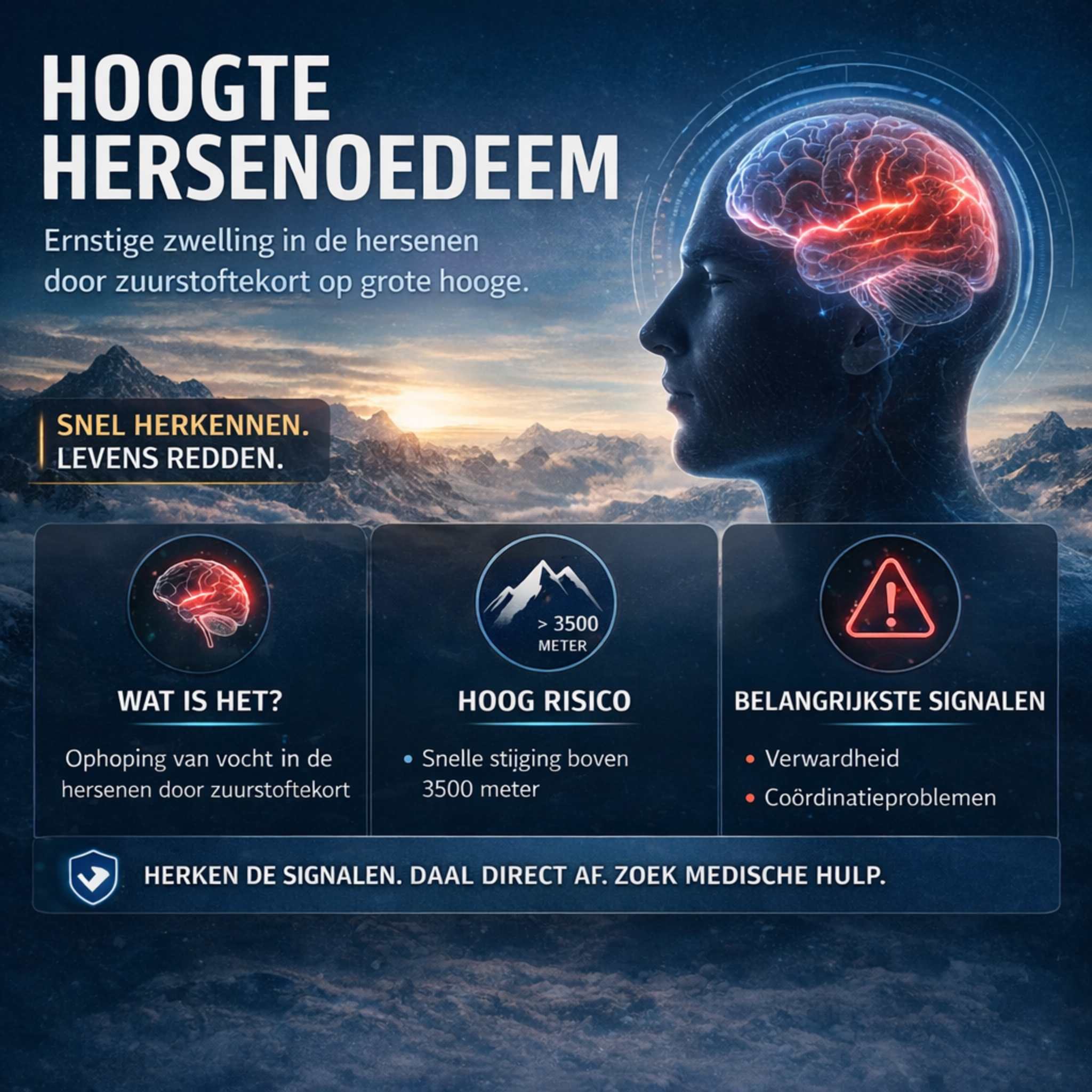
What is altitude cerebral oedema? Altitude cerebral oedema is a serious and potentially life-threatening complication of staying at altitude, in which fluid increases in the brain due to insufficient adaptation to oxygen deprivation. It does not usually arise out of nowhere, but often as an exacerbation of altitude sickness. In this article, you will read how to recognise altitude brain oedema, why acting quickly is crucial, which signals you should never ignore and how to minimise the risk.
Short answer: altitude cerebral oedema, also known as HACE, is swelling of the brain due to insufficient acclimatisation at altitude.
Main alarm signals: confusion, loss of coordination, drowsiness, altered behaviour and difficulty walking.
Direct action: stop ascending, descend as quickly as possible and consider this a medical emergency.
Conclusion: High brain oedema is rare but always serious and requires immediate action.
Nuance: symptoms often start subtly and sometimes resemble ordinary altitude sickness or extreme fatigue at first.
Practical hook: Those travelling at altitude should pay particular attention to behaviour, coordination and deterioration in a short time.
Those who delve into altitude sickness, quickly notices that not every complaint at altitude means the same thing. Headaches, nausea and worse sleep are relatively common. Altitude cerebral oedema, however, belongs in a different category. This is no longer an ordinary discomfort reaction, but an alarm situation where the brain is clearly disrupted by altitude and oxygen deprivation.
This is precisely why it is important not only to know that HACE exists, but also to understand how it differs from less severe symptoms. Indeed, many problems arise not because people do not feel anything, but because they misjudge the severity.
What exactly is altitude cerebral oedema?
Altitude cerebral oedema is the Dutch name for High Altitude Cerebral Edema, commonly abbreviated as HACE. Literally, it means fluid accumulation or swelling in the brain during stays at altitude. This happens because the body no longer properly accommodates the lack of oxygen and the brain reacts in a dysregulated manner to it.
In practice, you usually see altitude cerebral oedema in people who ascend too quickly, do not acclimatise sufficiently or continue while symptoms are already worsening. Often at first, there is ordinary acute altitude sickness. When that situation derails further, neurological symptoms may develop. These include unsteady walking, confused speech, illogical behaviour or increasing drowsiness.
This is what makes HACE so dangerous. The problem is not just in headaches or nausea, but in impairment of brain function. Once behaviour, coordination or consciousness change, you have to stop thinking in terms of comfort or performance. Then everything is about safety.
What is high brain oedema not?
Common altitude sickness: headache, mild nausea, worse sleep, decreased appetite, languid feeling.
Elevation cerebral oedema: marked neurological deterioration, confusion, ataxia, drowsiness, loss of independence.
Practical difference: In HACE, it is not discomfort, but loss of function that is the focus.
A common mistake is to think of altitude cerebral oedema as “a bit of bad altitude sickness”. This is putting it too lightly. Of course, HACE is often an extension of altitude sickness, but the clinical picture is substantially more serious. As soon as a person can no longer control his or her movements properly, shows odd behaviour or no longer reacts clearly, you have to assume a serious complication.
Also, altitude cerebral oedema is not the same as altitude pulmonary oedema. In pulmonary oedema, the main problem is in the lungs and air exchange. Brain oedema revolves around the nervous system and brain function. Both can occur separately, but sometimes together. This makes the situation even riskier.
How do you recognise high cerebral oedema?
The recognition is often in a combination of context and behaviour. Someone has recently ascended, already has symptoms of altitude sickness and then noticeably deteriorates. The following signs are suspicious:
- severe or increasing headaches
- confusion or slower thinking
- unsteady gait or difficulty walking straight
- markedly altered behaviour
- drowsiness or poor wakefulness
- loss of judgement or underestimation of the situation
- vomiting associated with neurological deterioration
Unsteady walking, in particular, is a practically strong signal. For example, ask someone to walk in a straight line or perform simple actions. If that suddenly works badly, it is much more alarming than just a headache. Even teammates often notice before the person themselves that something is wrong. Someone reacts strangely, forgets simple things or acts as if nothing is wrong when it clearly is.
Those who want to learn to distinguish more general alarm signals can also delve into symptoms and risks of altitude sickness. This helps to recognise the moment of turnaround more quickly.
When does height cerebral oedema usually develop?
Altitude cerebral oedema usually occurs above several thousand metres, especially when the rate of ascent is too high for the degree of acclimatisation. There is no exact fixed point at which it always happens. However, the risk clearly increases if you go to sleep too quickly higher, skip rest days or ignore warning signals.
Not everyone reacts the same way to altitude. One person still functions reasonably well at altitude where another already develops serious symptoms. Therefore, it is dangerous to rely only on altitude in metres. The overall picture counts: rate of ascent, sleep altitude, exertion, previous sensitivity, recovery, hydration and how symptoms develop.
⚠️ Reality check
Altitude cerebral oedema is not a problem you can safely “sit out until tomorrow”. If neurological symptoms increase at altitude, that is a reason to intervene immediately. Waiting it out usually makes the margin smaller, not larger.
Which symptoms fit with ordinary altitude sickness and which with altitude cerebral oedema?
| Image | Typical signals | Interpretation | Action |
|---|---|---|---|
| Mild altitude sickness | Headache, nausea, poor sleep, decreased appetite | Warning that acclimatisation is lagging behind | Do not rise further, rest, monitor |
| Worsening situation | More complaints, less functioning, headaches increase | Risk of escalation rises | Rise stop, serious reassessment |
| Suspect for HACE | Confusion, unsteady walking, drowsiness, strange behaviour | Neurological emergency | Descend immediately and organise medical assistance |
Mild altitude sickness
Typical signals: headache, nausea, worse sleep, less appetite.
Interpretation: acclimatisation lags behind altitude load.
Action: do not rise further, rest and complaints follow.
Worsening situation
Typical signals: symptoms increase, functioning subsides, headaches worsen.
Interpretation: risk of escalation increases.
Action: rise and reassess situation.
Suspect for HACE
Typical signals: confusion, unsteady walking, drowsiness, strange behaviour.
Interpretation: neurological emergency at altitude.
Action: descend immediately and arrange medical assistance.
What should you do if you suspect high cerebral oedema?
The main rule is simple: stop ascending immediately and descend as quickly as possible. With altitude cerebral oedema, descending is not a detail but the core of treatment. The sooner exposure to extreme altitude stops, the more likely the situation will improve.
Practical protocol when HACE is suspected:
1. Stop rising further immediately.
2. Never leave the person alone.
3. Reassess walking, behaviour and awareness.
4. Start descending as quickly as possible.
5. Arrange extra help, oxygen or medical support where possible.
Importantly, the affected person often no longer makes reliable decisions himself. This is precisely why the environment must intervene. Waiting for motivation, perseverance or “just see how it is tomorrow” is not a wise strategy here.
For the broader framework of action for serious complaints at height, also how to deal with acute altitude sickness useful. This especially helps teams and expedition mates make the right choices faster.
Why is high brain oedema so often recognised too late?
There are several reasons for this. First, the first signs sometimes start vaguely. Someone is tired, quiet, irritable or sluggish. This may seem normal on a tough mountain day. Second, ambition and tunnel vision often play a role. People don't want to lose their top day, schedule or group and rationalise signals that don't actually fit normal fatigue anymore.
A third problem is that very brain function is reduced. Someone with high brain oedema is thus worse at assessing how serious the situation is. As a result, you have to listen not only to what someone says, but especially to what you see: coordination, reaction speed, orientation and behaviour.
What increases the risk of altitude cerebral oedema?
The main risk factor is rising too fast. In addition, risks increase when someone:
- sleeping at altitude without sufficient build-up
- ignores initial symptoms of altitude sickness
- continues to rise despite deterioration
- previously proved susceptible to height problems
- recovers poorly at altitude or deteriorates for several days
- keeps too little margin under heavy physical load
It is wise to look not only at the end goal, but at the whole route up. Many serious problems are caused not by one wrong decision, but by a series of small underestimates in succession.
This is how you monitor this lens
In high cerebral oedema, objective monitoring is supportive, but never enough to rule out the diagnosis. Above all, you need to monitor behaviour and neurological signs. Still, a regular monitoring routine helps to see deterioration faster.
| Measuring point | What are you paying attention to? | What does deterioration mean? |
|---|---|---|
| SpO2 trend | Not a single isolated value, but a declining or unstable trend in context | Additional reason to take complaints very seriously, but not diagnostic per se |
| Sleep quality | Increasingly worse sleep combined with symptoms and deterioration | May indicate failing acclimatisation |
| Recovery | Does anyone feel markedly better or worse after rest? | No recovery after rest is an important warning signal |
| Symptoms | Walk test, clarity, behaviour, orientation, headache, nausea | Neurological deterioration means immediate action |
SpO2 trend
What are you paying attention to? Not on one single measurement, but on the trend combined with complaints.
Deterioration means: additional reason to be alert, but never the only decision point.
Sleep quality
What are you paying attention to? Several nights of worse sleep along with more complaints.
Deterioration means: acclimatisation may fall short.
Recovery
What are you paying attention to? Does someone get better after rest or does the deterioration remain visible?
Deterioration means: no recovery after rest is a serious alarm signal.
Symptoms
What are you paying attention to? Walk test, behaviour, orientation, clarity, headache and nausea.
Deterioration means: neurological signals call for immediate action.
Important detail: SpO2 can help provide context, but a saturation monitor never replaces clinical observation. A person with obvious neurological failure and an apparently “reasonable” reading may still be seriously ill.
When should you slow down or stop immediately?
Stop and descend immediately, though: in case of confusion, unsteady gait, drowsiness, marked change in behaviour or rapid deterioration.
Don't rely on: willpower, motivation, top drive or one loose saturation value.
Decision rule: if brain function or coordination becomes visibly worse, the discussion is over.
This is perhaps the most important practical rule of the whole article. Many height problems still leave room for observation, rest or reassessment. Altitude cerebral oedema does not. This is where the margin of safety must come back immediately.
How do you reduce the risk of altitude brain oedema?
Prevention is mainly about controlled acclimatisation. Those who acclimatise wisely greatly reduce the risk of serious complications. That starts with a realistic ascent plan, sufficient resting periods and discipline not to push through when symptoms increase.
In addition, it helps to understand in advance how your body usually reacts to altitude. For expeditions or climbs with little margin, a prepared route at home can be interesting. This does not replace real acclimatisation, but it can make the process more controlled, measurable and plannable.
These ground rules also remain in place:
- gradually build up sleeping height
- take initial complaints seriously
- do not rise in case of deterioration
- monitor trends rather than single snapshots
- make decision rules with your team in advance
Want to learn how to better prevent height problems?
Then immerse yourself in the key principles of safe construction, recognising signals and acting wisely at height.
Conclusion
Altitude cerebral oedema is a serious complication of staying at altitude in which brain function visibly deteriorates due to insufficient adaptation to oxygen deprivation. The core signs are not just headaches or nausea, but especially confusion, loss of coordination, drowsiness and behavioural changes.
Recognising this in time can make the difference between a dangerous escalation and a safe outcome. Therefore, the practical main rule is simple: stop ascending, descend and always treat neurological symptoms at altitude as a medical emergency.
FAQ
Is altitude cerebral oedema the same as ordinary altitude sickness?
No. Altitude cerebral oedema is a serious neurological complication. Ordinary altitude sickness often causes headaches, nausea and fatigue, but no obvious disturbances in behaviour or coordination.
From what height can cerebral oedema occur?
The risk increases at higher altitudes, especially with too rapid an ascent. There is no exact universal tipping point, as sensitivity varies greatly from person to person.
What is the clearest alarm signal?
Unsteady walking combined with confusion or drowsiness is a very serious sign. Especially if someone has risen recently and already had symptoms.
Can you cure altitude cerebral oedema at the same altitude?
This is not a safe strategy. When HACE is suspected, descent is the main measure, alongside additional support and medical assistance where possible.
Can a saturation monitor prove or rule out altitude cerebral oedema?
No. A saturation monitor can provide context, but neurological symptoms and clinical observation are leading.