Sound altitude generator: how much sound does an altitude generator actually make?
Published 1 September 2019 · 13 min read
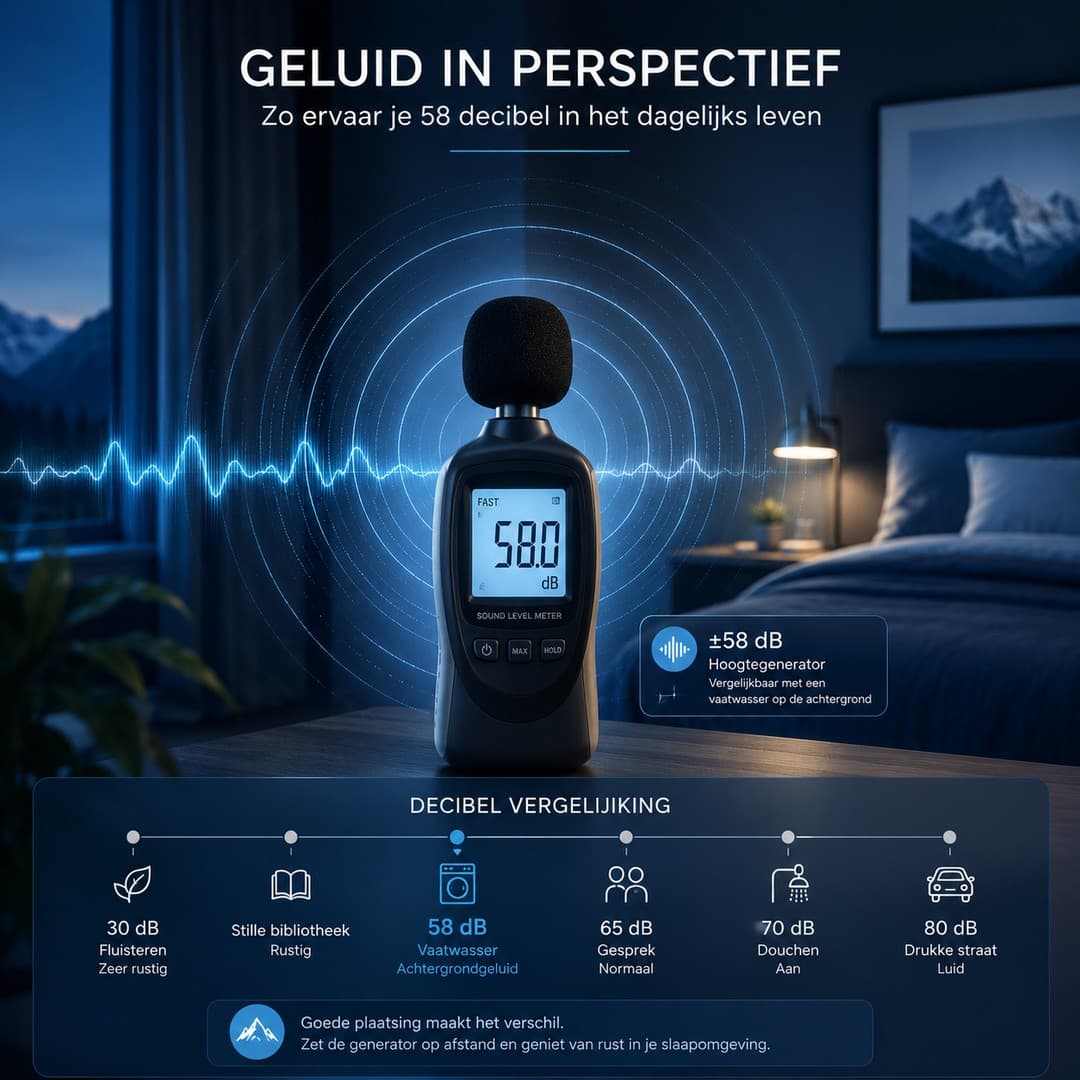
Sound height generator is a valid question if you want to use an altitude tent in your bedroom. A height generator always makes noise, as the system continuously draws in air, filters it, and sends oxygen-depleted air towards the tent. However, that doesn't have to disturb your sleep. The real question is not just how many decibels a generator produces, but primarily where you place it, how long the hose is, and how quietly the system has been designed.
At Altitude Dream, we use a premium altitude generator that operates at around 58 decibels. This may sound abstract on paper. In practice, this is roughly comparable to a dishwasher or quiet background noise. Furthermore, the generator is not normally placed next to your bed. Thanks to the long hose, the device can be located in another room, significantly reducing the noise level in the bedroom.
Short answer: A good altitude generator makes an audible sound, but doesn't need to disturb your sleep. With the correct setup, the generator isn't placed next to your bed, but at a distance. This way, you sleep in the altitude tent with the hypoxic stimulus, without the sound source being directly in your bedroom.
Conclusion: The sound of a height generator is important, but its placement is often more critical than the decibel level alone.
Nuance: 58 decibels next to the device sounds different to 58 decibels at a distance or behind a door.
Practical hook: Always ask about the length of the hose, installation advice, and where in your home the generator would be best placed.
Why does a height generator make noise?
A height generator makes a noise because it is actively processing air. When to use a height tent is it about normobaric hypoxia. This means that the air pressure in the room remains the same, but the percentage of oxygen in the air is reduced towards the tent.
To do that in a controlled manner, the generator must work continuously. The system draws in air, filters that air, and separates off some of the oxygen. This results in air with a lower oxygen content. That air is then channelled to the tent via a tube.
So the sound doesn't come from the tent itself. It mainly comes from the generator. Think of ventilation noise, airflow, and the internal compression process. That's why the sound experience feels very different from, for example, a device that's blowing next to your head.
Premium systems aren't just about peak sound levels. Stability, reliability, airflow, filter quality and the ability to position the unit intelligently are equally important. A quiet generator that delivers an unstable power output isn't a good solution. A powerful system that can be positioned effectively at a distance is often more practical.
Sound level generator: what does 58 decibels mean?
Decibels are tricky to estimate. It's not a linear scale. A few decibels difference can be audible, but the environment determines how bothersome the sound feels. A soft, constant sound is often perceived as less of a strain than a changing or sharp sound.
A sound level of around 58 decibels is roughly comparable to normal background noise in a house. Think of a dishwasher, gentle ventilation, or a quiet conversation from a distance. This doesn't mean you'd want to place the appliance next to your bed. It does mean that the noise is manageable if the installation is done correctly.
| Situation | Sound experience | What does this mean in practice? |
|---|---|---|
| Generator next to bed | Clearly audible | Not the ideal setup for a good night's sleep. |
| Generator in the same room | Present, but constant | Can work, but depends on sleep sensitivity. |
| Generator in another room | Strongly muted | Usually the best choice when sleeping in a height tent. |
| Generator behind a closed door | Quieter and less direct | Often enough to keep the sleeping environment comfortable. |
Sound experience: Clearly audible.
Practical: not the ideal setup for a night's sleep.
Sound experience: present, but constant.
Practical: can work, but depends on sleep sensitivity.
Sound experience: Strongly muted.
Practical: usually the best choice when sleeping in an altitude tent.
Sound experience: calmer and less direct.
Practical: often sufficient for a comfortable sleeping environment.
Why placement is more important than the number alone
Many people look only at decibels. That is understandable, but incomplete. The sound level is usually measured close to the device. However, you are not lying next to the generator when the installation is properly constructed.
At Altitude Dream, the altitude generator comes with a long 12-metre hose. This allows the unit to be placed in another room. Consider a landing, study, bathroom, utility room or hallway. The low-oxygen air travels via the hose to the altitude tent, while the noise source remains at a distance.
That's a significant practical difference. You use the tent for sleeping, recovering, and acclimatising. Therefore, the sleeping environment must remain tranquil. A good setup is therefore not a detail. It is part of the quality of the solution.
In practice: Don't just ask: how many decibels does the height generator produce? Specifically ask: where will the generator be placed, how many metres of hose are available, and how will the air supply be neatly channelled into the tent?
Those who are sensitive to noise may want to pay extra attention to hard floors, hollow spaces, and resonance. A generator on a wooden floor can sound different than the same generator on a solid, stable surface. A semi-open door, narrow corridor, or empty room can also affect the perceived sound.
Does noise affect your sleep?
With a good setup, the sound from the height generator should not disturb your sleep. This is important, as sleep is the very foundation of the principle. sleep high, train low Would you like to sleep under a controlled hypoxic stimulus, while being able to train, work, or recover normally during the day.
The quality of your night's sleep is partly what determines how well your body tolerates the stimulus. If you're lying awake due to noise, heat, stress, or an overly aggressive altitude setting, the system won't work optimally. That's why at Altitude Dream, we don't just look at the altitude setting, but also at comfort and practical liveability.
A constant, low background noise is quickly ignored by many people. However, this varies from person to person. Some athletes sleep through anything. Other users are sensitive to any mechanical sound. Therefore, a personal installation choice is important.
Highly disruptive versus well-managed
It is usually damaged when the generator is too close to the bed, stands on a resonant surface or when the room amplifies the sound.
It becomes well manageable when the generator is in a different room, the hose length is cleverly utilised and the air supply is neatly connected.
Another point is acclimatisation. The first night you often consciously listen to every new sound. After that, it usually fades into the background. Nevertheless, acclimatisation should never be the solution for a poor setup. A premium installation should feel logical and comfortable from the start.
Assess sound generators before you rent or buy
Anyone considering a height tent wants a realistic assessment, not a technical promise. Especially when you'll be sleeping at home with a system for several weeks, you'll want to know beforehand if it suits your home, your family, and your sleep rhythm.
Therefore, pay attention to four points. First: the specified decibel level. Second: the hose length. Third: the placement options in your home. Fourth: the quality of installation and explanation.
Checklist for a quiet and comfortable setup
- What is the noise level? around 58 decibels is easily manageable in practice with correct placement.
- Check the hose length A long hose allows placement outside the bedroom.
- Choose a stable surface: Prevent resonance on hollow floors or light furniture.
- Keep air intake and exhaust clear: A generator needs good ventilation.
- Sleep environment test Listen from bed, not next to the device.
- Beware of the heat Do not place the generator enclosed in a cupboard.
This last point in particular is often underestimated. A heat generator needs to be able to draw in air and dissipate heat. So, don't place it in a completely closed cabinet. This can affect its performance and lifespan. A quiet spot with sufficient ventilation is better than a place that seems acoustically sound but is technically unfavourable.
What does sound tell us about the quality of a height generator?
Sound says something, but not everything. A quieter device is not automatically better. A height generator must primarily deliver reliably and stably. The hypoxic stimulus must match the set altitude, and the system must have sufficient capacity for the tent and the user.
Therefore, it's better to look at the overall design. How stable is the output? How reliable is the oxygen reduction? How good are the filters? Is the system maintained? Is the generator suitable for long-term night-time use? And will you receive guidance during setup?
Altitude training at home isn't a gadget. It's a controlled physiological stimulus. For those who are serious about working on altitude training and acclimatisation, wants a system that is measurable, plannable and practically usable. Sound is one part of that.
At Altitude Dream, the generator choice is therefore linked to service, installation, and explanation. The goal is not just to supply a quiet machine. The goal is for the user to be able to sleep soundly at home, build up their training effectively, and objectively monitor how their body is responding.
This is how you monitor this lens
Sound is partly subjective. One person finds constant background noise soothing. Another person notices it immediately. Nevertheless, you can objectively track whether the setup is working well for your body and sleep.
Don't just use your gut feeling, but look at trends. This also applies to SpO2. A single value says little. The trend over multiple nights tells you more. Especially in the first week, you'll want to know if the altitude setting, sleep quality, and recovery status remain logical together.
| Measuring point | What are you paying attention to? | Practical interpretation |
|---|---|---|
| SpO2 trend | Morning values and night trend | Use SpO2 as a guide, not as an isolated absolute truth. |
| Sleep quality | Sleep through, rest, wake up | Poorer sleep can be caused by noise, the altitude setting, or stress. |
| Recovery | HRV, feeling of calm, training readiness | A downward trend could mean that the incentive is too heavy. |
| Symptoms | Headache, nausea, shortness of breath | With clear complaints, you need to adjust and not force things. |
What are you paying attention to? Morning values and night trend.
Interpretation: use SpO2 as a guide, not as a standalone absolute truth.
What are you paying attention to? Sleep, rest and wake up.
Interpretation: Poorer sleep can be caused by noise, altitude adjustment, or stress.
What are you paying attention to? HRV, feeling of rest, and training readiness.
Interpretation: A declining trend could mean the stimulus is too heavy.
What are you paying attention to? Headache, nausea, or shortness of breath.
Interpretation: With clear complaints, you must adjust and not force it.
So, if your sleep deteriorates after starting with the altitude tent, it doesn't necessarily mean it's due to noise. It could also be caused by too rapid an acclimatisation or a setting that's too high. Therefore, it's wise to consider acclimatisation, sleep, and saturation together.
For those who want to know what saturation trend can be considered normal, further research can be conducted into saturation in an altitude tent. This prevents you from attaching too much importance to a single measurement.
Decision rules: when is noise a problem?
Noise is a problem when it structurally degrades your sleep quality. One restless first night isn't always a red flag. Three to four nights of poor sleep, with the generator located near your bed, calls for an adjustment.
Use these practical decision rules
- Do you wake up to the sound? Move the generator further from the bedroom.
- Do you mainly hear vibrations? Check the foundation and avoid contact with light furniture.
- Is your sleep worse and your SpO2 trend lower? Build up more gradually and evaluate the height setting.
- Is the noise mainly present on the first night? Give yourself one or two nights to get used to it, but don't force it.
- Does it remain annoying? Have the setup reassessed.
A good altitude tent experience requires comfort and control. The system must not only work physiologically but also fit practically into your life. Especially for athletes, entrepreneurs, young families, or mountain climbers with busy schedules, sleep quality is not a secondary concern.
Common misconceptions about sound and altitude tents
Misunderstanding 1: the tent itself makes the noise
The tent is not the sound source. The generator makes the noise. This is advantageous, as the generator can be placed remotely. This keeps the tent itself a quiet sleeping environment.
Misconception 2: lower decibels automatically means better altitude training
Not always. You want a balance between quiet operation, stable hypoxic output, and sufficient capacity. A generator shouldn't just be quiet, it must also deliver reliably.
Misunderstanding 3: you always have to sleep with earplugs
With a good setup, that's usually not necessary. The long hose allows placement in another room. This greatly reduces the sound experience in the bedroom.
Misunderstanding 4: if you sleep badly, it's always due to noise
Poor sleep can also be caused by too rapid altitude gain, stress, heat, or recovery load. Therefore, always consider the overall picture.
Practical tips for a quieter setup
A height generator should be able to operate technically freely. At the same time, you can do a lot to reduce the sound experience. Start with the location. Preferably, do not place the device next to the bed, but in an adjacent room. Use the hose length consciously.
Pay attention to the surface as well. A stable floor dampens better than a light cabinet or hollow furniture. Keep the air inlet clear and ensure the generator can dissipate heat. It's better not to place it in a closed cabinet. That may seem quieter, but it's not ideal from a technical standpoint.
Also check the hose routing. A tidy hose route prevents kinks and unnecessary strain on the connection. During installation, you can immediately see what makes sense in your home.
Finally, judge the sound from your bed. Not next to the generator. It's about the sleeping experience, not the impression when you stand right next to the machine.
Do you want to sleep peacefully in an altitude tent?
The correct setup makes all the difference. Read how to practically use a height tent, set it up calmly, and objectively monitor how your body reacts.
Conclusion: the sound height generator is primarily an installation question
Sound height generator is important, but it’s rarely just a question of decibels. A premium height generator always makes a noise, but with a long hose and good placement, it doesn’t have to disturb your sleep.
The best question, therefore, is not: do I hear the generator? The better question is: do I still hear it in the place where I sleep? With smart setup, the generator is placed at a distance, the bedroom remains quiet, and you still get a controlled hypoxic stimulus.
This is in line with Altitude Dream’s approach to altitude training. An altitude tent is not a miracle cure, nor is it a substitute for genuine acclimatisation. However, it does make the process more controlled, measurable and predictable. As such, it can significantly reduce the risk of altitude-related symptoms, without offering a 100% guarantee.
By assessing noise, sleep quality, SpO2 trend, and recovery together, you get the most reliable impression. This way, choosing a height tent becomes not a gamble, but a practical decision based on comfort, physiology and experience.
FAQ about the sound of a height generator
How many decibels does a height generator make?
The Altitude Dream's height generator is around 58 decibels. The sound experience depends heavily on the distance, placement, and room acoustics.
Is it safe to sleep with a CPAP machine on?
Yes, with a good setup, that's perfectly fine. Ideally, the generator shouldn't be next to your bed, but in another room.
Does the altitude tent make noise itself?
No, the tent itself is not the source of the sound. The sound comes mainly from the elevation generator and the air displacement.
Should I use earplugs in a high-altitude tent?
Usually not. With a long hose and clever placement, the generator can be sufficiently far away.
What if I still sleep badly?
Look at the overall picture. Check sound, height setting, SpO2 trend, sleep quality, recovery, and any complaints.