Oxygen content in air: explained by altitude
Published 10 April 2026 · 10 min read
A oxygen content in the air seems like a simple story at altitude: the higher you get, the less oxygen there is. Yet this is only partly true. The oxygen percentage in the outside air remains almost the same, while the air pressure drops. As a result, you get fewer oxygen molecules per breath. In this article, you will therefore read about what really changes for each altitude, why this difference is important and how you should practically interpret these figures as an athlete, trekker or mountaineer.
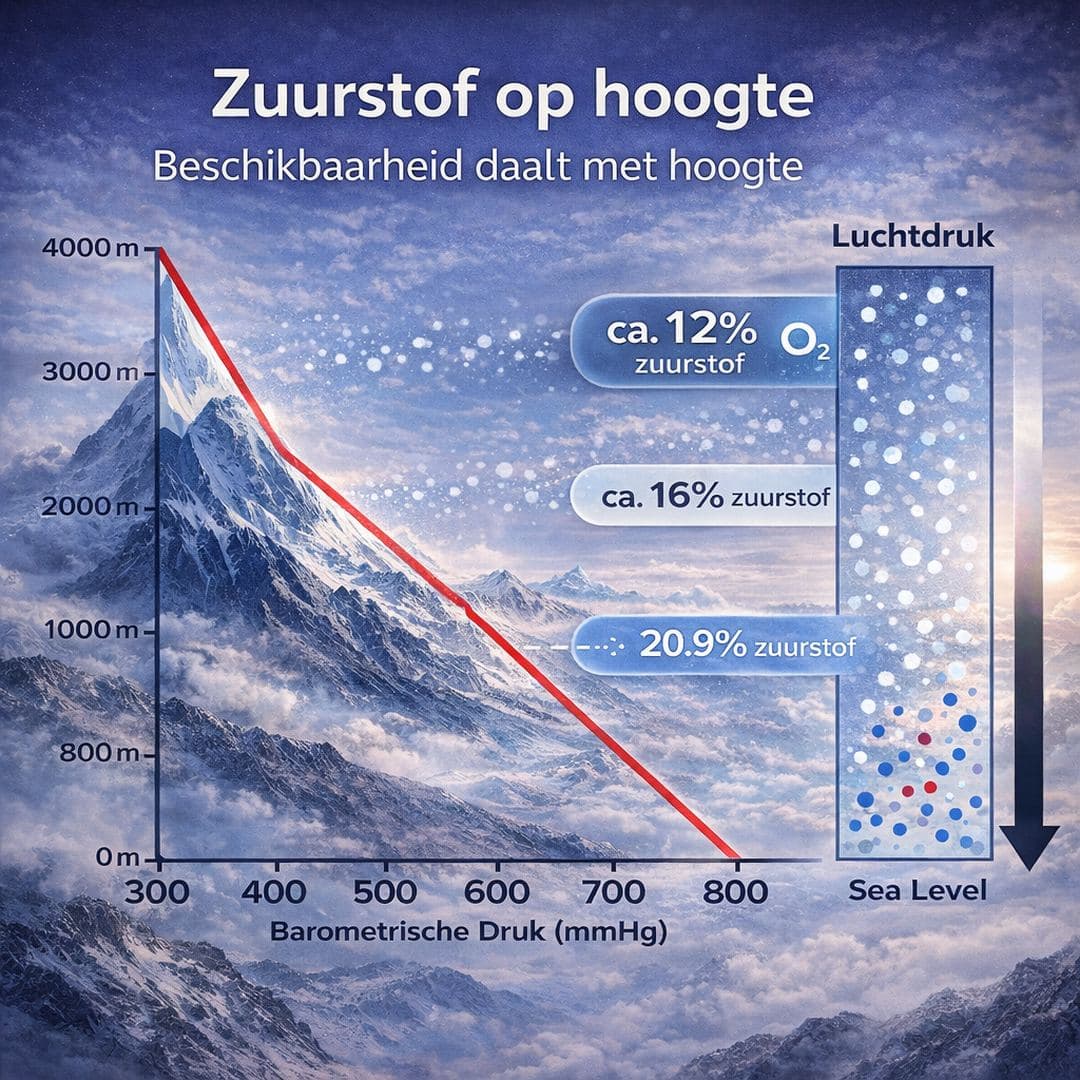
Short answer: the outside air contains about the same amount of oxygen in percentage terms at sea level and at high altitude, namely around 20.9%.
What does change: air pressure drops as you get higher, reducing the partial pressure of oxygen.
Practical consequence: so your body experiences altitude as if you are breathing air with a lower effective oxygen percentage.
Conclusion: at altitude, it is not mainly the oxygen percentage that drops, but the available oxygen per breath.
Nuance: which is why, in practice, many people still talk about less oxygen in the air.
Practical hook: For preparation, what matters most is what your body effectively takes in, not just the chemical percentage.
Those who understand this difference will also better understand why you run out of breath faster at altitude, why your saturation drops and why preparation is so important. If you then want to delve deeper into what altitude does to your measurements, read on oxygen saturation at altitude.
What exactly do we mean by oxygen content in the air?
By oxygen content, people often mean two different things. This creates confusion, even though the distinction is important.
Chemical oxygen percentage
This is the proportion of oxygen in the air mix. Outside air normally consists of about 20.9% of oxygen.
That percentage remains almost the same at altitude.
Available oxygen
This is the amount of oxygen your body can effectively absorb per breath.
It does fall, as air pressure decreases.
For practical purposes, this second meaning is especially important, because it is the one that determines how much oxygen your body can really use. The composition of air remains almost the same, but the pressure at which it enters your lungs becomes lower. As a result, the partial pressure of oxygen drops and oxygen transport becomes more difficult.
This is why people often say the air is thinner at altitude. This is not a perfect chemical explanation, but it is a useful practical description. There are fewer gas molecules per unit volume in the same air, and therefore fewer oxygen molecules.
In other words, it is not the percentage that is your biggest problem, but what your body can do with it physiologically. That very distinction helps you better understand tables, saturation values and altitude recommendations.
Oxygen content in air by altitude explained
The actual oxygen percentage remains almost the same
The table below therefore shows not only that the chemical oxygen percentage remains roughly the same, but also which effective oxygen percentage you can practically use to make altitude understandable. That effective rate is an approximation based on falling air pressure relative to sea level.
| Height | Actual O2 percentage | Effective O2 percentage | Practical significance |
|---|---|---|---|
| 0 m | 20,9% | 20,9% | Reference point. Normal outdoor air at sea level. |
| 1000 m | 20,9% | approx. 18.5% | Usually few complaints. Exercise may feel slightly heavier. |
| 1500 m | 20,9% | approx. 17.4% | Often first noticeable drop in training comfort or recovery. |
| 2000 m | 20,9% | approx. 16.4% | For many people, height is starting to become really physiologically relevant here. |
| 2500 m | 20,9% | approx. 15.4% | Probability of worse sleep and lower exercise capacity increases. |
| 3000 m | 20,9% | approx. 14.5% | Acclimatisation becomes more important. Pace and recovery change markedly. |
| 4000 m | 20,9% | approx. 12.7% | Serious strain. Complaints and loss of performance are more common. |
| 5000 m | 20,9% | approx. 11.1% | Acclimatisation is strongly recommended. Effort is markedly reduced. |
| 6000 m | 20,9% | approx. 9.7% | Extreme altitude. Approach responsibly only with serious preparation. |
| 8000 m | 20,9% | approx. 7.3% | Extreme zone. Here you are well outside normal physiological range. |
0 m
Actual O2 percentage: 20,9%
Effective O2 percentage: 20,9%
Significance: reference point at sea level.
1000 m
Actual O2 percentage: 20,9%
Effective O2 percentage: approx. 18.5%
Significance: exertion may feel slightly heavier.
1500 m
Actual O2 percentage: 20,9%
Effective O2 percentage: approx. 17.4%
Significance: initial physiological impact becomes more noticeable more often.
2000 m
Actual O2 percentage: 20,9%
Effective O2 percentage: approx. 16.4%
Significance: height clearly becomes more relevant to performance and recovery.
2500 m
Actual O2 percentage: 20,9%
Effective O2 percentage: approx. 15.4%
Significance: worse sleep and lower load capacity are more common.
3000 m
Actual O2 percentage: 20,9%
Effective O2 percentage: approx. 14.5%
Significance: acclimatisation becomes much more important.
4000 m
Actual O2 percentage: 20,9%
Effective O2 percentage: approx. 12.7%
Significance: serious strain with more chances of complaints.
5000 m
Actual O2 percentage: 20,9%
Effective O2 percentage: approx. 11.1%
Significance: preparation and build-up are highly recommended.
6000 m
Actual O2 percentage: 20,9%
Effective O2 percentage: approx. 9.7%
Significance: extreme altitude with high physiological stress.
8000 m
Actual O2 percentage: 20,9%
Effective O2 percentage: approx. 7.3%
Significance: extreme. Only relevant in very specific expedition context.
Why that practical translation is useful
Important: that effective oxygen percentage is a practical translation, not a change in the chemical composition of the air. This is precisely why this way of explaining it is so useful for athletes and mountain travellers. It makes it immediately apparent why 4,000 metres feels much heavier than 1,000 metres.
In short, those who only look at 20.9% are missing the most important part of the story. Those who include pressure drop in addition, understand much better why performance decreases and why acclimatisation takes time.
Why does your performance drop if the oxygen percentage remains the same?
It's about air pressure, not just percentages
Because your body does not work with percentages alone, it responds mainly to pressure differences, gas exchange in the lungs and the amount of oxygen that eventually enters the blood. When air pressure drops, oxygen pressure in inhaled air also drops. As a result, the transfer of oxygen to the blood is less favourable.
Therefore, two situations may appear similar on paper, while your body experiences them very differently. After all, at sea level, the same 20.9% is associated with a much higher air pressure than at 4000 metres.
You will notice this in practice
In practice, you usually notice this in four ways:
- your heart rate rises faster for the same effort
- you breathe faster or deeper
- your recovery takes longer
- your sleep quality may decline, especially from moderate heights
You see this not only in the mountains. Also at altitude training you make conscious use of this principle. So you are not changing the chemical reality of oxygen, but rather the physiological load on the body.
From what height does this really become relevant?
In practice, the physiological effect starts to be noticeable for many people between 1,500 and 2,500 metres. That doesn't mean that everyone gets complaints there. However, the margin for performance, sleep and recovery can become smaller even then.
Often still of limited relevance: to around 1,500 metres.
Clearly relevant: roughly from 2000 to 2500 metres.
Seriously relevant: from 3,000 metres and above, especially during rapid ascent or heavy exertion.
That's why it's smart not just to look at the final altitude of your trip or training camp. After all, the real question is: how fast will you ascend, how long will you stay there and what will your body have to perform there next?
For a broader physiological explanation of what oxygen deprivation does to the body, is this explanation of physical reactions to oxygen deprivation a logical next step.
Common misconceptions about oxygen content in air
Misconception 1: At altitude, air contains less than 20.9% oxygen
Not in ordinary outdoor air. The rate remains pretty much the same. What drops is the pressure. Consequently, the available oxygen per breath also drops.
Misconception 2: If your saturation drops, it is immediately dangerous
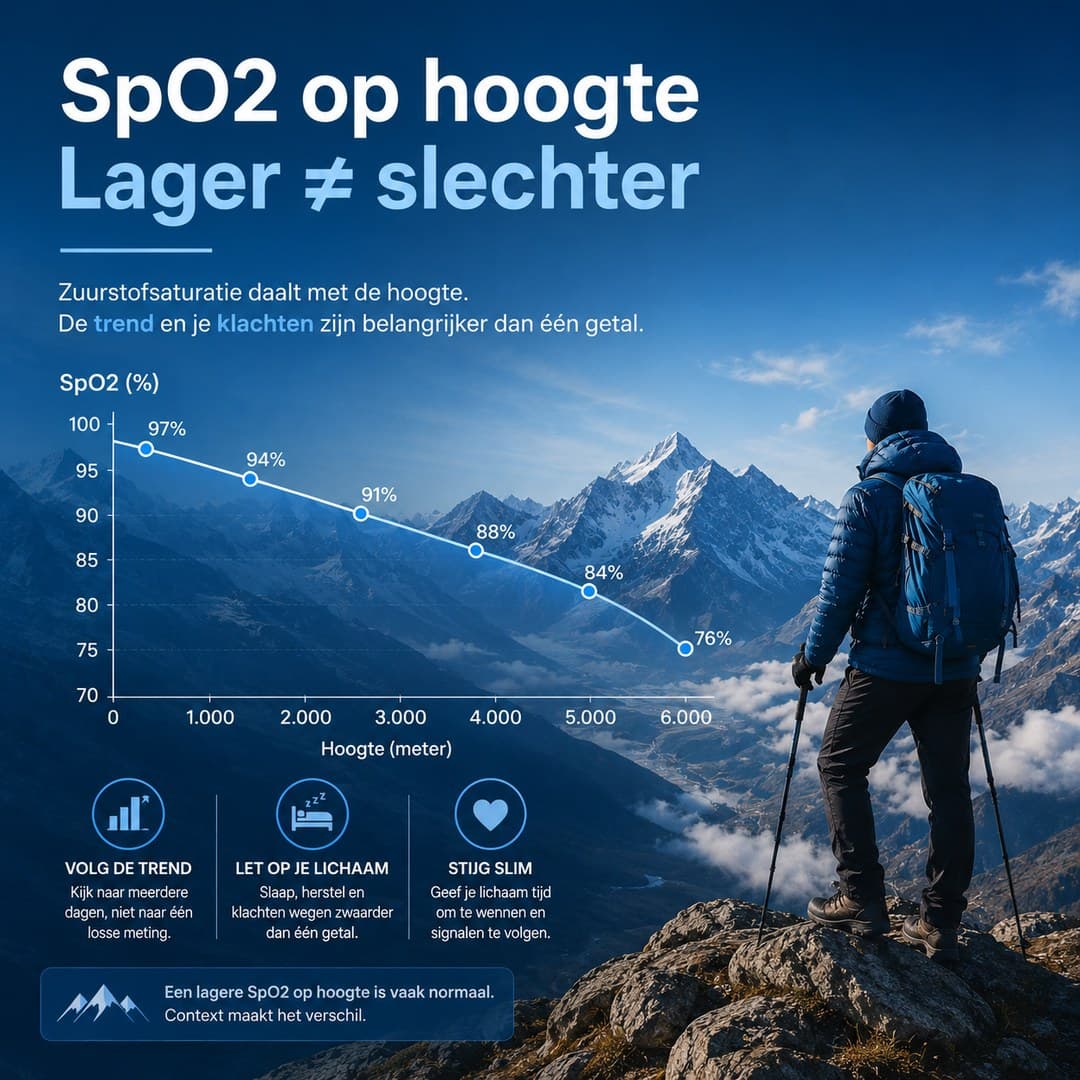
That too is too short of the mark. Lower saturation at altitude can be normal within the context of that altitude, exercise, sleep and individual sensitivity. Therefore, always look at the overall picture and not just one single measurement.
Misconception 3: only very high mountains count
No. Even moderate altitude can affect training, recovery and sleep. Especially if you are sensitive, short on time or want to perform heavily right away.
Misconception 4: same height feels the same for everyone
Individual differences are significant. Age, training condition, sleep, speed of ascent, previous altitude experience and susceptibility to complaints all play a role.
How to translate these figures to sport, trekking and expedition
For athletes
For athletes, therefore, it is less about the absolute altitude figure and more about training quality versus hypoxic stimulus. A smart altitude stimulus is often more moderate than many people think. So more is not automatically better.
For trekkers and mountain hikers
For this group, it is the combination of sleep altitude, ascent rate and daily load that counts most. As a result, a seemingly feasible route can still prove tough if you climb too fast or sleep poorly.
For expedition climbers
Here, the difference between chemical oxygen percentage and effective oxygen pressure becomes even more important. Above 5000 metres, the physiological margin is small and the importance of build-up, monitoring and preparation increases sharply.
If you are heading towards a mountain trip or expedition, it helps to consider in addition what are normal saturation values at altitude.
This is how you monitor this lens
If you want to properly translate the oxygen content in the air by altitude to your situation, don't just look at the altitude itself. Above all, look at how your body reacts to it.
| What are you monitoring? | What are you paying attention to? | Practical interpretation |
|---|---|---|
| SpO2 trend | Preferably measure at similar times, such as at rest in the morning. | Look at the pattern over several days, not one isolated outlier. |
| Sleep quality | Do you wake up more often, breathe more restlessly or recover worse? | Sleep often deteriorates before performance collapses completely. |
| Recovery | Pay attention to resting heart rate, fatigue and how quickly you recover after exercise. | Slower recovery is often an early sign that the load is high. |
| Symptoms | Headache, nausea, agitation, dizziness or abnormal shortness of breath. | Symptoms always outweigh a single number. |
SpO2 trend
What are you paying attention to? Measure at similar times, preferably at rest.
Interpretation: look at the pattern over several days.
Sleep quality
What are you paying attention to? More frequent waking, restless breathing, worse recovery.
Interpretation: sleep often deteriorates early in the process.
Recovery
What are you paying attention to? Resting heart rate, fatigue and recovery rate.
Interpretation: slower recovery often indicates higher load.
Symptoms
What are you paying attention to? Headache, nausea, dizziness, shortness of breath.
Interpretation: complaints are more important than one isolated figure.
Therefore, a single SpO2 value tells little without context. A declining trend combined with worse sleep, slower recovery and complaints tells much more. That very combination helps you make adjustments in time.
What does this mean for preparation with an altitude tent?
When preparing at home, you work with normobaric hypoxia. That means the air pressure remains normal, while the oxygen percentage in the supplied air is deliberately reduced. So this is a different technical route from real altitude, where mainly air pressure drops. Physiologically, however, the aim is similar: to expose your body to less available oxygen.
This is why it is important not to confuse figures. A simulated altitude is not a complete copy of a real mountain environment. However, it can be a controlled, measurable and plannable way to support your preparation. It does not replace real acclimatisation, but it can prepare the process in a more focused way.
Want to translate height figures into a practical plan?
Then take a look at our explanation of how oxygen saturation behaves at altitude. With this, you will make the step from theory to interpretation in practice.
Conclusion
Anyone searching for oxygen content in air by altitude usually looks for a practical answer. That answer is: the outside air at altitude still contains about 20.9% of oxygen, but the falling air pressure means you get less oxygen per breath. As a result, altitude feels heavier, your saturation drops and exercise, sleep and recovery are affected.
That distinction seems small, but it is fundamental. Once you understand that the focus is not the percentage but the available oxygen pressure, you can estimate altitude much better. And that's exactly where smarter preparation begins.
FAQ
Is there really less oxygen in the air at 3,000 metres?
Not in chemical composition. Air still contains about 20.9% of oxygen. However, air pressure is lower, reducing the available oxygen per breath.
So why do people still talk about less oxygen at altitude?
Because it practically feels that way. Your body effectively receives less oxygen, even though the percentage in the air remains almost the same.
From what height do you usually notice this?
For many people, this becomes noticeable between 1500 and 2500 metres. From around 3000 metres, it usually becomes more obviously relevant.
Is a lower effective oxygen percentage the same as altitude sickness?
No. It describes environmental stress. Altitude sickness depends on your reaction to it, plus factors such as ascent rate, sleep, load and individual sensitivity.
Can you recreate this at home?
Yes, via normobaric hypoxia. This involves reducing the oxygen percentage while keeping the air pressure the same. This can help with preparation, but is not a complete substitute for true acclimatisation.